
anātana Dharma itself is a classical Sanskrit term meaning “eternal duty/eternal way of life” and is broadly used to refer to the spiritual and philosophical foundations of Hinduism — but it isn’t a centralised religion with a single governing body like some religions have. It manifests through many temples, cultural centres, teaching organisations, and community networks all over the world.
There are various Hindu organisations and cultural groups globally (e.g., temples, nonprofit trusts, educational societies) that function independently but often share the goal of preserving and spreading the principles of Sanātana Dharma in their regions.
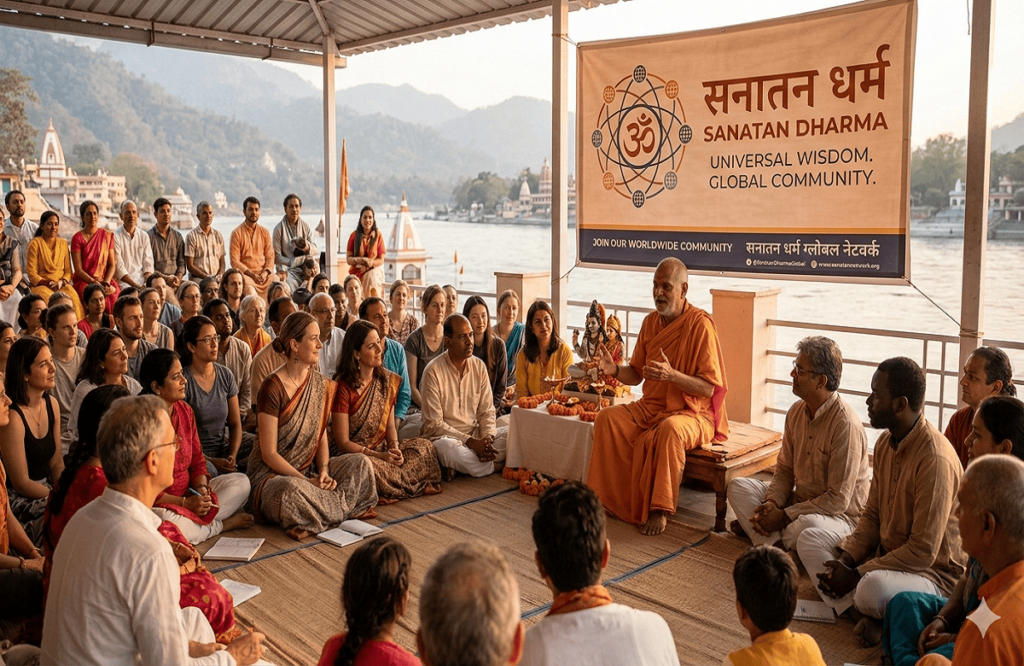
WHAT IS SANATAN DHARMA?
Sanātana Dharma (सनातन धर्म) literally means “eternal duty” or “eternal way of life.” It is a Sanskrit term traditionally used to describe the spiritual, moral, and philosophical framework that underlies what is commonly known today as Hinduism.
Here’s a clear breakdown:
1. Meaning and Essence
- Sanātana → Eternal, timeless, unchanging.
- Dharma → Duty, righteousness, law, or way of life.
- Together: “the eternal way of living in harmony with the universe and one’s own soul.”
Unlike some modern religions that focus on a single founder, prophet, or text, Sanātana Dharma emphasizes universal principles that guide life, morality, and spiritual practice across generations
2. Core Principles
Sanātana Dharma is guided by several timeless concepts:
- Karma – The law of cause and effect; actions have consequences.
- Dharma – Righteousness or moral duty according to one’s role in life.
- Moksha – Liberation or spiritual freedom from the cycle of birth and death.
- Ahimsa – Non-violence and compassion toward all living beings.
- Sanctity of Life and Nature – Respect for all creatures, plants, and the environment.
- Spiritual Practices – Yoga, meditation, devotion (bhakti), knowledge (jnana), and selfless service (seva).
3. Texts and Sources
- Vedas – The oldest sacred scriptures of India.
- Upanishads – Philosophical teachings about the self and the universe.
- Bhagavad Gita – Dialogue on duty, ethics, and spirituality.
- Puranas – Stories illustrating dharma and moral lessons.
These texts provide guidance rather than rigid rules, allowing Sanātana Dharma to be adaptable across cultures and times.
4. Global Perspective
- Sanātana Dharma is not confined to India; it is followed by millions worldwide in India, Nepal, Southeast Asia, Europe, and North America.
- Its focus is practical spirituality—how to live a life in harmony with universal principles.
- Modern movements sometimes call themselves “Sanatan Dharma Global” to promote these values internationally.
WHO IS REQUIRED FOR SANATAN DHARMA?
Sanātana Dharma is not limited to any one group of people—it is fundamentally universal and open to anyone who wishes to follow its principles.There are no strict entry requirements, conversions, or formal memberships. Here’s a detailed breakdown:
1. Anyone Can Follow
- Sanātana Dharma is considered the “eternal way of life”, so it is accessible to anyone, regardless of:
- Age
- Gender
- Ethnicity
- Nationality
- Previous religion or belief system
- Its teachings focus on moral living, spiritual growth, and harmony with the universe, which are universal values.
2. Requirements Are Internal, Not External
Rather than rituals or formal titles, the “requirements” are more about personal intention and practice:
- Desire to Live Righteously – Following dharma (ethical duty) in your personal and social life.
- Respect for Life and Nature – Practicing ahimsa (non-violence) and compassion.
- Spiritual Practice – Meditation, prayer, yoga, self-reflection, or devotion (bhakti).
- Self-Improvement and Learning – Seeking knowledge (jnana) and striving for personal and spiritual growth.
- Service to Others (Seva) – Helping others selflessly is considered an important practice.
3. No Formal Initiation Needed
- Unlike some religions with baptism or ordination, Sanātana Dharma does not require formal initiation for a person to live by its principles.
- Temples, gurus, or spiritual communities can guide you, but joining is voluntary.
4. Optional Roles
- Spiritual Guides / Gurus: Some choose to learn from a guru for guidance.
- Practitioners / Devotees: Anyone practicing dharma, yoga, meditation, or rituals.
- Community Members: Those participating in temple activities or cultural practices.
Even a person living ethically and compassionately in daily life, without rituals, is considered to be following Sanātana Dharma in spirit.
WHEN IS REQUIRED SANATAN DHARMA?
Sanātana Dharma is not bound by time or age, so it is never strictly “required” at a specific moment. Instead, it is a way of life that anyone can adopt at any point. Here’s how to understand it:
1. Timeless Philosophy
- Sanātana Dharma means “eternal duty”.
- Its principles—righteousness, compassion, self-discipline, spiritual growth—are applicable at any stage of life.
- There is no ritual, ceremony, or age limit that dictates when one must start following it.
2. Practical Approach
- You can start practicing whenever you feel ready—there’s no deadline.
- People often begin:
- As children, through family teachings and cultural traditions.
- As adults, when seeking spiritual meaning, ethical guidance, or self-improvement.
- At any stage of life, even in old age—because Sanātana Dharma values intent and effort over formal membership.
3. Life Events as Opportunities
- Certain practices may be observed at milestones (birth, education, marriage, festivals, or death rites) in cultural contexts, but they are optional.
- What matters most is the ongoing application of dharma in daily life, not the timing.
WHERE IS REQUIRED SANATAN DHARMA?
Sanātana Dharma, which means the eternal way of life, is not tied to any specific location. Unlike some religions or practices that require you to be in a certain temple, church, mosque, or sacred land, Sanātana Dharma is universal and can be practiced anywhere in the world. Its teachings focus on how you live, think, and act, rather than where you are. In other words, the “requirement” is not a place, but the application of its principles in your life.
You can practice Sanātana Dharma at home by performing your daily duties honestly and with care. This could mean being kind and responsible toward your family members, helping your parents, or teaching children to behave ethically. The home becomes a place where dharma is lived, not just taught. Similarly, workplaces and schools are equally valid places to practice Sanātana Dharma. Treating colleagues, classmates, and teachers with respect, doing your work sincerely, and avoiding harm to others are all ways of following dharma. Even when you are traveling or in public spaces, principles like compassion, honesty, and non-violence (ahimsa) are still applicable. Helping someone in need, protecting animals, or maintaining environmental cleanliness are practical expressions of Sanātana Dharma.
Many people also choose to visit temples, ashrams, or spiritual centers, but this is optional. These places provide guidance, a sense of community and opportunities for devotional practices such as prayer, meditation, and learning sacred texts. However, being physically present in a temple is not a requirement. A person who lives ethically, meditates, helps others, and strives for spiritual growth is already practicing Sanātana Dharma, regardless of location.
In today’s world, Sanātana Dharma can even be practiced online or in virtual communities. Millions of people across India, Nepal, North America, Europe, and Southeast Asia follow its teachings without ever stepping into a traditional temple. What matters is not the physical space but the intention and effort to live in harmony with dharma.
HOW SANATAN DHARMA IS REQUIRED?
Sanātana Dharma is not about rigid rules or compulsory rituals. It is a philosophy and a way of life, so when we ask “how it is required,” it doesn’t mean there is a formal obligation or external enforcement. Instead, it is “required” in the sense that anyone who wishes to live ethically, spiritually, and in harmony with the universe naturally follows it. The requirement is internal—it comes from one’s desire to live a righteous and meaningful life.
The “how” of practicing Sanātana Dharma can be understood through several key aspects:
1. Following Dharma (Righteous Duty)
The core of Sanātana Dharma is dharma, which means duty, morality, or ethical living. This includes:
- Honesty in personal and professional life
- Responsibility toward family, community, and society
- Performing one’s roles with sincerity, whether as a student, parent, worker, or citizen
Following dharma is “required” in the sense that living without it leads to disorder or harm, while adhering to it leads to balance and harmony.
SOURCE : Sadhguru
2. Practicing Karma and Selflessness
Sanātana Dharma emphasizes karma—the principle that every action has consequences. Acting with good intentions, helping others, and avoiding harm are essential. This is “required” in a practical sense because our choices shape our life experiences and spiritual growth.
Selfless service, or seva, is another way of fulfilling this requirement. Helping those in need, contributing to community welfare, or protecting nature reflects the principles of Sanātana Dharma in everyday life.
3. Spiritual Growth
Sanātana Dharma encourages self-improvement and liberation (moksha) through:
- Meditation and yoga
- Prayer and devotion (bhakti)
- Seeking knowledge (jnana)
- Reflecting on one’s actions and thoughts
The requirement here is personal effort—one must consciously cultivate awareness, discipline, and inner growth.
4. Universal Values
The “requirement” also extends to living in alignment with universal values such as:
- Non-violence (ahimsa)
- Compassion and empathy
- Respect for all living beings and the environment
Anyone who practices these values is effectively fulfilling the “requirement” of Sanātana Dharma, whether or not they belong to a temple or formal spiritual community.
CASE STUDY ON – SANATAN DHARMA
Introduction
Sanātana Dharma, meaning “eternal duty” or “eternal way of life”, is the classical Sanskrit term often used to describe the principles of what is widely known today as Hinduism. Unlike religions centered on a single founder or text, Sanātana Dharma emphasizes timeless ethical, spiritual and philosophical teachings that guide human life universally. Its focus is on morality, spiritual growth, and living in harmony with the universe.
Objective
The objective of this case study is to explore:
- Who can follow Sanātana Dharma
- When it is applicable
- Where it can be practiced
- How it is practiced in daily life
- Its global relevance and impact
Background
Sanātana Dharma has roots in ancient India, with foundational texts like the Vedas, Upanishads, Bhagavad Gita, and Puranas. Its teachings focus on key principles such as:
- Dharma – Righteous duty
- Karma – Cause and effect of actions
- Moksha – Spiritual liberation
- Ahimsa – Non-violence
- Seva – Selfless service
- Yoga and Meditation – Pathways for inner development
It is not restricted by caste, gender, nationality, or geography; anyone willing to follow its principles can adopt it.
Methodology
To understand the practical application of Sanātana Dharma, this study considers:
- Daily life practices at home, work, and community
- Ethical decision-making in modern society
- Spiritual practices like meditation, prayer, and seva
- Participation in cultural and religious events (optional, not compulsory)
- Global presence via online platforms and international communities
Findings
1. Who Can Follow
Sanātana Dharma is open to everyone. People of all ages, genders, and backgrounds can practice its teachings. The requirement is internal intention, not formal conversion or initiation. A person living ethically and practicing compassion, honesty, and spiritual discipline is following Sanātana Dharma in spirit.
2. When It Is Required
There is no specific time or age to start. Individuals can adopt its principles at any stage of life—childhood, adulthood, or old age. The “requirement” is to live ethically and strive for spiritual growth whenever one is ready.
3. Where It Is Practiced
Sanātana Dharma can be practiced anywhere—home, workplace, school, nature, or community spaces. Visiting temples or spiritual centers is optional; the focus is on how one lives and acts, not physical location. Its principles are applied globally, with followers in India, Nepal, Europe, North America, and Southeast Asia.
4. How It Is Practiced
- Following ethical duties (dharma) in personal and social life
- Acting with good intentions and engaging in selfless service (karma & seva)
- Practicing meditation, yoga, and devotion (bhakti) for spiritual growth
- Upholding universal values like non-violence, compassion, and respect for nature
These practices do not require formal rituals; they are lived in daily actions.
Impact
- Personal Level: Helps individuals develop moral character, mindfulness, and spiritual awareness.
- Social Level: Encourages compassion, service, and harmony within communities.
- Global Level: Promotes cultural understanding, interfaith dialogue, and a global network of followers through online platforms and diaspora communities.
Conclusion
Sanātana Dharma is timeless, universal, and flexible. Its practice is not compulsory in a formal sense, but it is “required” for anyone seeking ethical living, spiritual growth, and harmony with life. The principles of dharma, karma, ahimsa, seva, and meditation provide practical guidance for life at any time, in any place, and by anyone willing to adopt them.
It serves as a model of how ancient wisdom can remain relevant in modern, globalized life without being restricted by location, age, or formal membership.
WHITE PAPER ON : SANATAN DHARMA GLOBAL NETWORK
The Sanatan Dharma Global Network is a conceptual and practical framework envisioned to unite individuals, organizations, and communities committed to the philosophy and values of Sanātana Dharma — the eternal, ethical, spiritual, and cultural tradition rooted in ancient Indian thought (often associated with Hinduism) that emphasizes righteousness, compassion, self‑less service, and spiritual development. Unlike religion with rigid membership, this global network is designed to support unity, education, cultural preservation, humanitarian work, and community empowerment on an international scale.
This white paper outlines the rationale, objectives, structure, strategies, and impact of establishing such a network.
1. Background and Rationale
Sanātana Dharma is understood as the “eternal law” — a set of ethical and spiritual principles guiding life rather than a centralized religion with compulsory doctrine. It emphasizes dharma (righteous duty), karma (action and consequence), ahimsa (non‑violence), seva (service), and spiritual aspiration, and has significant global followers, diaspora communities, and cultural presence.
In the modern era, while Sanātana Dharma’s principles are widely practiced individually, there is potential to organize these practices globally, promote cultural knowledge, coordinate humanitarian activities, and foster unity among those who identify with its values.
2. Concept: What is a “Sanatan Dharma Global Network”?
A Sanatan Dharma Global Network refers to a cooperative alliance of:
- Individuals and communities interested in Sanātana Dharma principles
- Cultural and educational organizations sharing knowledge and resources
- Charitable and humanitarian groups aligned with social service mandates
- Media and outreach platforms promoting awareness and spiritual education
- International partnerships for collaborative events, seminars, and service initiatives
The goal is not to centralize power, but to strengthen collective influence, accessibility, and shared learning across regions.
3. Vision and Mission
Vision
To create a connected global community inspired by the ethical, spiritual, and cultural teachings of Sanātana Dharma that contributes meaningfully to individual growth and societal welfare.
Mission Objectives
- Promote understanding and practice of Sanātana Dharma principles globally
- Support educational initiatives, online learning, and cultural exchange
- Facilitate humanitarian and welfare activities for disadvantaged populations
- Build networks of cooperation among spiritual, social, and cultural organizations
- Encourage interfaith dialogue and respectful coexistence
One example of an organization with similar aims is Global Sanatan Aid, which works to address spiritual, social, and humanitarian needs of Hindus globally, promote unity, establish cultural centers, and support community welfare activities.
4. Key Components of the Global Network
4.1 Education and Awareness
- Digital academies and online webinars on scripture, philosophy, and ethics
- Workshops, conferences, and festivals to encourage cross‑cultural engagement
- Resource sharing through multimedia platforms and publications
4.2 Community and Cultural Outreach
- Support for local cultural centers and temples as hubs of learning and service
- Collaborative events celebrating festivals and traditions
- Youth engagement and leadership programs
4.3 Humanitarian and Social Service
- Welfare and empowerment initiatives similar to those described by Global Sanatan Aid—such as supporting underprivileged individuals, aiding disaster relief, and providing healthcare or career mentorship.
4.4 Digital and Media Integration
- Social platforms and mobile apps to connect members globally
- Live streaming of events, lectures, and devotional content
5. Organizational Structure
A Sanatan Dharma Global Network could be organized as a federation of affiliated groups rather than a single centralized authority. Components include:
- Executive Council — Guiding the mission and partnerships
- Regional Chapters — Local hubs across continents
- Working Committees — Focused on education, culture, welfare, and youth
- Digital Platforms — Connecting members from different countries
6. Strategic Implementation Plan
Phase 1: Foundation and Vision Setting
- Define network values, ethical code, and governance model
- Form core executive council with representatives from key regions
Phase 2: Partnerships and Outreach
- Establish collaborations with cultural groups, educational institutions, and welfare bodies
- Launch public digital portal and mobile network hub
Phase 3: Global Launch
- Host virtual summit and social awareness campaigns
- Begin member registration and regional chapter activation
Phase 4: Growth and Impact Assessment
- Monitor progress via surveys and community feedback
- Introduce improvement cycles and expand resources
7. Expected Impact
Cultural Preservation
Increases awareness of the philosophical roots and diverse traditions within the global Sanātana Dharma community.
Social Empowerment
Supports vulnerable individuals and communities with education, skills, and humanitarian assistance.
Global Connectivity
Enables spiritual seekers, scholars, and practitioners to learn, share, and collaborate across borders.
Spiritual Growth and Harmony
Strengthens personal and collective commitment to ethical living, compassion, and peaceful coexistence.
8. Conclusion
A Sanatan Dharma Global Network is not just an organization — it is a global ecosystem fostering shared values, spiritual wisdom, cultural education, and humanitarian cooperation. The network’s strength lies in connection, knowledge dissemination, and service to society, making ancient teachings relevant in modern global contexts.
This framework offers a roadmap for communities worldwide to work together while respecting local traditions and diversity, and can significantly contribute to the spiritual, cultural, and social well‑being of people who respect and embrace the eternal principles of Sanātana Dharma.
INDUSTRY APPLICATION OF : SANATAN DHARMA GLOBAL NETWORK
Sanatan Dharma Global Network (SDGN) is more than a spiritual initiative—it represents a framework of ethical, cultural, and social principles that can be applied across industries. By integrating its core values—dharma (ethics), karma (responsible action), seva (service), ahimsa (non-violence), and holistic growth—businesses and organizations can enhance sustainability, employee well-being, cultural relevance, and global social impact.
1. Education Industry
- Global Learning Platforms: SDGN principles can guide the creation of online educational content on ethics, philosophy, and life skills.
- Schools & Universities: Curricula can include modules on Sanatan Dharma values, meditation, and mindfulness, fostering ethical and spiritual growth among students.
- Cultural Exchange Programs: Partnering across countries to teach global youth about Sanatan Dharma’s teachings promotes cross-cultural understanding.
Example: Online webinars or digital academies that teach Vedic knowledge, ethics, and yoga to students worldwide.
2. Healthcare and Wellness Industry
- Mental Health and Stress Management: Yoga, meditation, and mindfulness practices from Sanatan Dharma can be incorporated into wellness programs.
- Holistic Health Practices: Ayurveda-based lifestyle programs align with SDGN principles, emphasizing preventive care, balance, and natural living.
- Corporate Wellness Programs: Businesses can integrate ethical living and mindfulness practices to improve employee well-being and productivity.
Example: Wellness retreats based on meditation, pranayama, and dharma-inspired lifestyle practices.
3. Technology and Digital Platforms
- Community Networks: Using digital platforms, SDGN can connect global followers for education, cultural exchange, and social projects.
- Apps and Portals: Spiritual learning, seva opportunities, online rituals, and ethical guidance can be delivered through mobile applications.
- Content Creation and Media: Streaming talks, virtual events, and digital libraries of scriptures can educate and inspire communities globally.
Example: A mobile app that provides daily teachings, global events, and volunteer opportunities aligned with Sanatan Dharma principles.
4. Social and Non-Profit Industry
- Charity and Seva Projects: SDGN can coordinate humanitarian activities—disaster relief, healthcare, education, and community development.
- Environmental Sustainability: Projects promoting non-violence and respect for nature can encourage eco-friendly practices globally.
- Youth Engagement and Leadership: Training programs for young leaders in ethics, community service, and cultural preservation.
Example: Global campaigns to plant trees, promote animal welfare, or provide education to underserved communities.
5. Corporate and Business Ethics
- Corporate Social Responsibility (CSR): Businesses can adopt SDGN-inspired ethical frameworks for fair trade, sustainability, and employee well-being.
- Leadership and Governance: Principles of dharma and karma can guide decision-making, ensuring transparency, responsibility, and accountability.
- Cultural Branding: Companies can engage with culturally aware marketing, events, and partnerships that respect traditions and global diversity.
Example: Multinational companies adopting mindfulness and ethical leadership training based on Sanatan Dharma teachings.
6. Tourism and Cultural Heritage Industry
- Spiritual Tourism: SDGN can organize global pilgrimages, meditation retreats, and cultural tours that educate visitors about Sanatan Dharma traditions.
- Cultural Festivals: Hosting global events, festivals, or exhibitions to preserve and promote Vedic arts, music, and rituals.
- Heritage Conservation: Supporting temples, libraries, and cultural centers worldwide.
Example: A global network coordinating tours to historic temples with workshops on dharma and Vedic culture.
Conclusion
Sanatan Dharma Global Network is not limited to spiritual practices—it provides a universal framework of ethical, cultural, and service-oriented values. Across industries like education, healthcare, technology, social work, corporate business, and tourism, SDGN can:
- Enhance ethical practices and corporate responsibility
- Promote wellness, mindfulness, and holistic development
- Build global communities around shared values
- Support cultural preservation and social welfare initiatives
By embedding SDGN principles into industry operations, organizations can align business success with ethical, spiritual, and social impact, creating sustainable growth while respecting universal human values.
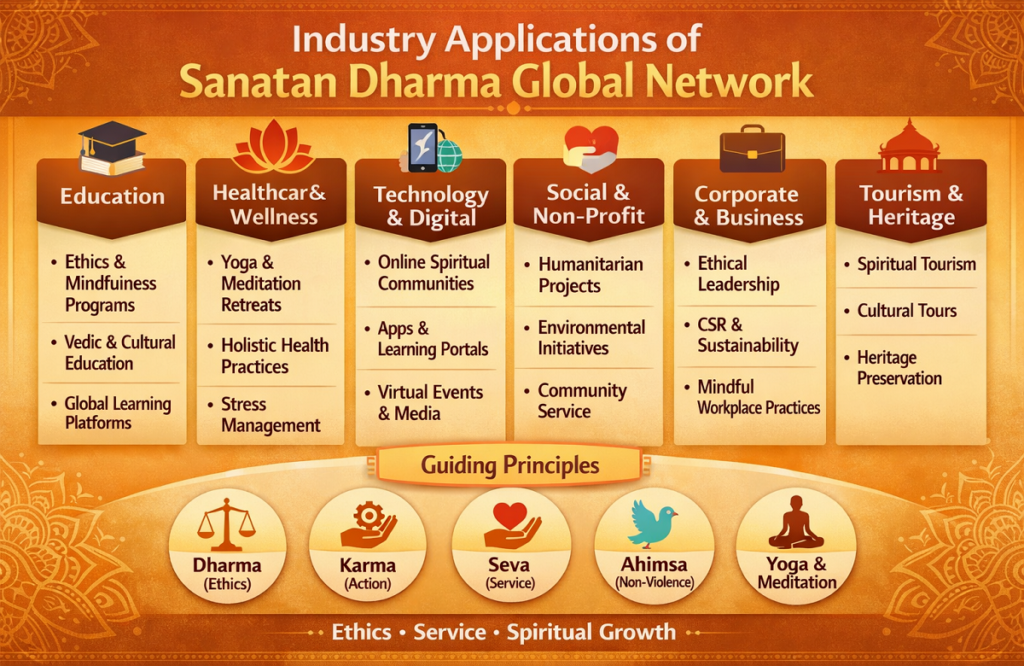
Table of Contents
ASK FAQ
1.What is Sanatan Dharma and its core principles?
Sanatan Dharma, meaning “eternal duty”, is the ancient spiritual and ethical framework that underpins Hindu philosophy. Its core principles include:
- Dharma – righteous duty and moral living
- Karma – the law of action and consequence
- Moksha – spiritual liberation from the cycle of birth and death
- Ahimsa – non-violence and compassion
- Seva – selfless service for the welfare of others
Sanatan Dharma is universal, adaptable, and applicable across cultures, emphasizing ethical, spiritual, and societal harmony.
2.Who can follow Sanatan Dharma?
Sanatan Dharma is open to everyone, regardless of age, gender, nationality, or previous religion. There are no formal conversion requirements or initiation rituals. Anyone who lives ethically, performs selfless service, practices compassion, and pursues spiritual growth is considered a follower in spirit. Its universal teachings make it accessible to individuals worldwide.
3.What is the Sanatan Dharma Global Network?
The Sanatan Dharma Global Network (SDGN) is a conceptual and practical framework connecting individuals, communities, and organizations worldwide that follow the principles of Sanatan Dharma. Its goals include:
- Promoting global awareness of Sanatan Dharma values
- Supporting education, cultural preservation, and humanitarian initiatives
- Facilitating digital and in-person community engagement
- Encouraging interfaith dialogue and global cooperation
SDGN acts as a platform for cultural exchange, spiritual education, and ethical collaboration.
4.How can Sanatan Dharma be applied in modern industries?
Sanatan Dharma principles can guide ethical, sustainable, and socially responsible practices in various industries:
- Education: Teaching ethics, mindfulness, and cultural awareness
- Healthcare and Wellness: Incorporating yoga, meditation, and holistic well-being
- Technology: Building digital communities for spiritual learning and service
- Corporate Governance: Implementing ethical leadership, transparency, and CSR initiatives
- Tourism: Promoting spiritual and cultural experiences, heritage preservation
By integrating these values, industries align business objectives with ethical and societal impact.
5.Where and when can Sanatan Dharma be practiced?
Sanatan Dharma is not restricted by location or time:
- Where: It can be practiced at home, school, workplace, nature, or temples (optional). Digital platforms also allow global engagement.
- When: Applicable at any stage of life—from childhood to old age. Practices include ethical living, selfless service, meditation, devotion, and spiritual reflection.
The focus is on intent, ethical action, and spiritual growth, making it universally accessible and timeless.