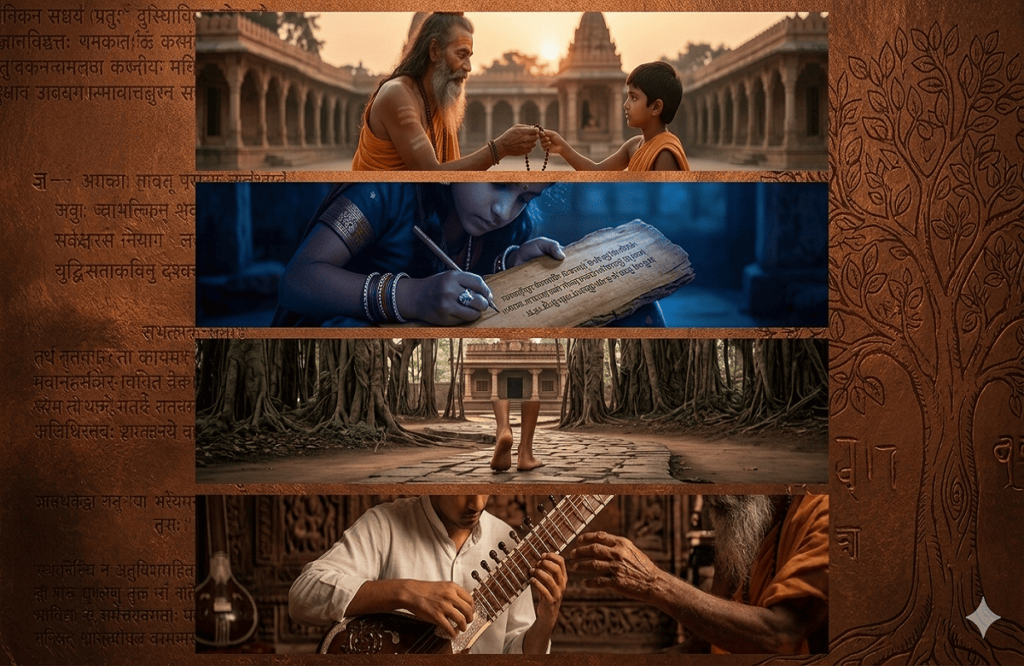
Parampara refers to the lineage or tradition of knowledge transmission, often from teacher to student, in an unbroken chain. It is a foundational concept in Indian philosophy, spirituality, arts, and sciences. Key points include
- Teacher-Student Lineage – Knowledge is transmitted orally and experientially, often in spiritual or scholarly contexts.
- Fields of Knowledge – Parampara exists in Vedic studies, classical music, dance, yoga, Ayurveda, martial arts, and other disciplines.
- Authenticity and Preservation – The chain ensures that teachings remain authentic, avoiding distortions over generations.
- Guru-Shishya Tradition – The personal relationship between teacher (guru) and disciple (shishya) is central.
- Examples –
- Vedic chanting traditions
- Classical music gharanas
- Yoga lineages tracing back to sages
WHAT IS PARAMPARA KNOWLEDGE NETWORK?
A Parampara Knowledge Network is a structured system or framework that maps, preserves, and facilitates the transmission of knowledge through traditional lineages (parampara). Essentially, it modernizes the guru–shishya (teacher-student) tradition using the idea of a network so that knowledge can be tracked, shared, and maintained across generations.
Here’s a clear breakdown:
1. Core Idea
- Parampara: A traditional Indian concept where knowledge is passed down in an unbroken chain from teacher (guru) to student (shishya).
- Knowledge Network: A system of interconnected nodes (people, institutions, texts) representing who teaches what and to whom.
- Parampara Knowledge Network = A networked model of knowledge lineage, combining tradition with modern tools.
2. Components
- Nodes – Entities in the network:
- Teachers / Gurus
- Students / Disciples
- Institutions or learning centers
- Knowledge repositories (manuscripts, recordings, texts)
- Edges / Links – Connections representing knowledge transfer:
- Teacher → Student
- Collaborative work or shared teachings
- Attributes / Metadata – Information about nodes and edges:
- Field of expertise (Vedic studies, music, Ayurveda, etc.)
- Time period or location
- Achievements, certifications, or lineage details
3. Purpose and Benefits
- Preserve traditional knowledge without loss or distortion
- Track lineage authenticity across generations
- Facilitate global access to traditional knowledge
- Support research, learning, and collaboration
- Visualize knowledge flow in lineage trees or network graphs
4. Applications
- Mapping Vedic teachers and their students over centuries
- Showing classical music gharanas and composition lineages
- Documenting yoga or martial arts lineages
- Digital archiving of Ayurveda practitioners and their knowledge
WHO IS REQUIRED PARAMPARA KNOWLEDGE NETWORK?
The Parampara Knowledge Network is relevant and useful for anyone involved in preserving, learning, or transmitting traditional knowledge, especially in contexts where lineage and authenticity matter. Key stakeholders include:
1. Teachers / Gurus
- To record and transmit their knowledge authentically.
- To maintain the continuity of their lineage.
- To connect with students beyond geographical limitations.
2. Students / Disciples
- To learn from authentic sources within a recognized lineage.
- To trace their knowledge roots and understand the tradition.
- To collaborate with other learners or lineages.
3. Institutions / Academies
- Universities, music schools, yoga centers, or Ayurveda institutes can use it to:
- Maintain a structured database of teachers and students.
- Ensure the authenticity of curriculum and training.
- Showcase lineage-based expertise to learners globally.
4. Researchers / Scholars
- To study the evolution of knowledge, texts, and practices.
- To map influence and transmission of ideas across time and regions.
- To analyze patterns in traditional knowledge networks.
5. Cultural / Heritage Organizations
- To preserve intangible cultural heritage.
- To digitally archive lineages for posterity.
- To support community-based knowledge sharing.
6. Policy Makers / Digital Knowledge Platforms
- Governments or NGOs aiming to preserve traditional knowledge.
- Platforms creating lineage-based learning portals or apps.

WHEN PARAMPARA KNOWLEDGE NETWORK IS REQUIRED?
A Parampara Knowledge Network becomes required or most valuable in situations where traditional knowledge needs to be preserved, authenticated, or widely shared. Specifically:
1. Preservation of Knowledge
- When ancient practices, texts, or skills are at risk of being lost.
- Examples: rare Vedic chants, classical music styles, Ayurveda lineages, or martial arts traditions.
2. Ensuring Authenticity
- When there is a need to verify the lineage of knowledge.
- Ensures that students learn from genuine sources rather than diluted or inaccurate teachings.
3. Knowledge Transmission Across Generations
- When teachers and students are geographically distant.
- Supports online or hybrid learning while maintaining traditional structures.
4. Research and Academic Purposes
- When scholars want to map influence, evolution, or spread of knowledge.
- Example: tracing how yoga lineages or musical gharanas evolved over centuries.
5. Digital Archiving and Documentation
- When cultural organizations, governments, or institutions want to create a permanent, accessible record of lineages.
- Useful for intangible cultural heritage protection.
6. Collaboration and Networking
- When multiple teachers, institutions, or students want to interconnect, share knowledge, or collaborate while respecting traditional lineage.
WHERE IS REQUIRED PARAMPARA KNOWLEDGE NETWORK?
A Parampara Knowledge Network is required wherever traditional knowledge, skills, or cultural practices need to be preserved, authenticated, and transmitted. Here’s a detailed breakdown:
1. Educational Institutions
- Schools, universities, and academies teaching Vedic studies, classical music, dance, yoga, or Ayurveda.
- Helps maintain lineage-based curricula and connect teachers with students globally.
2. Cultural and Heritage Organizations
- Museums, cultural centers, and NGOs focused on preserving intangible cultural heritage.
- Supports archiving lineages and practices for posterity.
3. Religious and Spiritual Centers
- Temples, monasteries, and ashrams where knowledge is passed through the guru–shishya tradition.
- Ensures authentic teaching of rituals, chants, and philosophies.
4. Research and Academic Centers
- Universities, think tanks, and research institutes studying history, philosophy, musicology, or traditional sciences.
- Enables mapping and analyzing knowledge networks across time and regions.
5. Digital Platforms
- Online learning platforms, apps, and databases that facilitate remote learning.
- Makes traditional knowledge accessible globally while maintaining authenticity.
6. Communities and Practitioner Networks
- Communities of practitioners of Ayurveda, classical arts, yoga, martial arts.
- Supports peer learning, mentorship, and lineage tracking.
HOW IS REQUIRED PARAMPARA KNOWLEDGE NETWORK?
A Parampara Knowledge Network is required through a structured approach that preserves, authenticates, and transmits traditional knowledge while connecting teachers, students, and institutions. Here’s a step-by-step explanation of how it is required and implemented:
1. Identify Knowledge to Preserve
- Determine the field or tradition (e.g., Vedic chanting, classical music, Ayurveda, yoga, martial arts).
- Identify key teachers, lineages, and texts that need preservation.
2. Map Lineages (Guru–Shishya Relationships)
- Create a network map of teachers and students across generations.
- Document who learned from whom, including dates, locations, and areas of expertise.
- This ensures authenticity and continuity.
3. Digitize Knowledge
- Record teachings in text, audio, video, or interactive formats.
- Maintain metadata about the teacher, student, location, and lineage.
- Digital tools make knowledge accessible globally while preserving tradition.
4. Create Network Infrastructure
- Establish nodes (teachers, students, institutions, resources) and edges (knowledge transfer links).
- Can be done using:
- Databases
- Interactive lineage maps
- Online platforms or apps for communication and learning
5. Enable Access and Collaboration
- Students can connect with authentic teachers.
- Institutions can share expertise and research findings.
- Practitioners can collaborate while respecting lineage integrity.
6. Maintain and Update
- Continuously update the network with new teachers, students, and practices.
- Track lineage growth and evolution over time.
- Ensure that knowledge remains accurate, verified, and traceable.
CASE STUDY ON PARAMPARA KNOWLEDGE NETWORK
1. Background
- Hindustani classical music has a long tradition of gharanas (musical lineages).
- Knowledge is traditionally transmitted from guru to shishya in a parampara.
- Many styles risk dilution or loss due to modernization and fewer direct students.
2. Objective
- To digitally map the lineages of different gharanas.
- To connect gurus with students globally while preserving teaching authenticity.
3. Implementation
- Mapping Lineages:
- Collected data on key teachers and disciples over the last 100 years.
- Visualized relationships in a network graph showing who learned from whom.
- Digital Tools:
- Created an online portal with audio/video archives of performances.
- Added metadata: style, compositions, location, period, and teacher’s profile.
- Access & Collaboration:
- Students can connect with teachers worldwide.
- Scholars can trace the evolution of styles and influence across gharanas.
4. Outcomes
- Preserved authentic compositions and teaching methods digitally.
- Enabled remote learning while maintaining the parampara structure.
- Provided researchers and institutions a resource for lineage-based studies.
5. Lessons Learned
- Digital mapping ensures knowledge preservation across generations.
- Parampara Knowledge Network strengthens authentic learning while enabling global access.
- Regular updates and verification are necessary to maintain lineage integrity.
SOURCE : SRI SANKARA TV
WHITE PAPER ON PARAMPARA KNOWLEDGE NETWORK
The Parampara Knowledge Network (PKN) is an innovative framework that merges the ancient Indian guru–shishya tradition with modern digital knowledge management. By mapping knowledge lineages, preserving authenticity, and enabling global access, PKN ensures that traditional knowledge across disciplines—such as Vedic studies, classical arts, yoga, and Ayurveda—is safeguarded for future generations.
1. Introduction
- Context: Many traditional knowledge systems risk being lost due to modernization, urbanization, and generational gaps.
- Problem Statement: Traditional learning methods rely on oral transmission, making them vulnerable to distortion and discontinuity.
- Solution: Parampara Knowledge Network combines lineage-based authenticity with modern networking and digital tools to preserve, manage, and transmit knowledge.
2. Concept of Parampara Knowledge Network
- Definition: A structured system to map, track, and transmit knowledge across teacher-student lineages.
- Core Principles:
- Authenticity: Ensures knowledge is passed down faithfully.
- Accessibility: Connects learners and teachers globally.
- Documentation: Digitally archives lineages, texts, and practices.
- Collaboration: Facilitates interaction between institutions, teachers, and students.
3. Components of the Network
| Component | Description |
|---|---|
| Nodes | Teachers, students, institutions, or knowledge repositories |
| Edges / Links | Teacher-student relationships, mentorships, collaborations |
| Metadata | Field of expertise, lineage, location, time period, achievements |
| Digital Tools | Online portals, databases, lineage maps, multimedia archives |
4. Areas of Application
- Vedic Knowledge & Chanting – Preserving oral traditions.
- Classical Music & Dance Gharanas – Mapping stylistic evolution.
- Yoga & Ayurveda – Documenting lineages of practitioners.
- Martial Arts – Tracking teaching lineages and regional techniques.
- Cultural Heritage Preservation – Archiving intangible cultural assets.
5. Benefits
- Preserves authentic traditional knowledge.
- Enables global access without compromising lineage integrity.
- Supports research and academic studies.
- Facilitates mentorship, collaboration, and knowledge sharing.
- Creates a permanent digital archive for future generations.
6. Implementation Framework
- Identify Knowledge to Preserve – Field, teachers, lineages.
- Map Lineages – Guru–shishya relationships, nodes, and edges.
- Digitize Knowledge – Texts, audio, video, and interactive formats.
- Build Digital Infrastructure – Portals, databases, lineage graphs.
- Enable Access – Students, researchers, and institutions interact via the network.
- Maintain and Update – Continuous verification and addition of new nodes.
7. Case Study Example
Hindustani Classical Music Gharanas
- Mapped teachers and disciples across generations.
- Created online archive with audio/video recordings.
- Enabled remote learning while maintaining traditional lineage.
- Provided scholars with a lineage-based study tool.
8. Challenges and Solutions
| Challenge | Solution |
|---|---|
| Knowledge Dilution | Digital verification and lineage mapping |
| Geographic Barriers | Online learning platforms and portals |
| Data Management | Structured metadata and database design |
| Community Engagement | Incentives for teachers and students to participate |
9. Future Scope
- AI-assisted lineage verification
- Global collaborative networks for traditional knowledge
- Integration with blockchain for authenticity and intellectual property protection
- Expansion into other cultural heritage domains
10. Conclusion
The Parampara Knowledge Network bridges ancient tradition and modern technology. It preserves knowledge, ensures authenticity, and enables global access, creating a sustainable framework for the future of traditional learning and cultural preservation.
INDUSTRY APPLICATION OF PARAMPARA KNOWLEDGE NETWORK
The Parampara Knowledge Network (PKN) concept is not limited to cultural or spiritual knowledge—it has practical applications across multiple industries where knowledge preservation, lineage, or expertise continuity is critical
1. Education & Academia
- Universities and Schools: Maintain lineage-based expertise for disciplines like classical arts, philosophy, and sciences.
- Research Institutions: Map teacher-student knowledge transfer, track evolution of academic schools of thought.
- E-learning Platforms: Connect learners with verified experts while preserving authenticity.
Example: An online music academy mapping the guru–shishya lineage of Hindustani classical music for global learners.
2. Arts & Culture
- Performing Arts: Music, dance and theater institutions can preserve stylistic traditions.
- Cultural Heritage Organizations: Document and safeguard intangible heritage using networked lineages.
Example: Archiving dance forms like Bharatanatyam or Kathak along with teacher lineages to ensure authentic transmission.
3. Healthcare & Traditional Medicine
- Ayurveda, Yoga, Naturopathy: Track practitioners, lineages, and authentic remedies or practices.
- Pharmaceutical Knowledge: Preserve indigenous knowledge about herbal treatments and formulations.
Example: Creating a lineage map of Ayurvedic practitioners to ensure authentic training and documentation of medicinal practices.
4. Corporate Knowledge Management
- Mentorship Programs: Map senior experts to mentees for skills transfer within organizations.
- Institutional Memory Preservation: Capture tacit knowledge of experienced employees to prevent knowledge loss.
- Succession Planning: Ensure smooth transition of expertise in leadership and technical roles.
Example: A consulting firm mapping senior consultants’ expertise to junior teams to maintain project quality over generations.
5. Technology & Innovation
- R&D Knowledge Lineages: Map inventors, developers, and contributors in technology or research domains.
- Open Innovation Networks: Connect experts with learners or collaborators while preserving intellectual heritage.
- AI-assisted Knowledge Graphs: Automate lineage tracking and expertise verification.
Example: Software development communities documenting mentor-mentee relationships in open-source projects.
6. Agriculture & Traditional Practices
- Farming Techniques: Preserve indigenous agricultural knowledge passed down through generations.
- Sustainable Practices: Track experts who teach eco-friendly or region-specific farming methods.
Example: Mapping rice farming practices in specific regions, connecting older farmers (gurus) to younger learners (shishyas).
7. Legal & Intellectual Property
- Patent and IP Lineages: Track the origin of innovations and know-how over generations.
- Traditional Knowledge Protection: Maintain records to protect cultural or medicinal practices from misappropriation.
Table of Contents
ASK FAQ
1. What is a Parampara Knowledge Network and how does it work?
A Parampara Knowledge Network (PKN) is a structured system that maps and preserves knowledge through traditional lineages, such as the guru–shishya tradition. It works by identifying teachers, students, and institutions as nodes, connecting them through edges that represent knowledge transfer. Digital tools, databases, and lineage maps enable global access while maintaining authenticity.
2.How can traditional knowledge be preserved using a Parampara Knowledge Network?
Traditional knowledge can be preserved by documenting teacher-student relationships, recording teachings (audio, video, text), and creating digital archives. The network ensures that knowledge is passed down accurately across generations, protects against dilution, and allows scholars and learners to access authentic resources globally.
3.What are the benefits of a Parampara Knowledge Network in education and culture?
The benefits include:
- Maintaining authentic knowledge transmission
- Enabling remote learning while respecting lineage
- Supporting research and academic studies
- Preserving cultural and intangible heritage
- Facilitating mentorship, collaboration, and knowledge sharing
4.Which industries can implement Parampara Knowledge Networks for knowledge management?
Industries that benefit include:
- Education & Academia – lineage-based learning and research
- Arts & Culture – music, dance, theater, and heritage preservation
- Healthcare & Traditional Medicine – Ayurveda, Yoga, herbal knowledge
- Corporate Knowledge Management – mentorship, succession planning, institutional memory
- Technology & Innovation – R&D lineage mapping and knowledge graphs
5. How to digitally map guru–shishya lineages in a Parampara Knowledge Network?
Digital mapping involves:
- Identifying key teachers and students in the lineage
- Creating nodes (teachers, students, institutions) and edges (mentorship connections)
- Recording metadata such as field of expertise, location, and time period
- Using digital tools or platforms to visualize lineages with graphs or interactive portals
- Continuously updating the network with new members and verified information