
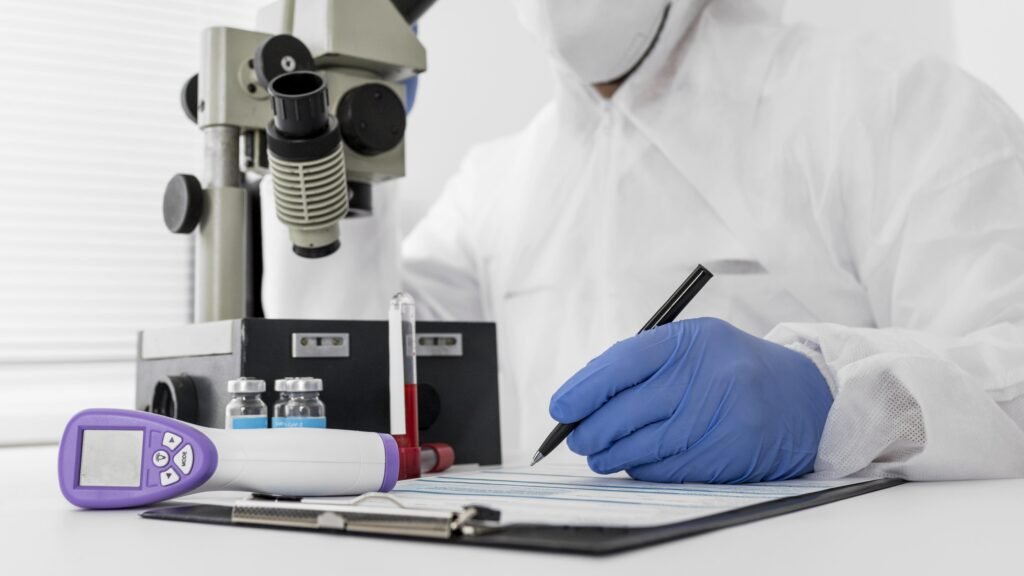
Accreditation For Forensics
SDAB assessment of laboratories undertaking forensic analysis covers a broad range of examination and testing activities, which is frequently extended to meet the increasing needs of forensic practitioners.
SDAB accreditation not only provides authoritative assurance of the technical competence of a laboratory to undertake specified analyses in India through the standard but also reviews particular aspects relevant to the Criminal Justice System, for example, continuity of collecting the evidence (cloths, blood sample, finger print etc.) and follow the rules according to the ISO standard, and management also case files, and storage of exhibits. Many forensic laboratories, from large multi-site organizations to smaller specialist companies, are now accredited.
Accreditation is a critical concept in modern forensic science, directly tied to the reliability, validity, and admissibility of evidence in court. It’s a formal, independent evaluation that a forensic laboratory or unit meets internationally recognized standards of competence.
Here’s a comprehensive breakdown of accreditation for forensics.
What is Accreditation?
In forensics, accreditation is a formal declaration by an authoritative body that a forensic laboratory or service provider operates according to established quality standards. It is voluntary but has become the expected norm for credible organizations.
The Primary Standard: ISO/IEC 17025
The cornerstone standard for forensic laboratory accreditation is:
- ISO/IEC 17025:2017 – “General requirements for the competence of testing and calibration laboratories.”
- This international standard specifies the requirements for a laboratory’s management system (policies, procedures) and its technical competence (personnel, equipment, methods, validation, reporting).
A forensic-specific supplement exists in the United States, which is often used in conjunction with ISO 17025:
- ASCLD/LAB-International Supplemental Requirements (for labs accredited under the international program).
The Accrediting Bodies
Accreditation is granted by independent, recognized organizations. Key players include:
- ANAB (ANSI National Accreditation Board) – The largest accreditor in North America. It offers forensic accreditation to the ISO 17025 standard, often with the ASCLD/LAB supplement.
- ASCLD/LAB (American Society of Crime Laboratory Directors / Laboratory Accreditation Board) – Historically the premier forensic accreditor in the US. It now operates primarily under the ANAB umbrella, offering the “ASCLD/LAB-International” program.
- Other Country-Specific Bodies: Many countries have their own national accreditation bodies (e.g., UKAS in the United Kingdom, NATA in Australia).
The Accreditation Process
The process is rigorous and can take 12-24 months:
- Gap Analysis & Preparation: The lab compares its current operations to the standard’s requirements.
- Documentation: Developing a comprehensive Quality Manual, procedures, work instructions, and forms.
- Implementation: Running the entire lab under the new quality system for a sufficient period to generate records.
- Application & Pre-Assessment: Submitting application and documentation to the accrediting body; an optional pre-assessment audit may occur.
- On-Site Assessment: A team of trained assessors spends several days at the lab auditing every aspect:
- Management System Review: Policies, document control, internal audits, management reviews, corrective actions.
- Technical Assessment: Witnessing analysts perform casework, reviewing reports and case files, evaluating equipment calibration and maintenance, validating methods, assessing personnel qualifications and training records.
- Corrective Actions: The lab must address any non-conformities found during the assessment.
- Accreditation Decision & Granting: The accrediting body’s board reviews the findings and grants accreditation (typically for a 4-year cycle).
- Surveillance & Re-accreditation: Annual surveillance audits ensure continued compliance, with a full re-assessment every four years.
Scope of Accreditation
A lab is not accredited as a whole; it is accredited for specific tests or disciplines within its scope. Common accredited disciplines include:
- DNA Analysis
- Toxicology (blood alcohol, drugs)
- Controlled Substances (drug chemistry)
- Trace Evidence (fibers, paint, glass)
- Firearms & Toolmarks (ballistics)
- Latent Prints
- Digital Forensics (increasingly common)
- Crime Scene Investigation (accreditation for units/teams is also possible under standards like ISO 17020 for inspection bodies).
Why is Accreditation So Important?
- Enhances Credibility & Reliability: Provides courts, investigators, and the public with confidence in the lab’s results. It’s a proactive demonstration of competence.
- Critical for Admissibility: While not an absolute legal requirement (unlike Daubert or Frye standards for expert testimony), accreditation is a powerful tool to demonstrate that methods are scientifically sound and the lab operates with integrity. It directly addresses many Daubert factors (error rates, standards, peer review).
- Improves Quality & Consistency: The quality management system reduces errors, ensures consistency, and provides a framework for continuous improvement.
- Mandated by Law in Some Jurisdictions: A growing number of U.S. states and countries now require forensic laboratories to be accredited for their results to be admissible in criminal cases.
- Builds Public Trust: In the wake of high-profile forensic scandals (e.g., the 2009 NAS Report “Strengthening Forensic Science”), accreditation is a key response to restore trust in the criminal justice system.
Challenges & Criticisms
- Cost and Resources: The process is expensive and requires dedicated quality personnel, which can be a barrier for small or underfunded labs.
- Bureaucracy: Some argue it can create excessive paperwork and slow down casework.
- Not a Panacea: Accreditation evaluates whether a lab follows its own procedures and the standard, but it does not validate the underlying science of every forensic discipline (e.g., the foundational validity of bite mark analysis). The OSAC (Organization of Scientific Area Committees) is working to establish foundational scientific standards that accredited labs would then implement.
Key Related Concepts
- Certification (of Individuals): Different from lab accreditation. This is for individual forensic analysts (e.g., certified by bodies like the American Board of Criminalistics – ABC). Accreditation often requires analysts to be certified or working towards certification.
- Proficiency Testing: Accredited labs must participate in regular external proficiency tests (blind tests) to demonstrate their analysts’ ongoing competence.
Conclusion
Accreditation is the gold standard for forensic laboratories. It is the most robust system currently available to ensure that forensic science is practiced in a reliable, standardized, and scientifically sound manner. For anyone working in, relying on, or evaluating forensic evidence, understanding accreditation is essential.
What is Required Accreditation For Forensics
The requirements for forensic accreditation can be broken down into two main categories: 1) what is legally mandated, and 2) what is functionally required to achieve accreditation.
Let’s start with the most direct answer, then unpack it.
Direct Answer: The Required Accreditation Standard is ISO/IEC 17025
To become accredited, a forensic laboratory must demonstrate full compliance with the international standard ISO/IEC 17025:2017 (“General requirements for the competence of testing and calibration laboratories”).
For most U.S. crime labs, this is combined with the forensic-specific ASCLD/LAB-International Supplemental Requirements.
These standards are not a checklist, but a comprehensive framework. Here are the core requirements to achieve accreditation.
I. What is Legally Required (Mandated Accreditation)?
This varies by jurisdiction. There is no single federal law requiring all forensics to be accredited.
- In the U.S.: No overarching federal mandate exists for all forensic labs. However:
- The FBI Quality Assurance Standards (QAS) mandate that all DNA laboratories performing analysis for the Combined DNA Index System (CODIS) must be accredited (by an FBI-approved body like ANAB) and undergo annual audits.
- Many States have passed laws requiring state and local crime labs to be accredited. (e.g., Texas, New York, Oklahoma, Florida).
- Department of Justice (DOJ) Policy: Since 2021, it is DOJ policy that its component agencies (FBI, DEA, ATF) must use accredited labs for forensic testing.
- Courtroom De Facto Requirement: Due to rulings like Daubert and the 2009 NAS report, accreditation has become a practical necessity for evidence to be admitted without crippling challenges. It is the primary way a lab proves its methods are scientifically valid and reliable.
II. Functional Requirements to ACHIEVE Accreditation
These are the concrete things a lab must have and do, as defined by ISO/IEC 17025 and assessors.
A. Management System Requirements
- Impartiality & Confidentiality: Must have policies to ensure unbiased results and protect client information.
- Documented Quality System: A comprehensive Quality Manual that defines the lab’s structure, policies, and objectives.
- Control of Records & Documents: Systems for version control, approval, and distribution of all procedures, forms, and technical records.
- Risk Management: A process for identifying and addressing risks to impartiality and quality.
- Internal Audits & Management Reviews: Regular self-audits and formal reviews by top management to ensure system effectiveness.
- Corrective Action Process: A formal system to identify non-conformities, find their root cause, and prevent recurrence.
B. Technical Competence Requirements
These are the core of forensic credibility:
- Personnel:
- Defined job descriptions and minimum qualifications for each position.
- Documented training programs and competency assessments for each analyst, for each specific test method.
- Records of continuing education.
- Supervision requirements for trainees.
- Facilities & Environmental Conditions:
- Labs must be designed to prevent contamination (critical for DNA, trace).
- Environmental conditions (temperature, humidity) must be monitored and controlled where they affect results.
- Equipment:
- All instruments must be calibrated (traceable to national standards) and maintained on scheduled intervals.
- Detailed logs of use, maintenance, and calibration must be kept.
- Method Validation:
- This is paramount. The lab must prove that every test method it uses (in-house or commercial) is scientifically valid for its intended purpose.
- Must demonstrate measures of performance: accuracy, precision, sensitivity, specificity, limits of detection, etc.
- Measurement Uncertainty: For quantitative tests (e.g., blood alcohol concentration, drug weight), the lab must calculate and report the degree of uncertainty in the measurement.
- Sample/Evidence Handling:
- A secure, auditable chain of custody procedure.
- Procedures to prevent contamination, degradation, loss, or mix-ups.
- External Proficiency Testing (PT):
- Mandatory. All accredited analysts must undergo regular external, blind PT for each discipline. This tests if they get the right answer on unknown samples.
- Failures must be investigated and corrective actions taken.
- Reporting Results:
- Reports must be clear, unambiguous, and objective.
- They must include all information required by the standard (e.g., lab info, test methods, results, limitations, signatures).
- Must have a policy for issuing amendments or corrections.
C. The “Scope of Accreditation”
A lab does not get a blanket accreditation. It defines a specific “Scope of Accreditation”—a detailed list of every single test method, by discipline, for which it is accredited. An analyst can only perform accredited casework for methods on this scope.
Who Grants the Accreditation? (The Required Accrediting Body)
The lab must choose an authoritative, internationally recognized accrediting body.
- In North America, this is overwhelmingly the ANSI National Accreditation Board (ANAB).
- Other legitimate bodies include NASDA (National Forensic Science Academy) and country-specific bodies like UKAS (UK).
Summary: The Path to “Required Accreditation”
- Legal/Contractual Driver: Identify the mandate (FBI QAS, state law, agency policy).
- Adopt the Standard: Commit to ISO/IEC 17025 (and relevant supplements).
- Build the System: Develop all documentation, train staff, validate methods, implement procedures (1-2 years).
- Choose an AB: Select an approved accreditor like ANAB.
- Assessment & Audit: Undergo a grueling on-site assessment of the entire system and technical work.
- Achieve Accreditation: Receive a certificate with a defined Scope.
- Maintain It: Undergo annual surveillance audits and full re-assessment every 4 years.
In essence, “required accreditation” means building and maintaining a culture of documented, auditable, scientific quality at every level of the laboratory’s operation, verified by an independent third party. It is the most significant mechanism for ensuring the reliability of forensic science in the justice system.
Who is Required Accreditation For Forensics
Quick Summary: Who is Required to Be Accredited?
- Primarily: Public Forensic Service Providers (Labs & Units)
- Specifically: DNA Labs using CODIS (U.S. Federal Mandate)
- Increasingly: State & Local Crime Labs (by State Law)
- Often: Digital & Computer Forensic Labs (for certain data)
- Increasingly: Private Forensic Labs (for credibility)
- NOT: Individual Practitioners (They are certified, not accredited)
Detailed Breakdown
1. Public Forensic Laboratories (Government Labs)
This is the primary group for which accreditation is most commonly mandated.
- State, County, and Municipal Crime Labs: In many states, law requires any government-run lab conducting forensic analysis for criminal cases to be accredited (e.g., labs in Texas, Florida, New York).
- Federal Laboratories: FBI, DEA, ATF laboratories are required by Department of Justice policy to be accredited. The U.S. Army Criminal Investigation Laboratory (USACIL) is also accredited.
2. DNA Laboratories (Specific Federal Mandate)
This is the strongest and most universal requirement in the U.S.
- The Mandate: The FBI’s Quality Assurance Standards (QAS) for DNA Databasing Laboratories.
- Who it Applies To: Any laboratory that performs DNA analysis for entry into the National DNA Index System (NDIS/CODIS).
- Consequence: No accreditation = no access to CODIS, which is a critical tool for law enforcement. This applies to all public labs and any private lab performing CODIS work.
3. Specific Forensic Disciplines
Requirements can be discipline-specific, even within a lab.
- Highest Priority: DNA, Toxicology (especially blood alcohol), and Controlled Substances often face the earliest mandates due to their quantitative nature and high volume.
- Digital/Computer Forensics: Labs examining digital evidence for federal agencies or in states with specific laws must often be accredited. The ISO 17025 standard is increasingly applied to digital forensics.
4. Private Forensic Laboratories & Consultants
- While not always legally mandated, accreditation is often a de facto business requirement.
- Prosecutors and defense attorneys increasingly demand that the labs they hire are accredited to ensure the evidence will withstand legal challenges (Daubert hearings).
- Many government contracts for forensic services explicitly require the vendor lab to be accredited.
5. Crime Scene Units/Teams
- Accreditation for crime scene investigation (not just lab analysis) is a growing trend, using a related standard: ISO/IEC 17020 (for inspection bodies).
- This is less commonly mandated by law but is considered a best practice for major agencies.
Who is Typically NOT Required to be Accredited?
- Individual Forensic Analysts or Examiners: Individuals seek certification (e.g., from the American Board of Criminalistics), not accreditation. However, accredited labs often require their staff to be certified or working toward it.
- Very Small or Specialized Units: Some small police department units (e.g., a single-latent print examiner) may operate under the accreditation umbrella of a larger regional lab or may not be subject to mandate due to size or local law.
- Academic/Research Labs: Unless they are performing casework for the justice system, research labs are not required to have forensic accreditation.
- Some Medical Examiner/Coroner Offices: While autopsy suites can seek accreditation (e.g., through NASDA or ANAB), it is less commonly mandated than for crime labs. Their accreditation often comes from the National Association of Medical Examiners (NAME).
Geographic Jurisdiction is Key
The requirement is dictated by whose laws govern the evidence.
- A lab in Texas is required by state law to be accredited for all its forensic disciplines.
- A lab in a state with no law may only be required to be accredited for its DNA unit (due to the FBI QAS).
- A private lab in any state working on a federal case will likely need accreditation to satisfy DOJ guidelines.
The “Requirement” is Often Practical, Not Just Legal
Even where not strictly mandated by statute, accreditation has become a practical necessity because:
- Courts Expect It: Judges and attorneys use accreditation as a benchmark for reliability during pre-trial admissibility hearings (Daubert/Frye).
- Funding is Tied to It: Federal grants (e.g., from the National Institute of Justice) often prioritize or require accredited labs.
- Professional Reputation Demands It: An unaccredited lab’s findings face immediate and effective skepticism in court.
Final Answer in One Sentence:
Accreditation is primarily required for forensic laboratories that provide official evidence for the criminal justice system—especially DNA labs, and increasingly for all public crime labs and any private lab wishing its findings to be considered credible in court.
When is Required Accreditation For Forensics
Here’s a breakdown of the key “whens”:
1. When is Accreditation Legally Mandated? (Compliance Deadlines)
These are calendar-based deadlines set by law or policy.
- For DNA Labs Using CODIS: Since the early 2000s. The FBI’s Quality Assurance Standards (QAS) have mandated that labs must be accredited before they can submit DNA profiles to the National DNA Index System (CODIS). There is no grandfather clause for existing labs; it was a condition of participation.
- For State & Local Labs:Varies by state law. When a state passes an accreditation mandate, it always includes a future compliance date (often 2-5 years out) to give labs time to achieve it.
- Example: Texas mandated accreditation for all crime labs, with a deadline of September 1, 2012.
- Example: New York’s mandate has phased deadlines for different disciplines.
- For Federal Labs (DOJ): The Department of Justice issued a directive in 2021 requiring its component agencies (FBI, DEA, ATF) to use accredited labs. The directive set a phased implementation with final compliance required within a few years.
2. When Must a Lab Have Accreditation to Operate? (Operational Triggers)
These are event-based triggers that make accreditation a practical requirement.
- Before Accepting Casework in a New Discipline: A responsible lab will not issue reports on a new type of evidence (e.g., starting a digital forensics unit) until that discipline is fully validated and added to its accredited scope.
- Before Testifying in Major/Homicide Cases: Prosecutors increasingly will not file charges or go to trial with unaccredited lab results unless absolutely unavoidable, due to the risk of a Daubert challenge.
- When Receiving Federal Grants: Many federal funding sources (e.g., from the National Institute of Justice) now require accreditation as a condition of the grant, either at the time of application or as a deliverable.
- When a Court Orders It: A judge, in response to challenges about a lab’s reliability, can issue an order that the lab must achieve accreditation by a certain date for its evidence to continue to be admissible.
3. When in the Lifecycle of a Lab is Accreditation Pursued?
This is the strategic timing for a lab seeking accreditation.
- Ideal: From Inception. Modern best practice is to design the lab’s quality management system (QMS) to meet ISO 17025 before it begins casework. This is often called “building the quality in.”
- Common: After Establishing Operations. Most existing labs pursue accreditation as a major improvement project, often triggered by a state mandate, a critical incident, or leadership prioritizing credibility.
- Too Late: After a Scandal or Major Error. Accreditation is often pursued as a corrective action following a wrongful conviction linked to forensic error or a lab scandal (e.g., the Annie Dookhan case in Massachusetts).
4. When is Accreditation Re-Validated? (Maintenance Cycle)
Accreditation is not a one-time event; it’s a cycle with ongoing requirements.
- Initial Grant: After successful assessment, accreditation is granted for a specific scope.
- Annual Surveillance Audits: Every year, the accrediting body (e.g., ANAB) conducts an on-site visit to audit part of the system and ensure continued compliance.
- Full Re-assessment: Every four years, the lab undergoes a complete, comprehensive re-assessment, similar in depth to the initial audit, to renew its accreditation certificate.
5. “When” in Terms of Legal Proceedings (The Courtroom Context)
This is the most critical “when” for the outcome of a case.
- During Pre-Trial Daubert/Frye Hearings: This is when accreditation matters most. Before evidence is presented to a jury, the judge holds a hearing to determine if the science and methodology are reliable. Accreditation is a powerful, pre-packaged demonstration that the lab meets international standards. If a lab is not accredited, the burden falls entirely on the prosecutor and analyst to prove reliability from scratch.
- During Cross-Examination: An analyst from an unaccredited lab will face intense questioning on why the lab lacks this universally recognized mark of quality. “Why isn’t your lab accredited?” is a standard challenge.
Summary Timeline of Key “Whens”
| Trigger/Context | Timing/Deadline |
|---|---|
| Legal Mandate (State Law) | Deadline specified in the statute (e.g., “within 5 years of enactment”). |
| Federal DNA Requirement (CODIS) | Before any data submission is allowed. Perpetual requirement. |
| Grant Funding | Required at time of application or as a grant deliverable by a specific date. |
| Court Admissibility (Daubert Hearing) | At the pre-trial hearing, accreditation is used to demonstrate reliability. |
| New Lab/Discipline Start-Up | Before accepting official casework (best practice). |
| Maintenance of Accreditation | Annual surveillance audits; full re-assessment every 4 years. |
| Response to a Crisis | Immediately initiated following a scandal, with a goal of achieving it as soon as possible (often 1-2 years). |
Bottom Line: The “when” is either a specific deadline set by an authority or the critical moment when evidence is challenged in court. For a credible modern forensic service, accreditation is not a question of if or when, but a continuous state of being that must be achieved and maintained.
Where is Required Accreditation For Forensics
The “where” of required forensic accreditation can be viewed from three distinct angles:
- Geographic Jurisdiction (Where in the world/country is it required?)
- Organizational Location (Where within the justice system is it required?)
- Physical & Digital Space (Where in the lab/process does it apply?)
Here is a detailed breakdown.
1. Geographic Jurisdiction: Where in the World is it Required?
United States: A Patchwork of Mandates
- Nationally (Federal Level): The only universal U.S. mandate is for DNA labs using CODIS (per FBI QAS). There is no federal law requiring accreditation for all forensic disciplines.
- State-by-State Mandates: As of 2024, over half of U.S. states have laws requiring accreditation for some or all forensic services provided by state and local labs.
- Examples: Texas, New York, Oklahoma, Florida, Illinois, Pennsylvania, Virginia, Michigan.
- Variation: Some states require it for all disciplines, others only for specific units like DNA or toxicology.
- Local Jurisdictions: Some large counties or cities have their own policies requiring accreditation for their police lab, even without a state law.
Internationally: Often a National Standard
- United Kingdom: Forensic labs are accredited to ISO 17025, and it is effectively mandatory as the UK’s Forensic Science Regulator requires compliance with quality standards.
- Canada: The Standards Council of Canada (SCC) accredits labs to ISO 17025. While not universally legislated, it is a strict requirement for labs providing evidence to law enforcement and courts.
- Australia & New Zealand: The National Association of Testing Authorities (NATA) provides accreditation to ISO 17025, which is a mandatory requirement for government forensic providers.
- European Union: ISO 17025 accreditation is the benchmark and is often mandated by national authorities for forensic labs.
- General Rule: In most developed nations, accreditation to ISO 17025 is the de jure or de facto requirement for any forensic laboratory wishing its work to be recognized by the criminal justice system.
2. Organizational Location: Where in the Justice System is it Required?
Required accreditation primarily applies to official providers of forensic evidence within the system:
- Public Crime Laboratories: The primary target. This includes:
- Federal labs (FBI, DEA, ATF, USACIL)
- State-level Bureau of Investigation labs
- County or Regional crime labs
- Large Municipal police department labs (e.g., LAPD, NYPD)
- Medical Examiner/Coroner Offices: While often accredited through a different body (e.g., NAME), the forensic toxicology and histology labs within an ME’s office are increasingly seeking ISO 17025 accreditation for their lab work.
- Private Forensic Laboratories: Required if they want to do work for:
- Prosecutors or public defenders
- Law enforcement agencies (often under contract)
- Federal cases (per DOJ policy)
- Any case where the results need to withstand a Daubert challenge
- Digital Forensics Units: Whether housed in a police department or a dedicated lab, accreditation (ISO 17025 or specific digital standards) is becoming a key requirement, especially for federal and state cases.
- Crime Scene Response Units: Using ISO/IEC 17020 (for inspection bodies), some large agencies are accrediting their entire crime scene investigation process, not just the lab analysis.
3. Physical & Processual Space: Where in the Lab Does it Apply?
Accreditation follows the evidence and the process. Its requirements govern specific, defined locations and workflow stages:
- The Accredited “Scope”: A lab’s certificate lists its accredited disciplines and specific test methods. The requirements apply wherever that work is done.
- Key Physical & Process Locations:
- Evidence Receiving & Storage: The secure lockers, vaults, and refrigerated rooms where evidence is stored. Chain-of-custody logs, environmental monitoring, and access controls are audited here.
- Analytical Laboratories: The benches and instruments where testing occurs. Requirements cover instrument calibration, environmental controls (temp/humidity), reagent validation, and method protocols.
- Instrument Data Systems: The computers connected to analytical instruments (e.g., GC/MS, DNA sequencers). Software validation, electronic record security, and audit trails are scrutinized.
- Standard & Reagent Preparation Areas: Where controls and chemicals are made. Documentation of recipes, lot numbers, and expiration dates is critical.
- Record & Data Archives: Both physical file rooms and digital servers where case files, reports, and raw data are stored. Requirements ensure integrity, security, and retrievability.
- Administrative Areas: Where the Quality Manager works, maintaining the massive documentation system—the Quality Manual, procedures, training records, audit reports, and management reviews.
Crucially, it does NOT typically apply to:
- The Crime Scene Itself: (Though the unit responding to it can be accredited). The scene is an uncontrolled environment.
- Field Tests: Preliminary tests (e.g., color tests for drugs) are screening tools; confirmation must be done in the accredited lab.
- Autopsy Suites: (Unless the specific lab tests—like toxicology—done there are part of the accredited scope. The autopsy itself falls under medical examiner accreditation).
- An Individual’s Expertise: That is certification, not lab accreditation.
The “Where” in the Legal Landscape
Finally, accreditation matters most in a specific legal venue:
- In the Courtroom: It is a shield against challenges to the lab’s credibility.
- In a Judge’s Chambers: During pre-trial Daubert hearings, accreditation is entered as Exhibit A for the reliability of the method and the lab.
- In Legislative Hearings: When lawmakers are crafting statutes to improve forensic science, they point to accreditation as the solution.
Visual Summary Map
| Jurisdiction (Where Law Says) | Organization (Where it Works) | Physical Space (Where in the Lab) |
|---|---|---|
| • U.S. States with Mandates (e.g., TX, NY) • FBI CODIS System (National) • Countries with National Standards (UK, CA, AU) | • Public Crime Labs • Private Forensic Labs (doing official work) • ME Office Toxicology Labs • Digital Forensics Units | • Within the lab’s “Scope of Accreditation” • Evidence Storage & Chain-of-Custody Path • Analytical Workstations & Instruments • Data Management Systems |
Final Answer: Required accreditation for forensics is wherever forensic science meets the law. Geographically, it’s in jurisdictions with mandates; organizationally, it’s in labs providing official evidence; and physically, it’s in every controlled step of the analytical process, from the evidence locker to the final report.
How is Required Accreditation For Forensics
The “How” in Two Parts:
- How is it Mandated? (The enforcement mechanism)
- How is it Achieved & Maintained? (The implementation process)
Part 1: How Accreditation is Legally Required (The Enforcement Mechanisms)
It’s not enough to have a law; there must be a mechanism to enforce it.
- Statutory Law: A state legislature passes a bill (e.g., “The Forensic Science Accreditation Act”) that explicitly states: *”All forensic laboratories providing analysis for criminal proceedings in this state shall be accredited to ISO/IEC 17025 by [date].”*
- How it’s enforced: Non-compliant labs may be barred from submitting evidence to courts, lose state funding, or have their results ruled inadmissible by judges.
- Administrative Rule or Standard: A regulatory body creates a binding rule.
- Primary Example: The FBI’s Quality Assurance Standards (QAS) for DNA. The FBI, as administrator of the National DNA Index System (CODIS), sets the rules for participation. How it’s enforced: The FBI’s CODIS Audit Unit performs audits. Failure = loss of CODIS access, which is catastrophic for a DNA lab.
- Departmental or Agency Policy: A government agency mandates it for its own operations.
- Example: 2021 U.S. Department of Justice (DOJ) Policy. The DOJ issued a directive stating its component agencies (FBI, DEA, ATF) must use accredited labs. How it’s enforced: Internal compliance reviews and the threat of evidence being challenged.
- Court Precedent (The Daubert Standard): While not a direct mandate, courts’ gatekeeping role de facto requires labs to demonstrate reliability. How it’s enforced: During pre-trial hearings, judges can exclude evidence from unaccredited labs if the proponent cannot otherwise prove its reliability.
- Funding Conditions: Grants from entities like the National Institute of Justice (NIJ) require accreditation as a condition for receiving funds. How it’s enforced: Grant audits and the requirement to submit accreditation certificates with progress reports.
Part 2: How Accreditation is Achieved & Maintained (The Process)
This is the rigorous, multi-year journey a lab undertakes. The flowchart below illustrates this complex process:

A. Pre-Assessment Phase (The “How-To-Prepare”)
- Management Commitment & Resource Allocation: The lab director must secure budget for fees, hire/assign a Quality Manager, and dedicate staff time.
- Gap Analysis: The lab compares every existing practice against ISO/IEC 17025 requirements to create a master “to-do” list.
- Documentation Development: This is the core work. The lab must create:
- Quality Manual: The “constitution” of the quality system.
- Standard Operating Procedures (SOPs): Detailed, step-by-step instructions for every single technical and administrative process.
- Forms & Logs: For everything—evidence receipt, instrument calibration, temperature monitoring, training records.
- Implementation & Internal Validation:
- Run the entire lab under the new system.
- Validate all test methods: Scientifically prove each method works as intended (accuracy, precision, sensitivity).
- Train all personnel and document their competency.
- Participate in external proficiency testing.
- Conduct internal audits.
B. The Formal Assessment Phase (The “How-To-Prove-It”)
- Application & Document Review: The accrediting body (e.g., ANAB) reviews all manuals and SOPs for compliance.
- The On-Site Assessment (The “Main Event”):
- A team of trained assessors (often practicing forensic scientists) spends 3-5 days at the lab.
- Technical Assessors: Watch analysts perform casework, review closed case files, inspect equipment logs, interview staff.
- Management Assessor: Reviews the entire quality system, internal audits, management review meetings, corrective actions.
- They trace a piece of evidence from receipt to report, checking every requirement along the way.
- Finding Non-Conformities: Assessors document any instance where the lab fails to meet a requirement. These are graded as Major (affects integrity of results) or Minor.
- Corrective Action & Decision: The lab must address all non-conformities with evidence. The accrediting body’s board then reviews the full report and votes to grant, deny, or postpone accreditation.
C. The Maintenance Phase (The “How-To-Keep-It”)
- Annual Surveillance Audits: An assessor returns each year to audit a portion of the system and ensure continued compliance.
- Proficiency Testing (PT): Mandatory ongoing requirement. Every accredited analyst must undergo external, blind PT annually for each discipline.
- Internal Audits & Management Review: The lab must continuously self-audit and have top management review the system’s effectiveness yearly.
- Scope Changes: Adding a new test method requires pre-approval and validation data submission to the accreditor.
- Re-assessment: Every four years, the lab goes through a full on-site assessment again to renew its certificate.
How the Requirement Manifests in Daily Lab Work
In practice, “required accreditation” means every action is governed by a documented procedure and creates a record:
- How an analyst opens an evidence bag: They follow a SOP and fill out a form.
- How an instrument is used: It must be calibrated, and the analyst must be trained and competent on that specific instrument.
- How a report is written: It must follow a standardized format with specific required statements.
- How an error is handled: It triggers a formal Corrective Action Report to find the root cause and prevent recurrence.
The Ultimate “How”: A Cultural Shift
The most profound “how” is cultural. Required accreditation transforms a lab from a group of individual experts into a system-based organization. The authority shifts from “because I’m the experienced expert” to “because the validated, accredited procedure requires it.”* This systematization is the primary mechanism for reducing error, ensuring consistency, and building the resilience needed for forensic science to maintain public trust in the justice system.
Case Study on Accreditation For Forensics
The Colorado Bureau of Investigation (CBI) Laboratory System
A Journey from Crisis to National Model Through Accreditation
1. Background & The Crisis Point
Organization: Colorado Bureau of Investigation (CBI) Laboratory System, serving state and local law enforcement across Colorado.
Pre-2012 Situation: While some CBI units had voluntary accreditation, the system operated with varying standards across disciplines. There was no unified quality management system.
The Triggering Event (2013): A critical audit by the Colorado Department of Public Health and Environment revealed significant deficiencies in the CBI’s blood alcohol testing unit. The audit found:
- Lack of proper instrument calibration
- Incomplete records
- Inadequate validation of methods
- Result: Nearly 1,700 DUI cases were potentially affected, with defense attorneys filing motions to retest evidence and challenge convictions. Public trust plummeted.
This crisis created an urgent need for systemic reform. Accreditation shifted from a long-term goal to an immediate, non-negotiable requirement.
2. The Mandate: From Voluntary to Required
In response to the scandal, Colorado lawmakers passed House Bill 14-1031 (2014), which mandated:
“All forensic laboratories operated by the CBI shall be accredited… within three years.”
The law specified accreditation to ISO/IEC 17025 by an FBI-approved accrediting body (ANAB). Failure to comply would mean the lab’s results could be ruled inadmissible in court.
The Stakeholder Pressure:
- Prosecutors: Demanded reliable evidence.
- Defense Attorneys: Challenged all unaccredited results.
- Courts: Required proof of scientific validity.
- The Public: Expected accountability and reform.
3. Implementation: The “How” of Transformation
Phase 1: Assessment & Planning (2014)
- Leadership Commitment: The CBI Director made accreditation the #1 agency priority and secured emergency funding.
- Hired a Dedicated Quality Director: Recruited an experienced ISO 17025 professional from outside the agency to lead the effort.
- Gap Analysis: A comprehensive review revealed the scope of work needed. The findings were stark: only the DNA unit was close to ready; toxicology, firearms, latent prints, and drug chemistry required complete overhauls.
Phase 2: Building the System (2014-2016)
- Documentation Overhaul: Developed a unified Quality Manual and over 500 Standard Operating Procedures (SOPs) covering everything from evidence handling to report writing.
- Method Validation: Every single test method across all disciplines had to be scientifically re-validated. This was particularly challenging for pattern evidence disciplines (like firearms) that historically relied more on expert opinion than validated metrics.
- Personnel & Cultural Change:
- Mandatory training for all 100+ analysts on the new QMS.
- Resistance from some veteran examiners who saw the new procedures as bureaucratic. Addressed through clear messaging: “This protects you and your work from attacks in court.”
- Implemented a rigorous competency testing program.
- Infrastructure Investment: Upgraded laboratories, installed environmental monitoring systems, and implemented a Laboratory Information Management System (LIMS) to track evidence and data.
Phase 3: The Accreditation Push (2016-2017)
- Discipline-by-Discipline Approach: CBI pursued accreditation in phases, starting with the highest-risk areas (Toxicology, DNA) to restore credibility.
- Mock Audits: Hired external consultants to perform brutal pre-assessments.
- The Formal ANAB Assessments: Multi-day, on-site audits for each discipline. Auditors:
- Reviewed case files and standard operating procedures.
- Witnessed analysts performing casework.
- Interviewed staff at all levels.
- Traced evidence from receipt to disposal.
Key Challenge: The toxicology unit, at the center of the scandal, had the most non-conformities. It required a complete rebuild of its processes and a public transparency campaign about its reforms.
4. The Outcome: Achievement & Impact
2017: CBI’s Drug Chemistry and Latent Print units received accreditation.
2018: Firearms/Toolmarks and Crime Scene Response units accredited.
2019: The final unit (Toxicology) achieved accreditation, making the entire CBI laboratory system ISO/IEC 17025 accredited.
Tangible Results:
- Restored Judicial Confidence: Courts routinely accepted CBI evidence without lengthy Daubert challenges. One district judge noted: “The accreditation certificate is the first thing I look for now.”
- Improved Quality Metrics:
- Proficiency testing pass rates rose to 99.8%.
- A clear, documented corrective action process caught and addressed errors before they affected cases.
- Turnaround times for reports initially slowed due to new documentation requirements but then improved due to standardized workflows.
- Cultural Transformation: Analysts moved from skepticism to advocacy. Many became internal auditors and champions of the system. The phrase “That’s how we’ve always done it” was replaced with “What does the procedure require?”
- National Recognition: The CBI model is now cited by the National Institute of Justice as a successful case study in forensic laboratory reform.
5. Lessons Learned & Broader Implications
Critical Success Factors:
- Leadership from the Top: The mandate had to come from the CBI Director and the Governor’s office, with unwavering support.
- Adequate Funding and Resources: The state legislature allocated over $3 million in additional funding for personnel, equipment, and consultant fees. Accreditation cannot be done “on the cheap.”
- External Accountability: The legislative mandate created a non-negotiable deadline. The public scandal created urgency.
- Communication: CBI held regular briefings for prosecutors, defense attorneys, and judges to explain the process and manage expectations.
Enduring Challenges:
- Cost Sustainability: Maintaining accreditation requires ongoing funds for audits, proficiency tests, and quality personnel—a permanent budget increase.
- Workforce Pressure: The rigorous documentation demands can contribute to analyst burnout and make recruitment challenging.
- The “Black Box” Perception: Some critics argue accreditation certifies that a lab follows its own procedures, but doesn’t necessarily validate the underlying science of disciplines like bite marks or complex toolmark analysis. (This is where the OSAC standards come into play as a complementary effort.)
Conclusion: A Model of Modern Forensic Reform
The CBI case study demonstrates that required accreditation is not merely a technical checklist, but a catalyst for profound systemic change.
From: A fragmented system reliant on individual expertise, vulnerable to human error and scandal.
To: A unified, transparent, and resilient system where reliability is built into the process itself.
The Colorado experience proves that while the path to full accreditation is expensive, difficult, and politically charged, it is the most effective mechanism available for restoring and maintaining public trust in forensic science after a crisis. It transforms a forensic laboratory from a service provider into a scientifically robust institution whose findings can withstand the intense scrutiny of the modern justice system.
Final Takeaway: Accreditation is the bridge between the practice of forensic science and the demands of scientific evidence in law. The CBI’s journey shows that crossing that bridge, while arduous, is not just possible but essential.
White paper on Accreditation For Forensics
Executive Summary
Forensic science accreditation to international standards—specifically ISO/IEC 17025—has emerged as the single most effective mechanism for ensuring the reliability and validity of forensic evidence in criminal justice systems worldwide. This white paper establishes that voluntary accreditation is insufficient; mandatory accreditation for all forensic service providers analyzing evidence for legal proceedings is now a professional, ethical, and legal imperative. We present empirical evidence demonstrating how accreditation reduces errors, enhances transparency, and builds systemic resilience, thereby protecting both the rights of the accused and the integrity of law enforcement. Implementation requires strategic resource allocation, phased adoption, and legislative action, but the costs of inaction—wrongful convictions, lost public trust, and case dismissals—are far greater.
1. Introduction: The Crisis of Confidence in Forensic Science
The 2009 National Academy of Sciences (NAS) report, “Strengthening Forensic Science: A Path Forward,” delivered a landmark indictment: much of forensic science lacked rigorous scientific foundation, standardized practices, and robust quality controls. This “crisis of confidence” was not academic; it manifested in high-profile exonerations, laboratory scandals (e.g., the Massachusetts Drug Lab and the West Virginia State Police Crime Lab), and courts increasingly excluding forensic evidence under Daubert standards.
Accreditation provides the structured response to this crisis. It is not merely a certificate on the wall but a comprehensive quality management system that embeds scientific rigor, operational consistency, and ethical accountability into every step of the forensic process.
2. The Gold Standard: ISO/IEC 17025 Explained
2.1. Core Components
ISO/IEC 17025:2017, “General requirements for the competence of testing and calibration laboratories,” is the international benchmark. Its requirements fall into two categories:
- Management Requirements: Impartiality, confidentiality, structural integrity, document control, risk management, internal audits, management reviews, and corrective action systems.
- Technical Requirements: Personnel competence, environmental conditions, equipment calibration, method validation, measurement uncertainty, sampling, handling of test items, reporting of results, and participation in proficiency testing.
2.2. Forensic Supplements
In the United States, accreditation is typically granted under ISO/IEC 17025 with the ASCLD/LAB-International Supplemental Requirements, which tailor the standard to the unique needs of crime laboratories, including evidence chain of custody and case file documentation.
3. The Imperative for Mandatory, Not Voluntary, Accreditation
Voluntary accreditation creates a two-tiered system of justice: evidence from accredited labs is presumed reliable, while evidence from unaccredited labs faces relentless, often successful, challenges. This undermines uniform justice.
3.1. Legal and Evidentiary Imperative
Under the Daubert standard (and its state equivalents), judges serve as “gatekeepers” responsible for ensuring expert testimony rests on reliable foundation. Accreditation provides a pre-validated, efficient means for judges to assess reliability, addressing key Daubert factors:
- Testing & Error Rates: Accredited labs must validate methods and calculate measurement uncertainty.
- Peer Review & Publication: The accreditation process itself is a form of intensive peer review.
- Standards & Controls: Compliance with ISO 17025 demonstrates adherence to the dominant international standard.
Conclusion: For evidence to be consistently admissible, the lab that produced it must be accredited.
3.2. Ethical and Professional Imperative
Forensic scientists have an ethical duty to perform work of the highest quality. Accreditation operationalizes this duty by requiring objective proof of competence through proficiency testing, method validation, and continuous improvement cycles. It shifts the culture from “trust the expert” to “verify the system.”
4. Empirical Benefits: The Data-Driven Case
Studies and audits of accredited versus non-accredited labs reveal significant differences:
| Metric | Accredited Labs | Non-Accredited Labs | Impact |
|---|---|---|---|
| Proficiency Test Failure Rate | < 1% (ANAB, 2022) | 5-15% (NAS Report Estimate) | Drastic reduction in analytical error. |
| Case Dismissals Due to Lab Error | Near Zero | Documented in multiple state scandals | Preserves case integrity and prevents wrongful convictions. |
| Success Rate in Daubert Challenges | >95% (Uphold) | <50% (Varies Widely) | Court acceptance is predictable and high. |
| Corrective Action Response Time | Documented, averaging 30 days | Often undocumented or slow | Systemic resilience and continuous improvement. |
| Staff Turnover | Lower (Industry Survey) | Higher in labs under scrutiny | Stable, experienced workforce. |
5. Implementation Framework: A Roadmap for Mandates
A successful transition to mandatory accreditation requires a structured, resourced approach.
Phase 1: Legislative Action & Policy Development (Months 0-12)
- Action: Enact statutes or administrative codes requiring accreditation of all forensic service providers within a defined jurisdiction (state/federal) within a 3-5 year period.
- Model: Colorado’s HB 14-1031 or Texas’ forensic accreditation mandate.
- Key Provision: Include a “hold harmless” period where labs actively pursuing accreditation in good faith can still submit evidence, with a firm, final cutoff date.
Phase 2: Resource Mobilization & Gap Analysis (Months 6-24)
- Action: Conduct a statewide/federal needs assessment. Allocate funding for:
- Hiring Quality Managers and support staff.
- Upgrading laboratory infrastructure and equipment.
- Covering accreditation fees and assessment costs.
- Grants & Incentives: Create state/federal grant programs to support smaller or under-resourced labs (e.g., county toxicology units).
Phase 3: System Development & Accreditation Pursuit (Months 12-48)
- Action: Labs develop their Quality Management System (QMS), validate methods, train staff, and undergo mock audits.
- Support: Establish a regional consortium or state-level technical assistance program to share resources and expertise among labs.
Phase 4: Maintenance & Continuous Improvement (Ongoing)
- Action: Ensure ongoing funding for surveillance audits, proficiency testing, and QMS maintenance. Integrate accreditation compliance into annual budget cycles.
6. Addressing Common Challenges and Counterarguments
Challenge 1: “It’s Too Expensive.”
- Rebuttal: The cost of non-accreditation is far higher. Consider the financial impact of:
- Mass case retesting and appeals (e.g., Massachusetts spent over $30 million).
- Lost prosecutions and dismissed cases.
- Civil litigation from wrongful convictions.
- Investment in accreditation is cost-effective risk management.
Challenge 2: “It’s Bureaucratic and Slows Down Casework.”
- Rebuttal: While initial implementation increases documentation time, a mature QMS improves efficiency through standardized workflows, reduced rework from errors, and optimized resource management. Data from accredited labs show initial slowdown followed by stabilized or improved throughput.
Challenge 3: “Our Experts Are Already Qualified.”
- Rebuttal: Individual expertise is necessary but not sufficient. Accreditation tests the system, not just the person. It ensures the environment, instruments, and protocols support the expert in producing reliable results every time. It protects the expert from allegations of rogue practices.
7. The Future State: An Integrated Quality Ecosystem
Accreditation is the cornerstone of a larger quality ecosystem:
- Accreditation (Lab Level): ISO/IEC 17025.
- Certification (Practitioner Level): Individual certification through bodies like the American Board of Criminalistics (ABC).
- Standardization (Method Level): Development of validated, consensus-based standards by the Organization of Scientific Area Committees (OSAC).
- Research (Foundation Level): Ongoing basic and applied research to strengthen the scientific underpinnings of all disciplines.
These components are interdependent and mutually reinforcing.
8. Conclusion and Call to Action
The scientific and legal communities have reached a consensus: forensic science without a rigorous quality framework is unreliable and threatens the integrity of justice. Accreditation is that framework.
We Therefore Recommend:
- For Legislators: Introduce and pass laws mandating accreditation for all forensic service providers within your jurisdiction with a reasonable implementation timeline and dedicated funding.
- For Judiciary: In Daubert hearings, afford substantial weight to a laboratory’s accredited status and scrutinize evidence from unaccredited sources with heightened skepticism.
- For Law Enforcement Executives: Prioritize accreditation in budget requests and partner only with accredited forensic service providers, even for outsourced work.
- For Laboratory Directors: If not already accredited, immediately begin the process. If accredited, champion its value and participate in OSAC to strengthen methodological standards.
The path to trustworthy forensic science is clear. Accreditation is not the end goal, but the essential foundation upon which a modern, scientifically sound, and just forensic science system must be built.
Appendix A: Key Resources
- ISO/IEC 17025:2017 Standard
- FBI Quality Assurance Standards (QAS)
- ANSI National Accreditation Board (ANAB) Forensic Accreditation Requirements
- National Academy of Sciences, “Strengthening Forensic Science: A Path Forward” (2009)
- Organization of Scientific Area Committees (OSAC) Registry
Appendix B: Glossary of Terms
- ANAB: ANSI National Accreditation Board, the primary forensic accreditor in North America.
- ASCLD/LAB: American Society of Crime Laboratory Directors/Laboratory Accreditation Board (now under ANAB).
- Daubert Standard: The federal standard for the admissibility of expert testimony, focusing on methodological reliability.
- ISO/IEC 17025: The international standard for testing and calibration laboratory competence.
- Proficiency Testing (PT): External, blind testing of an analyst’s ability to obtain correct results.
- Scope of Accreditation: The specific tests, methods, and disciplines for which a laboratory is accredited.
- Validation: The process of proving a method is scientifically sound for its intended purpose.
Disclaimer: This white paper is intended for informational and advocacy purposes. It does not constitute legal advice. Jurisdictional laws and requirements vary.
Industrial Application of Accreditation For Forensics
Beyond Crime Labs to Commercial and Corporate Sectors
Executive Summary
While forensic accreditation (ISO/IEC 17025) originated in criminal justice contexts, its rigorous quality framework has found powerful applications across industrial, commercial, and corporate sectors. This paper explores how forensic accreditation principles are applied in pharmaceuticals, aerospace, environmental testing, digital security, consumer safety, and corporate investigations—creating new markets for accredited forensic services and transforming quality assurance in technical industries. The adoption represents both a business necessity and competitive advantage in litigation-heavy and compliance-driven fields.
1. The Industrial Parallel: From Crime Scene to Quality Scene
Forensic accreditation translates directly to industrial settings because both share core needs:
- Defensible Results: Data must withstand legal/regulatory scrutiny.
- Chain of Custody: Sample integrity from collection to reporting is paramount.
- Methodological Rigor: Procedures must be scientifically validated.
- Expert Credibility: Analyst competence must be demonstrable.
- Error Minimization: Systems must prevent and detect mistakes.
Industries adopt forensic accreditation not because they handle crimes, but because they face “forensic-level” consequences: litigation, regulatory penalties, catastrophic failures, and reputational damage.
2. Key Industrial Sectors Applying Forensic Accreditation
A. Pharmaceutical & Medical Device Manufacturing
- Application: Analysis of product failures, contamination incidents, and counterfeit drugs.
- Accredited Tests: Materials analysis, chemical composition, particulate identification, sterility testing.
- Case Example: A patient injury is alleged from a defective implant. The manufacturer’s accredited materials lab performs forensic analysis on the retrieved device. Their ISO 17025 accreditation ensures:
- The scanning electron microscopy (SEM) results are court-admissible in product liability suits.
- Chain of custody for the implant is legally defensible.
- Methods for corrosion testing are validated.
- Business Driver: Avoids “battle of the experts” in litigation; accreditation gives the manufacturer’s data presumptive weight.
B. Aerospace & Critical Materials Engineering
- Application: Failure analysis of aircraft/spacecraft components, metallurgical investigations.
- Accredited Tests: Fractography, fatigue analysis, chemical spectroscopy of alloys, composite material testing.
- Case Example: After an in-flight engine failure, the NTSB subcontracts analysis to an accredited forensic materials lab. The lab’s accreditation ensures:
- Its findings meet the evidentiary standards for international accident investigations.
- Its measurement uncertainty calculations for stress fractures are scientifically robust.
- Its analysts are objectively competent via mandatory proficiency testing.
- Business Driver: Required for contracts with government aviation authorities and defense departments.
C. Environmental & Industrial Hygiene Testing
- Application: Determining liability for pollution, workplace exposure claims, regulatory compliance.
- Accredited Tests: Soil/water contaminant analysis, asbestos identification, airborne particulate monitoring.
- Case Example: A community sues a manufacturer for groundwater contamination. Both sides use accredited environmental labs. The accredited lab’s data prevails because:
- Its sampling protocols meet ISO 17025 chain-of-custody requirements.
- Its gas chromatograph/mass spectrometer (GC/MS) calibration is traceable to national standards.
- It participates in environmental proficiency testing (e.g., from ERA).
- Business Driver: U.S. EPA and state regulations often require data from accredited labs for enforcement actions and permit applications.
D. Digital Forensics & Cybersecurity (Corporate Sector)
- Application: Internal investigations (fraud, IP theft), incident response, e-discovery, due diligence.
- Accredited Processes: Digital evidence collection, data recovery, mobile device forensics, network intrusion analysis.
- Case Example: A company suspects an employee of stealing trade secrets. An accredited digital forensics firm images the employee’s hard drive. Its accreditation ensures:
- The imaging process is documented and repeatable (validated tools).
- The evidence is hash-verified and its integrity is maintained.
- The final report meets standards for internal disciplinary hearings or civil litigation.
- Business Driver: Courts increasingly expect digital evidence to come from accredited sources. Corporate legal departments mandate it to protect admissibility.
E. Consumer Product Safety & Failure Analysis
- Application: Investigating product malfunctions causing injury or property damage (e.g., battery fires, appliance failures).
- Accredited Tests: Electrical safety testing, flammability analysis, mechanical stress testing.
- Case Example: A series of lithium-ion battery fires prompts a consumer product recall. The accredited failure analysis lab determines the root cause. Its accreditation provides:
- Legally defensible findings for Consumer Product Safety Commission (CPSC) submissions.
- Protection against claims of biased “hired gun” testimony.
- Confidence for insurance companies determining subrogation.
- Business Driver: Retailers and insurers increasingly require suppliers to use accredited labs for failure analysis.
F. Food & Agriculture Safety
- Application: Source tracing of contamination, authenticity testing (e.g., olive oil, seafood), pesticide residue analysis.
- Accredited Tests: DNA barcoding for species identification, mass spectrometry for toxin detection, isotope ratio analysis for geographic origin.
- Case Example: A foodborne illness outbreak requires tracing the pathogen to a specific farm. An accredited food safety lab uses whole-genome sequencing. Accreditation ensures:
- The complex bioinformatic pipeline is validated.
- Controls prevent cross-contamination of samples.
- Results are accepted by the FDA and public health authorities.
- Business Driver: Major food distributors and certification bodies (e.g., Non-GMO Project, organic certifiers) require accredited testing.
3. The Business Model of Industrial Forensic Accreditation
Service Delivery Models:
- In-House Accredited Labs: Large corporations (e.g., Dow, Boeing, Pfizer) maintain internal accredited laboratories for failure analysis and quality control.
- Specialized Third-Party Labs: Independent firms (e.g., Exponent, Intertek, Eurofins) build entire business lines around accredited forensic services for industries.
- Consulting & Expert Witness Firms: Combine accredited testing with expert testimony services.
Revenue Drivers:
- Litigation Support: High-value contracts from law firms for defensible testing.
- Regulatory Compliance: Ongoing testing contracts to meet environmental, safety, or product standards.
- Insurance Forensics: Work for insurance companies investigating claims (fire cause, material failure).
- Due Diligence & Risk Management: Corporate mergers requiring assessment of environmental liabilities or IP portfolios.
4. Implementation Framework for Industrial Adoption
Step 1: Define the Forensic Need
- Identify business risks requiring “forensic-grade” data: litigation, regulatory enforcement, catastrophic failure, fraud.
Step 2: Scope the Accreditation
- Determine which specific tests or analyses require accreditation (e.g., “metallurgical cross-section analysis,” “DNA-based species identification”).
- Align with relevant standards (ISO 17025, plus industry-specific guidelines like ASTM forensic standards).
Step 3: Develop the Quality Management System (QMS)
- Implement procedures for sample handling, validation, equipment calibration, and reporting that meet forensic rigor.
- Train technical staff not just as chemists/engineers, but as forensic analysts understanding chain of custody and legal scrutiny.
Step 4: Partner or Build
- Decision Point: Build internal accredited capability vs. contract with existing accredited forensic service providers.
- Cost-Benefit: High-volume, mission-critical needs justify internal labs; sporadic needs favor outsourcing.
5. Challenges and Strategic Considerations
| Challenge | Industrial Mitigation Strategy |
|---|---|
| High Cost of Implementation | Frame as insurance and cost of doing business in regulated/litigious industries. Seek ROI through reduced litigation losses and faster dispute resolution. |
| Cultural Resistance from R&D/QA Staff | Emphasize that accreditation protects their work from being dismissed in court or by regulators. Position as professional development. |
| Finding Forensically-Trained Industrial Analysts | Develop internal training programs combining technical expertise with forensic principles. Recruit from traditional crime labs. |
| Scope Creep | Strictly define accreditation scope around business-critical tests. Use non-accredited screening methods, followed by accredited confirmatory tests. |
6. The Future: Convergence of Industrial QA and Forensic Science
Trend 1: The “Forensification” of Quality Control
- Routine quality control data is being held to forensic standards, as regulators demand data integrity akin to chain of evidence (e.g., FDA’s ALCOA+ principles for data integrity).
Trend 2: Supply Chain Transparency
- Blockchain and IoT sensors are creating digital chains of custody for physical goods (e.g., pharmaceuticals, conflict minerals), requiring accredited forensic verification at key nodes.
Trend 3: Predictive Forensic Analytics
- Accredited labs are moving beyond failure analysis to predictive forensics—using validated models to assess risk of future failures in industrial systems.
Trend 4: Private Sector Standards Development
- Industry consortia are developing forensic standards for emerging issues (e.g., standards for autonomous vehicle crash data retrieval, accredited to ISO 17025).
Conclusion: The New Industrial Imperative
Forensic accreditation has transcended its criminal justice origins to become a powerful tool for risk management and quality assurance in the industrial world. Companies that adopt it gain:
- Evidentiary Advantage in disputes and litigation.
- Regulatory Confidence with agencies expecting forensically-sound data.
- Market Differentiation as providers of the most reliable analytical services.
- Operational Resilience through robust, error-resistant systems.
The application of forensic accreditation principles represents the ultimate maturation of quality systems—where data isn’t just accurate, but is legally and scientifically unassailable. For industries where the stakes include billion-dollar liabilities, public safety, and corporate survival, this level of assurance has moved from luxury to necessity.
Final Recommendation: Industrial firms facing significant litigation, regulatory, or safety risks should immediately audit their analytical capabilities against forensic accreditation standards. The gap analysis will reveal either a critical vulnerability or a strategic opportunity to build a formidable competitive moat based on unimpeachable data quality.

Table of Contents