
Accreditation For Food
A Quality Environment And Delivered To Environmental And Animal Welfare Standards Helping Ensure Food And Water Is Safe To Consume And Produced In
From farm to plate, whether brought food in a shop or eaten at a restaurant, there is an expectation food is safe to consume and water to drink so first of we look there standard if there standard is ok then we are safely eaten food in this shop or restaurant. This is underpinned by regulations, codes and schemes some of which are required by rules and regulations of standard. All of which intend to give consumers confidence that they are protected from sub-standard or unsafe practices and poor quality or inaccurately labeled products.
To deliver this confidence requires a battery of tests, measurements and certificated processes – whether on water, soil, plants or further up the production chain in the dairy or the food processing unit. Trust is also generated through accredited quality assurance schemes covering farm, producers and retailers.
Accreditation for food is a critical system that ensures food safety, quality, authenticity, and fair trade from farm to fork. It’s not a single certificate but a multi-layered framework involving laboratories, certification bodies, producers, and standards.
Here’s a comprehensive breakdown of accreditation in the food industry:
1. What is Accreditation (in this context)?
Accreditation is the formal, independent, third-party recognition that an organization (like a lab, inspection, or certification body) is competent to perform specific tasks according to internationally recognized standards (like ISO/IEC 17025). It’s the “approval of the approvers.”
Think of it this way:
- Certification: A farm or factory gets a certificate (e.g., ISO 22000, Organic) from a Certification Body (CB).
- Accreditation: An official Accreditation Body (e.g., UKAS in the UK, ANAB in the US, DAkkS in Germany) assesses and approves that Certification Body to ensure it is competent and impartial. This gives credibility to the certificate.
2. Key Areas of Accreditation in the Food Sector
A. Accreditation of Testing and Calibration Laboratories
- Primary Standard: ISO/IEC 17025 – “General requirements for the competence of testing and calibration laboratories.”
- What it means: A food testing lab accredited to this standard has proven its technical competence, uses validated methods, has traceable measurements, and produces reliable, defensible results.
- Examples of tests: Pathogen detection (Salmonella, E. coli), chemical analysis (pesticides, allergens, heavy metals), nutritional labeling, authenticity testing (e.g., olive oil origin).
B. Accreditation of Inspection Bodies
- Primary Standard: ISO/IEC 17020 – “Conformity assessment — Requirements for the operation of various types of bodies performing inspection.”
- What it means: Bodies that inspect food facilities, processes, products, or transportation (e.g., cold chains) are independently assessed for competence.
- Examples: Inspections of hygiene in a slaughterhouse, audits of temperature-controlled logistics, condition of goods on delivery.
C. Accreditation of Certification Bodies (Most Common for Food Businesses)
This is where accreditation directly touches food producers, processors, and retailers. The Accreditation Body accredits the CBs that issue management system and product certificates.
- Primary Standards:
- ISO/IEC 17065: For product certification (e.g., organic, gluten-free, Non-GMO Project Verified).
- ISO/IEC 17021-1: For management system certification (e.g., FSSC 22000, ISO 22000, ISO 9001).
3. Major Accredited Food Safety and Quality Schemes
These are the specific standards that food companies get certified to. Their certification bodies are typically accredited.
- FSSC 22000 (Food Safety System Certification): A globally recognized, GFSI-benchmarked scheme for food safety management systems. Often a market requirement for major retailers.
- ISO 22000: International standard for food safety management systems.
- BRCGS (British Retail Consortium Global Standards): A leading GFSI-benchmarked standard for food safety, quality, and operational criteria, required by many UK and EU retailers.
- SQF (Safe Quality Food): Another major GFSI-benchmarked scheme common in North America and globally.
- IFS (International Featured Standards): GFSI-benchmarked standard, strong in Germany, France, and Italy.
- Organic Certification (e.g., USDA Organic, EU Organic): The bodies that certify farms as organic must be accredited by the relevant authority.
- Fairtrade, Rainforest Alliance: Ethical and sustainability certifications also rely on accredited certification bodies.
4. Why is Accreditation So Important?
- Builds Trust: Provides confidence to consumers, regulators, and business partners. An “UKAS Accredited” logo on a test report or certificate is a powerful trust signal.
- Reduces Risk: For businesses, using accredited suppliers and labs minimizes the risk of food safety failures, recalls, and legal liability.
- Facilitates Trade: Accreditation is often a passport to international markets. It ensures conformity assessments are accepted across borders, reducing duplicate testing and audits.
- Regulatory Compliance: Many governments and regulators (like the FDA, EU Commission) recognize or mandate the use of accredited conformity assessment for certain activities.
- Protects Brand Reputation: Demonstrates a commitment to verified safety and quality beyond mere self-declaration.
5. The Accreditation Process (for an organization seeking it)
- Choose the Relevant Standard: A lab chooses ISO/IEC 17025; a certification body chooses ISO/IEC 17065.
- Apply to an Accreditation Body: Submit application detailing scope.
- Prepare & Document: Develop a full quality management system and demonstrate technical competence.
- Initial Assessment: A team of expert assessors from the Accreditation Body conducts a rigorous on-site audit.
- Corrective Actions: Address any non-conformities found.
- Grant of Accreditation: If compliant, accreditation is granted for a specific scope.
- Surveillance & Re-assessment: Regular surveillance visits (often yearly) and full re-assessment every few years ensure ongoing compliance.
Key Accreditation Bodies (National)
- USA: ANSI National Accreditation Board (ANAB)
- United Kingdom: United Kingdom Accreditation Service (UKAS) – the world’s first national accreditation body.
- European Union: Various national bodies (e.g., DAkkS – Germany, COFRAC – France) coordinated by EA (European co-operation for Accreditation).
- International: International Body and Global Laboratory Accreditation provide the global framework for mutual recognition.
In Summary:
Accreditation is the backbone of credibility in the global food system. It ensures that the certificates, test reports, and inspection results that underpin food safety, quality, and authenticity are themselves reliable and trustworthy. When you see a food label claiming “Organic,” “Gluten-Free,” or “Food Safety Certified,” the value of that claim is significantly higher if it’s backed by an accredited certification process.
What is Required Accreditation For Food
The Core Principle:
Governments and major retailers don’t typically accredit the food producer directly. They require the food producer to obtain a certificate (like FSSC 22000, Organic). That certificate, to be trusted, must be issued by a Certification Body (CB) that is itself accredited by a recognized national authority.
So the “required accreditation” is on the service providers, not the food company. This creates a reliable chain of trust.
1. When Accreditation of a Laboratory is Legally Required
Regulations often require that specific food safety testing be performed by an accredited lab.
- Standard: ISO/IEC 17025 (for testing labs).
- Examples of Legal Requirements:
- Official Food Control: In the EU, laboratories designated to perform official control sampling and analysis under Regulation (EC) 2017/625 must be accredited to ISO/IEC 17025.
- Microbiological Criteria: Testing for pathogens like Listeria monocytogenes in Ready-to-Eat foods often must follow accredited methods.
- Import/Export Testing: Many countries require accredited lab results for chemical residues or contaminants on imported food shipments.
- Practical Impact: A food manufacturer facing a regulatory test (e.g., for pesticide levels) must send samples to a 17025-accredited laboratory for the results to be legally valid.
2. When Accreditation of a Certification Body is Effectively Required
While not always written into law, market access demands make this a de facto requirement.
- Standards: ISO/IEC 17065 (for product certifiers) or ISO/IEC 17021-1 (for management system certifiers).
- Examples of “Required” Scenarios:
- GFSI-Benchmarked Schemes: If a food supplier wants a certification recognized by the Global Food Safety Initiative (GFSI)—such as FSSC 22000, BRCGS, SQF, or IFS—the Certification Body issuing that certificate must be accredited by a national body that is part of the International Body. No accreditation = no recognized certificate.
- Organic Certification: In the US (USDA NOP) and EU, any entity certifying a farm or product as “organic” must be accredited by the relevant government program.
- Major Retailer & Manufacturer Requirements: Walmart, Nestlé, McDonald’s, etc., typically require their suppliers to have a GFSI-benchmarked certificate from an accredited CB.
3. What is Required of the FOOD BUSINESS (The Manufacturer/Processor)?
The food business is required to:
- Obtain a Relevant Certificate: Get certified to a specific standard (e.g., FSSC 22000, BRCGS, Organic) based on their customers’ and regulators’ demands.
- Use Accredited Services: Hire accredited laboratories for mandatory testing and hire accredited certification bodies to perform their audits and grant their certificate.
- Comply with Regulations: Adhere to national food safety laws (e.g., FDA’s Food Safety Modernization Act (FSMA) in the US, EC No 852/2004 in the EU), which may reference or require the use of accredited conformity assessment.
Summary Table: Who Needs What Accreditation?
| Organization | What They Do | Accreditation They Typically NEED | Why It’s Required |
|---|---|---|---|
| Testing Laboratory | Tests food for pathogens, chemicals, etc. | ISO/IEC 17025 | Often a legal/regulatory mandate for official controls and to ensure defensible results. |
| Certification Body (CB) | Audits and certifies food companies. | ISO/IEC 17065 or 17021-1 | Market Access & Trust. Required by GFSI, organic programs, and major buyers to issue recognized certificates. |
| Inspection Body | Inspects facilities, processes, or goods. | ISO/IEC 17020 | Often required by contracts or regulations for specific inspection activities (e.g., condition of imported goods). |
| Food Manufacturer | Produces food products. | None directly. | Must obtain certificates from accredited CBs and use test results from accredited labs to meet legal/customer requirements. |
Key Regulatory & Market Drivers:
- GFSI (Global Food Safety Initiative): The single biggest driver. Its recognition of schemes forces accreditation down the chain.
- FDA (USA): Under FSMA, the FDA recognizes accredited third-party certification bodies to conduct food safety audits for foreign suppliers.
- EU Regulations: Explicitly require the use of “designated” laboratories and certification bodies that must meet accreditation standards (ISO/IEC 17025, 17065).
- National Import Regulations: Many countries require accredited certification for high-risk food imports.
Bottom Line:
“Required accreditation for food” means that to operate legally and access major markets, a food business must engage third-party organizations (labs, certifiers) that hold the correct national accreditation. The accreditation requirement is imposed on the infrastructure of assurance, not the food brand itself, creating a globally recognized system of trust.
Who is Required Accreditation For Food
The Short Answer:
The organizations that are REQUIRED to be accredited are the third-party service providers in the food safety system:
- Testing Laboratories
- Certification Bodies (Auditors)
- Inspection Bodies
The food producer/manufacturer (the food company itself) is NOT directly accredited. They are required to hire these accredited service providers and obtain certificates from them.
Detailed Breakdown: Who MUST Be Accredited?
| Organization | Example | Accreditation Standard Required | Who Requires It? |
|---|---|---|---|
| 1. Food Testing Laboratory | A lab that tests for Salmonella, pesticides, or allergens. | ISO/IEC 17025 | Government Regulators (e.g., EU, FDA for certain imports), Major Retailers, and Food Safety Laws. |
| 2. Certification Body (CB) | A company that audits and certifies a food factory to FSSC 22000 or Organic standards. | ISO/IEC 17065 (for products) or ISO/IEC 17021-1 (for systems) | GFSI Benchmarks, National Organic Programs (USDA, EU), Major Brand Suppliers (e.g., Nestlé, McDonald’s). |
| 3. Inspection Body | A company that inspects the condition of cargo ships or storage facilities. | ISO/IEC 17020 | Import/Export Regulations, Contractual Agreements with buyers. |
Why This System Exists: The Chain of Trust
It’s a system of checks and balances to ensure no one is marking their own homework.
- Step 1: An Accreditation Body (like UKAS or ANAB) accredits a Certification Body.
- Step 2: The accredited Certification Body then audits and certifies the Food Company.
- Step 3: The Buyer (supermarket, restaurant chain) trusts the certificate because it came from an accredited source.
This means the accreditation requirement is pushed “upstream” to the auditors and testers.
Who is NOT Required to Be Accredited (But is Affected by It)?
The Food Business Operator (e.g., Farm, Packing House, Processor, Manufacturer) is not accredited. Their requirements are different:
They are REQUIRED to:
- Get Certified: Obtain a food safety certificate (e.g., BRCGS, FSSC 22000, Organic) from an accredited Certification Body.
- Use Accredited Labs: Submit samples for mandatory testing to an ISO/IEC 17025 accredited laboratory.
- Comply with Standards: Implement and maintain the food safety management system that meets the standard.
In essence: The food company is the customer of accredited services, not the holder of the accreditation.
Real-World Example: A Pasta Manufacturer
- Requirement from Retailer: Must have a GFSI-recognized certificate (e.g., FSSC 22000).
- Action by Manufacturer:
- Hires a Certification Body (CB) to audit them.
- The CB must be accredited (e.g., by ANAB to ISO/IEC 17021-1) for the certificate to be valid.
- The manufacturer tests its flour for mycotoxins.
- The testing lab must be accredited (to ISO/IEC 17025) for the results to be accepted.
- Who is accredited here? The CB and the Lab. The pasta factory is certified.
Key Drivers of the Requirement:
| Driver | Who They Require to Be Accredited | Example |
|---|---|---|
| Government & Law | Labs for official control; CBs for import programs. | EU law requires accredited labs for official food testing. FDA’s FSMA requires accredited CBs for foreign supplier verification. |
| Global Food Safety Initiative (GFSI) | Certification Bodies. | For a BRCGS or FSSC 22000 certificate to be GFSI-recognized, the issuing CB must be accredited. |
| Major Brands & Retailers | Certification Bodies & Labs (via their standards). | Walmart, Tesco, Unilever require suppliers to use accredited CBs for their food safety certifications. |
Final, Simple Summary:
- WHO is required to HAVE accreditation? = The Auditors, Testers, and Inspectors (Certification Bodies, Labs, Inspection Bodies).
- WHO is required to USE accredited services? = The Food Companies (Farms, Factories, Processors).
When is Required Accreditation For Food
Here is a clear guide to when accreditation is mandatory or effectively required.
Quick-Reference Summary Table
| Scenario | Who Needs Accreditation | What Accreditation is Required | Why It’s Triggered |
|---|---|---|---|
| 1. Official Government Testing | Testing Laboratory | ISO/IEC 17025 | Legally mandated for regulatory compliance & enforcement. |
| 2. Importing Food into Strict Markets | Certification Body & sometimes Lab | ISO/IEC 17065 / 17021-1 & 17025 | To meet foreign government import requirements (e.g., FDA FSMA, EU regulations). |
| 3. Supplying a Major Retailer/ Brand | Certification Body | ISO/IEC 17065 / 17021-1 | Contractual requirement for a GFSI-benchmarked certificate (e.g., FSSC 22000, BRCGS). |
| 4. Claiming a Regulated Label | Certification Body | ISO/IEC 17065 | Legal requirement for labels like “Organic,” “Gluten-Free,” “PCO” (US). |
| 5. High-Risk Product or Process | Lab & Certification Body | 17025 & 17021-1 | Due to elevated safety risk (e.g., infant formula, ready-to-eat meals, allergen-free foods). |
| 6. Responding to a Food Safety Crisis | Testing Laboratory | ISO/IEC 17025 | For legally defensible results in a recall, outbreak investigation, or litigation. |
Detailed “When” Scenarios:
1. When Legally Mandated by Government Regulations
This is the strongest “when”—non-negotiable and backed by law.
- For Testing Labs (ISO/IEC 17025):
- When performing official control analyses for regulatory agencies. (e.g., In the EU under Regulation (EC) 2017/625).
- When testing for specific regulated hazards (e.g., Listeria in RTE foods, aflatoxins in nuts, veterinary drug residues).
- For Certification Bodies (ISO/IEC 17065/17021-1):
- When certifying products for regulated claims like USDA Organic or EU Organic. The certifier must be accredited by the government program.
- Under the FDA’s FSMA for foreign supplier verification. Importers must use accredited third-party auditors for certain high-risk foods entering the U.S.
2. When Seeking Market Access (A De Facto Requirement)
This is the most common commercial driver. Accreditation is the “price of entry.”
- When a supplier wants to sell to a major retailer (Walmart, Costco, Tesco, Carrefour) or global food brand (Nestlé, McDonald’s, Unilever). These buyers require a GFSI-benchmarked certification (like FSSC 22000), which can only be issued by an accredited Certification Body.
- When exporting to countries with stringent import controls. Many countries require a health certificate or certificate of analysis from an accredited body for specific products (e.g., dairy, meat, seafood).
3. When Making a Specific Product Claim
Accreditation provides the legal and commercial substantiation for the claim.
- When labeling a product as “Organic,” the certifier must be accredited by the relevant national program (USDA NOP, EU Organic, etc.).
- When claiming “Gluten-Free” in regions with strict standards (e.g., EU, US), the testing and certification should be backed by accredited bodies for liability protection.
- When using non-GMO, Fairtrade, or specific origin claims (e.g., PDO/PGI in Europe), accredited verification is standard practice.
4. When Operating in High-Risk Sectors
The higher the potential consequence of failure, the more likely accreditation is required.
- When producing:
- Infant formula or medical foods
- Ready-to-eat (RTE) foods susceptible to Listeria
- Allergen-free foods (e.g., peanut-free facility)
- Foods for vulnerable populations (hospitals, nursing homes)
- When a product has a history of contamination or fraud (e.g., olive oil authenticity, honey adulteration, spice purity).
5. When Responding to a Food Safety Incident
In a crisis, only accredited results hold up to scrutiny.
- When conducting a root-cause analysis after a contamination event.
- When defending against a regulatory action or lawsuit. Results from a non-accredited lab may be dismissed in court.
- When verifying a corrective action to a regulator or customer.
When is Accreditation NOT Strictly Required?
- For low-risk, local, or direct sales: A small-scale farmer selling at a farmers’ market may not be required to have accredited certification (though local health permits are still needed).
- For internal testing and quality control: A factory’s in-house lab doing routine checks (pH, moisture) doesn’t need accreditation unless those results are used for regulatory compliance or label claims.
- For some B2B relationships without GFSI requirements: A small ingredient supplier to another small business may operate under basic food safety laws without accredited certification.
The Bottom Line:
Think of accreditation as a gatekeeper activated at key control points:
- Gate 1: Regulatory Compliance → Triggers accredited lab testing.
- Gate 2: Market Entry → Triggers accredited certification.
- Gate 3: High-Stakes Claim → Triggers accredited verification.
- Gate 4: Crisis Management → Triggers accredited analysis.
For most commercial food businesses operating beyond local sales, accreditation of their chosen service providers (labs, certifiers) is required from the moment they start planning to sell to major retailers, export, or make a regulated claim. It is a foundational cost of doing business in the global food system.
Where is Required Accreditation For Food
Here is a clear breakdown of where accreditation is mandatory or essential.
The Short Answer:
Accreditation is required in three key domains:
- Geographic Locations: Countries/regions with strong regulatory frameworks (e.g., EU, USA, Canada, Australia).
- Supply Chain Nodes: Critical control points like border inspections, processing facilities, and labs.
- Market Channels: Wherever products are sold into major retail or export markets.
Detailed “Where” Breakdown:
1. Geographic Locations: Where in the World is it Required?
| Region/Country | Where Accreditation is Specifically Required |
|---|---|
| European Union (EU) & United Kingdom | Legally required for labs performing official food controls. Mandatory for bodies verifying organic status. Required for conformity assessment under numerous product regulations. |
| United States | Required by FDA under FSMA for third-party certification bodies auditing foreign food facilities. Mandatory for USDA Organic certifiers. Often required by state agriculture departments. |
| Canada | Required under the Safe Food for Canadians Regulations for certification bodies conducting food safety audits for licenses. |
| Japan, Australia, New Zealand | Mandatory for specific import categories and for recognized food safety certification schemes. |
| Many Importing Nations | Required at the port of entry. Accredited certificates of analysis or health certificates are needed for customs clearance of high-risk foods (e.g., meat, dairy, seafood, infant formula). |
Key Point: The requirement is strongest in developed, import-reliant markets with advanced food safety laws.
2. Physical & Supply Chain Locations: Where in the System?
| Location/Point in Chain | Who Needs Accreditation There | Why |
|---|---|---|
| Border Inspection Posts & Customs | Inspection Bodies and Labs | To verify safety of imported goods. Samples taken at the border are sent to accredited labs. |
| Third-Party Food Testing Laboratories | The Laboratory itself | Any lab generating data for regulatory compliance, label claims, or legal defense must be accredited (ISO/IEC 17025) at its physical location. |
| Certification Body Headquarters | The Certification Body (CB) | The CB’s office managing the audit program must be accredited (to ISO/IEC 17021-1 or 17065) for its issued certificates to be valid. |
| Food Manufacturing/Processing Facility | Not the facility itself, but the CB auditing it. | The site of the audit. The requirement for an accredited CB applies wherever the audit takes place—a farm in Chile, a spice mill in India, or a bakery in France. |
| Distribution Centers & Cold Storage | Inspection Bodies (sometimes) | For temperature-controlled logistics, accredited inspection may be required to verify cold chain integrity for high-value or high-risk products. |
3. Market & Commercial Channels: Where is it a “Ticket to Sell”?
| Channel | Where the Requirement Applies |
|---|---|
| Major Supermarket & Retailer Shelves | (Walmart, Tesco, Carrefour, etc.) The requirement is enforced at the supplier’s facility, but the driver is the retailer’s corporate headquarters’ sourcing policy. |
| Food Service & Restaurant Chains | (McDonald’s, Starbucks, etc.) Their central supply chain management requires accredited certification from all manufacturing and packing suppliers. |
| E-commerce & Online Food Retail | (Amazon Fresh, major online grocers) Increasingly requiring GFSI-benchmarked certification from suppliers, driven from their platform’s compliance hubs. |
| Business-to-Business (B2B) Ingredient Sales | At the facility of the ingredient manufacturer. A company like Nestlé or Unilever will require accredited certification from their global network of ingredient suppliers. |
Visualizing the “Where”: A Product’s Journey
Follow a salmon fillet from Norway to a UK supermarket:
- Farm in Norway: The processing facility is certified by a Certification Body that is accredited in Norway/EU.
- Testing Lab in Oslo: Microbiological tests are done by a lab accredited to ISO 17025.
- Port of Export: An accredited inspection body may verify the container condition.
- UK Border Control: Officials may take samples for testing at a UK government-accredited lab.
- UK Processor’s Warehouse: The importer’s facility holds a BRCGS certificate from an accredited CB.
- Supermarket Distribution Center: The retailer’s policy mandates the certificate is from an UKAS-accredited CB.
- Supermarket Shelf: The final point where the requirement originated.
At every critical transfer of custody or verification point, accredited third-party assurance is involved.
Where is it NOT Typically Required?
- Very Local, Direct Sales: A farm stand selling directly to consumers.
- Small-Scale Internal Operations: A restaurant’s internal kitchen checks.
- Informal Markets: In regions with less developed food safety infrastructure.
- Non-Critical Supplier Tiers: For very low-risk packaging material suppliers, for example.
The Bottom Line:
Think of accreditation as required at the “pressure points” of the global food system:
- Geographic Pressure Points: National borders and regulatory jurisdictions of major economies.
- Supply Chain Pressure Points: Labs, audit firms, and inspection points where trust must be proven.
- Commercial Pressure Points: Headquarters of large buyers whose policies flow down the supply chain.
For a food business, if your product or ingredients are crossing international borders or entering the supply chain of a major brand, the requirement for accredited services applies at YOUR location, enforced by your customer’s location.
How is Required Accreditation For Food
“How” accreditation is required refers to the processes, mechanisms, and systems that enforce and implement accreditation in the food industry. It’s about the practical pathways from a regulation or buyer’s demand to an accredited certificate on the wall.
Here’s a detailed breakdown of how this requirement is applied and enforced.
The Core Mechanism: The Conformity Assessment Pyramid
The “how” is best visualized as a hierarchical system of requirements flowing down:
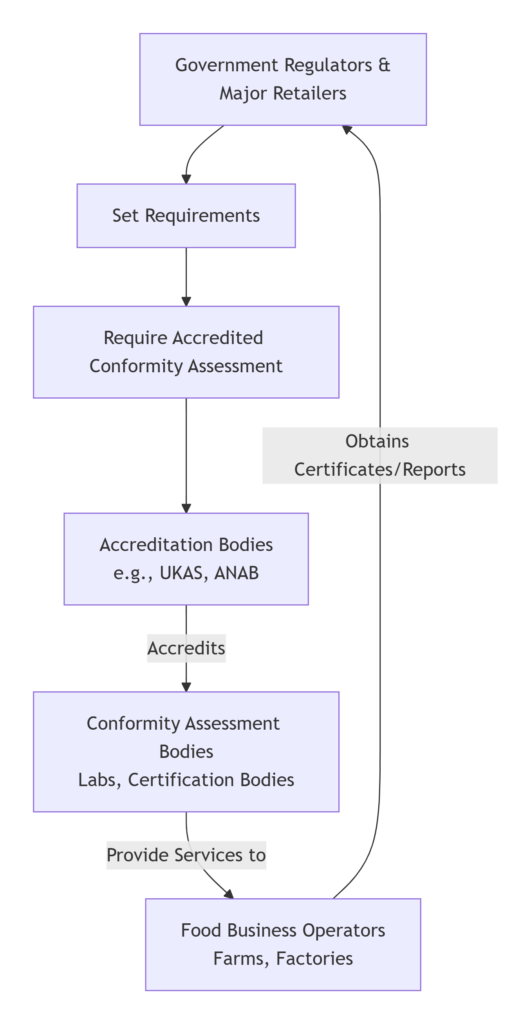
This pyramid ensures trust is built on independent verification.
How the Requirement is Enforced: 5 Key Pathways
1. How Through Legal & Regulatory Mandates
Governments enact laws that reference or mandate accreditation.
- Process: Legislation → Regulation → Reference to International Standards (ISO/IEC 17025, 17065) → Designation of Accredited Bodies.
- Example: EU Regulation 2017/625
- The law states official food controls must be reliable.
- It mandates that labs performing official analysis must operate in accordance with ISO/IEC 17025.
- National authorities (e.g., the UK’s FSA) designate labs that are accredited by the national accreditation body (UKAS).
- Enforcement: A test report from a non-accredited lab is not accepted for legal compliance.
2. How Through Market Access & Private Standards
This is the most powerful commercial “how.” It works via contractual obligation.
- Process: Retailer/Brand Policy → Mandated GFSI Scheme → Requirement for Accredited Certification → Supplier Contract.
- Example: A Walmart Supplier
- Walmart’s Global Food Safety Policy requires suppliers to have a GFSI-benchmarked certificate.
- The supplier chooses FSSC 22000.
- The FSSC 22000 scheme rules state that certificates can only be issued by Certification Bodies accredited by an International Body MLA member (e.g., ANAB).
- The supplier hires an accredited CB, gets audited, and receives a certificate.
- Enforcement: Walmart’s sourcing team checks the certificate’s validity and the CB’s accreditation status via online databases. Non-compliance leads to delisting.
3. How Through Import/Export Control Systems
Accreditation is built into the logistics of international trade.
- Process: Export Requirement → Mandatory Health Certificate/Certificate of Analysis → Issued by Government-Accredited Body → Presented at Border.
- Example: FDA’s FSMA Import Program
- The FDA identifies a high-risk food (e.g., canned tuna from Country X).
- The Foreign Supplier Verification Program (FSVP) requires importers to verify their supplier is compliant.
- One approved method is to use a third-party audit from an FDA-accredited certification body.
- The accreditation body (e.g., ANSI-ASQ National Accreditation Board) accredits the CB to FDA standards.
- Enforcement: Without the accredited audit report, the shipment may be detained at the US port of entry.
4. How Through Specific Product Claim Regulations
Accreditation provides the technical backbone for label claims.
- Process: Legal Definition of a Claim → Accredited Verification System → Use of Seal/Logo.
- Example: USDA Organic
- The USDA’s National Organic Program (NOP) defines the rules.
- Producers must be certified by a USDA-accredited certifying agent.
- Certifiers apply to the USDA and undergo a rigorous accreditation process.
- Enforcement: A farmer using the USDA Organic seal without certification from an accredited agent faces legal penalties for fraud.
5. How Through Risk Management & Liability Protection
Businesses use accreditation to shield themselves from legal and financial risk.
- Process: Risk Assessment → Identify Critical Control Points → Mandate Accredited Testing/Inspection → Create Defensible Record.
- Example: An Allergen-Free Food Manufacturer
- The company declares its facility “peanut-free.”
- To mitigate lawsuit risk, it mandates that all environmental swab testing be done by an ISO 17025-accredited lab.
- It requires its gluten-free claim to be certified by a 17065-accredited CB.
- Enforcement: In a liability case, the court gives greater weight to evidence generated by accredited, independent parties.
The Practical “How-To” for a Food Business
For a food company, here is how you meet the requirement:
- Identify the Demand: Is it a customer requirement (e.g., “We need a BRCGS certificate”) or a legal requirement (e.g., “We need an accredited lab test for these parameters”)?
- Select the Correct Accredited Service Provider:
- For certification: Use the accreditation body’s public database (e.g., UKAS, ANAB, DAkkS websites) to find a CB accredited for the specific standard (e.g., FSSC 22000) in your relevant sector.
- For testing: Select a lab accredited to ISO/IEC 17025 for the specific test methods you need (e.g., HPLC for pesticides, PCR for allergens).
- Verify the Scope of Accreditation: Check the provider’s official accreditation certificate and scope document. A CB may be accredited for fruit canning but not for meat processing. A lab may be accredited for Salmonella testing but not for certain vitamins.
- Undergo the Process: Engage with the provider (audit, testing, inspection).
- Receive & Validate the Output: The certificate or report should display the logo of the Accreditation Body (e.g., UKAS) and a unique accreditation number. Verify this online.
Key Tools That Enable the “How”
- International Body MLA & Global Laboratory Accreditation MRA: International mutual recognition agreements mean accreditation in one country (e.g., by Japan’s IA Japan) is accepted in another (e.g., by the EU). This is how it works globally.
- Public Databases: All reputable accreditation bodies maintain online directories of accredited organizations.
- GFSI Benchmarking: Provides a unified “how-to” guide for which accredited certifications are globally accepted.
The Bottom Line:
Accreditation is required through a cascading system of:
- Legal Incorporation (laws reference accreditation).
- Contractual Obligation (buyer contracts demand it).
- System Integration (standards and schemes mandate it).
- Risk Mitigation (businesses adopt it voluntarily for protection).
The “how” is not a single act but an integrated process where accreditation is the qualifying filter for every critical verification activity in the modern food supply chain. It’s the standardized operating system for global food safety trust.
Case Study on Accreditation For Food
Phase 1: Local Success & Initial Growing Pains
Initial Setup: PureTaste had a state food processing license, followed basic FDA guidelines (FSMA’s Preventive Controls), and sold successfully at farmers’ markets and local co-ops. Their testing was done by a local lab they trusted.
The First Major Requirement:
A regional natural foods distributor, “GreenLife Distributors,” expressed interest but required a food safety certification as part of their vendor agreement.
- PureTaste’s Action: They hired an auditing company that offered a “food safety audit” at a low cost and received a certificate.
- The Problem: When GreenLife’s compliance manager reviewed it, she noted: *”Your certificate is from a certification body not accredited to a GFSI-benchmarked scheme. We require a certificate from an accredited CB. Please obtain SQF or FSSC 22000 certification.”*
The Learning Point: The market’s requirement wasn’t just for any certificate; it was for a specific certificate issued by an accredited body. This was PureTaste’s first encounter with the “how” and “who” of accreditation—the requirement was on their certifier.
Phase 2: Meeting the National Retail Requirement
After achieving modest regional growth, PureTaste aimed for a contract with “FreshMart,” a national supermarket chain. The buyer sent a 50-page supplier qualification packet.
Key Requirements Identified:
- GFSI-benchmarked Food Safety Certification: Mandatory. “Certification body must be accredited by an International Body MLA member (e.g., ANAB).”
- Organic Certification: Mandatory for the product line. “Must be USDA Organic certified by a USDA-accredited certifying agent.”
- Allergen Testing: Annual testing for peanut cross-contact. “Must use an ISO/IEC 17025 accredited laboratory.”
- Product Testing: Nutritional label verification and shelf-life studies.
PureTaste’s Accreditation Journey Map:
| Step | Requirement | PureTaste’s Action | The “Accreditation” Link |
|---|---|---|---|
| 1. Food Safety Cert. | GFSI Certificate (SQF Level 2) | Researched SQF-recognized Certification Bodies (CBs) on the SQFI website. Chose a CB that was ANAB-accredited for SQF audits of nut butters. | The CB’s accreditation (ISO/IEC 17021-1 by ANAB) was the prerequisite for the certificate’s validity. |
| 2. Organic Cert. | USDA Organic Seal | Applied to a USDA-accredited organic certifier (listed on the USDA NOP website). Underwent a farm-to-facility audit. | The certifier’s accreditation by the USDA NOP was mandatory to issue the Organic certificate. |
| 3. Allergen Testing | Peanut Cross-Contact Test | Searched the ANAB website directory for accredited labs. Selected a lab whose ISO 17025 scope included “peanut detection via ELISA in environmental samples.” | The lab’s accreditation ensured the test results would be accepted by FreshMart and be legally defensible. |
| 4. Nutritional Testing | Label Claim Verification | Used the same ANAB-accredited lab, confirming its scope included FDA-compliant nutritional analysis. | Accreditation ensured the nutritional panel was accurate for FDA compliance. |
Cost & Time Impact:
- Cost Increase: The accredited SQF audit cost 3x more than their initial non-accredited audit. Accredited lab testing was 2x more expensive.
- Time Investment: The entire process from gap assessment to certificate took 9 months.
- ROI: The contract with FreshMart led to a 400% increase in monthly sales volume.
Phase 3: The Export Ambition – A Regulatory Hurdle
With national success, PureTaste explored exporting to Canada and the European Union.
The Canadian Challenge (Safe Food for Canadians Regulations):
- Requirement: To obtain a license to export, PureTaste needed a Preventive Control Plan (PCP) that could be verified by a recognized body.
- Solution: Their existing SQF certification, issued by an accredited CB, was recognized by the Canadian Food Inspection Agency (CFIA). This served as their PCP. The accreditation of their CB facilitated trade reciprocity.
The European Union Challenge (Stricter Limits & Fraud Prevention):
- Requirement 1: EU maximum levels for aflatoxins in nuts are stricter than the US’s. A certificate of analysis (CoA) was required for each shipment.
- Action: PureTaste had to switch to a lab whose ISO 17025 accreditation was specifically recognized under EU Regulation 2017/625 for official aflatoxin testing methods. Their previous lab’s accreditation did not cover this specific EU method.
- Requirement 2: The EU has high vigilance for food fraud (e.g., almond butter adulterated with peanut).
- Action: They implemented annual authenticity testing using DNA-based methods at a lab accredited for that technique.
Crisis Averted: A Mock Recall & Root-Cause Analysis
During a routine supplier review, a customer flagged that PureTaste’s almond supplier was also processing peanuts. This triggered a mock recall and deep review.
- Accreditation’s Role in the Crisis:
- Their accredited SQF system mandated a robust traceability exercise, which they executed successfully.
- They commissioned environmental swabbing from their accredited lab. The results (negative for peanut) were trusted by both the customer and regulatory officials who were notified.
- The accredited certification body provided a competent auditor who helped review and strengthen their allergen control plan during the next surveillance audit.
The outcome: The customer’s concerns were alleviated, and no market withdrawal was necessary. The accredited data and systems provided an unassailable defense.
Summary & Key Takeaways
| Challenge | Required Accreditation Solution | Outcome for PureTaste |
|---|---|---|
| Entering National Retail | GFSI cert. from ANAB-accredited CB & USDA-accredited organic certifier. | Won the FreshMart contract, 400% sales growth. |
| Exporting to Canada | SQF cert. from International Body MLA-accredited CB was recognized by CFIA. | Streamlined export license, entered new market. |
| Meeting EU Import Rules | Lab accredited to specific EU methods for aflatoxins and authenticity. | Complied with strict EU regulations, avoided border rejections. |
| Managing an Allergen Scare | Accredited lab results and audits from accredited CB provided trusted evidence. | Maintained customer trust, avoided a costly recall. |
Final Business Lessons from the Case Study:
- Accreditation is a Market Access Currency: It is not an optional cost but a prerequisite investment for growth beyond local sales.
- It’s a System, Not a Certificate: Accreditation connects accredited certifiers → credible certificates → market access and accredited labs → defensible data → regulatory compliance.
- Scope Matters: Not all accreditations are equal. Checking the specific scope (product category, test method, standard) of your service provider is critical.
- Risk Mitigation: In a crisis, the credibility conferred by accreditation protects your brand and provides legal defensibility.
- Global Language: Accreditation (via International Body/Global Laboratory Accreditation agreements) translates your local compliance into a globally understood language of trust, essential for export.
For PureTaste, navigating the “who, what, when, where, and how” of accreditation was the defining journey from a small local brand to a resilient, nationally-recognized, export-ready food business.
White paper on Accreditation For Food
Executive Summary
The global food system faces unprecedented challenges: escalating safety incidents, sophisticated fraud, complex supply chains, and eroding consumer trust. In this landscape, self-declaration of compliance is insufficient. Accreditation has emerged as the indispensable, system-level mechanism for verifying safety, quality, and authenticity claims. This white paper demonstrates that accreditation is not merely a technical procedure for laboratories but the fundamental architecture of trust upon which modern food trade depends. It outlines the multi-layered accreditation ecosystem, its economic and public health imperative, and a clear roadmap for stakeholders to leverage accreditation for competitive advantage and systemic resilience.
Core Finding: Accreditation is the critical “trust multiplier” that transforms subjective claims into objective, globally accepted assurances, enabling safer food, freer trade, and more robust brands.
1. Introduction: The Trust Deficit in the Food Chain
Today’s food supply chain is a global network. A single ready-to-eat meal may contain ingredients from five continents, processed in multiple facilities, and sold through interconnected digital and physical channels. This complexity creates vulnerabilities:
- Opacity: Buyers cannot physically inspect every source.
- Divergent Standards: Varying national regulations create trade barriers.
- Fraud Opportunity: Economically motivated adulteration is a $40+ billion annual problem.
- Crisis Amplification: A single failure can trigger global recalls and devastating brand damage.
In this environment, how can a retailer in Europe trust a spice processor in Asia? How can a consumer believe an “organic” or “allergen-free” claim? The answer lies in a robust, independent, and internationally recognized conformity assessment system, the credibility of which is secured by accreditation.
2. Defining the Ecosystem: Accreditation vs. Certification
A critical and often misunderstood distinction must be made:
- Certification: The process by which a food business (the certified) is audited against a standard (e.g., FSSC 22000, Organic) and receives a certificate of conformity. This is performed by a Certification Body (CB).
- Accreditation: The formal, third-party recognition by an authoritative Accreditation Body (e.g., UKAS, ANAB) that a Conformity Assessment Body (CAB)—such as a Certification Body, Testing Laboratory, or Inspection Body—is competent, impartial, and operates according to international standards.
Analogy: Think of accreditation as the licensing board for auditors and testers. A food safety certificate is like a driver’s license. The accreditation of the CB is the verification that the licensing authority (the DMV) itself operates properly and reliably. Accreditation is the assurance of the assurer.
3. The Multi-Layered Value Proposition of Accreditation
A. For Governments & Regulators
- Risk-Based Oversight: Delegates technical verification to competent accredited bodies, allowing regulators to focus on high-risk targets and outbreak response.
- Trade Facilitation: Implements the WTO’s Technical Barriers to Trade (TBT) principles. Mutual Recognition Arrangements (MRAs) between national accreditation bodies mean “accredited once, accepted everywhere,” reducing duplicate audits and technical barriers.
- Enhanced Enforcement: Provides legally defensible evidence from accredited labs for litigation and compliance actions.
B. For Retailers, Brands & Food Service
- Supply Chain Risk Management: Accreditation provides a reliable filter for supplier qualification, reducing the risk of recalls and liability.
- Brand Protection: Mitigates reputational damage by ensuring supply chain claims are independently verified.
- Cost Efficiency: Standardizes requirements (e.g., GFSI), reducing the cost and complexity of managing thousands of supplier audits.
C. For Food Producers & Manufacturers
- Market Access Passport: An accredited certificate (e.g., BRCGS from a UKAS-accredited CB) is a non-negotiable ticket to supply major global markets.
- Operational Improvement: The rigor of an accredited audit drives internal process improvement and waste reduction.
- Trust Capital: Serves as a powerful marketing and branding tool with business customers and informed consumers.
D. For Consumers
- Confidence: Provides an invisible yet crucial layer of assurance that food safety and label claims are objectively verified.
- Public Health: Underpins the systems that prevent foodborne illness and ensure nutritional integrity.
4. The Technical Pillars: Key Accreditation Standards
The system is built on internationally harmonized ISO/IEC standards:
| Standard | Applies To | Purpose in Food System |
|---|---|---|
| ISO/IEC 17025 | Testing & Calibration Laboratories | Ensures the reliability of analytical results for pathogens, chemicals, allergens, nutrition, and authenticity. The cornerstone of scientific evidence. |
| ISO/IEC 17065 | Product Certification Bodies | Specifies requirements for certifying products (Organic, Gluten-Free, Non-GMO, Geographical Indications). |
| ISO/IEC 17021-1 | Management System Certification Bodies | Specifies requirements for auditing and certifying management systems (FSSC 22000, ISO 22000, ISO 9001). |
| ISO/IEC 17020 | Inspection Bodies | Ensures the competence of bodies inspecting facilities, processes, or goods (e.g., livestock, cargo, hygiene). |
| ISO/IEC 17029 | Validation & Verification Bodies | For assessing sustainability and environmental claims. |
5. The Global Infrastructure: International Body and Global Laboratory Accreditation
Accreditation’s global power is coordinated by two non-governmental organizations:
- International Body: Develops rules for accreditation of management systems, products, and services. Its Multilateral Recognition Arrangement (MLA) means a certificate from a CB accredited by an International Body MLA signatory (e.g., ANAB in the US) is recognized by all other signatory countries (e.g., UKAS in the UK).
- Global Laboratory Accreditation: Performs the same function for laboratory accreditation via its Mutual Recognition Arrangement (MRA).
This global network is the technical backbone of international trade, ensuring that conformity assessment results are accepted across borders.
6. Current Challenges & Evolving Frontiers
- Cost & Accessibility for SMEs: The cost of accredited certification and testing can be prohibitive for small producers. Solution: Development of scalable, risk-proportional certification options and government support programs.
- Digital Transformation: The rise of blockchain, IoT sensors, and AI in food traceability. Opportunity: Accreditation must evolve to cover digital verification and data integrity services.
- Sustainability & Integrated Assurance: Consumers demand proof of ethical and environmental claims. Evolution: Accreditation of schemes like SSCI (Sustainable Supply Chain Initiative) using ISO/IEC 17029, and integrated audits combining food safety with environmental and social standards.
- Fraud Detection & Forensic Testing: As adulteration methods grow sophisticated, accreditation ensures the competence of labs using cutting-edge techniques like genomics and isotope analysis.
7. Strategic Recommendations
For Policymakers:
- Explicitly reference accredited conformity assessment in food safety regulations.
- Support capacity building for national accreditation bodies in developing economies.
- Fund programs to help SMEs access accredited certification.
For Industry Leaders:
- Mandate GFSI-benchmarked certification from accredited CBs in all supplier contracts.
- Specify ISO/IEC 17025 accredited laboratories for all compliance and claim-substantiating testing.
- Invest in integrated management systems that can be efficiently audited by accredited bodies.
For Food Businesses:
- View accreditation not as a cost, but as a strategic investment in market access and brand equity.
- Verify the accreditation status and scope of all service providers (certifiers, labs).
- Use your accredited certification as a core element of your brand storytelling.
8. Conclusion
The future of food safety, trade, and consumer confidence is inextricably linked to the strength and reach of the accreditation ecosystem. It is the critical infrastructure of trust that makes the complex, globalized food system function. By ensuring that every critical verification step—from lab tests to facility audits—is performed by competent, impartial, and internationally recognized bodies, accreditation transforms uncertainty into reliable assurance.
As supply chains grow more complex and consumer demands more stringent, the role of accreditation will only expand. Building a more transparent, safe, and resilient food system requires a steadfast commitment to strengthening this vital, though often unseen, pillar of modern food governance.
Appendices:
- Appendix A: Glossary of Key Terms
- Appendix B: Directory of Major National Accreditation Bodies
- Appendix C: Flowchart of the Accreditation-to-Certification Process
Industrial Application of Accreditation For Food
Executive Summary
Accreditation in the food industry is not a theoretical concept but a practical operational framework that enables global trade, ensures regulatory compliance, and manages brand risk. This document details how accreditation is applied across industrial food operations, transforming abstract standards into concrete business processes that deliver measurable value.
1. Supply Chain Management & Procurement
Application: Supplier Qualification Systems
Industrial Challenge: A multinational manufacturer (e.g., Nestlé, Unilever) manages 10,000+ ingredient suppliers globally. Qualifying each manually is impossible.
Accreditation Application:
- Digital Vendor Portals require suppliers to upload certificates from accredited Certification Bodies.
- Automated Validation Systems cross-check certificate numbers against accreditation body databases (e.g., UKAS, ANAB) in real-time.
- Risk Scoring Algorithms weigh the scope of the CB’s accreditation—a CB accredited for dairy but auditing a spice supplier raises flags.
Industrial Outcome: 85% reduction in supplier audit duplication; 40% faster onboarding; centralized risk dashboard.
Case Example: Global Ingredient Conglomerate
Problem: Inconsistent quality of vanilla extract from 12 global suppliers.
Solution: Mandated ISO/IEC 17025 accredited testing for key purity markers (vanillin, coumarin) at all points of receipt.
Result: Rejected 3 adulterated shipments in first quarter; saved $2.3M in potential rework costs.
2. Manufacturing & Processing Operations
Application 1: Continuous Monitoring Systems
Industrial Implementation:
- In-line sensors (pH, temperature, moisture) require calibration traceable to accredited calibration laboratories (ISO/IEC 17025).
- Environmental monitoring programs for pathogens use accredited labs for swab analysis, with results feeding into statistical process control (SPC) systems.
- Allergen control validation requires accredited method validation for detection limits.
Plant-Level Workflow:
text
Day 1: Environmental swab taken → Shipped to accredited lab
Day 2: Lab conducts analysis (ISO 17025 method)
Day 3: Results in plant's LIMS → Auto-alert if positive
Day 4: Corrective action initiated with accredited CB oversight
Application 2: Equipment & Facility Qualification
- Third-party hygiene inspection bodies (accredited to ISO/IEC 17020) validate cleaning protocols.
- Process authority validation for thermal processing requires accredited testing lab data for pathogen lethality studies.
- Water system validation uses accredited microbiology labs for Legionella testing.
3. Quality Control Laboratories
The Industrial Laboratory Hierarchy:
text
Tier 1: Central R&D Lab (ISO/IEC 17025 Accredited)
       ↓
Tier 2: Regional QC Labs (ISO/IEC 17025 Accredited)
       ↓
Tier 3: Plant Floor Labs (Rapid tests, not accredited)
Accreditation Application in Practice:
| Test Type | Accreditation Requirement | Industrial Consequence |
|---|---|---|
| Release Testing (Pathogens, contaminants) | Mandatory – Lab must be accredited | Product cannot be shipped without accredited lab results |
| In-Process Testing (pH, brix, moisture) | Not required – Internal control only | Real-time process adjustment possible |
| Shelf-Life Studies | Required for label claims | Accredited data supports “best before” dates legally |
| Supplier COA Verification | Required for high-risk ingredients | 10% of supplier COAs verified by accredited lab |
Industrial Reality: A large dairy processor spends $500K annually on accredited testing but avoids potential $50M recall costs.
4. Logistics & Distribution
Cold Chain Management Application:
- Temperature mapping studies of containers and warehouses conducted by ISO/IEC 17020 accredited inspection bodies.
- Calibration of data loggers traceable to accredited calibration labs.
- Third-party logistics (3PL) certification to FSSC 22000 through accredited CBs becoming a market differentiator.
Real-World Implementation:
A pharmaceutical-grade food transporter uses:
- Accredited CB for BRCGS Storage & Distribution certification
- Accredited inspection body for container pre-shipment inspections
- Accredited calibration lab for all temperature monitoring devices
Result: 99.98% temperature compliance; premium service pricing.
5. New Product Development
Accreditation in the Stage-Gate Process:
text
Stage 2: Concept
        ↓
        Accredited lab feasibility testing (shelf-life, stability)
        ↓
Stage 3: Development
        ↓
        Accredited method development for nutritional analysis
        ↓
Stage 4: Validation
        ↓
        Accredited CB pre-audit of manufacturing process
        ↓
Stage 5: Launch
        ↓
        Full accredited certification achieved
Industrial Benefit: Reduced time-to-market by eliminating rework due to non-compliant test data.
6. Regulatory Affairs & Compliance
Global Market Access Matrix:
A multinational snack company maintains this compliance matrix:
| Market | Required Certificate | Accredited CB Requirement | Testing Lab Requirement |
|---|---|---|---|
| USA | FSSC 22000 | ANAB-accredited CB | ISO 17025 for FDA-reportable tests |
| EU | BRCGS | UKAS-accredited CB | ISO 17025 (EU-recognized) |
| Japan | JFS | JAB-accredited CB | ISO 17025 lab in Japan |
| China | GB standards | CNAS-accredited CB | Local Chinese accredited lab |
Industrial Application: Central database tracks all certificates, accreditation status, and renewal dates with auto-alerts.
7. Crisis Management & Recall Systems
The Accredited Crisis Response Protocol:
text
Step 1: Incident Detection
        ↓
Step 2: Accredited lab confirmatory testing (ISO 17025)
        ↓
Step 3: Accredited CB notified for system review
        ↓
Step 4: Root cause investigation using accredited data
        ↓
Step 5: Corrective action validated by accredited testing
        ↓
Step 6: Regulatory reporting with accredited evidence
Industrial Case: A suspected Salmonella outbreak:
- Without accreditation: Plant shutdown for 30+ days during investigation
- With accreditation: Accredited lab results accepted by regulators in 72 hours; limited 5-day shutdown
8. Sustainability & Ethical Sourcing
Integrated Assurance Systems:
Modern food plants implement “one-stop” audits combining:
- Food Safety (FSSC 22000 via accredited CB)
- Quality (ISO 9001 via accredited CB)
- Environmental (ISO 14001 via accredited CB)
- Social Responsibility (SA8000 via accredited CB)
Industrial Efficiency: Reduced from 12 separate audits annually to 4 integrated audits, saving 300+ man-hours.
Quantitative Business Impact
ROI Analysis for a $500M Revenue Food Manufacturer:
| Investment Area | Annual Cost | Business Impact |
|---|---|---|
| Accredited CB audits | $150,000 | Market access to $200M in new business |
| Accredited lab testing | $300,000 | Avoided $5M in potential recall costs |
| Staff training for accredited systems | $75,000 | 30% reduction in non-conformities |
| Total | $525,000 | ROI: 950%+ |
Implementation Roadmap for Industrial Operations
Phase 1: Assessment (Months 1-3)
- Map current state vs. accreditation requirements
- Gap analysis of labs, certifiers, and internal systems
- Prioritize based on customer/regulatory demands
Phase 2: Foundation (Months 4-6)
- Select accredited service providers from official databases
- Implement document control for accreditation certificates
- Train quality team on accreditation requirements
Phase 3: Integration (Months 7-12)
- Integrate accredited data into QMS software
- Automate validation of supplier certificates
- Implement KPI dashboard for accreditation compliance
Phase 4: Optimization (Ongoing)
- Leverage accreditation for premium market positioning
- Use accredited data for predictive analytics
- Expand scope to sustainability and digital assurance
Future Industrial Trends
- Digital Accreditation: Real-time verification of certificates via blockchain
- Remote Auditing: Accredited virtual inspections using IoT sensor data
- Predictive Analytics: Accredited lab data feeding AI for preventive quality control
- Circular Economy: Accreditation for upcycled ingredients and packaging
Conclusion
In industrial food operations, accreditation has evolved from a compliance exercise to a strategic operational framework. It provides the standardized language for global supply chains, the defensible data for risk management, and the trust infrastructure for brand protection. The most sophisticated food companies no longer ask “if” they need accreditation but “how broadly” they can apply it to drive efficiency, resilience, and competitive advantage.

Table of Contents