
Testing Laboratories
ISO/IEC 17025:latest – Standard Is For The Most Part Utilized By Testing And Calibration Laboratories. At First Known As ISO/IEC 17025 Includes Skill Prerequisites And It Applies Straightforwardly To Those Associations That Produce Testing Results/endorsements.
SDAB Certification Is Accessible For The Following Classifications:
Acoustic Estimation, Ballistic Estimation, Fire Testing, Aspect Estimation, Testing Of Electronic Hardware/item, Testing Of Electromagnetic Compatibility(EMC), Synthetic Material’s Testing Geology, Testing Of Individual Security and Assurance Types of gear, Non Destructive Testing (NDT), Information Technology (IT), Chemical Testing, Erosion Testing, Actual Material’s Testing, Metallurgical Testing, Microbiological Testing, Assessment Of The Environments Influence On Products & Equipments, Behaviour, Tangible Investigation, Security, Scientific categorization, Ionizing Radiations and Radio Action, Atomic Science, Genetic Modified Organisms (GMO), Biology, Veterinary Medication, Bio-Banks And Forensic Examinations.
SDAB Certification Is Accessible For The Following Classifications:
• ISO/IEC 17025:latest – General Necessities For The Capability Of Testing And Calibration Laboratories.
• Shown Specialized Capability Well defined for The Field In Which Testing Is Performed.
• Applicable SDAB Accreditation Necessities.
Comprehensive Guide to SDAB Accreditation Under ISO/IEC 17025:Latest
Executive Summary
ISO/IEC 17025:latest represents the gold standard for testing and calibration laboratories worldwide, establishing rigorous requirements for technical competence and reliable operation. The Standardization and Development Accreditation Board (SDAB) certification provides formal recognition that laboratories meet these international requirements across diverse scientific and technical fields. This comprehensive guide explores the implementation, requirements, and significance of SDAB accreditation for laboratories seeking to demonstrate their technical competence and produce valid results in today’s competitive global marketplace.
Introduction to ISO/IEC 17025: Evolution and Significance
Historical Development
ISO/IEC 17025 was first published in 1999, evolving from the ISO/IEC Guide 25 and EN 45001 standards. The standard has undergone significant revisions, with the 2017 version (currently the latest) representing a major restructuring to align with contemporary quality management principles. Originally developed to harmonize laboratory competence requirements globally, the standard has become the cornerstone of laboratory accreditation systems worldwide.
The “latest” designation refers to the 2017 edition, which introduced a stronger focus on risk-based thinking, greater flexibility in processes, and enhanced emphasis on information technology systems. This evolution reflects the changing landscape of testing and calibration, where technological advancements and globalization have increased demands for reliable, internationally recognized results.
Global Impact and Recognition
ISO/IEC 17025 accreditation has become a prerequisite for laboratories operating in regulated industries and international trade. The standard is recognized through international agreements such as the International Laboratory Accreditation Cooperation (ILAC) Mutual Recognition Arrangement (MRA), which facilitates acceptance of test results across borders. This global recognition eliminates the need for retesting in importing countries, reducing costs and time for international trade.
For laboratories, accreditation provides numerous benefits:
- Enhanced credibility and recognition of test results
- Competitive advantage in procurement processes
- Reduced liability through demonstrated competence
- Improved operational efficiency and reliability
- Access to regulated markets requiring accredited testing
- Foundation for continual improvement
SDAB Accreditation Framework
Organizational Structure and Governance
The Standardization and Development Accreditation Board operates as an independent accreditation body that assesses laboratories against ISO/IEC 17025 requirements. SDAB’s governance structure typically includes:
- A board of directors representing stakeholders from industry, government, and academia
- Technical committees for different testing disciplines
- Assessment teams comprising technical experts and lead assessors
- An appeals process for contested decisions
SDAB maintains its own competence through regular peer evaluations by regional and international accreditation cooperations, ensuring its assessments remain credible and internationally recognized.
Accreditation Process
The SDAB accreditation process follows a systematic approach:
- Application and Document Review: Laboratories submit quality manuals, procedures, and technical documentation for preliminary review.
- Pre-assessment (Optional): An informal gap analysis identifies areas requiring improvement before formal assessment.
- Initial Assessment: A comprehensive on-site evaluation covering management systems and technical competence.
- Proficiency Testing: Verification of technical capability through interlaboratory comparisons or proficiency testing schemes.
- Corrective Actions: Addressing non-conformities identified during assessment.
- Accreditation Decision: SDAB’s committee reviews assessment findings and makes accreditation decisions.
- Surveillance Assessments: Regular monitoring visits (typically annual) to ensure continued compliance.
- Re-assessment: Comprehensive re-evaluation every four to five years to maintain accreditation.
Detailed Analysis of ISO/IEC 17025:2017 Requirements
Structural Framework
The 2017 revision of ISO/IEC 17025 introduced a new structure aligned with other ISO management system standards, comprising:
- Scope – Defines applicability to organizations performing laboratory activities
- Normative References – Lists referenced standards
- Terms and Definitions – Clarifies terminology
- General Requirements – Impartiality and confidentiality
- Structural Requirements – Laboratory organization and management
- Resource Requirements – Personnel, facilities, equipment, and systems
- Process Requirements – Review of requests, methods, sampling, and reporting
- Management System Requirements – Options for implementation
Critical Requirements Breakdown
Impartiality and Confidentiality (Clause 4)
Laboratories must demonstrate structural and operational impartiality, identifying and mitigating risks to objectivity. This includes:
- Implementing conflict of interest policies
- Ensuring activities are not influenced by commercial, financial, or other pressures
- Protecting client confidentiality at all operational levels
- Documenting confidentiality agreements with personnel
Structural Requirements (Clause 5)
The laboratory must be a legal entity or part of a legal entity with defined responsibilities and authorities. Management must:
- Define the organization’s structure and reporting lines
- Ensure adequate supervision of testing activities
- Implement policies to prevent improper influence on results
- Communicate the importance of meeting standards and customer requirements
Resource Requirements (Clause 6)
Personnel: Laboratories must define competence requirements for each function, provide training, monitor performance, and authorize personnel for specific tasks. Competence must be demonstrated through education, training, experience, and demonstrated skills.
Facilities and Environmental Conditions: Testing environments must not adversely affect results. Requirements include monitoring, controlling, and documenting environmental conditions, implementing access control, and separating incompatible activities.
Equipment: Laboratories must have equipment capable of achieving required measurement accuracy. This includes calibration programs, unique identification, protection from adjustment, and procedures for handling defects.
Metrological Traceability: Measurements must be traceable to the International System of Units (SI) through an unbroken chain of calibrations. Laboratories must select appropriate calibration services and verify measurement uncertainty.
Externally Provided Products and Services: Procedures must ensure purchased materials and services conform to requirements, including evaluation of suppliers and verification of received items.
Process Requirements (Clause 7)
Review of Requests, Tenders, and Contracts: Laboratories must ensure requirements are adequately defined, documented, understood, and within their capability before commencing work.
Selection, Verification, and Validation of Methods: Laboratories must use appropriate test methods validated for their intended use. This includes documented procedures, method validation to confirm fitness for purpose, and estimation of measurement uncertainty.
Sampling: When laboratories perform sampling, they must have plans and procedures addressing factors affecting sample integrity. Samples must be uniquely identified and tracked throughout testing.
Handling of Test Items: Procedures must protect test items from deterioration, damage, or loss during handling, storage, and preparation.
Technical Records: Laboratories must maintain records of all original observations, calculations, and data, including sufficient information to repeat the test under as near as possible original conditions.
Evaluation of Measurement Uncertainty: Laboratories must identify contributions to measurement uncertainty and evaluate it for all calibrations and most tests. Uncertainty must be reported with results when relevant.
Ensuring Validity of Results: Laboratories must monitor validity of results through quality control activities such as use of reference materials, replicate testing, and participation in proficiency testing.
Reporting of Results: Test reports must be accurate, clear, unambiguous, and objective, including all information necessary for interpretation and traceability. Reports must indicate compliance with specific methods and identify the laboratory.
Complaints: Laboratories must have procedures for receiving, evaluating, and resolving complaints, including investigation of underlying causes.
Nonconforming Work: Procedures must identify and control nonconforming work, including notification to clients and authorization of resumption.
Control of Data and Information Management: Laboratories must ensure integrity and confidentiality of data in both electronic and paper formats, including protection from loss and unauthorized access.
Management System Options (Clause 8)
Laboratories can implement management system requirements through either:
- Option A: Addressing all requirements directly in their management system
- Option B: Establishing and maintaining a management system conforming to ISO 9001, with supplementary documentation addressing ISO/IEC 17025-specific requirements
The standard emphasizes a process approach and risk-based thinking, requiring laboratories to identify risks and opportunities and plan actions to address them.
Technical Competence Requirements for Specific Fields
Acoustic Estimation
Laboratories conducting acoustic testing must demonstrate competence in sound pressure level measurements, frequency analysis, reverberation time determination, and sound insulation testing. Special requirements include anechoic and reverberation chambers, calibrated sound level meters, and personnel trained in psychoacoustics where applicable. Measurement uncertainty must account for environmental factors, instrument limitations, and methodological constraints.
Ballistic Estimation
Ballistic testing laboratories require specialized facilities including secure test ranges, high-speed imaging equipment, and witness materials. Competence requirements include knowledge of terminal ballistics, penetration mechanics, and fragment analysis. Safety protocols must address explosive hazards, and measurement traceability must be established for velocity, pressure, and energy measurements.
Fire Testing
Fire testing laboratories need controlled burn facilities, calorimeters, and specialized instrumentation for heat release, smoke production, and flame spread measurements. Personnel must understand fire dynamics, material flammability, and relevant standards (e.g., ISO 5660, ASTM E84). Quality control includes regular verification using reference materials and participation in interlaboratory comparisons for critical parameters.
Dimensional Measurement
Dimensional metrology laboratories require temperature-controlled environments, calibrated reference standards (gauge blocks, ring gauges, etc.), and appropriate measuring instruments (CMMs, optical comparators, surface roughness testers). Measurement uncertainty budgets must consider thermal expansion, instrument resolution, and operator skill. Laboratories must maintain proficiency in geometric dimensioning and tolerancing principles.
Electronic Hardware/Product Testing
Competence requirements include knowledge of circuit theory, electromagnetic theory, and digital systems. Laboratories need appropriate signal generators, analyzers, oscilloscopes, and environmental chambers. Method validation must address frequency response, distortion, sensitivity, and stability measurements. ESD control and cleanroom facilities may be required for certain tests.
Electromagnetic Compatibility (EMC) Testing
EMC laboratories require shielded rooms, anechoic chambers, and specialized equipment for emissions and immunity testing. Personnel must understand electromagnetic theory, regulatory requirements, and test methodologies. Accreditation requires demonstration of site attenuation characteristics and validation of test setups. Uncertainty contributions include antenna factors, cable losses, and instrumentation errors.
Chemical Materials Testing
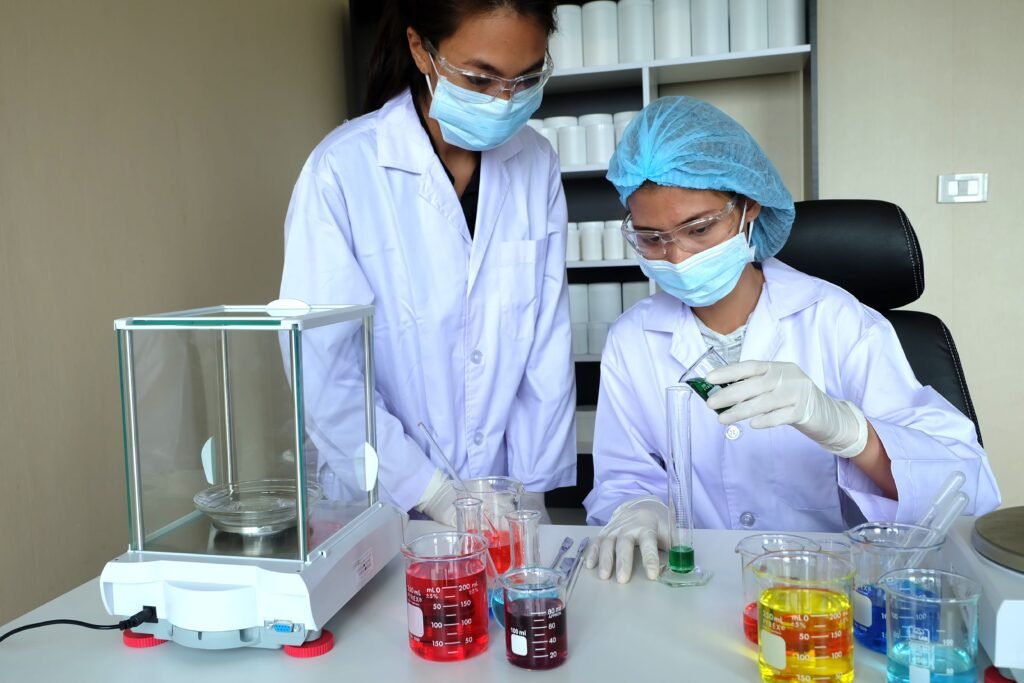
Chemical testing laboratories must address a wide range of techniques including chromatography, spectroscopy, titration, and physical property testing. Requirements include appropriate separation of incompatible activities, validated analytical methods, and control of reference materials. Personnel qualifications must include theoretical knowledge and practical skills specific to each technique. Measurement uncertainty must account for sample heterogeneity, extraction efficiency, and calibration curve fitting.
Geology Testing
Geological testing encompasses mineralogy, petrology, geochemistry, and geotechnical properties. Laboratories require specialized equipment such as X-ray diffractometers, electron microscopes, and triaxial testing apparatus. Competence includes sample preparation techniques, interpretation of geological formations, and understanding of weathering processes. Quality control involves use of certified reference materials and participation in proficiency testing schemes specific to geological matrices.
Personal Security and Protection Equipment Testing
Testing of PPE requires specialized facilities for impact resistance, penetration testing, and environmental conditioning. Laboratories must understand human factors, ergonomics, and relevant performance standards. Equipment calibration includes force measurement systems, headforms, and impact test apparatus. Validation must address realistic use conditions and worst-case scenarios.
Non-Destructive Testing (NDT)
NDT laboratories require certification of personnel to recognized schemes (e.g., ISO 9712, ASNT). Methods include ultrasonic, radiographic, magnetic particle, liquid penetrant, and visual testing. Equipment calibration must be specific to each technique, and reference standards must represent relevant defect types. Procedures must address technique selection, sensitivity determination, and interpretation criteria.
Information Technology (IT) Testing
IT testing laboratories evaluate hardware reliability, software functionality, security vulnerabilities, and performance metrics. Requirements include controlled test environments, standardized test suites, and expertise in specific technologies. Accreditation addresses test method validation, data integrity, and reporting of security findings. Uncertainty may relate to system configurations, test data characteristics, and environmental conditions.
Corrosion Testing
Corrosion laboratories conduct accelerated tests (salt spray, humidity, cyclic corrosion) and electrochemical measurements. Requirements include controlled environments, calibrated sensors, and standardized specimen preparation. Personnel must understand corrosion mechanisms, metallurgy, and protective coating systems. Method validation must correlate accelerated tests with real-world performance.
Physical Materials Testing
This category includes mechanical properties (tensile, compression, hardness, fatigue), thermal properties, and rheological measurements. Laboratories require calibrated universal testing machines, environmental chambers, and specialized fixtures. Measurement uncertainty must consider specimen alignment, strain measurement, and test machine characteristics. Personnel qualifications include understanding of material science and deformation mechanisms.
Metallurgical Testing
Metallurgical testing encompasses composition analysis, microstructure examination, phase identification, and heat treatment evaluation. Laboratories require sample preparation equipment, microscopes, and spectroscopic instruments. Competence includes interpretation of microstructures, understanding of phase diagrams, and knowledge of metal forming processes. Reference materials must represent appropriate alloys and heat treatment conditions.
Microbiological Testing
Microbiological laboratories require controlled environments, aseptic techniques, and validated methods for enumeration, identification, and characterization of microorganisms. Biosafety levels must match organism hazards. Personnel qualifications include microbiology education and sterile technique proficiency. Quality control involves reference strains, media checks, and incubation condition monitoring.
Environmental Influence on Products & Equipment
Testing includes climatic conditions (temperature, humidity, altitude), mechanical stresses (vibration, shock), and combined environments. Laboratories require chambers capable of controlled conditions and monitoring systems. Test methods must simulate realistic conditions while being reproducible. Uncertainty contributions include spatial gradients, control system stability, and sensor calibration.
Behavioral and Sensory Investigation
These laboratories conduct human subject testing requiring ethical review processes and statistical expertise. Facilities must control environmental factors that influence perception or behavior. Methods must be validated for reliability and relevance. Personnel qualifications include experimental design, data analysis, and understanding of psychological or sensory mechanisms.
Security Testing
Security testing includes physical security (locks, barriers, access controls) and cybersecurity assessments. Laboratories require specialized tools and controlled environments. Personnel must maintain current knowledge of threats and countermeasures. Accreditation addresses ethical testing practices, data protection, and reporting of vulnerabilities.
Taxonomy and Classification
Taxonomic laboratories require reference collections, specialized identification keys, and often molecular biology capabilities. Personnel qualifications include systematic training and specific taxonomic expertise. Methods must be validated for accuracy against authoritative references. Quality control involves verification by independent experts and maintenance of voucher specimens.
Ionizing Radiation and Radioactivity Measurements
Radiation testing laboratories require licensed facilities, calibrated detectors, and contamination controls. Personnel must be trained in radiation safety and measurement techniques. Methods must be validated for specific radionuclides and matrices. Proficiency testing is essential given the potential consequences of measurement errors.
Nuclear Science
Nuclear testing includes reactor materials, fuel performance, and radiation effects. Laboratories require specialized facilities, remote handling equipment, and high-purity detectors. Personnel must understand nuclear physics, radiation damage mechanisms, and safety protocols. Accreditation addresses unique requirements for handling radioactive materials and interpreting complex phenomena.
Genetic Modified Organisms (GMO) Testing
GMO testing laboratories require containment facilities for certain activities, validated PCR methods, and reference materials. Personnel must understand molecular biology, gene expression, and regulatory frameworks. Method validation must address specificity, sensitivity, and quantification limits. Quality control includes positive controls, negative controls, and inhibition checks.
Biology and Veterinary Medicine
Biological testing includes histopathology, clinical chemistry, hematology, and molecular diagnostics. Veterinary testing adds species-specific considerations. Laboratories require appropriate facilities for handling biological specimens, validated methods for each species/matrix, and qualified pathologists or clinical scientists. Accreditation addresses pre-analytical, analytical, and post-analytical phases of testing.
Bio-Banks
Bio-banking accreditation focuses on sample integrity, traceability, and ethical compliance. Requirements include temperature monitoring systems, validated preservation methods, and information management systems. Personnel must be trained in specific handling techniques and regulatory requirements. Quality control involves stability studies, sample homogeneity assessments, and information system validation.
Forensic Examinations
Forensic laboratories require chain of custody procedures, validated methods for trace evidence, and personnel with expertise in legal testimony. Facilities must separate different evidence types to prevent contamination. Methods must be validated for forensic applications, addressing issues of mixture interpretation and low-template analysis. Accreditation includes specific requirements for testimony and reporting to legal standards.
Implementation Strategy for Laboratories
Gap Analysis and Readiness Assessment
Before pursuing accreditation, laboratories should conduct a comprehensive gap analysis comparing current practices against ISO/IEC 17025 requirements. This assessment should address:
- Management system documentation and implementation
- Technical competence for each test method
- Facility and equipment suitability
- Personnel qualifications and training
- Existing quality control procedures
- Record-keeping practices
The gap analysis should prioritize improvements based on impact on accreditation and resource requirements.
Documentation Development
ISO/IEC 17025 requires a structured documentation system including:
Quality Manual: Top-level document describing the management system and its implementation.
Procedures: Detailed instructions for performing activities affecting quality. Required procedures include document control, record control, internal audits, management reviews, corrective actions, and handling of nonconforming work.
Work Instructions: Step-by-step directions for performing specific tests or operating equipment.
Records: Evidence of conformity to requirements and effective operation of the management system.
Documentation should be developed with input from technical staff to ensure practicality and accuracy. The system should be scalable to accommodate laboratory growth and changing requirements.
Personnel Training and Competence Assessment
Laboratories must establish a systematic approach to personnel competence including:
- Defining competence requirements for each position
- Providing initial and ongoing training
- Evaluating competence through observation, testing, or review of work
- Authorizing personnel for specific tasks
- Maintaining records of qualifications, training, and authorization
Training programs should address technical skills, quality system requirements, safety procedures, and ethical conduct. Competence assessments should be performed regularly and documented.
Method Validation and Verification
Method validation demonstrates that a method is fit for its intended purpose. The extent of validation depends on factors including method novelty, complexity, and application. Validation should address:
- Specificity/Selectivity: Ability to measure the analyte in the presence of interferences
- Accuracy/Trueness: Closeness to accepted reference values
- Precision: Repeatability and reproducibility
- Detection and Quantification Limits: Lowest levels reliably detected and quantified
- Linearity: Ability to produce proportional responses to analyte concentration
- Range: Interval over which method performance is acceptable
- Robustness: Resistance to small changes in operational parameters
For standard methods, verification confirms the laboratory can achieve published performance characteristics. For non-standard or laboratory-developed methods, full validation is required.
Measurement Uncertainty Estimation
Laboratories must evaluate measurement uncertainty for all calibrations and for tests where it is relevant to validity or application of results. The evaluation should follow recognized approaches such as those in the “Guide to the Expression of Uncertainty in Measurement” (GUM). Uncertainty budgets should include contributions from:
- Reference standards and equipment
- Environmental conditions
- Operator technique
- Sample heterogeneity
- Method limitations
Uncertainty should be reported with results when required by the customer, relevant standards, or when it affects conformity decisions.
Internal Audits and Management Reviews
Internal audits provide objective evidence of system implementation and effectiveness. Laboratories should:
- Develop an audit program covering all activities and requirements
- Train auditors in ISO/IEC 17025 requirements and audit techniques
- Schedule audits based on importance and previous findings
- Document audit findings and corrective actions
- Verify effectiveness of corrective actions
Management reviews assess the continuing suitability and effectiveness of the management system. Reviews should consider:
- Status of previous actions
- Changes in volume or type of work
- Customer feedback
- Results of internal and external audits
- Corrective and preventive actions
- Proficiency testing results
- Changes in standards or requirements
- Resource adequacy
- Risk assessment outcomes
Proficiency Testing Participation
Proficiency testing provides objective evidence of technical competence. Laboratories should participate in relevant programs for each major area of testing. When proficiency testing is not available, laboratories should use alternative approaches such as:
- Interlaboratory comparisons
- Exchange of samples with other laboratories
- Retesting using different methods
- Retesting of retained samples
Results should be analyzed for trends and corrective actions taken when results are unsatisfactory.
Maintaining Accreditation
Surveillance Assessments
SDAB conducts regular surveillance assessments (typically annually) to verify continued compliance. These assessments may be announced or unannounced and generally focus on:
- Changes to the management system
- Implementation of corrective actions
- Technical competence for specific tests
- Proficiency testing performance
- Customer complaints
Laboratories should maintain readiness for surveillance through continual adherence to documented procedures and regular internal audits.
Scope Management
Accreditation is granted for a specific scope of tests. Laboratories must notify SDAB of any significant changes including:
- New test methods or modifications to existing methods
- Changes in key personnel
- Relocation of facilities
- Major equipment changes
- Changes in legal status or organization
Extensions to scope require assessment of relevant technical competence before accreditation is granted.
Addressing Non-Conformities
Non-conformities identified during assessments must be addressed through a systematic corrective action process:
- Root Cause Analysis: Identify underlying causes, not just symptoms
- Corrective Action Plan: Define actions to eliminate causes and prevent recurrence
- Implementation: Execute planned actions within agreed timelines
- Verification: Confirm effectiveness of actions
- Documentation: Record analysis, actions, and verification
SDAB may require evidence of corrective action effectiveness before maintaining accreditation.
Continual Improvement
Accredited laboratories should implement a culture of continual improvement through:
- Analysis of quality indicators (turnaround time, customer complaints, etc.)
- Review of emerging technologies and methods
- Participation in standardization activities
- Benchmarking against best practices
- Encouraging staff suggestions for improvement
Improvement initiatives should be documented and evaluated for effectiveness.
Industry-Specific Challenges and Solutions
Small Laboratory Challenges
Small laboratories often face resource constraints in implementing accreditation. Solutions include:
- Prioritizing critical processes for initial implementation
- Utilizing shared proficiency testing schemes
- Implementing simplified documentation appropriate to laboratory size
- Seeking mentoring from larger accredited laboratories
- Using generic procedures that can be adapted for multiple tests
Multidisciplinary Laboratory Management
Laboratories offering diverse testing services must address:
- Separate competency requirements for different disciplines
- Specialized facility requirements that may conflict
- Different regulatory frameworks for various test types
- Varied customer expectations and reporting requirements
Solutions include clear organizational structure with technical managers for each discipline, separate quality indicators by discipline, and tailored training programs.
Technological Advancement Adaptation
Rapid technological changes require laboratories to:
- Continuously update staff skills
- Validate new methods while maintaining existing services
- Ensure equipment compatibility with evolving standards
- Manage data from increasingly automated systems
A structured technology watch program and regular training budgets help address these challenges.
Global Supply Chain Integration
Laboratories serving global supply chains must:
- Understand diverse regulatory requirements
- Offer testing to multiple national/regional standards
- Provide documentation in required formats and languages
- Manage logistics for international sample exchange
Solutions include maintaining awareness of international regulatory developments, employing multilingual staff, and developing partnerships with foreign laboratories.
Future Trends in Laboratory Accreditation
Digital Transformation
Emerging technologies are transforming laboratory operations:
- Digital records and signatures: Replacing paper systems with enhanced security and traceability
- Artificial intelligence: Assisting with data interpretation, method optimization, and predictive maintenance
- Blockchain: Providing immutable records of sample custody and test results
- Remote assessments: Using digital tools for virtual audits and technical evaluations
Accreditation bodies are developing requirements to address data integrity in digital systems while maintaining the rigor of on-site assessments.
Risk-Based Approaches
The 2017 revision of ISO/IEC 17025 introduced risk-based thinking, requiring laboratories to identify and address risks to impartiality and result validity. Future developments may include:
- More explicit risk assessment requirements
- Integration with enterprise risk management systems
- Risk-based scheduling of surveillance activities
- Focus on emerging risks such as cybersecurity threats
Sustainability Integration
Environmental sustainability is becoming increasingly important with potential future requirements for:
- Energy efficiency in laboratory operations
- Waste reduction and recycling programs
- Sustainable procurement practices
- Carbon footprint reporting
Laboratories may need to demonstrate environmental responsibility alongside technical competence.
Expanded Scope
Accreditation is expanding beyond traditional testing to include:
- Reference material production
- Sampling activities
- Data evaluation services
- Consulting related to testing
Accreditation bodies are developing specific requirements for these emerging services.
Conclusion
SDAB accreditation under ISO/IEC 17025:latest represents a comprehensive framework for demonstrating laboratory competence across diverse technical fields. The accreditation process requires systematic implementation of management systems, technical validation, and continual improvement. For laboratories, accreditation provides tangible benefits including enhanced credibility, competitive advantage, and operational efficiency. For society, it provides assurance in test results that affect health, safety, environmental protection, and fair trade.
The journey to accreditation requires significant commitment but delivers substantial returns. Laboratories should approach implementation as an opportunity to improve systems and demonstrate excellence rather than merely as a compliance exercise. With proper planning, resource allocation, and management commitment, laboratories of all sizes and specialties can achieve and maintain SDAB accreditation, positioning themselves as trusted providers of reliable testing services in an increasingly quality-conscious global marketplace.
As testing technology and stakeholder expectations evolve, ISO/IEC 17025 and SDAB accreditation will continue to adapt, maintaining their relevance as the international benchmark for laboratory competence. Laboratories that embrace accreditation as a foundation for excellence will be best positioned to meet future challenges and opportunities in the dynamic field of testing and calibration.

Branches
SDAB Accreditation
SDAB Head Office
SDAB Sanatan Dharma Accreditation Board
SDAB House
C/O Mr.Garry 54, Glengarnock Avenue,
E-14 3BP Isle Of Dogs, London UK
Tel .: +44-8369083940
email: info@sanatanboards.com
Website: www.sanatanboards.com
MUMBAI Head Office
Sanatan Dharma Accreditation Board (SDAB)
SDAB House
B-401, New Om Kaveri Chs. Ltd., Nagindas pada,
Next To Shiv Sena Office, Nallasopara (E)
Tel .: +91-7499991895
email: info@sanatanboards.com
Website: www.sanatanboards.com
DELHI-NCR Regd. Office
Sanatan Dharma Accreditation Board (SDAB)
SDAB House
Asaoti, Dist Palwal
Faridabad Delhi NCR, Haryana
Tel .: +91-7979801035
Fax: +91-250 2341170
Website: www.sanatanboards.com
Table of Contents