
Sanatan Dharma Kumbh Mela Gods
A Confluence of Gods, Humanity, and Cosmic Time
The Kumbh Mela is not merely a religious gathering; it is a cosmological event made terrestrial, a metaphysical concept rendered into a breathtakingly human spectacle. To understand the Kumbh Mela is to delve into the very heart of Sanatan Dharma (often called Hinduism)—its myths, its theology, its conception of time, and its profound understanding of the relationship between the divine and the mortal.
At this sacred confluence, the gods are not distant figures of worship; they are active, immanent presences whose primordial actions created the festival’s raison d’être, and whose energies are believed to descend to bless the millions. This exploration journeys through the pantheon of deities central to the Kumbh’s legend and practice, revealing how the Mela is a living tapestry woven with divine threads.
The Primordial Myth: The Churning of the Ocean and the Spilling of Amrita
The genesis of the Kumbh Mela lies in a foundational myth of Sanatan Dharma: the Samudra Manthan, or the Churning of the Ocean of Milk. This epic narrative, found in the Puranas, is a tale of collaboration and conflict between the Devas (gods) and Asuras (demons) in their quest for Amrita, the nectar of immortality.
The churning used Mount Mandara as a rod and the great serpent Vasuki as a rope. As the ocean was churned, it first yielded deadly poison (Halahala), threatening to destroy all creation. To save the universe, Lord Shiva drank the poison, holding it in his throat, which turned blue, earning him the name Neelkantha (the blue-throated one). This first act establishes the Kumbh site of Ujjain (home to the Mahakaleshwar Jyotirlinga, a form of Shiva) and Nashik (near the source of the Godavari, associated with Shiva’s calming presence after consuming the poison) as inherently sacred, places touched by Shiva’s supreme sacrifice.
After the poison emerged fourteen divine ratnas (gems), including the goddess Lakshmi, the divine physician Dhanvantari, and finally, Dhanvantari himself emerged holding the Kumbh (pot) filled with Amrita. A fierce battle ensued for its possession. During the ensuing twelve-day celestial struggle, drops of Amrita fell at four places on Earth: Prayagraj (at the confluence of the Ganga, Yamuna, and mythical Saraswati), Haridwar (where the Ganga descends to the plains), Ujjain (on the banks of the Shipra), and Nashik-Trimbakeshwar (on the banks of the Godavari).
In the divine reckoning, one celestial day equals one human year. Thus, the twelve-day chase translates to twelve years, dictating the Kumbh Mela’s twelve-year cycle at each site. The Ardh Kumbh (Half Kumbh) every six years and the Maha Kumbh every 144 years mark further calculations within this cosmic calendar. The festival is, therefore, a direct re-enactment and remembrance of this divine event, a time when the sacred geography of India is believed to be recharged with the essence of immortality.
The Divine Presiders: The Trimurti and the Sacred Rivers
The Kumbh Mela is governed by a hierarchy of divine presences, led by the Trimurti—the triad of Brahma, Vishnu, and Shiva—who represent the cosmic functions of creation, preservation, and destruction/transformation.
- Lord Shiva (The Transformative Ascetic): Shiva’s role is multifaceted. As Neelkantha, he is the protector who makes the procurement of Amrita possible. In his form as Mahadeva (the Great God) and Bhole Nath (the Innocent Lord), he is the patron deity of the Naga Sadhus—the militant, ascetic orders who are the first to bathe during the Shahi Snan (royal bath). Their fierce, ash-smeared, and often naked appearance is a direct emulation of Shiva’s own ascetic, world-renouncing aspect. The Akharas (ascetic regiments) are, in essence, Shiva’s armies, guarding the Sanatan Dharma. At Ujjain, his presence as Mahakala (the Great Time) is overwhelming, reminding devotees of the cyclical nature of time celebrated by the Kumbh itself.
- Lord Vishnu (The Preserving Strategist): Vishnu, in his role as preserver, is central to the myth. It is he who often devises the plan to retrieve the Amrita from the Asuras. His incarnations are palpably present:
- As Kurma (the tortoise), his avatar provided the base upon which Mount Mandara rested during the churning. This avatar underscores stability and support.
- Most significantly, at the climax of the chase, it is Mohini, Vishnu’s enchanting female form, who secures the Kumbh for the Devas. Through cunning and allure, Mohini distracts the Asuras and retrieves the nectar. This episode highlights the divine play (Lila) where form and strategy are fluid in the service of cosmic balance. Vishnu’s presence is felt in the orderly preservation of cosmic law (Dharma) that the Mela ultimately upholds.
- Lord Brahma (The Cosmic Witness): While not as actively worshipped as Shiva or Vishnu during the Kumbh, Brahma’s presence is crucial at Prayagraj, which is called Tirtharaj, the “king of pilgrimage sites.” Prayag is believed to be the place where Brahma performed the first Ashwamedha Yajna (horse sacrifice). The Brahma Kund at Prayag is considered the precise spot where the Amrita fell. Brahma represents the creative principle, the genesis of the cosmic cycle within which the Samudra Manthan and the Kumbh occur.
The Goddesses as Sacred Rivers: The Liquid Divinity
The physical act of bathing is the central rite of the Kumbh. The rivers are not mere water bodies; they are goddesses incarnate.
- Ganga (Goddess Ganga): The most revered of all, Ganga is the river of heaven who descended to Earth through the penance of King Bhagiratha and the grace of Lord Shiva, who caught her in his matted locks to break her fall. Bathing in the Ganga at Haridwar is believed to cleanse all sins and liberate the soul from the cycle of rebirth. She is mother, purifier, and liberator. During the Kumbh, her divine energy is believed to be at its peak potency.
- Yamuna (Goddess Yamauna): The daughter of Surya (the Sun God) and sister of Yama (the God of Death), Yamuna is a goddess of compassion and devotion, famously associated with Lord Krishna’s leelas in Vrindavan. At Prayagraj, her dark waters merge with the pale Ganga. Her presence mitigates the fear of death, and bathing at the Sangam is seen as a divine embrace that transcends mortality.
- Saraswati (Goddess of Wisdom): The mythical third river of the Prayag Sangam, Saraswati is invisible, believed to flow underground. As the goddess of knowledge, music, and arts, her hidden presence signifies the esoteric, wisdom dimension of the pilgrimage. The confluence (Sangam) thus becomes a union of the physical (Ganga, Yamuna) and the metaphysical (Saraswati), of action, devotion, and knowledge.
- Shipra (at Ujjain) and Godavari (at Nashik): These rivers, too, are personified as goddesses. The Kshipra (Shipra) means “that which flows rapidly,” symbolizing the swift bestowal of blessings. The Godavari is revered as Gautami Ganga, the Ganga of the South, and her source at Trimbakeshwar near Nashik is deeply associated with the penance of the sage Gautama. Their sanctity is eternally sealed by the fallen drops of Amrita.
The Celestial Cast: Planetary Deities and the Kumbh Calendar
The timing of the Kumbh Mela is not random but determined by precise astrological configurations. The planets themselves are Graha Devatas (divine astral beings) whose positions unlock the sacred energies.
- Brihaspati (Jupiter): The most important celestial body for the Kumbh. The Maha Kumbh at Prayag occurs when Jupiter enters Aries (Mesha Rashi) and the Sun and Moon enter Capricorn (Makara Rashi). Jupiter’s slow movement (spending about a year in each sign) dictates the 12-year cycle. Jupiter (Guru) represents wisdom, expansion, and priesthood, aligning the Mela with the expansion of spiritual consciousness.
- Surya (The Sun): The Sun’s entry into Capricorn marks the Makara Sankranti, which heralds the beginning of the Uttarayana (the sun’s northward journey), considered an auspicious period for spiritual endeavors. The Sun represents the soul, vitality, and the ultimate illuminator of truth.
- Chandra (The Moon): The Moon’s specific position, often in conjunction with specific Nakshatras (lunar mansions), fine-tunes the dates of the most auspicious bathing days. The Moon represents the mind, emotions, and the cyclical nature of time.
The festival is thus a cosmic alignment—a moment when the celestial drama of the Samudra Manthan is mirrored in the heavens, and its divine fruits are made accessible on Earth.
The Saints and Sages: Living Embodiments of the Divine
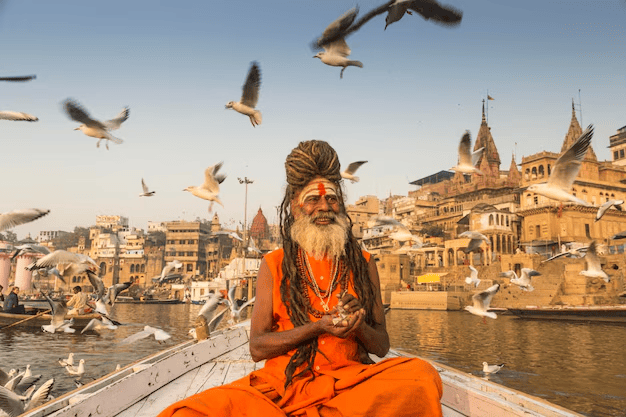
At the Kumbh Mela, the divine is also manifest in human form through the countless sadhus, sants, and gurus. They are considered living representations of the gods’ attributes.
- The Naga Akharas: As devotees of Shiva, they embody his fierce, ascetic, and untamed nature. Their processions are a awe-inspiring sight, a visual declaration of renunciation and power. They are the direct descendants of the warrior-ascetics who organized to defend faith and pilgrimage.
- The Bairagi Akharas: Devotees of Vishnu and his incarnations (like Rama and Krishna), they often lead kirtans, discourses on the Ramayana and Bhagavata Purana, and exhibit devotional fervor. They represent the path of Bhakti (devotion).
- The Udasin and Sikh Traditions: Founded by Sri Chand (son of Guru Nanak), the Udasins represent a syncretic ascetic order. The presence of Sri Guru Granth Sahib and the Nishan Sahib flag at the Kumbh underscores the shared spiritual heritage and the divine wisdom embodied in scripture.
- The Shankaracharyas and Mahamandaleshwars: As heads of monastic institutions (mathas), they are the custodians of Vedic knowledge and philosophy (Jnana Marga). Their discourses attract thousands, providing the intellectual and doctrinal framework for the faith.
- The Devotional Singers and Storytellers: In countless camps, kirtankars sing the glories of Ram, Krishna, Durga, and Hanuman, transforming the entire Mela ground into a continuous, moving temple. The divine stories (Lila) are retold, making the gods and their teachings vibrantly alive.
The Rituals: Where Humanity Meets Divinity
Every ritual at the Kumbh is a dialogue with the divine.
- Shahi Snan (The Royal Bath): This is the climax of the Mela. When the ascetic orders, led by their mahants atop lavishly decorated chariots and elephants, proceed to the river, it is not just a bath. It is a re-enactment of the Devas taking possession of the Amrita. The faith holds that at the exact astrological moment, the waters turn into Amrita itself. By bathing after the saints, the common devotees partake in this divinized essence.
- The Evening Aarti on the Ghats: As the sun sets, the grand Ganga Aarti in Haridwar or Prayag is a spectacle of collective devotion. Facing the river goddess, priests offer large flaming lamps in synchronized movements, accompanied by the resonant sounds of bells, gongs, and chanting. The river is no longer just water; she is a conscious, benevolent deity receiving her devotees’ love.
- Kalpavasis: These are devotees who reside at the Mela for the entire month of Magha, living an austere, ritualistic life akin to the ancient sages of the Kalpa (cosmic cycle). They perform daily baths, prayers, and fires (homas), aiming for a spiritual rebirth. They embody the ideal of tapping into the timeless, divine energy of the place.
- Darshan of the Saints: For many, the primary purpose is to take darshan (sacred viewing) of revered holy men and women. Receiving their blessing or a word of wisdom is considered a direct channel of divine grace.
- Charity (Daana): Giving food, clothes, and money to the poor and to saints is considered an act of worship in itself, a service to the divine residing in all beings.
The Philosophical Underpinning: The Eternal Dharma and the Cyclical Cosmos
The Kumbh Mela is the ultimate expression of the core principles of Sanatan Dharma:
- The Cyclical Nature of Time: Unlike linear history, time in Sanatan thought is cyclical (Kalachakra). The Kumbh, with its 12-year and 144-year cycles, mirrors the cosmic cycles of creation, preservation, and dissolution. It celebrates a moment of eternal recurrence—the Amrita falls again and again, spiritually.
- The Unity of Existence: The confluence of rivers symbolizes the ultimate confluence—the meeting of the individual soul (Jivatman) with the universal soul (Paramatman). The millions of diverse individuals—rich and poor, high caste and low caste, scholar and illiterate—all reduced to the same act of bathing, embodies the principle of Vasudhaiva Kutumbakam (the world is one family) and the essential divinity of all (Atman).
- The Four Pursuits of Life (Purusharthas): The Kumbh encompasses all four: Dharma (righteousness/ritual duty), Artha (material prosperity sought through blessings), Kama (worldly desires, including progeny and health), and Moksha (liberation). While the ascetics seek only Moksha, the householder seeks a balance, and the Kumbh provides for all.
- The Guru-Shishya Parampara: The continuous transmission of knowledge from guru to disciple is on full display, ensuring the living breath of the tradition.
Conclusion: A Living Universe of the Divine
The Kumbh Mela is where the metaphysics of Sanatan Dharma becomes a physical, experiential reality. The gods are not confined to temple sanctums; they are in the astral calculations determining the date, in the sacred rivers that are their liquid forms, in the myths recited in a thousand tongues, in the awe-inspiring forms of the ascetics, and in the hopeful, devout hearts of millions. It is a grand theater where the timeless drama of the struggle between immortality and oblivion, knowledge and ignorance, is eternally staged.
Every drop of the sacred rivers at the Kumbh moment is believed to carry the echo of the falling Amrita. Every pilgrim who submerges themselves is, in that act, participating in the divine narrative—seeking not just purification from sin, but a taste of the eternal. In this colossal human endeavor, Sanatan Dharma demonstrates its profound understanding: the divine is not a remote sovereign, but an imminent, accessible reality that periodically converges with the human world at sacred nodes of time and space, offering a chance for humanity to bathe in its own highest potential—the potential for immortality.
The Kumbh Mela is, therefore, the universe of Sanatan Dharma’s gods made manifest, a temporary city built on faith, where heaven and earth, legend and history, deity and devotee, flow together in a relentless, sacred, and unforgettable stream.
Top 100 name of Sanatan Dharma Kumbh Mela Gods
The Kumbh Mela is one of the largest religious gatherings in the world, deeply rooted in Sanatan Dharma (Hinduism). It is associated with the sacred rivers and divine beings mentioned in Hindu scriptures. The main deities worshiped during the Kumbh Mela include gods and goddesses from the Vedic, Puranic, and regional Hindu traditions.
Here’s a list of 100 important deities associated with Sanatan Dharma and revered at the Kumbh Mela:
Trimurti (The Supreme Trinity)
- Brahma – Creator of the universe
- Vishnu – Preserver of the universe
- Shiva – Destroyer and transformer
Courtesy: HISTORY TV18
Dashavatara (Ten Incarnations of Vishnu)
- Matsya – The fish incarnation
- Kurma – The tortoise incarnation
- Varaha – The boar incarnation
- Narasimha – The lion-man incarnation
- Vamana – The dwarf incarnation
- Parashurama – The warrior with an axe
- Rama – The prince of Ayodhya
- Krishna – The divine charioteer of Arjuna
- Buddha – The enlightened teacher (sometimes replaced by Balarama)
- Kalki – The future warrior incarnation
Devas (Celestial Gods)
- Indra – King of the gods and ruler of heaven
- Agni – God of fire
- Varuna – God of cosmic waters
- Vayu – God of wind
- Surya – The Sun god
- Chandra – The Moon god
- Yama – God of death and dharma
- Kubera – God of wealth
- Rudra – The storm god (a form of Shiva)
- Soma – God of the divine nectar
Sapta Rishis (Seven Great Sages)
- Vashishtha
- Vishwamitra
- Atri
- Bhrigu
- Angiras
- Gautama
- Jamadagni
Shiva’s Divine Forms
- Mahadeva – The great god
- Nataraja – The cosmic dancer
- Ardhanarishwara – Half male, half female (Shiva & Parvati)
- Dakshinamurthy – The divine teacher
- Bhairava – The fierce form of Shiva
- Neelkanth – The blue-throated one
- Pashupati – Lord of all beings
Shakti (Divine Feminine Energy)
- Parvati – Consort of Shiva
- Durga – The warrior goddess
- Kali – Goddess of time and destruction
- Saraswati – Goddess of wisdom and learning
- Lakshmi – Goddess of wealth and prosperity
- Annapurna – Goddess of food and nourishment
- Chandi – The fierce goddess
- Bhavani – The maternal goddess
Courtesy: The Indian Express
Ganesha and Kartikeya
- Ganesha – Remover of obstacles
- Kartikeya – God of war
Other Forms of Vishnu
- Dhanvantari – God of medicine
- Hayagriva – God of wisdom
- Garuda – Vishnu’s divine mount
Other Forms of Shiva
- Khandoba – A regional form of Shiva
- Virabhadra – Shiva’s warrior form
Divine Beings & Rishis
- Hanuman – The monkey god
- Narada – The celestial sage
- Markandeya – The immortal sage
- Chyavana – The rejuvenation sage
Yogic & Philosophical Figures
- Patanjali – Father of Yoga
- Adi Shankaracharya – Philosopher and saint
Nag Devtas (Serpent Gods)
- Sheshnag – Vishnu’s cosmic bed
- Vasuki – The churning rope of the ocean
- Takshaka – King of serpents
Sacred Rivers as Goddesses
- Ganga – Goddess of the Ganges
- Yamuna – Sacred river goddess
- Saraswati – The lost river of knowledge
- Godavari – Sacred river of Maharashtra
- Narmada – Sacred river of Madhya Pradesh
- Kaveri – Sacred river of the South
Other Celestial & Mythological Figures
- Kamadhenu – The divine cow
- Ashwini Kumaras – Twin gods of medicine
- Rambha – A celestial nymph
Lokpals (Guardians of Directions)
- Kubera – North
- Yama – South
- Varuna – West
- Indra – East
Four Kumaras (Eternal Youths)
- Sanaka
- Sanandana
- Sanatkumara
- Sanatana
Mahabharata & Ramayana Figures
- Bhishma – The grandsire warrior
- Drona – The teacher of the Kauravas & Pandavas
- Arjuna – The great warrior
- Bhima – The strongest Pandava
- Yudhishthira – The righteous king
- Ravana – The learned but misguided king
- Vibhishana – The noble brother of Ravana
Other Hindu Saints & Philosophers
- Valmiki – Author of the Ramayana
- Vyasa – Compiler of the Mahabharata
- Tulsidas – Poet-saint of the Ramcharitmanas
- Mirabai – Devotee of Krishna
- Surdas – Blind poet and devotee of Krishna
- Kabir – Mystic poet
- Gorakhnath – Founder of the Nath sect
Astrological Deities (Navagrahas)
- Surya – Sun
- Chandra – Moon
- Mangala – Mars
- Budha – Mercury
- Guru (Brihaspati) – Jupiter
- Shukra – Venus
- Shani – Saturn
- Rahu & Ketu – Lunar nodes
These 100 divine names are revered at the Kumbh Mela, which is not just a religious event but a celebration of Sanatan Dharma’s spiritual legacy.

Table of Contents