
Sea Wagon Services Private Limited
Table of Contents
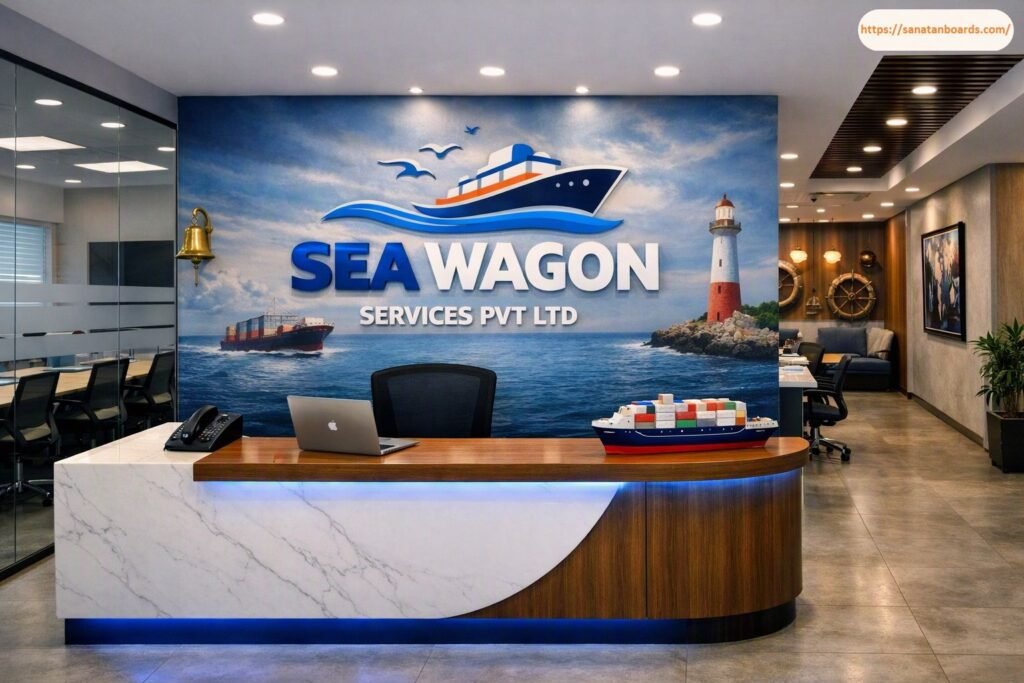
Introduction
The story of Sea Wagon Services Private Limited is a story about an industry in which ordinary standards of service are never enough.
Supplying food provisions to marine, offshore and industrial organizations is fundamentally different from selling food through an ordinary retail outlet. The customer may be far away. The receiving location may be a vessel, an offshore installation, an industrial facility, a remote camp or another environment where replacing an incorrect, damaged or unsafe food item is difficult. The supply chain therefore becomes part of the company’s reputation.
For Sea Wagon Services Private Limited, operating from Masjid East in Mumbai, the business was connected to a demanding world of marine and industrial supply. Dry provisions, fresh provisions and frozen provisions each required different handling considerations. The company had to think beyond procurement and delivery. It had to think about product condition, hygiene, storage, transportation, supplier selection, traceability, documentation and customer confidence.
The decision to establish a formal food-safety approach and achieve a HACCP certificate in 2022 represented an important stage in that journey.
HACCP is fundamentally preventive. Rather than waiting for a food-safety problem to occur, it seeks to identify hazards and establish controls at points where those hazards can be prevented, eliminated or reduced to an acceptable level. The Codex framework describes seven principles covering hazard analysis, critical control points, critical limits, monitoring, corrective action, verification and documentation.
For Sea Wagon Services, these principles could be translated into practical business discipline.
The certificate itself was not the end of the journey. It was a milestone.
The real story was what happened when food safety became part of the company’s operating culture.
This case story therefore follows Sea Wagon Services through a narrative of transformation: from a provision supplier focused primarily on fulfilling orders to an organization increasingly conscious of process control, supplier discipline, cold-chain considerations, documentation, customer assurance and continuous improvement.
The story also focuses on the promoter and the people behind the company. Every certificate ultimately becomes meaningful only when management and employees convert its principles into everyday behavior.
The growth described in this story is presented as a business-development narrative based on the supplied company and certification information. Specific financial figures, employee counts, customer names and percentage growth figures have not been invented. Instead, the story explains the types of organizational and commercial improvements that a HACCP-based system can support.
Chapter 1 The Beginning: Understanding the Responsibility Behind Food Supply
Every business has a product.
For Sea Wagon Services Private Limited, however, the real product was more than food.
The company supplied provisions.
That distinction was important.
When a company supplies dry, fresh and frozen food to marine, offshore and industrial customers, the customer is purchasing reliability as much as the physical product. The customer expects the right items, in the right quantity, in acceptable condition, at the required time and with appropriate handling.
The business therefore depended on coordination.
A typical order could begin with a customer requirement. That requirement would move through purchasing, supplier coordination, inspection, preparation, storage and transportation before reaching the customer.
At each stage, something could go wrong.
A supplier might provide an unsuitable batch.
A fresh product might not maintain its required condition.
Frozen goods might be exposed to inappropriate temperatures.
Packaging might become damaged.
An item might be incorrectly identified.
A delivery might be delayed.
Documentation might be incomplete.
A seemingly small mistake could become a major service problem when the destination was a vessel or remote industrial location.
This reality shaped the company’s development.
Sea Wagon Services operated in Mumbai, a city deeply connected with ports, shipping, logistics, industrial activity and maritime commerce. Its location at 310, Trapinex House, 15 Solapur Street, Masjid East, placed the organization within an environment where commercial relationships, supply networks and logistics were central to business.
The company’s scope—supply of dry, fresh and frozen provisions to marine, offshore and industrial companies—required a different mindset from conventional food distribution.
The promoter and management team had to understand that customers were not merely comparing prices.
They were evaluating dependability.
Could the supplier respond?
Could it source difficult items?
Could it maintain product condition?
Could it document what had been supplied?
Could it handle urgent requirements?
Could it maintain consistency?
Could it demonstrate that food-safety risks were being considered?
These questions gradually became more important as the company matured.
In the early stages of many supply businesses, success is often driven by relationships, market knowledge, procurement ability and personal attention from management.
Those strengths are valuable.
But as business expands, informal systems can become difficult to control.
A promoter who personally remembers every supplier, customer requirement and delivery detail may be able to manage a smaller operation effectively. As the organization grows, however, more employees become involved. More suppliers enter the network. More orders are processed simultaneously. More products move through storage and transportation.
The business begins to require systems.
That was the environment in which the importance of food-safety management became increasingly clear.
The company did not need food safety to be an abstract concept.
It needed food safety to become operational.
The first transformation was therefore one of thinking.
Instead of asking only, “Can we supply this order?” management increasingly had to ask:
“What could go wrong?”
“Where could contamination occur?”
“How should the product be controlled?”
“How should suppliers be evaluated?”
“How should fresh and frozen items be handled?”
“What evidence should be maintained?”
“What should happen if something does not meet requirements?”
These questions are consistent with the preventive philosophy of HACCP.
Codex describes HACCP as a system for identifying specific hazards and preventive measures, determining critical control points and establishing monitoring, corrective action, verification and documentation.
For Sea Wagon Services, that philosophy offered a framework for organizing activities that were already important to the business.
Food safety was no longer merely the responsibility of one person.
It became a process.
The promoter’s role changed accordingly.
Instead of being involved only in commercial decisions, management had to provide direction for operational discipline. Procurement decisions, supplier relationships, storage practices, employee awareness and customer communication became connected.
This was the beginning of a more structured company.
The transformation did not happen overnight.
There were procedures to establish.
People had to be trained.
Responsibilities had to be clarified.
Records had to be maintained.
Supplier controls had to become more systematic.
The organization had to learn to treat documentation not as paperwork for an auditor but as evidence of what had actually happened.
That cultural change would become one of the most important outcomes of the certification journey.
The company was entering a new phase.
It was no longer enough to say that food safety mattered.
Sea Wagon Services had to demonstrate how it managed food safety.
#SeaWagonServices
Chapter 2 The Decision to Build a Food-Safety Culture
The decision to pursue HACCP certification was not simply a decision to obtain a certificate.
It represented a management decision to formalize responsibility.
In a food-supply business, responsibility can become fragmented very quickly.
The purchasing employee believes the supplier is responsible.
The supplier believes the distributor is responsible.
The warehouse employee believes the purchasing department checked the goods.
The delivery employee believes the warehouse released acceptable products.
The customer receives the order and expects the supplier to have controlled everything.
Without defined responsibilities, problems can move through the organization unnoticed.
HACCP helped Sea Wagon Services approach the problem differently.
The organization could identify hazards systematically.
This meant considering biological, chemical and physical hazards as applicable to the products and activities under its control.
The purpose was not to assume that every product was dangerous.
The purpose was to understand where risks might arise and how they could be controlled.
For dry provisions, attention could be given to packaging integrity, storage conditions, infestation risks, contamination and shelf life.
For fresh provisions, the organization needed stronger awareness of hygiene, freshness, handling and appropriate temperature control.
For frozen provisions, temperature management and preservation of frozen condition became particularly significant considerations.
The company’s business therefore contained several different control environments.
The same procedure could not necessarily be applied identically to every category.
This realization encouraged a more detailed approach to operations.
Supplier selection became increasingly important.
A supplier was not simply a company offering an attractive price.
A supplier became part of the food-safety chain.
The company could consider factors such as product quality, reliability, packaging, delivery capability, documentation and history of performance.
This did not mean that every supplier needed to be perfect.
It meant that suppliers needed to be evaluated according to the requirements of the business.
The same principle applied internally.
Employees became an important control point.
A well-designed food-safety procedure is ineffective if employees do not understand it.
Therefore, awareness became central.
People handling food-related supplies needed to understand hygiene expectations, contamination risks, storage discipline, product identification and reporting of problems.
Training also helped create a shared language.
Instead of an employee saying, “This product doesn’t look right,” the organization could develop more structured ways of reporting nonconformities.
Instead of assuming that an item was acceptable because it had arrived from a known supplier, staff could inspect it against defined requirements.
Instead of discarding a problematic product without recording the incident, the organization could document the issue and consider whether corrective action was required.
This was an important cultural shift.
The company began moving from individual judgment toward controlled judgment.
The promoter played a central role.
Management support was necessary because food-safety systems require resources.
There may be costs associated with training, documentation, supplier evaluation, storage arrangements, inspection and verification.
Management must also accept that food safety can occasionally require difficult commercial decisions.
A low-priced product may not be appropriate if it does not meet requirements.
A supplier may need to be questioned.
A delivery may need to be rejected.
An order may need to be corrected.
A customer may need to be informed.
A process may need to be changed.
These actions require management commitment.
The certification process therefore became an opportunity for the promoter and management team to examine the organization.
What did the company do well?
Where were the weaknesses?
Which activities depended too much on individual memory?
Which records were missing?
Which suppliers required stronger evaluation?
Which areas needed clearer responsibility?
Which customer requirements needed better communication?
The questions were sometimes uncomfortable.
But they were useful.
Growth is not always about adding more sales.
Sometimes growth begins with removing uncertainty.
When an organization knows who is responsible for a task, how the task must be performed and what evidence must be retained, it becomes easier to manage increasing volumes.
This was especially important for Sea Wagon Services because the company served marine, offshore and industrial customers.
Such customers can have demanding operational schedules.
A missed delivery or incorrect supply can have consequences beyond a normal commercial inconvenience.
The company’s ability to organize itself around food safety therefore had a commercial dimension.
Food safety supported service reliability.
Service reliability supported customer confidence.
Customer confidence supported long-term relationships.
The management system began connecting these elements.
The company was learning that quality and food safety were not separate from business growth.
They were part of it.
#HACCPCertification
Chapter 3 Building Control into Dry, Fresh and Frozen Provisions
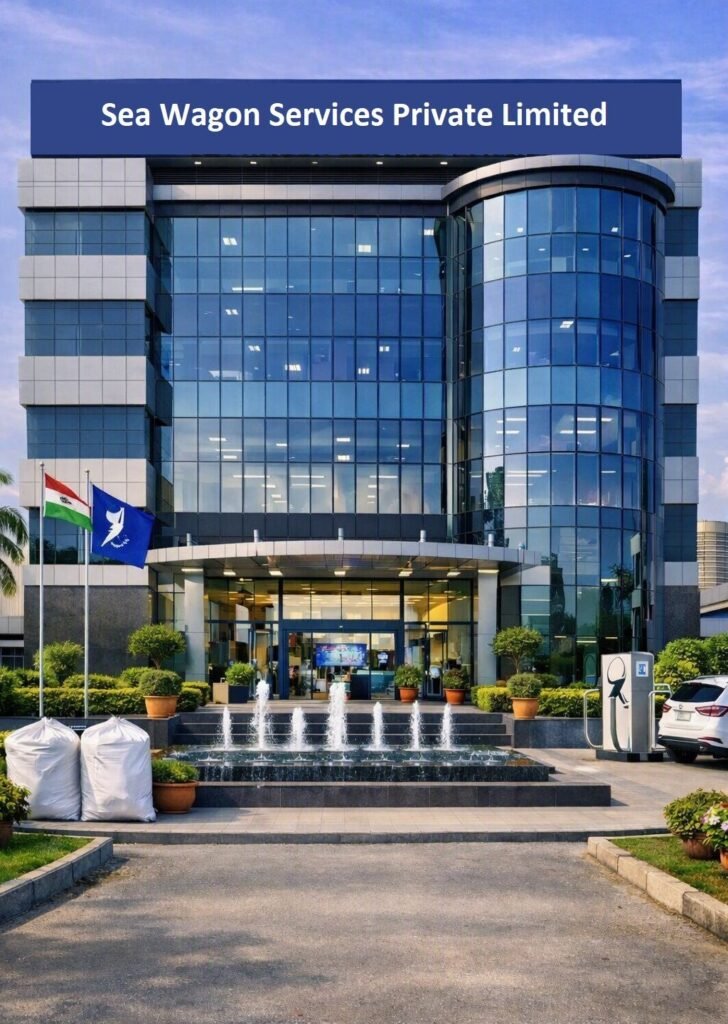
The greatest challenge of the company’s scope was its diversity.
Sea Wagon Services did not supply only one type of provision.
Its scope included dry, fresh and frozen provisions.
Each category presented different operational considerations.
Dry goods generally have different storage characteristics from fresh food.
Fresh provisions can be sensitive to handling, hygiene, time and temperature.
Frozen products depend heavily on maintaining appropriate frozen conditions throughout relevant stages.
Therefore, a mature food-safety approach had to recognize these differences.
For dry provisions, the company could focus on maintaining clean and organized storage, protecting products from contamination, checking packaging and identifying products appropriately.
Stock rotation became important.
A systematic approach to stock movement could reduce the likelihood of older stock being overlooked.
Product identification also became increasingly important.
If several similar items were being handled simultaneously, clear identification could reduce mistakes.
Fresh provisions required another level of attention.
Freshness is immediately visible to customers, but food safety involves more than appearance.
Handling practices, hygiene, product condition and temperature control can all matter.
Employees therefore had to understand that fresh food should be handled with care from receiving through dispatch.
Frozen provisions presented their own challenges.
Maintaining frozen condition can become particularly important when products move through multiple stages.
The company had to consider the journey rather than only the final delivery.
Supplier.
Receiving.
Storage.
Preparation.
Transportation.
Customer.
Each stage formed part of the chain.
A weakness at one stage could affect the next.
This encouraged a process-based way of thinking.
Instead of treating procurement, storage and delivery as independent activities, Sea Wagon Services could view them as connected stages.
That was one of the most valuable lessons of the certification journey.
The company began to understand that food safety was not created at the moment of delivery.
It was created through a sequence of controlled activities.
The sequence started with suppliers.
Supplier evaluation became a meaningful management activity.
The organization could establish criteria for approving suppliers and periodically review performance.
Questions could include:
Was the supplier reliable?
Were products consistently acceptable?
Were deliveries properly packed?
Were agreed requirements met?
Were complaints or deviations occurring?
Was corrective action effective?
This approach created accountability.
The company also developed stronger awareness of incoming materials.
Receiving became more than a logistical event.
It became a control activity.
Products could be checked against requirements.
Packaging condition could be considered.
Product identity and quantity could be confirmed.
Where relevant, temperature or other product-specific conditions could be evaluated.
Items that did not meet requirements could be identified and handled through an appropriate process.
This discipline had another benefit.
It improved communication between departments.
Procurement personnel had a clearer understanding of what operations required.
Operations personnel had better information about suppliers.
Management had greater visibility into recurring issues.
Customers could receive more consistent service.
Documentation connected these activities.
Records became the memory of the organization.
A business can forget what happened six months ago.
A properly maintained record can provide evidence.
That evidence can be used during audits.
It can help investigate complaints.
It can help identify recurring problems.
It can support supplier review.
It can help management make decisions.
Documentation therefore became a business asset.
The promoter’s perspective also changed.
Earlier, management might have viewed documentation primarily as administrative work.
After the food-safety system matured, records could be viewed as management information.
If a supplier repeatedly failed to meet requirements, records could reveal the pattern.
If a particular product repeatedly generated complaints, records could help identify it.
If deliveries were delayed under particular circumstances, operational data could support corrective action.
This created a feedback loop.
The company supplied products.
The organization recorded what happened.
Management reviewed information.
Problems were identified.
Corrective actions were taken.
Processes were improved.
The improved process generated new records.
The cycle continued.
This is how a management system can become more than a certification requirement.
It becomes an organizational learning system.
For Sea Wagon Services, this learning process helped strengthen the foundation for future growth.
#FoodSafetyManagement
Chapter 4 The 2022 HACCP Certification Milestone
Courtesy: Maritime Pawan
The year 2022 became an important point in the company’s history.
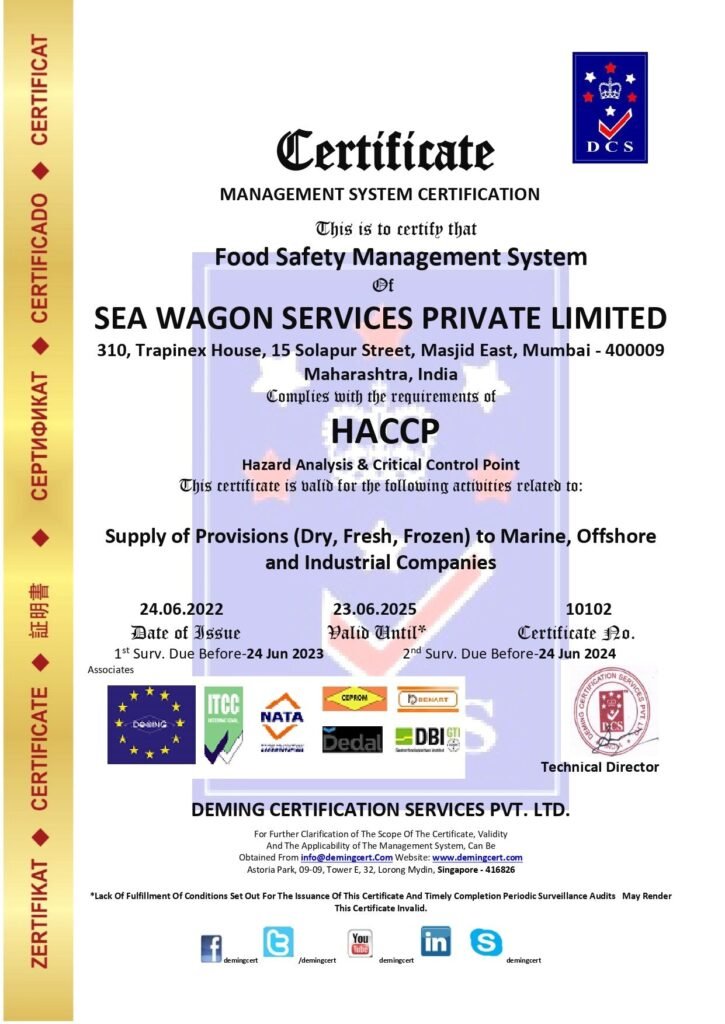
According to the information provided, Sea Wagon Services Private Limited received its HACCP Certificate in 2022, with validity through 2025.
The certificate gave formal recognition to the company’s food-safety approach within the stated scope.
But the most meaningful change was not the document itself.
It was the discipline required to reach that stage.
Certification creates visibility.
Processes that previously seemed acceptable may be examined more closely.
Responsibilities must be explained.
Records must be produced.
Procedures must correspond to actual practices.
Employees must understand what they are expected to do.
Management must demonstrate commitment.
The organization must show that it has considered relevant food-safety hazards and controls.
This process can be demanding.
It requires the company to look at itself from the perspective of risk.
The audit environment can therefore become a learning environment.
For the promoter, certification represented a moment of reflection.
The business had moved beyond simply competing on availability and price.
It was developing a more formal identity.
Sea Wagon Services could communicate to customers that food safety had been taken seriously enough to build a structured HACCP-based approach.
For marine and offshore customers, this could be particularly relevant.
Food provision is closely connected to the well-being and operational continuity of people working away from conventional retail environments.
A supplier’s ability to demonstrate organized food-safety practices can therefore support confidence in procurement relationships.
This did not mean that a certificate guaranteed that every future delivery would be perfect.
No management system can eliminate every possible risk.
Instead, the system provides a structured method for identifying, controlling, monitoring and responding to risks.
That distinction was important.
The promoter began to see certification not as a destination but as a commitment.
The company had to maintain the system.
Employees had to continue following procedures.
Records had to remain meaningful.
Corrective actions had to be taken.
Internal checks and verification activities had to continue.
Supplier performance needed ongoing attention.
Customer feedback had to remain relevant.
The certification milestone therefore created a new responsibility.
The company had to protect what it had built.
The period after certification became an opportunity to test whether the system actually worked under real business conditions.
Orders continued.
Customers continued to expect timely service.
Suppliers continued to change.
Products continued to move.
Unexpected situations continued to arise.
The difference was that Sea Wagon Services now had a stronger framework for responding.
If a problem occurred, the organization could ask:
Where did the problem originate?
Was the hazard previously identified?
Was the control effective?
Was the employee trained?
Was the supplier appropriate?
Was the monitoring adequate?
Was the corrective action sufficient?
Could the problem recur?
These questions turned mistakes into learning opportunities.
That was one of the most important effects of the certification journey.
The company was developing organizational memory.
The promoter could now manage not only through personal experience but through systems, records and defined responsibilities.
This helped create a foundation for sustainable growth.
#FoodSafetyCertification
Chapter 5 From Certificate to Customer Confidence
A certificate has commercial value only when customers believe that it represents something meaningful.
For Sea Wagon Services, the HACCP certification could become part of the company’s customer-confidence story.
Marine, offshore and industrial companies often need suppliers who can understand operational requirements.
The buyer is not necessarily looking for the cheapest product.
The buyer may also be concerned about:
Consistency.
Availability.
Product condition.
Documentation.
Responsiveness.
Delivery discipline.
Food safety.
Traceability.
Supplier reliability.
The HACCP milestone strengthened the company’s ability to communicate that food safety was being managed systematically.
This could influence the way the company presented itself.
Instead of describing itself simply as a provision supplier, Sea Wagon Services could position itself as a supplier with a structured food-safety orientation.
That distinction mattered.
The company’s commercial team could explain the scope more clearly.
Dry, fresh and frozen provisions were not simply commodities.
They were products that moved through a controlled supply chain.
The organization could discuss supplier management, receiving controls, handling, storage and delivery practices with greater confidence.
The promoter could also use the certification journey as a tool for strengthening relationships.
Business relationships become stronger when customers see evidence of consistency.
If a customer raises a concern, a systematic organization can investigate it.
If a customer introduces new requirements, a process-oriented company can evaluate them.
If a recurring issue appears, management can examine records.
This is where certification can influence growth indirectly.
It does not create customers automatically.
It creates a framework that can support trust.
Trust can support repeat business.
Repeat business can support stability.
Stability can create opportunities for expansion.
The company’s reputation therefore became connected to its systems.
This also influenced employee behavior.
Employees began to understand that their work represented the company.
A careless receiving decision could affect the customer.
Poor handling could affect product condition.
Incomplete records could weaken traceability.
Incorrect communication could create delivery problems.
The management system made these connections visible.
The promoter could reinforce a simple principle:
Every employee contributes to customer confidence.
The warehouse employee contributes.
The purchasing employee contributes.
The delivery employee contributes.
The administrative employee contributes.
Management contributes.
The customer ultimately experiences the combined result.
This created a stronger culture of ownership.
Another important development was consistency.
In a growing organization, two employees may otherwise perform the same task differently.
One employee may inspect incoming products carefully.
Another may assume that the supplier has already checked everything.
A documented process creates a common expectation.
This does not eliminate human judgment.
It provides a foundation for judgment.
The organization can define what must be checked and what must be recorded while allowing employees to identify unusual situations.
That combination—standardization plus awareness—became important for Sea Wagon Services.
The promoter’s role increasingly shifted from personally controlling every activity to ensuring that the organization itself could control its activities.
That is a major step in business maturity.
A small business often grows because of its promoter.
A mature business grows because of its systems and people.
The HACCP journey helped Sea Wagon Services move toward the second model.
#MarineFoodSupply
Chapter 6 The Human Side of Transformation
Behind every management system are people.
Certificates do not receive food deliveries.
Employees do.
Certificates do not inspect packaging.
Employees do.
Certificates do not communicate with suppliers.
Employees do.
Certificates do not respond to customers.
Employees do.
Therefore, the real transformation at Sea Wagon Services depended on people.
Training became one of the important elements of the journey.
Employees needed to understand why procedures existed.
If a worker understands only that a form must be completed, the system can become mechanical.
If the worker understands why the record matters, the system becomes meaningful.
For example, a receiving record is not simply a piece of paper.
It can provide evidence that a product was checked.
A corrective-action record is not simply an audit requirement.
It can show how the organization responded to a problem.
A supplier evaluation is not merely a form.
It can help management decide whether a supplier continues to meet expectations.
A monitoring record can demonstrate that a defined control was actually observed.
This understanding changed the culture.
Employees became more conscious of their responsibilities.
Training also encouraged communication.
Food-safety systems work best when employees feel comfortable reporting problems.
If someone notices damaged packaging, an unusual product condition or a storage issue, management needs to know.
Silence can hide risk.
Communication exposes risk so that it can be controlled.
The promoter therefore had to create an environment where identifying a problem was considered a responsible act rather than a failure.
This was a significant cultural development.
The organization could learn from problems without automatically assigning blame.
A food-safety issue could be investigated through questions:
What happened?
Why did it happen?
Where did the process fail?
Was the procedure unclear?
Was training insufficient?
Was equipment inadequate?
Was the supplier responsible?
Was supervision sufficient?
What can prevent recurrence?
This approach encouraged root-cause thinking.
The organization gradually became more analytical.
Employees could see that improvement was not about finding someone to blame.
It was about strengthening the process.
This also helped management.
When employees reported problems early, corrective action could be taken before the issue became larger.
The company could therefore become more proactive.
That proactive culture aligned closely with the philosophy of HACCP.
The purpose is to identify and control hazards rather than wait for a food-safety incident to occur. Codex’s HACCP principles specifically emphasize monitoring, corrective action, verification and documentation.
The promoter’s leadership was crucial.
Management had to demonstrate through actions that food safety mattered.
If an employee was asked to follow a procedure but management ignored it, the system would weaken.
If management insisted on proper records, supplier evaluation and corrective action, employees would recognize that the system was genuine.
Leadership therefore became visible in daily decisions.
The company also had to balance food safety with commercial pressure.
There could be urgent orders.
There could be difficult suppliers.
There could be tight delivery windows.
There could be pressure to accept a questionable product to avoid delay.
A strong food-safety culture helped employees understand that short-term convenience should not replace defined controls.
The company’s people were learning to protect both the customer and the organization.
That was one of the deepest changes produced by the certification journey.
The certificate belonged to the company.
But the culture belonged to the people.
#OffshoreCatering
Chapter 7 Growth Through Better Processes
Business growth is often measured through sales.
But sales are only one dimension of growth.
A company can increase sales and still become weaker if its systems cannot support the additional volume.
For Sea Wagon Services, the HACCP journey created an opportunity to connect growth with process maturity.
As orders increased, the company needed to coordinate more information.
More suppliers.
More products.
More customers.
More deliveries.
More documentation.
More decisions.
Without systems, complexity can grow faster than revenue.
A structured food-safety system helped establish a framework for managing this complexity.
Procurement could be more organized.
Receiving could be more consistent.
Storage requirements could be clearer.
Product movement could be better documented.
Customer requirements could be communicated more systematically.
Corrective actions could be tracked.
Supplier performance could be reviewed.
This did not eliminate operational pressure.
Instead, it made the organization better prepared to manage pressure.
The promoter could begin delegating responsibilities with greater confidence.
Delegation is one of the most important steps in business growth.
A promoter who must personally approve every detail eventually becomes a bottleneck.
A promoter who establishes clear systems can allow trained employees to make routine decisions within defined boundaries.
This creates scalability.
Sea Wagon Services could therefore begin thinking beyond immediate order fulfillment.
It could consider new customer relationships.
New marine customers.
Offshore organizations.
Industrial companies.
Additional product categories.
Larger supply requirements.
Longer-term procurement relationships.
Each opportunity required confidence in the company’s ability to maintain standards.
The HACCP framework provided part of that confidence.
Food-safety management also encouraged the company to think about continuous improvement.
Improvement could come from small changes.
Better supplier communication.
Improved product inspection.
Clearer records.
More effective training.
Better storage organization.
Improved delivery coordination.
More consistent customer feedback.
None of these changes alone necessarily transformed the business.
Together, however, they could produce cumulative improvement.
This is how operational maturity develops.
One procedure becomes better.
One problem is prevented.
One customer complaint is reduced.
One supplier relationship improves.
One employee becomes more capable.
One process becomes easier to monitor.
The promoter begins to see the organization differently.
Instead of asking only, “How much business did we do?” management can ask:
“How reliably did we do it?”
“How many problems did we prevent?”
“What did we learn?”
“Where can we improve?”
“Which suppliers are strongest?”
“Which processes require attention?”
This broader view is an important feature of mature management.
Food safety becomes part of business performance.
The company’s identity also becomes stronger.
Sea Wagon Services is no longer simply a supplier competing for orders.
It is an organization attempting to build reliability into its service.
That message can be particularly relevant in marine and offshore supply, where the cost of inconvenience can be significant.
The business can therefore compete not only through availability and pricing but through confidence.
Confidence in process.
Confidence in handling.
Confidence in communication.
Confidence in documentation.
Confidence in accountability.
The promoter’s original entrepreneurial vision remains important.
But now it is supported by organizational discipline.
That combination can create sustainable development.
#IndustrialFoodSupply
Chapter 8 Building a Reputation in the Marine and Offshore Supply Chain
The marine environment creates a unique commercial context.
A supplier may operate from a major commercial center while delivering provisions to locations that are operationally distant.
The customer’s environment can involve vessels, offshore facilities, industrial operations and demanding schedules.
This creates a need for coordination.
Sea Wagon Services’ scope placed it directly within this environment.
The company therefore had to understand that logistics and food safety were connected.
A food item can be safe when purchased but compromised through inappropriate handling.
A product can be correct but delivered too late.
A delivery can arrive on time but contain an incorrect item.
A frozen product can be properly sourced but improperly transported.
Therefore, customer service required an integrated approach.
The company had to think about the complete journey.
The HACCP approach encouraged this perspective.
Hazard analysis is not restricted to a single moment.
The Codex principles consider stages from production and processing through distribution and consumption, with controls established at relevant points.
For a provision supplier, this meant understanding the supply chain.
Supplier.
Transport.
Receiving.
Storage.
Preparation.
Dispatch.
Delivery.
Customer acceptance.
Each stage could influence the next.
This broader understanding helped Sea Wagon Services strengthen its reputation.
Reputation in business is built slowly.
A customer may remember a company because an urgent order was handled correctly.
Another customer may remember the company’s responsiveness.
Another may appreciate clear documentation.
Another may value consistent product quality.
Another may consider certification when evaluating suppliers.
Over time, these experiences create a commercial identity.
The HACCP certification became part of that identity.
It provided a formal point that the company could reference when communicating its commitment to food safety.
But reputation also depended on behavior after certification.
If the company had a certificate but ignored its own procedures, the certificate would lose practical meaning.
Therefore, maintaining the system was as important as achieving it.
The 2022–2025 certification period became a period of continued discipline.
The organization had to keep the system active.
This included maintaining records, reviewing processes, responding to deviations and reinforcing awareness.
The promoter had to continue supporting food safety even when there was no immediate audit.
That is when a management system becomes genuine.
Anyone can prepare for an inspection.
A mature organization builds its controls into ordinary work.
Sea Wagon Services’ challenge was therefore to make food safety routine.
A routine inspection.
A routine supplier review.
A routine record.
A routine verification.
A routine corrective action.
A routine management review.
The word “routine” was not a sign that food safety had become unimportant.
It was the opposite.
It meant food safety had become integrated into business activity.
This helped the company create a professional image.
Professionalism is not only about appearance.
It is about predictability.
Customers want to know what to expect.
They want suppliers who communicate clearly.
They want suppliers who respond to problems.
They want suppliers who understand requirements.
They want suppliers who can demonstrate control.
Sea Wagon Services increasingly built its reputation around these characteristics.
The promoter’s growth story was therefore closely connected with the company’s institutional growth.
The promoter was no longer building only a trading business.
The promoter was building an organization.
#QualityManagement
Chapter 9 Continuous Improvement and the Road Beyond 2022–2025
Certification periods have an important characteristic:
They have an end date.
For Sea Wagon Services, the supplied certificate was issued in 2022 and valid through 2025.
That period should not be interpreted as the end of food-safety responsibility.
In reality, certification creates a continuing cycle.
Implement.
Monitor.
Review.
Improve.
Repeat.
This cycle is particularly important in food safety because hazards, suppliers, products, customer expectations and operating conditions can change.
A supplier that performed well yesterday may experience difficulties tomorrow.
A new product may introduce different risks.
A new employee may require training.
A new customer may have additional requirements.
A new storage arrangement may change the process.
A new logistics route may introduce additional handling.
Continuous improvement therefore became part of the company’s long-term thinking.
Management could periodically ask:
Are our controls still appropriate?
Are our employees still aware?
Are suppliers performing consistently?
Are complaints being analyzed?
Are corrective actions effective?
Are records complete?
Are there repeated problems?
Can we simplify any process without reducing control?
Can technology improve traceability?
Can communication be improved?
These questions supported organizational maturity.
The promoter could also think strategically.
What should Sea Wagon Services become in the future?
Should it strengthen its presence in marine supply?
Should it expand offshore relationships?
Should it increase industrial supply?
Should it develop stronger cold-chain capabilities?
Should it expand its supplier network?
Should it adopt additional food-safety or quality certifications?
These are management decisions that depend on the company’s actual business strategy and evidence.
The HACCP experience nevertheless provides a strong foundation for such discussions.
The company had learned how to establish controls.
It had learned how to document processes.
It had learned how to evaluate risks.
It had learned how to respond to deviations.
It had learned the importance of employee awareness.
It had learned that customer confidence depends on operational consistency.
Those lessons remain useful beyond a single certificate.
The broader food-safety ecosystem also continues to evolve.
ISO explains that ISO 22000:2018 is a food-safety management standard designed for organizations throughout the food chain and that it integrates HACCP principles with management-system elements and prerequisite programs.
This illustrates an important strategic point for Sea Wagon Services.
HACCP should not be treated as an isolated technical exercise.
It can form part of a broader management philosophy.
The organization can continue developing its food-safety capabilities according to customer needs, regulatory requirements and business objectives.
At the same time, the company must remain conscious that certification does not replace applicable law.
Codex explicitly notes that Codex standards are not substitutes for national legislation and that businesses must comply with applicable national requirements.
This principle reinforces the company’s responsibility.
Food safety is both a management issue and a regulatory responsibility.
The promoter’s role is therefore ongoing.
The promoter must keep asking whether the company is prepared for the next stage.
The next stage may require better technology.
It may require additional training.
It may require improved storage.
It may require stronger supplier qualification.
It may require new certifications.
It may require better customer communication.
Growth should be accompanied by control.
That became one of the central lessons of the Sea Wagon Services journey.
#FoodSafety
Chapter 10 The Promoter’s Legacy: From Provision Supplier to Trusted Food-Safety Partner
Every entrepreneurial story begins with a decision.
Someone decides to start.
Someone accepts uncertainty.
Someone approaches customers.
Someone develops suppliers.
Someone takes responsibility when problems arise.
For Sea Wagon Services Private Limited, the promoter’s journey was not merely about building sales.
It was about building credibility.
The company entered a demanding field: supplying dry, fresh and frozen provisions to marine, offshore and industrial organizations.
That field required commercial knowledge.
But it also required discipline.
The HACCP certification milestone of 2022 represented an important stage in that development.
It signaled that the company had moved toward a structured approach to food safety.
The certificate’s validity through 2025 marked a defined period during which the organization had an opportunity to demonstrate and maintain its system.
The deeper story, however, lies beyond the dates.
It lies in the transformation of the organization.
Before a formal system, many decisions can depend heavily on individual experience.
After systematic implementation, responsibilities become clearer.
Processes become more consistent.
Records become more meaningful.
Supplier management becomes more structured.
Employees become more aware.
Customer complaints can be investigated systematically.
Corrective action becomes part of management.
The company becomes less dependent on memory and more dependent on systems.
That is organizational growth.
Financial growth is important.
Market expansion is important.
Customer acquisition is important.
But organizational growth determines whether the business can sustain those achievements.
A company that grows without control can eventually become unstable.
A company that grows with strong processes can create a more durable foundation.
Sea Wagon Services’ HACCP journey can therefore be understood as a story of capability building.
The promoter’s role evolved.
From entrepreneur to manager.
From manager to system builder.
From system builder to organizational leader.
The company itself evolved.
From provision supplier to a business increasingly conscious of food-safety assurance.
From individual decisions to defined processes.
From reactive problem solving to preventive thinking.
From informal knowledge to documented organizational knowledge.
From simply completing orders to understanding the complete supply chain.
The real achievement was not the certificate hanging on a wall.
The real achievement was the mindset behind it.
HACCP asks organizations to think about hazards before they become incidents.
It asks them to establish controls.
It asks them to monitor those controls.
It asks them to take corrective action.
It asks them to verify that the system works.
It asks them to maintain records.
These seven principles provide a disciplined way of thinking about food safety.
Sea Wagon Services applied this philosophy to its own business context.
The result was a stronger awareness of what it means to supply food responsibly.
The company’s address in Masjid East, Mumbai, represents a physical location.
Its real business identity, however, extends through its supply network and customer relationships.
Its reputation travels with every delivery.
Its credibility travels with every order.
Its food-safety commitment travels with every product.
That is why the promoter’s story is ultimately a story of responsibility.
A vessel crew member may never know the name of the person who checked a provision before dispatch.
An offshore worker may never see the warehouse where the product was handled.
An industrial customer may never meet every employee involved in the supply chain.
Yet all of them experience the result.
That is the hidden responsibility of food supply.
The company stands between the food source and the customer.
It must therefore protect the integrity of that journey as far as its responsibilities extend.
This understanding gave deeper meaning to certification.
The certificate did not create responsibility.
The certificate recognized a structured approach to managing it.
The promoter and employees were responsible for maintaining that commitment every day.
#BusinessGrowt
Conclusion
A Journey Built on Trust, Discipline and Continuous Improvement
The story of Sea Wagon Services Private Limited is ultimately a story about evolution.
The company began and developed within a specialized business environment involving marine, offshore and industrial customers.
Its scope covered dry, fresh and frozen provisions.
That scope brought with it a responsibility to think carefully about food safety.
The HACCP certification achieved in 2022, with validity through 2025 according to the supplied information, became an important milestone in this journey.
It encouraged a systematic approach to hazards, controls, monitoring, corrective action, verification and documentation.
But certification was only one part of the story.
The larger achievement was organizational.
The company developed a stronger appreciation of supplier control.
It strengthened awareness of product handling.
It recognized the importance of appropriate storage and transportation.
It encouraged employee responsibility.
It created a stronger foundation for traceability and documentation.
It gave management a framework for investigating problems.
It helped connect food safety with customer confidence.
And it demonstrated that quality is not created by one department.
It is created through the combined actions of the entire organization.
For the promoter, the journey represented an important stage of professional development.
Entrepreneurship requires courage.
Management requires discipline.
Leadership requires consistency.
Building a food-safety culture requires all three.
The company could now look toward the future with lessons learned from its certification experience.
Those lessons could support further development, whether through improved technology, stronger supplier relationships, expanded marine and offshore services, enhanced cold-chain practices, employee training, customer-service systems or additional management-system certifications.
The next chapter of the company’s story would depend on future decisions.
But the foundation had been strengthened.
The most important lesson from the journey was simple:
A successful food-supply company does not merely deliver provisions. It delivers confidence.
Confidence that the order has been understood.
Confidence that suppliers have been considered.
Confidence that products have been handled responsibly.
Confidence that problems will be addressed.
Confidence that the company understands its responsibilities.
Confidence that management takes food safety seriously.
That confidence is built one process at a time.
One supplier at a time.
One employee at a time.
One delivery at a time.
One customer relationship at a time.
And one improvement at a time.
Sea Wagon Services Private Limited’s HACCP journey therefore represents more than a certification milestone.
It represents the transformation of food safety from an external requirement into an internal business value.
It represents the movement from informal experience toward structured organizational knowledge.
It represents the promoter’s evolution from managing a business toward building an institution.
And it represents the company’s continuing ambition to serve marine, offshore and industrial customers with greater consistency, discipline and responsibility.
The journey does not end with the certificate’s validity date.
A mature management system creates a habit of improvement.
The certificate may have a date.
The commitment should not.
For Sea Wagon Services, the real legacy of the 2022 HACCP milestone is therefore not the document itself.
It is the culture created around it.
A culture that asks questions before problems occur.
A culture that values prevention.
A culture that respects documentation.
A culture that listens to customers.
A culture that evaluates suppliers.
A culture that trains employees.
A culture that investigates deviations.
A culture that learns from experience.
A culture that treats food safety as a business responsibility.
And above all, a culture that understands that every provision supplied carries the reputation of the company behind it.
That is the foundation on which sustainable growth can be built.
That is the story of Sea Wagon Services Private Limited.
And that is the continuing journey from certification to confidence, from confidence to reputation, and from reputation to long-term organizational growth.
#MarineProvisionSupply #FrozenFoodSupply #FreshFoodSupply #DryFoodSupply #HACCPFoodSafety
Take the Next Step Today
Don’t wait to enhance your business’s quality and efficiency. Partner with Sanatan Dharma Accreditation Boards and experience the transformation that comes with expert consultancy and training. Contact us today to learn more about how we can help you achieve your business goals. Reach out via phone at +91-8668266780, visit our website at sanatanboards.com, or email us at info@sanatanboards.com Let us be your guide on the journey to excellence and innovation.





