
Rohit Sharma
Table of Contents
Chapter 1 – The Beginning of a Quality-Driven Journey
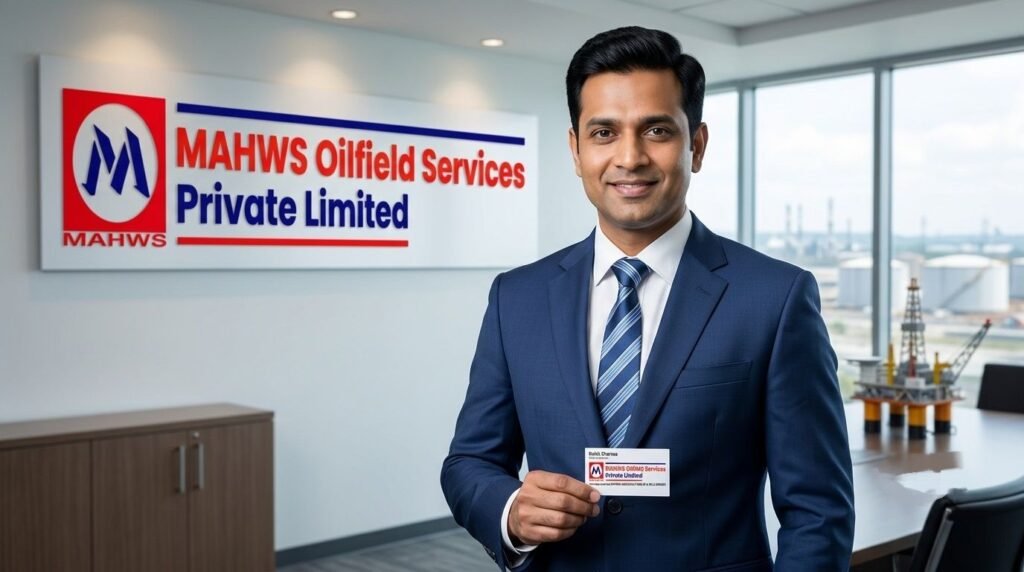
The story of Rohit Sharma and MAHWS Oilfield Services Private Limited is a story about professional development, technical confidence, quality consciousness and the gradual transformation of competence into business value.
Located in the TTC Industrial Area of Pawne, Navi Mumbai, MAHWS Oilfield Services Private Limited operates in an industrial environment where technical knowledge, operational discipline and reliability are particularly important. Oilfield-related activities frequently involve complex equipment, demanding working environments and situations in which technical mistakes can have consequences beyond ordinary commercial inconvenience. In such an environment, competence is not simply a personal advantage. It can become an important component of organizational credibility.
For Rohit Sharma, professional growth therefore could not be viewed only through the traditional measurements of experience, responsibility or years spent in an industry. The increasingly important question was whether knowledge and practical ability could be demonstrated through a recognized framework.
The company’s certification journey became part of this broader transition.
The foundation associated with ISO 9001 quality-management thinking encouraged an important change in attitude: quality should not exist only as a statement in company documents. It should become part of everyday work. Procedures, responsibilities, records, communication, customer requirements and continual improvement all needed to be considered systematically. (https://mathewassociates.com/)
For a technical organization, this way of thinking creates an important bridge between management and technical operations.
Rohit Sharma’s journey represented that bridge.
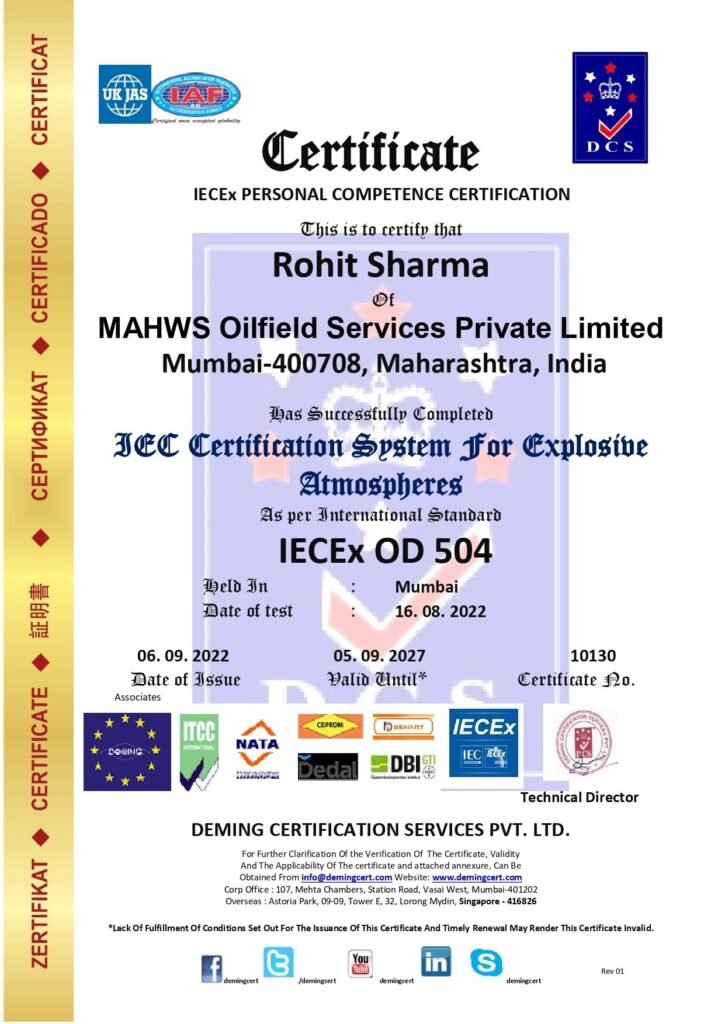
In 2022, the professional milestone became more specialized through IECEx Personnel Competence Certification associated with IECEx OD 504. IECEx describes its personnel competency scheme as an independent means of evaluating whether an individual can apply relevant knowledge and practical skills in hazardous-area work.
This distinction was important.
A training certificate can show that a person participated in learning. A competence certification framework is designed around assessment of the person’s ability to demonstrate relevant competence. IECEx itself notes that training is an input to competence, but successful completion of training alone does not constitute IECEx personnel certification.
For Rohit Sharma, this created a stronger professional identity.
The certification was not simply another document placed inside an office file. It became a symbol of a more disciplined approach to technical responsibility.
The timing was also significant. The industrial sector was becoming increasingly interconnected. Clients were looking for suppliers and service organizations that could demonstrate reliability. Technical organizations were expected to understand not only their own products and services but also the risks associated with the environments in which those services were delivered.
In explosive or hazardous atmospheres, competence assumes an even greater importance.
IECEx’s framework recognizes that work in hazardous areas requires specific knowledge, skills and experience and that competence needs to be maintained over time.
This principle helped reshape the way Rohit viewed professional development.
Instead of asking, “What certificate can I obtain?”, the more meaningful question became, “What competence can I demonstrate?”
That change in thinking gradually affected the organization around him.
Documentation became more meaningful.
Technical discussions became more structured.
Customer requirements received greater attention.
Risk awareness became more closely connected with operational planning.
And professional credibility increasingly became associated with demonstrated capability rather than verbal assurances.
The certification journey also provided a foundation for future conversations with customers, suppliers, contractors and industry professionals.
When a company operates in technically sensitive sectors, every successful assignment contributes to reputation. A technically competent individual can therefore contribute to organizational confidence far beyond the immediate task being performed.
Rohit’s IECEx certification became one such contribution.
The certificate carried an issue date of 2022 and validity through 2027 as supplied for this case. That five-year period also created a longer-term responsibility: certification was not the end of learning. It was a commitment to maintaining competence.
This became one of the central themes of MAHWS’s development.
Quality was no longer treated as an event.
Competence was no longer treated as a one-time achievement.
Certification was no longer treated merely as a framed document.
Instead, all three became elements of a continuing professional journey.
The story of Rohit Sharma therefore began not with a dramatic overnight transformation, but with a simple and powerful realization: in specialized industrial work, credibility grows when knowledge, process discipline and demonstrable competence come together.
That realization would influence the next stage of his professional development and the evolving identity of MAHWS Oilfield Services Private Limited.
#RohitSharma
Chapter 2 – Understanding Why Competence Matters
The second stage of Rohit Sharma’s journey was understanding the real meaning behind the certification.
It is easy to misunderstand professional certification.
Some organizations consider certification primarily as a marketing requirement. Others see it as a customer-documentation requirement. Some professionals regard it as another qualification to add to their curriculum vitae.
But the deeper value of certification becomes visible when the requirements of the workplace are examined carefully.
Hazardous-area work is an environment where theoretical knowledge must connect with practical application. IECEx explains that competence includes knowledge, skills and experience and that its certification scheme evaluates the ability of personnel to apply knowledge and practical skills in relevant hazardous-area activities.
For Rohit, this principle encouraged a change in professional behavior.
Technical work could no longer be viewed simply as completing an assignment.
Each assignment needed to be considered from several perspectives:
What is the customer’s requirement?
What technical standards are relevant?
What risks exist?
What equipment or systems are involved?
What competence is necessary?
What records should be maintained?
What evidence can demonstrate that the work was performed correctly?
This systematic thinking was closely aligned with the broader philosophy of quality management.
ISO 9001 thinking emphasizes process control, customer focus, evidence-based decision-making and continual improvement. IECEx personnel competence certification, meanwhile, focuses on the demonstrated ability of individuals to perform relevant work functions within the explosive-atmosphere field.
Together, these approaches can create a powerful professional framework.
One focuses heavily on the management system.
The other focuses strongly on individual competence.
For an oilfield-services organization, both perspectives can be valuable.
Rohit’s development therefore became an example of how organizational quality and individual competence can reinforce each other.
The IECEx framework is structured around Units of Competence rather than simply giving a generalized qualification for every possible hazardous-area activity. IECEx lists units covering areas such as basic principles of protection, hazardous-area classification, installation, maintenance, inspection, design and auditing.
This modular approach has an important practical advantage.
It recognizes that people perform different functions.
A person responsible for installation does not necessarily have the same responsibilities as a person performing detailed inspection. A person involved in design may require a different competence profile from someone responsible for maintenance.
Rohit’s certification journey therefore encouraged a more precise understanding of professional responsibility.
Instead of considering technical expertise as one large category, competence could be viewed as a collection of specific capabilities.
This mindset gradually influenced internal discussions at MAHWS.
When employees or associates discussed technical tasks, the focus increasingly moved toward the exact activity being performed.
When a new assignment was considered, the team could ask whether the necessary expertise was available.
When a customer presented a technical requirement, the organization could consider whether the requirement matched its actual competence.
When documentation was prepared, the emphasis could move toward evidence rather than assumptions.
This was an important cultural change.
Quality systems are most effective when they influence behavior rather than merely create paperwork.
For Rohit, certification became a personal reminder that professional responsibility must be demonstrated.
The result was a stronger relationship between technical work and documentation.
Reports could be treated as evidence.
Checklists could be treated as control mechanisms.
Inspection records could be treated as operational memory.
Customer feedback could become an input for improvement.
Lessons learned could be incorporated into future work.
This process gradually strengthened organizational maturity.
The certification also became a communication tool.
When dealing with customers who were unfamiliar with MAHWS, Rohit could communicate the organization’s seriousness through documented competence rather than relying entirely on personal introductions.
This did not automatically guarantee business. IECEx itself makes clear that certification does not automatically provide access to every site or satisfy every country’s or industry’s requirements.
That limitation was actually useful.
It encouraged realistic expectations.
Certification was not viewed as a shortcut.
Instead, it was viewed as one part of a larger professional qualification framework.
The company still needed to understand customer requirements, site rules, legal obligations, contractual conditions and project-specific competencies.
But the certification provided a credible foundation.
Over time, this foundation helped Rohit become more confident in professional conversations.
He could discuss quality and competence with greater clarity.
He could distinguish between training and assessed competence.
He could explain why documentation mattered.
He could emphasize the importance of continuing development.
And most importantly, he could connect certification with actual work.
The journey was therefore becoming less about the certificate itself and more about what the certificate represented.
It represented accountability.
It represented technical discipline.
It represented willingness to be assessed.
And it represented a commitment to continue learning.
For MAHWS Oilfield Services Private Limited, these values became increasingly relevant as the company looked toward future opportunities.
#MAHWSOilfieldServices
Chapter 3 – From Individual Certification to Organizational Confidence

A major turning point in the story occurred when Rohit’s individual certification began influencing the way the organization viewed itself.
Companies are often described through equipment, infrastructure, turnover, projects and manpower.
Yet an organization can be defined just as strongly by the competence of the people who perform its work.
In technical industries, a company’s reputation is often built through repeated interactions.
A customer asks a technical question.
A professional provides an answer.
A project begins.
A technical problem appears.
A decision has to be made.
A report is prepared.
A corrective action is required.
A deadline approaches.
At every stage, competence becomes visible.
Rohit’s certification helped reinforce this understanding inside MAHWS.
The organization began to see professional competence not merely as an individual’s achievement but as a strategic resource.
That did not mean that every employee automatically became IECEx certified. It meant that the company could begin thinking more systematically about competence requirements for different activities.
This was an important distinction.
The certification belonged to the competent person and to the defined scope for which that person had been assessed. It could not simply be transferred to another employee.
IECEx emphasizes that Certificates of Personnel Competence provide independent evidence of an individual’s knowledge and skills within the relevant scope.
This encouraged MAHWS to think more carefully about assigning responsibilities.
The organization could identify areas where specialized expertise was necessary.
It could encourage employees to develop specific technical skills.
It could maintain training records.
It could distinguish between experienced personnel and personnel who required additional supervision.
It could create stronger documentation around competency evaluation.
This was particularly useful for an organization operating around oilfield and industrial services.
Industrial customers generally expect service providers to understand the environment in which their work will be conducted.
A technically strong company must therefore combine practical experience with structured processes.
Rohit’s certification became one piece of that structure.
Another important change was the organization’s attitude toward customer communication.
Earlier, a technical service provider might primarily explain what it could do.
With greater quality maturity, the conversation could become more evidence-based.
The company could explain:
what its personnel were competent to perform;
what standards or certification frameworks were relevant;
what documentation could be provided;
what procedures were followed;
and what limitations or additional requirements might apply.
This made conversations more professional.
It also reduced the risk of overpromising.
In the long term, honest communication can become a powerful business advantage.
A customer may not expect a service provider to claim universal capability.
Instead, customers often appreciate a supplier that understands its limits and can clearly identify what additional expertise is required.
Rohit’s professional development helped reinforce this culture.
The organization also became more conscious of continual improvement.
Certification is not a permanent substitute for learning. IECEx states that competence can evolve and may deteriorate, making continuing training and assessment important.
That principle became especially important as technology changed.
Oilfield operations evolve.
Electrical equipment changes.
Safety expectations change.
Documentation systems become digital.
Customers become more demanding.
Standards are updated.
Personnel change roles.
Each of these developments can affect competence.
Therefore, MAHWS’s growth could not depend entirely on what the company knew in 2022.
It needed to continue learning after 2022.
The period from certification toward the later years of its validity could therefore be viewed as a period of professional consolidation.
Rohit had the opportunity to use his certification as a platform for further learning rather than as the conclusion of learning.
This also created an important example for younger professionals.
An experienced person who continues learning sends a strong message to the organization.
It tells junior staff that professional development is not something that ends after employment begins.
It demonstrates that seniority does not remove the need for assessment.
It shows that technical credibility must be maintained.
And it communicates that quality is a habit rather than a slogan.
This influence can be difficult to measure in financial terms, but it can have significant organizational value.
A company with a stronger competence culture can potentially make better decisions about work allocation, technical supervision, documentation and customer requirements.
For MAHWS, this represented an important stage of growth.
The company was gradually moving from a model centered primarily on delivering services toward a more mature model centered on delivering services through controlled competence and quality-oriented processes.
Rohit Sharma’s certification became a visible symbol of that transition.
#ISO9001Certification
Chapter 4 – Building Trust Through Demonstrated Capability
Trust is one of the most important assets in industrial business.
Customers may compare prices.
They may compare delivery schedules.
They may compare equipment.
But when technical risk is involved, trust can become a decisive factor.
A customer wants to know that the organization understands the assignment.
A customer wants confidence that technical personnel are competent.
A customer wants records.
A customer wants accountability.
And a customer wants problems to be addressed professionally.
This is where Rohit’s IECEx certification became particularly valuable in the story of MAHWS.
The certificate did not guarantee a project.
It did not automatically qualify MAHWS for every industrial site.
It did not replace project-specific requirements.
IECEx explicitly states that certification does not automatically satisfy all requirements for access or work in every site, country or industry.
But it could provide independent evidence of competence within its defined scope.
That distinction allowed the company to communicate more accurately.
Instead of saying, “We are certified, therefore we can do everything,” the professional message could become:
“We have demonstrated competence in defined areas, and we will evaluate your specific requirements before undertaking the work.”
That is a more mature approach.
Over time, this type of communication can strengthen customer confidence.
It also changes internal behavior.
When a company knows that customers may evaluate competence and documentation, employees become more attentive to records.
They become more careful about procedures.
They understand why technical decisions should be documented.
They recognize that reports are not simply administrative outputs.
Documentation becomes part of the service itself.
For Rohit, this was one of the most important lessons of the certification journey.
Technical quality must be visible.
If a company performs excellent work but cannot explain what it did, what standards were considered or what evidence exists, the customer may struggle to evaluate the result.
Documentation therefore becomes the bridge between technical activity and customer confidence.
This principle also supported MAHWS’s broader quality-management approach.
An ISO 9001-oriented environment encourages organizations to consider processes, customer requirements, performance evaluation and continual improvement.
The IECEx competence framework adds a specialized technical dimension.
Together, these ideas helped create a more complete quality culture.
One part of the system asks:
“Is the organization controlling its processes?”
Another asks:
“Does the individual have the demonstrated competence to perform the relevant technical function?”
The combination can be powerful.
Rohit increasingly understood that his professional identity was connected to both questions.
His responsibility was not simply to know technical concepts.
He needed to apply them.
He also needed to communicate them.
He needed to document them.
He needed to recognize when additional expertise was required.
And he needed to maintain his competence over time.
These habits gradually became part of the organization’s professional image.
The company’s location in Navi Mumbai’s industrial environment also provided a practical context for this development.
The TTC Industrial Area and surrounding industrial ecosystem place organizations within a network of manufacturing, engineering, service and technical businesses.
In such an ecosystem, reputation can travel through professional networks.
A good technical experience can create repeat opportunities.
A well-managed assignment can produce referrals.
A professional response can strengthen relationships.
Likewise, poor documentation or weak technical discipline can damage confidence.
Therefore, every project can become part of the company’s reputation.
Rohit’s certification contributed to the positive side of this equation by providing an externally assessed professional credential.
It could be included in professional profiles and qualification discussions where relevant.
IECEx notes that certified persons can use their certificates as evidence of successfully demonstrated competence and can refer employers to the publicly available certificate information.
This creates a valuable transparency mechanism.
The certificate does not merely exist inside a company file.
Its existence can support external verification.
That transparency is important in technical industries.
It reduces dependence on unsupported claims.
It allows professional competence to become more visible.
And it encourages individuals to take ownership of their qualifications.
For Rohit, this contributed to greater confidence.
For MAHWS, it contributed to organizational credibility.
For customers, it created an additional piece of evidence when evaluating technical capability.
Thus, the certification became part of a larger trust-building cycle.
Competence created confidence.
Confidence supported professional relationships.
Professional relationships created opportunities.
Opportunities created experience.
Experience strengthened competence.
And the cycle continued.
This was not instant growth.
It was sustainable professional development built step by step.
#IECExCertification
Chapter 5 – The Role of Quality Management in Business Growth
Courtesy: The Navy Quora
The connection between certification and business growth is often misunderstood.
A certificate does not automatically produce customers.
A certificate does not automatically increase revenue.
A certificate does not automatically eliminate operational problems.
Instead, certification can provide structure.
The real growth comes when that structure is converted into better behavior, better service and stronger customer relationships.
For MAHWS Oilfield Services Private Limited, the quality-management foundation associated with ISO 9001 became important in this regard.
ISO 9001 thinking encourages organizations to understand customer requirements, manage processes, evaluate performance and continually improve.
IECEx personnel competence certification adds a specialized professional dimension.
Rohit’s 2022 certification under the IECEx personnel competence framework therefore fit naturally into a broader quality-oriented business philosophy.
The organization could begin looking at technical work as a process.
First came customer requirements.
Then technical review.
Then resource and competence evaluation.
Then planning.
Then execution.
Then inspection or verification where applicable.
Then documentation.
Then customer communication.
Then feedback and improvement.
This process-oriented approach reduced the tendency to treat each project as an isolated event.
Instead, every assignment could become a source of organizational learning.
Suppose a customer raised an unexpected technical question.
The question could be recorded.
Suppose a report required clarification.
The documentation process could be reviewed.
Suppose a technical activity revealed a recurring difficulty.
The company could examine whether additional training or procedure improvement was required.
Suppose a customer appreciated a particular method.
That good practice could potentially be incorporated into future assignments.
This is how continual improvement becomes practical.
It is not always about large innovations.
Sometimes it is simply about preventing the same problem from occurring twice.
Rohit increasingly understood this principle.
A mature organization does not merely solve problems.
It learns from them.
That learning becomes part of the system.
Over time, accumulated learning can become a competitive advantage.
The company can become faster at identifying requirements.
Employees can become better at anticipating customer concerns.
Reports can become clearer.
Communication can become more consistent.
Technical decisions can become better documented.
Training can become more targeted.
And management can make decisions based on evidence.
The IECEx certification also helped emphasize the difference between experience and demonstrated competence.
Experience remains valuable.
Years of field exposure can teach lessons that cannot be learned from books alone.
But experience is strongest when it is supported by current knowledge and structured assessment.
This is why IECEx emphasizes competence assessment rather than treating training alone as sufficient.
For MAHWS, the lesson was straightforward:
Experience should be respected.
Training should be encouraged.
Competence should be demonstrated.
Performance should be reviewed.
And learning should continue.
This philosophy also affected employee development.
A company that invests in competence can potentially create stronger internal career paths.
Junior employees can identify technical areas in which they need development.
Experienced professionals can mentor younger staff.
Management can identify skill gaps.
Training plans can be based on actual business needs.
Certification goals can be connected with organizational requirements.
The result is a more deliberate approach to human-resource development.
Rohit’s own journey became an example of this approach.
His certification demonstrated that a professional could move beyond general industry experience toward specialized competence recognition.
This could encourage others to pursue similar development.
It could also help create a culture in which learning was associated with professional pride rather than merely compliance.
That distinction matters.
When employees learn only because management tells them to learn, training can become a checkbox.
When employees understand how competence improves safety, quality and career opportunities, learning becomes self-motivated.
MAHWS’s growth story therefore cannot be reduced to a simple statement such as “certification increased business.”
A more realistic interpretation is that certification contributed to the development of professional systems that could support business growth.
It strengthened the company’s ability to present itself professionally.
It encouraged stronger competence management.
It supported quality-oriented documentation.
It contributed to customer confidence.
And it gave Rohit a recognized framework through which his technical competence could be understood.
The commercial value emerged indirectly.
Better processes can support better delivery.
Better delivery can support stronger relationships.
Stronger relationships can support repeat opportunities.
Repeat opportunities can support business stability.
Business stability can create resources for further investment in people and systems.
That creates a sustainable cycle.
The certification therefore became one part of a larger growth strategy.
#IECExOD504
Chapter 6 – Expanding Professional Identity and Market Confidence
By the middle years of the certification period, Rohit’s professional identity had evolved.
The individual who entered the certification journey was not the same professional who emerged from it.
Certification had changed the way he thought about technical responsibility.
It had also changed how he could present his professional capabilities.
A qualification has value when it is understood correctly.
Rohit’s IECEx Personnel Competence Certification provided evidence of assessed competence within the applicable scope. IECEx describes its CoPC scheme as providing independent validation of an individual’s ability to apply knowledge and practical skills in hazardous-area work.
That distinction strengthened his professional profile.
When participating in technical discussions, he could approach them from a more structured perspective.
When reviewing requirements, he could consider competence boundaries.
When discussing hazardous-area work, he could place greater emphasis on technical discipline.
When supporting MAHWS’s customers, he could contribute not only field experience but also a certification-backed understanding of competency expectations.
This created a stronger professional identity.
The effect was particularly important for a growing organization.
Smaller and mid-sized technical businesses sometimes face the challenge of demonstrating credibility when competing with larger organizations.
They may have skilled people.
They may have strong experience.
But potential customers do not always know the quality of that experience.
Recognized certifications can help make professional competence more visible.
They do not eliminate the need to prove performance.
But they can provide a starting point for trust.
For MAHWS, this meant that the company’s technical story could be communicated through multiple dimensions.
The company could discuss its services.
It could discuss its industrial experience.
It could discuss its quality orientation.
And where relevant, it could highlight the certified competence of its professionals.
This created a more complete market identity.
Rohit also became increasingly aware that professional credibility is cumulative.
One certificate does not create a reputation.
A reputation develops through consistent behavior.
A customer receives a technically sound report.
Another customer experiences professional communication.
A third customer sees that documentation is complete.
A project is delivered responsibly.
An issue is addressed transparently.
A technical limitation is explained honestly.
These experiences accumulate.
Certification can strengthen that process because it demonstrates that the individual has undergone an external assessment.
But the company must continue proving itself through performance.
This understanding protected MAHWS from one of the common mistakes associated with certification marketing: treating certification as the entire business proposition.
Instead, the certificate became evidence supporting the proposition.
The proposition remained quality service.
The value remained technical competence.
The objective remained customer satisfaction.
The certification simply strengthened the credibility of those objectives.
During this period, Rohit also became more conscious of the importance of maintaining certification.
IECEx states that CoPC certification is typically valid for five years and requires reassessment for renewal.
The five-year validity period from 2022 to 2027 therefore provided a defined professional horizon.
Rather than waiting until the final year, a forward-looking professional could use the validity period to continue development.
This could include technical reading, participation in relevant training, field exposure, review of standards, learning from project experience and preparation for future reassessment.
Such activities strengthen the idea that certification is part of a professional lifecycle.
For MAHWS, this also supported succession planning.
A company should not depend forever on one person’s knowledge.
If Rohit’s certification represented an important competence area, the organization could consider developing additional competent personnel over time.
That creates resilience.
If one professional is unavailable, the organization should still have a pathway for meeting customer requirements.
This is an important part of sustainable growth.
Growth is not simply doing more work.
Growth also means building the capability to handle greater responsibility.
As MAHWS developed, this distinction became increasingly important.
A larger workload without stronger systems can create operational pressure.
A larger workload supported by competence management, documentation and quality processes can create an opportunity for sustainable expansion.
Rohit’s certification therefore became part of a wider organizational lesson:
Do not grow faster than your ability to control quality.
Build competence before taking on greater technical responsibility.
Document what works.
Learn from what does not.
And maintain professional credibility through continuous improvement.
This philosophy helped transform certification from a static achievement into an active management resource.
It became something the company could use to shape its future.
#PersonnelCompetenceCertification
Chapter 7 – Creating a Culture of Continual Improvement
One of the strongest long-term outcomes of the certification journey was the development of a continual-improvement mindset.
Continual improvement is often misunderstood as a requirement for major technological breakthroughs.
In reality, improvement can be much smaller.
A better checklist is improvement.
A clearer report is improvement.
A faster response to a customer query is improvement.
A better training plan is improvement.
A reduction in repeated errors is improvement.
A more accurate understanding of customer requirements is improvement.
For Rohit Sharma, this way of thinking became increasingly natural after the certification journey.
The IECEx framework itself recognizes that competence can evolve and may deteriorate without continued development, which reinforces the importance of ongoing learning and reassessment.
This principle had direct relevance to MAHWS.
Technical knowledge is never completely static.
Equipment changes.
Standards evolve.
Customers introduce new specifications.
Industrial environments change.
Digital systems transform documentation.
Safety expectations increase.
New personnel join.
Experienced personnel move into different responsibilities.
All these changes require learning.
The organization therefore needed to treat competence as a living resource.
Rohit could contribute to this culture by encouraging technical discussions and sharing lessons learned.
An assignment could be reviewed after completion.
What went well?
What was difficult?
What could have been done earlier?
Was the customer’s requirement fully understood?
Was documentation sufficient?
Were technical responsibilities clearly assigned?
Did any unexpected issue occur?
Could the process be improved?
These questions may appear simple, but they create organizational learning.
Over time, the answers can become a knowledge base.
This is particularly valuable in specialized technical businesses.
When knowledge remains only in an individual’s memory, the company becomes dependent on that individual.
When knowledge is documented and shared, the organization becomes stronger.
Rohit’s experience could therefore be converted into organizational knowledge through procedures, training discussions, technical notes and lessons learned.
This also created an opportunity for younger employees.
Instead of learning only through trial and error, they could benefit from the experiences of senior professionals.
Mentoring could become more structured.
Technical competence could be discussed openly.
Employees could be encouraged to ask questions rather than hide uncertainty.
This last point is especially important in hazardous-area environments.
A professional who recognizes uncertainty and asks for guidance can prevent a problem.
A professional who pretends to know everything may create unnecessary risk.
Certification culture can encourage humility because assessment demonstrates that competence has defined boundaries.
IECEx’s modular structure reinforces this concept: a person is certified for specific Units of Competence rather than automatically becoming qualified for every hazardous-area task.
Rohit could therefore communicate a valuable professional message:
Know what you know.
Know what you do not know.
And know when additional competence is required.
That attitude strengthened the company’s risk awareness.
It also improved communication.
Instead of rushing into an unfamiliar technical task, personnel could evaluate the requirement and identify whether additional expertise, supervision or customer clarification was needed.
This is a sign of organizational maturity.
Another important improvement involved customer feedback.
Customer comments could be treated as information rather than criticism.
If a customer wanted a more detailed report, the company could examine its reporting format.
If a customer needed faster documentation, the workflow could be reviewed.
If customers repeatedly asked similar questions, the company could prepare standardized explanations or technical documentation.
These changes could save time while improving service quality.
The result was a more responsive organization.
Over several years, small improvements could accumulate into meaningful business capability.
This was one of the most important lessons from Rohit’s certification journey.
Certification created a benchmark.
Continual improvement created movement beyond the benchmark.
The certificate showed that a defined competence had been demonstrated.
The organization’s ongoing efforts determined how effectively that competence was applied in real-world business.
Therefore, the period from 2022 onward became more than a certification validity period.
It became a period of professional development.
Rohit had an opportunity to strengthen his technical knowledge.
MAHWS had an opportunity to strengthen its systems.
Employees had an opportunity to learn.
Customers had an opportunity to experience increasingly professional service.
And the company had an opportunity to convert quality principles into competitive strength.
That was the deeper meaning of continual improvement.
#ExplosiveAtmospheres
Chapter 8 – From Certification to Sustainable Business Development
Business growth becomes meaningful only when it can be sustained.
A company can experience temporary growth because of one large contract, one major customer or one exceptional market opportunity.
But sustainable growth requires systems.
It requires people.
It requires knowledge.
It requires financial discipline.
It requires customer relationships.
And it requires operational consistency.
For MAHWS Oilfield Services Private Limited, the certification journey contributed to this broader foundation.
Rohit’s IECEx certification represented specialized competence.
The quality-management approach associated with ISO 9001 represented process discipline.
Together, they created a framework through which technical services could be delivered with greater attention to consistency and evidence.
The organization could increasingly view every customer engagement as a complete cycle.
The process could begin with understanding requirements.
Then came evaluation of capability.
Then planning.
Then execution.
Then verification.
Then reporting.
Then customer feedback.
Then improvement.
This cycle has a strong connection with quality-management thinking.
It also supports business development.
Why?
Because a company that understands its own capabilities can market more intelligently.
Instead of pursuing every possible opportunity, it can identify areas where its competence is strongest.
Instead of making broad claims, it can communicate specific capabilities.
Instead of accepting technically unsuitable work, it can evaluate requirements before committing.
This can reduce the risk of operational overextension.
Rohit’s certification helped reinforce this principle.
IECEx certification is based on defined Units of Competence, and IECEx emphasizes that the certification does not automatically make a person qualified for every job or every industrial site.
This limitation became an advantage from a management perspective.
It encouraged precision.
Precision improves decision-making.
Suppose a customer approached MAHWS with a specialized requirement.
The company could evaluate:
Does the requirement fall within our competence?
Does the project require additional certification?
Are there site-specific requirements?
Do local regulations apply?
Are additional personnel required?
Is specialized equipment necessary?
Can the work be delivered within our quality system?
These questions protect both the customer and the company.
They also support sustainable growth.
A business grows sustainably when it knows its boundaries.
This was one of the most important lessons that Rohit carried into his professional development.
He increasingly viewed quality as a business-development tool rather than merely a compliance requirement.
A strong quality system can help an organization understand its own processes.
Competent personnel can execute those processes.
Clear documentation can demonstrate the results.
Customer feedback can improve the system.
Together, these elements create a business capable of learning.
That learning capacity is valuable.
Markets change.
Customer expectations change.
Technology changes.
Companies that learn faster can adapt more effectively.
MAHWS could therefore look beyond the immediate value of a 2022 certification.
The larger question became:
What kind of organization should MAHWS become by 2027 and beyond?
The answer was not simply “a certified organization.”
It was a more mature organization with stronger technical competence, better process discipline, clearer documentation and greater customer confidence.
This distinction is crucial.
Certification can be obtained.
Organizational maturity must be developed.
A certificate has an issue date.
A culture has to be built every day.
Rohit therefore became an important contributor to that culture.
His role was not limited to holding a certificate.
He could share knowledge.
He could encourage technical discipline.
He could support younger professionals.
He could contribute to customer discussions.
He could help identify competence requirements.
And he could continue his own professional development.
The company could then build upon those contributions through systems and people.
In this way, individual competence became organizational capability.
Organizational capability became service quality.
Service quality became customer confidence.
Customer confidence became the foundation for future business opportunities.
That was the real pathway from certification to growth.
It was gradual.
It was evidence-based.
And it was sustainable.
#OilfieldServices
Chapter 9 – Rohit Sharma as a Symbol of Professional Transformation
The story of MAHWS Oilfield Services Private Limited cannot be separated from the professional journey of Rohit Sharma.
Organizations are built by people.
Processes may define how work should be performed, but people bring those processes to life.
Rohit’s certification journey therefore represented more than an individual achievement.
It represented a transformation in professional identity.
Before certification, technical knowledge may primarily have been understood through experience.
After certification, knowledge could be understood through a combination of experience, training, assessment and documented competence.
This was a major change.
The IECEx personnel competence scheme provides a structured means of independently assessing competence for individuals working in or associated with hazardous areas.
For Rohit, that structure provided a professional benchmark.
He could compare his existing knowledge against defined competency expectations.
He could identify areas requiring improvement.
He could recognize the importance of practical assessment.
And he could appreciate the responsibility associated with working in technically sensitive environments.
This transformed certification into a learning experience.
The value was not simply that Rohit could say he was certified.
The value was that he understood why competence matters.
He understood why standards matter.
He understood why technical boundaries matter.
He understood why documentation matters.
He understood why continuing development matters.
These lessons influenced his approach to work.
Over time, this professional mindset could influence colleagues.
People often learn not only through formal training but also by observing experienced professionals.
When a senior person carefully checks a requirement, others notice.
When a technical professional refuses to make an unsupported claim, others learn.
When someone insists on proper documentation, it establishes a standard.
When someone asks for additional technical support rather than taking an unnecessary risk, it creates a culture of responsibility.
Rohit therefore became a practical example of quality culture.
His certification could also contribute to the organization’s external image.
In discussions with customers, professional associations, technical partners or other stakeholders, certification provided an objective element that could support the company’s credibility.
But the most important impact remained internal.
The certificate reminded Rohit that professional competence has to be maintained.
IECEx states that CoPC certification is typically valid for five years and requires reassessment for renewal.
This creates a powerful professional principle:
Achievement must be followed by maintenance.
Maintenance must be followed by improvement.
Improvement must be followed by reassessment.
And reassessment begins another cycle.
This is similar to the broader philosophy of quality management.
Quality is not achieved once.
It is maintained through repeated control and improvement.
Rohit’s journey therefore connected individual professional development with organizational quality management.
The result was a more mature understanding of growth.
Growth was no longer simply about increasing workload.
Growth meant increasing capability.
It meant developing better people.
It meant improving systems.
It meant serving customers more effectively.
It meant understanding technical limitations.
It meant documenting results.
It meant becoming more reliable.
It meant preparing for future requirements.
This is why Rohit’s story is relevant beyond one certificate.
His journey demonstrates how certification can become a catalyst for professional transformation when the certificate is supported by genuine learning and practical application.
For MAHWS, the benefit was the creation of a stronger technical identity.
For Rohit, the benefit was a stronger professional identity.
For customers, the benefit was another source of confidence when evaluating technical competence.
For future employees, the story provided an example of what professional development could look like.
And for the organization as a whole, the certification created a foundation on which future capability could be developed.
The most important achievement, therefore, was not the certificate itself.
It was the change in mindset that followed.
Rohit increasingly approached his professional responsibilities with a quality-oriented perspective.
He recognized that technical work affects people, equipment, business continuity and reputation.
He understood that competence is demonstrated through action.
And he recognized that professional growth does not end when a certificate is issued.
The journey continues.
#QualityManagement
Chapter 10 – Looking Toward 2027 and Beyond
The final chapter of this certification story is not really an ending.
It is a transition.
The IECEx certification supplied for this case was issued in 2022 and valid through 2027. That period provided Rohit Sharma and MAHWS Oilfield Services Private Limited with several years in which the value of the certification could be translated into professional development, organizational learning and customer confidence.
As the validity period approached its later stage, the focus naturally shifted toward the future.
What had the company learned?
What competencies had been strengthened?
What processes had improved?
What customer expectations had changed?
What new technologies had emerged?
What additional training was required?
What should be done before reassessment?
These questions were more important than simply asking whether the certificate had been renewed.
The true objective was continuity of competence.
IECEx explains that competence certification is maintained through reassessment, and that continuing development is important because competence can change over time.
This created an opportunity for Rohit to approach the next stage proactively.
Rather than waiting for certification renewal requirements to arrive, he could treat the approaching milestone as a professional review.
His experience since 2022 could be examined.
Technical knowledge could be refreshed.
Relevant standards could be reviewed.
Training gaps could be identified.
Practical experience could be documented.
Professional records could be organized.
The same approach could be applied at the organizational level.
MAHWS could review its competence matrix.
It could evaluate which technical activities required specialist personnel.
It could review customer feedback.
It could assess internal procedures.
It could identify documentation improvements.
It could consider future certification requirements.
It could develop additional technical personnel.
This would transform certification renewal from an administrative activity into a strategic planning exercise.
The company could also consider how its quality-management foundation should evolve.
ISO 9001 principles could continue supporting process control, customer focus and continual improvement.
IECEx competence requirements could continue supporting specialized professional capability.
The two systems could reinforce one another.
The organization could build a future in which quality was embedded into daily work rather than treated as a separate department.
This would be especially valuable as MAHWS expanded its professional network.
Every new customer would bring new expectations.
Every new project would bring new learning.
Every new employee would bring new skills.
Every new technology would create new opportunities.
But expansion would need to remain controlled.
The company’s future success would depend on its ability to grow without compromising the principles that created its credibility.
Rohit’s journey provided an important lesson in this regard.
Certification should never become an excuse for complacency.
Instead, certification should create greater responsibility.
Once a professional has demonstrated competence, expectations become higher.
Customers expect professionalism.
Colleagues expect leadership.
Management expects reliability.
The professional therefore has an opportunity to become a standard-setter.
Rohit could use his experience to encourage a culture in which competence was continuously developed.
That could include mentoring.
It could include technical workshops.
It could include documented lessons learned.
It could include refresher training.
It could include encouraging colleagues to pursue appropriate competence certification.
It could include stronger project reviews.
These activities would help ensure that the knowledge represented by one person’s certification could influence the organization as a whole.
The larger story of MAHWS Oilfield Services Private Limited is therefore one of evolution.
The company began with the practical realities of industrial and oilfield services.
Quality-management thinking introduced greater process discipline.
Rohit’s IECEx certification added specialized competence recognition.
Experience transformed certification into practical knowledge.
Practical knowledge strengthened organizational confidence.
Organizational confidence supported professional relationships.
And professional relationships created a foundation for future growth.
The journey from 2022 toward 2027 can therefore be understood as a journey from certification to capability.
The certificate was the milestone.
The capability was the achievement.
The culture of quality was the lasting benefit.
Looking beyond 2027, the objective should not simply be to preserve an old certificate.
The objective should be to preserve the competence, discipline and learning culture that made the certification meaningful.
That is how a certification can become part of a company’s long-term identity.
That is how a professional credential can contribute to organizational maturity.
And that is how Rohit Sharma’s individual achievement can become part of the continuing story of MAHWS Oilfield Services Private Limited.
#IndustrialSafety
Conclusion
Rohit Sharma’s professional journey with MAHWS Oilfield Services Private Limited illustrates how certification can contribute to growth when it is supported by genuine competence, quality management and continual improvement.
The IECEx Personnel Competence Certification associated with IECEx OD 504, issued in 2022 and supplied as valid through 2027, represented a significant professional milestone.
IECEx OD 504 establishes specifications for competence assessment outcomes for personnel working with equipment associated with explosive atmospheres, while the IECEx personnel competency scheme provides independent assessment of relevant knowledge and practical skills.
For Rohit, the achievement became more than a qualification.
It became a professional responsibility.
For MAHWS, it became more than a certificate in a file.
It became part of a broader quality and competence culture.
The company’s growth story therefore should not be measured only through numerical indicators. It can also be measured through stronger systems, improved technical confidence, better documentation, clearer customer communication, stronger competence management and a greater commitment to continual learning.
The most valuable lesson is simple:
Certification creates recognition, but competence creates value.
Quality systems create structure, but people create performance.
Experience creates knowledge, but continual improvement turns knowledge into capability.
And when these elements come together, an organization can build a stronger foundation for sustainable growth.
For Rohit Sharma and MAHWS Oilfield Services Private Limited, the 2022 certification milestone can therefore be remembered not merely as a certificate issue date, but as an important chapter in a continuing journey toward professional excellence, technical responsibility and quality-driven business development.
#HazardousAreaCertification #TechnicalCompetence #OilAndGasIndustry #QualityAssurance #BusinessGrowth
Take the Next Step Today
Don’t wait to enhance your business’s quality and efficiency. Partner with Sanatan Dharma Accreditation Boards and experience the transformation that comes with expert consultancy and training. Contact us today to learn more about how we can help you achieve your business goals. Reach out via phone at +91-8668266780, visit our website at sanatanboards.com, or email us at info@sanatanboards.com Let us be your guide on the journey to excellence and innovation.





