
Madhusudan Sen
Table of Contents

Chapter 1 – The Beginning of a Professional Journey
Every successful professional journey begins with a willingness to accept responsibility. In industries connected with oilfields, engineering services, hazardous locations and explosive atmospheres, responsibility has a meaning far deeper than simply completing a job on time. It means understanding risk, respecting procedures, maintaining technical discipline and ensuring that every activity is performed by people who possess the knowledge and competence required for the work.
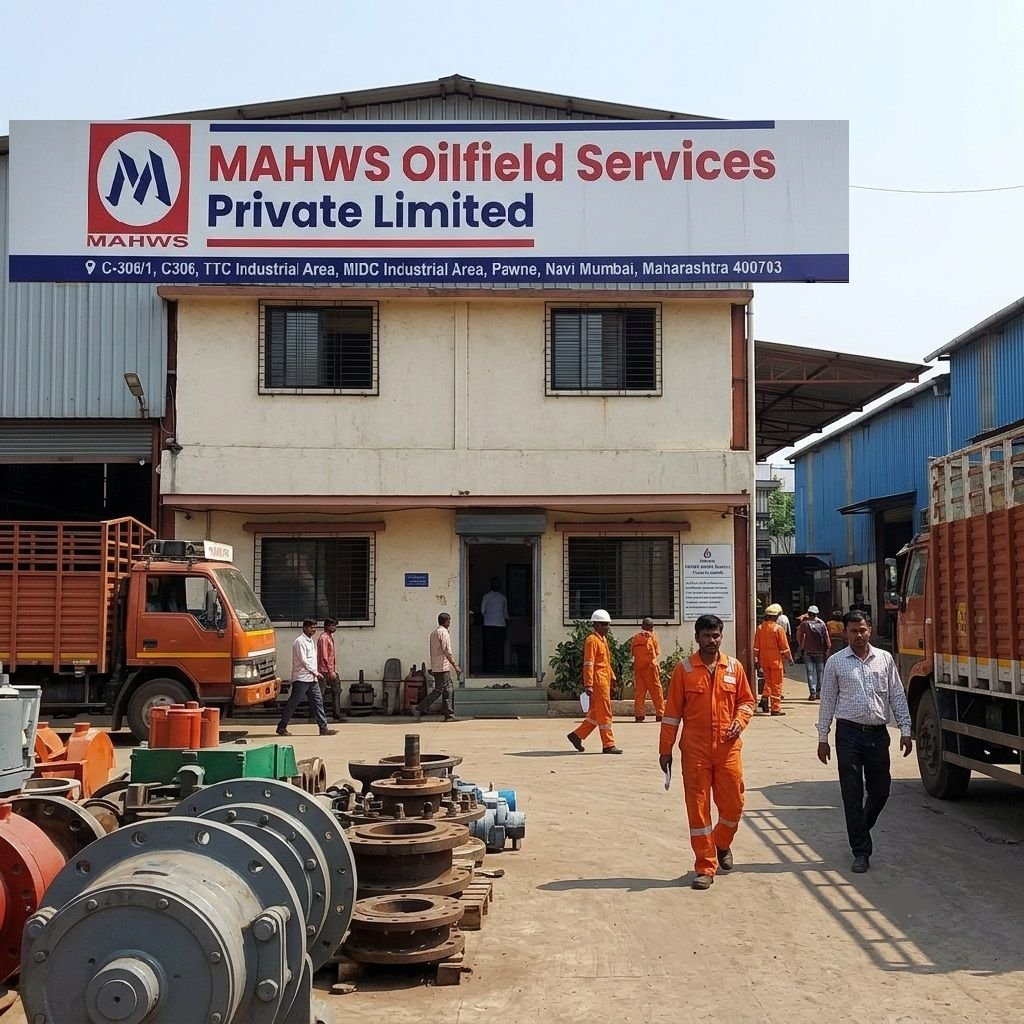
For Madhusudan Sen, associated with MAHWS Oilfield Services Private Limited at C-306/1, C306, TTC Industrial Area, MIDC Industrial Area, Pawne, Navi Mumbai, Maharashtra, the journey toward professional recognition was rooted in precisely this understanding.
The oilfield-services environment is fundamentally different from ordinary commercial work. The working environment may involve flammable gases, vapours, hazardous substances, specialized equipment, electrical installations and operating conditions where a small mistake can have consequences far beyond the immediate task. IECEx itself explains that hazardous-area safety depends strongly on the competence of people involved in planning, installation, operation, inspection, maintenance, repair and related activities. (https://mathewassociates.com/)
That reality makes competence a professional asset.
For an individual such as Madhusudan Sen, competence was not merely a line on a résumé. It represented the ability to demonstrate that technical knowledge could be applied responsibly in an environment where safety and quality were inseparable.
MAHWS Oilfield Services Private Limited operated within an industrial ecosystem where clients increasingly expected evidence of capability. In earlier generations of industrial contracting, experience and personal recommendations could often open doors. But modern industrial procurement has become increasingly structured. Customers want documentation. They want qualified people. They want traceability. They want assurance that technical activities are performed according to recognized requirements.
This changing environment created an important opportunity.
Certification could transform professional experience into independently recognizable competence.
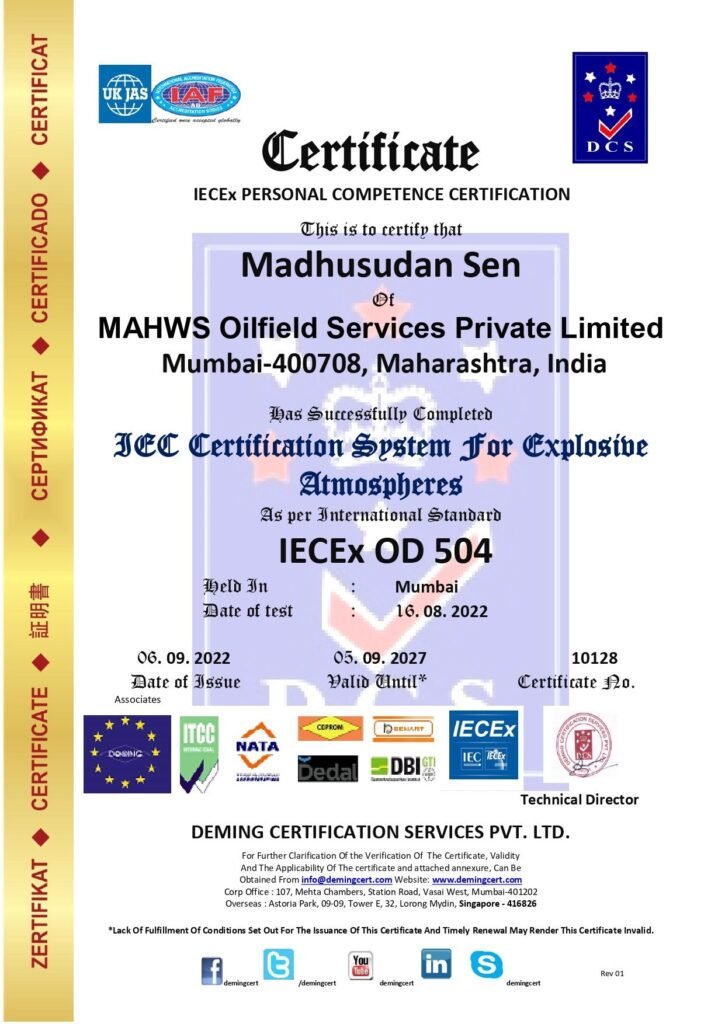
The year 2022 became an important milestone in Madhusudan Sen’s professional story. The IECEx Personnel Competence Certification associated with IECEx OD 504 provided a formal framework through which competence could be assessed and documented. IECEx identifies OD 504 as the specification for units of competence assessment outcomes within its Personnel Competencies Scheme.
The significance of this achievement went beyond possessing a certificate.
A certificate becomes meaningful when it reflects disciplined preparation, technical understanding and the ability to demonstrate competence. IECEx emphasizes that certification is based on assessment and independent validation rather than simply attendance at training.
For Madhusudan Sen, therefore, the certification represented a professional transition.
It was a transition from simply saying, “I have experience,” to being able to say, “My competence has been formally assessed.”
That distinction matters greatly in the oilfield-services sector.
MAHWS Oilfield Services Private Limited was located in the TTC Industrial Area of Pawne, Navi Mumbai, a region surrounded by engineering, manufacturing, industrial and service organizations. Such an ecosystem creates both opportunities and competition. Companies must demonstrate why clients should trust them, and professionals must demonstrate why their expertise deserves responsibility.
Quality management and technical competence began to work together.
ISO 9001 provides a framework for organizations to establish, implement, maintain and continually improve a quality-management system. Within an organization serving industrial customers, this philosophy can influence everything from documentation and communication to corrective action, customer satisfaction and continual improvement.
The certification journey therefore became part of a larger professional philosophy.
For Madhusudan Sen, quality was not simply about producing a document. It was about creating confidence.
Confidence for customers.
Confidence for colleagues.
Confidence for management.
And confidence within the professional himself.
The 2022 certification became a visible milestone in that journey. With validity extending to 2027 as supplied for this case story, the certification period created an opportunity for continued professional development and application.
The story that followed was not about a certificate hanging on a wall.
It was about what happened when competence became part of professional identity.
It was about how a recognized qualification could strengthen credibility.
It was about how quality principles could influence daily work.
And most importantly, it was about how a professional commitment to competence could support the wider growth story of MAHWS Oilfield Services Private Limited.
The journey had begun with knowledge.
It would continue through discipline.
And it would ultimately become a story of trust.
#MadhusudanSen
Chapter 2 – Understanding the Importance of Quality
Quality in the oilfield-services sector cannot be treated as an isolated department. It must become part of the way work is planned, executed, checked and improved.
For Madhusudan Sen and MAHWS Oilfield Services Private Limited, the growing importance of certification reflected a broader change in the industrial marketplace.
Customers were becoming more careful.
Procurement teams were becoming more documentation-oriented.
Technical responsibilities were becoming more clearly defined.
And safety expectations were becoming increasingly important.
An organization working around hazardous-area requirements cannot depend exclusively on informal knowledge. Technical competence has to be visible, repeatable and demonstrable.
This is where the philosophy of ISO 9001 becomes relevant.
ISO describes ISO 9001 as a globally recognized quality-management standard intended to help organizations improve performance, meet customer expectations and demonstrate commitment to quality.
For a company like MAHWS Oilfield Services Private Limited, this philosophy can translate into practical habits.
A customer requirement should be understood before work begins.
Responsibilities should be clear.
Technical documentation should be controlled.
Personnel competence should be evaluated.
Equipment and tools should be appropriate for the intended activity.
Records should be maintained.
Problems should be investigated.
Corrective actions should be followed.
Customer feedback should become an input for improvement.
The transformation is subtle but powerful.
Instead of asking only, “Did we complete the work?”
a quality-oriented organization asks:
“Did we complete the work according to requirements?”
“Was the process controlled?”
“Was the responsible person competent?”
“Can we demonstrate what was done?”
“Can the same quality be reproduced next time?”
These questions create organizational maturity.
Madhusudan Sen’s IECEx Personnel Competence Certification complemented this philosophy particularly well because the certification focused on competence in relation to explosive atmospheres.
IECEx explains that its Personnel Competency Scheme provides independent validation of an individual’s ability to apply knowledge and practical skills in hazardous-area work.
That means competence becomes more than theoretical knowledge.
It becomes demonstrated capability.
For MAHWS, such an approach could strengthen the connection between people and processes.
Imagine a technical assignment involving hazardous-area equipment. A conventional approach may focus primarily on the equipment itself. A mature quality approach also asks who will work on it, whether the individual understands the applicable requirements, whether the work has been planned properly, whether appropriate documentation exists and whether the completed work can be verified.
The people executing the process become part of the quality system.
This is particularly important because technical standards and procedures cannot compensate for inadequate human competence.
A perfectly written procedure is of limited value if the person applying it does not understand the hazards involved.
Conversely, experienced personnel can contribute significantly more when their knowledge is supported by systematic procedures, documentation and continual learning.
Madhusudan Sen’s certification therefore became an important bridge between individual capability and organizational quality.
The certificate represented individual competence.
The quality-management philosophy represented organizational discipline.
Together, they created a stronger foundation.
This also affected customer conversations.
Instead of discussing only rates, schedules and deliverables, professional discussions could include competence, certification, procedures and quality assurance.
That changes the character of a business relationship.
Price remains important, but trust becomes another form of value.
A client selecting an industrial service provider is not merely buying hours of labour. The client is buying assurance that the assigned people understand their responsibilities.
The certification helped make that assurance easier to communicate.
The impact of quality was also internal.
Once a company begins taking certification seriously, employees can start seeing documentation not as unnecessary paperwork but as evidence of controlled work.
A checklist is no longer simply a form.
A record is no longer simply a file.
An inspection report becomes evidence.
A training record becomes evidence.
A corrective-action report becomes evidence.
A competence certificate becomes evidence.
Together, these records tell the story of how an organization controls its work.
This approach can also reduce dependence on individual memory.
If a process exists only in the mind of one experienced person, organizational knowledge is fragile.
If the process is documented, reviewed and continually improved, knowledge becomes organizational property.
This was one of the most important lessons emerging from the certification journey.
Growth should not depend only on working harder.
Growth should also come from working better.
For Madhusudan Sen, the 2022 certification therefore represented a commitment to professional discipline. For MAHWS Oilfield Services Private Limited, it could become part of a broader culture in which technical competence and quality management supported each other.
The result was not an overnight transformation.
It was a change in mindset.
And every sustainable business transformation begins with a change in mindset.
#MAHWSOilfieldServices
Chapter 3 – The Significance of IECEx OD 504
To understand the importance of Madhusudan Sen’s certification, it is necessary to understand why IECEx personnel competence matters.
Explosive atmospheres create conditions in which the presence of a flammable gas, vapour, mist or combustible dust can create a potential explosion hazard when combined with an ignition source.
IECEx notes that industries with hazardous locations include oil refineries, oil rigs and processing plants, offshore facilities, tankers, drilling ships, chemical-processing plants, aircraft-refuelling environments and other specialized facilities.
This makes competence critical.
A person entering such an environment may be exposed to responsibilities involving specialized equipment, installation practices, inspection requirements, maintenance procedures or technical assessments.
IECEx’s Personnel Competence Scheme was developed to provide confidence that people working in hazardous areas possess assessed competence.
IECEx OD 504 has a specific role within this system.
The IECEx Operational Documents page identifies OD 504 as the “Specification for Units of Competence Assessment Outcomes.”
This is significant because the scheme is based on defined competence units rather than vague descriptions of professional ability.
The IECEx framework identifies multiple competency areas, including basic principles of protection, hazardous-area classification, installation, maintenance, overhaul and repair, testing, inspection, design and audit-related functions.
Such modularity allows competence to be connected with actual work functions.
For Madhusudan Sen, this structure meant that professional competence could be presented in a form recognized within an international framework.
That can have considerable value in industrial services.
Consider the difference between two professional statements.
“I have worked in this field for many years.”
and
“I have demonstrated competence under a recognized personnel-certification scheme.”
The first communicates experience.
The second communicates experience plus independently assessed competence.
Neither statement eliminates the need for responsible work practices. Certification is not a substitute for experience, supervision, company procedures or regulatory compliance. But it provides an additional layer of confidence.
IECEx specifically explains that competence includes knowledge, skill, experience and training, and that competence can evolve over time.
This creates another important lesson.
Certification should not be treated as the end of learning.
It should be treated as a milestone in learning.
A professional working in a technical field must continue developing.
Standards change.
Technology changes.
Equipment changes.
Customer expectations change.
Work environments change.
Therefore, competence has to be maintained.
IECEx indicates that Certificates of Personnel Competence are typically maintained through reassessment at five-year intervals.
The 2022–2027 period supplied for Madhusudan Sen’s certification therefore represents more than a validity period. It can be viewed as a professional development window.
Within that period, experience could deepen.
Technical knowledge could expand.
Customer exposure could increase.
Organizational processes could mature.
And the relationship between quality management and technical competence could become stronger.
This is where MAHWS Oilfield Services Private Limited could derive organizational value.
When a company has personnel with recognized competence, the company can use that competence as one component of its overall service proposition.
For a client, the question is often:
“Who will perform this work?”
The answer can influence the client’s confidence in the entire project.
The professional identity of Madhusudan Sen therefore became connected with the organizational identity of MAHWS.
His competence could support the company’s credibility.
The company’s systems could support his professional capability.
This relationship is important.
A certified individual working in a poorly controlled organization may struggle to deliver consistent quality.
Similarly, a highly organized company without technically competent personnel may also face difficulties.
The strongest model is the combination.
Competent people + controlled processes + customer focus + continual improvement = sustainable professional credibility.
This became one of the central themes of the MAHWS growth journey.
The certification also created a language for discussing competence with customers.
Instead of using general statements such as “experienced staff,” organizations can point toward structured competence requirements.
This makes professional communication clearer.
It helps procurement teams understand the basis of technical capability.
It can support tender documentation.
It can strengthen technical presentations.
It can contribute to prequalification discussions.
And it can improve the professional image of the organization.
None of these outcomes should be interpreted as a guarantee of contracts or revenue.
Certification does not automatically create business.
What it can do is strengthen the foundation upon which business opportunities are pursued.
For Madhusudan Sen, that foundation was built in 2022.
The certificate became a symbol of a broader principle:
In hazardous industrial environments, competence is not an optional advantage. It is part of responsible professional practice.
#IECExCertification
Chapter 4 – From Individual Certification to Organizational Confidence
The most meaningful certification stories are not about certificates alone.
They are about what organizations do with the confidence created by certification.
After Madhusudan Sen achieved the IECEx Personnel Competence Certification in 2022, the next challenge was to integrate that professional achievement into the wider working culture of MAHWS Oilfield Services Private Limited.
A certificate has limited organizational value if it remains isolated from everyday processes.
The real opportunity begins when the organization asks:
“How can this competence improve the way we work?”
That question can lead to improvements across multiple areas.
The first is planning.
Industrial service activities require planning before execution. Scope, responsibilities, resources, technical requirements and safety considerations need to be understood.
A quality-focused approach encourages the team to identify requirements before starting work rather than discovering them during execution.
The second area is documentation.
A mature service organization recognizes that documentation is part of the deliverable.
Work instructions, inspection records, technical reports, competency records, customer communications and corrective-action documentation can all contribute to traceability.
The third area is communication.
Industrial projects often involve multiple parties. Customers, contractors, engineers, supervisors, inspectors and management may all have different responsibilities.
Clear communication reduces misunderstandings.
The fourth area is competence management.
Not every task should automatically be assigned to every employee.
Responsibilities should be aligned with competence.
This is particularly important in hazardous-area work.
IECEx explains that its scheme provides certification against specific competence units and work functions.
Therefore, competency should be treated as something specific rather than generic.
The fifth area is continual improvement.
A quality-oriented organization does not simply ask whether a project was completed.
It asks what could have been done better.
Was there a recurring customer complaint?
Was a document difficult to prepare?
Was there unnecessary rework?
Was a technical requirement misunderstood?
Was a tool or instrument unavailable when required?
Did the project require better planning?
Each problem becomes an opportunity to strengthen the system.
For MAHWS, these principles could support a gradual change in organizational behavior.
Instead of viewing quality as an audit requirement, quality could become a management philosophy.
This is consistent with the broader purpose of ISO 9001, which ISO describes as a framework for establishing, implementing, maintaining and continually improving a quality-management system.
Madhusudan Sen’s certification could therefore become a practical example of how competence and quality interact.
Suppose a customer asks for evidence that personnel assigned to hazardous-area work are competent.
The organization can respond with structured evidence.
Suppose a client requests details about technical responsibility.
The company can provide documented role allocation.
Suppose a project encounters a problem.
The organization can investigate the cause rather than simply correcting the immediate symptom.
Suppose a customer provides feedback.
The company can treat the feedback as an input for improvement.
These practices create confidence.
Confidence is especially valuable in technical services because customers often cannot directly observe every aspect of the work.
A client may see the final report.
The client may see the completed installation.
The client may see the inspection result.
But the client may not see every decision made during execution.
Documentation and certification provide visibility.
They allow the organization to demonstrate that important activities were controlled.
This is one reason certification can support business development indirectly.
A professional service company grows when customers trust it enough to assign responsibility.
Trust develops through repeated experiences.
Certification can contribute to that trust by providing independent evidence of competence.
For Madhusudan Sen, the IECEx certification became part of that evidence.
For MAHWS, the broader quality approach became an organizational framework.
The result was a stronger professional identity.
The company could position itself not merely as a service provider but as an organization committed to controlled processes, technical competence and customer requirements.
This distinction becomes important when competing for industrial work.
Many organizations can offer manpower.
Many can offer technical services.
Many can offer competitive pricing.
But organizations that combine technical capability with quality discipline can create a more compelling value proposition.
The growth story therefore began to move beyond the individual.
Madhusudan Sen’s achievement became part of MAHWS’s collective professional story.
His certification demonstrated competence.
The organization’s quality practices demonstrated discipline.
The combination created credibility.
And credibility became an important foundation for growth.
#IECExOD504
Chapter 5 – The Customer’s Perspective
Courtesy: The Navy Quora
Business growth ultimately depends on customers.
A company may have excellent systems, experienced professionals and impressive documentation, but sustainable growth requires customers to recognize value.
For an industrial organization like MAHWS Oilfield Services Private Limited, customer confidence can be particularly important because the services may involve technically demanding and potentially hazardous environments.
Customers do not simply want work to be completed.
They want work to be completed responsibly.
They want competent people.
They want reliable communication.
They want documentation.
They want predictable quality.
They want problems to be addressed quickly.
They want evidence that the service provider understands the seriousness of the assignment.
This is where Madhusudan Sen’s IECEx Personnel Competence Certification could become an important part of the customer conversation.
The certification gave an objective professional reference point.
IECEx describes its Personnel Competency Scheme as providing independent validation of a person’s ability to apply knowledge and practical skills in hazardous-area environments.
For a customer, this is meaningful.
It shifts the conversation from personal claims to assessed competence.
It does not mean that certification alone guarantees successful project delivery. Nor does it eliminate the need for company-level systems, safety controls, supervision and project-specific competence.
But it can strengthen the overall evidence package.
In procurement situations, documentation can be decisive.
A customer may ask for:
- Competency certificates
- Experience records
- Technical qualifications
- Training evidence
- Inspection procedures
- Quality-management documentation
- Calibration records
- Work reports
- Corrective-action records
- Safety documentation
Each document answers a question.
“Can this person perform the work?”
“Does the organization control the process?”
“Can the organization demonstrate what it has done?”
“Does the company learn from problems?”
“Can the customer rely on the service provider?”
The quality-management philosophy helps connect these answers.
ISO 9001 emphasizes customer focus and continual improvement as part of quality management.
For MAHWS, this can mean that customer requirements are not treated as a one-time transaction.
They become inputs into the organization’s operating system.
A customer complaint can become a corrective-action opportunity.
A repeated request can become a standardized procedure.
A documentation problem can lead to a revised format.
A technical observation can become a training topic.
A successful project can become a model for future work.
This is how organizations become stronger over time.
Madhusudan Sen’s professional certification could also contribute to customer confidence during technical discussions.
When customers understand that the professional responsible for relevant work has undergone formal competence assessment, the relationship can become more technically grounded.
The discussion can move from “Can you do this?” to “How will you do this?”
That is a higher level of conversation.
It allows the service provider to explain methodology, competence, controls and verification.
For MAHWS, this could support a stronger professional image in the industrial market.
The company could communicate its commitment through multiple channels.
Certificates could be included in technical submissions.
Competency information could be presented during customer meetings.
Quality procedures could support tender documentation.
Project records could demonstrate consistency.
Training and reassessment could demonstrate continuing commitment.
The company’s location in the TTC Industrial Area, Pawne, Navi Mumbai, also placed it within a major industrial environment where engineering capability and professional networking could become important sources of opportunity.
The growth process therefore became cumulative.
One successful interaction could lead to another.
One satisfied customer could provide a reference.
One well-controlled project could strengthen reputation.
One professional certification could strengthen credibility.
One improved process could reduce errors.
One documented lesson could prevent repetition.
Growth rarely comes from one dramatic event.
It often comes from hundreds of small improvements accumulating over time.
This is why the 2022 certification should be understood as a milestone rather than a magic solution.
The certification did not create customers automatically.
It created evidence.
The quality system did not create growth automatically.
It created consistency.
Madhusudan Sen’s professional competence did not eliminate risk.
It strengthened the ability to manage responsibility.
Together, these elements created a more credible foundation for business development.
For customers, the message was simple:
MAHWS Oilfield Services Private Limited understood that industrial service is ultimately built on trust.
And trust is earned through competence, consistency and responsible execution.
#PersonnelCompetenceCertification
Chapter 6 – Building a Culture of Continual Improvement
A certification becomes truly valuable when it changes behavior.
For Madhusudan Sen and MAHWS Oilfield Services Private Limited, the period following certification could therefore be viewed as a period of continual improvement.
The first improvement was cultural.
Employees and management began to see quality as everyone’s responsibility.
Quality was no longer limited to a particular person or department.
A technician could influence quality.
A supervisor could influence quality.
An administrator could influence quality.
A project coordinator could influence quality.
Management could influence quality.
Every activity contributed to the final customer experience.
This philosophy is central to a mature quality-management system.
A second improvement involved documentation.
Organizations often discover that documentation creates discipline.
When employees know that activities need to be recorded, they become more conscious of what they are doing.
When reports are reviewed, accuracy becomes important.
When corrective actions are tracked, accountability increases.
When records are retained, organizational memory improves.
This is particularly useful in technical services where projects may be separated by time and location.
A third improvement was competence development.
The IECEx certification highlighted an important principle: competence is not permanent simply because a person once passed an assessment.
IECEx states that competence depends on knowledge, skills, experience and training, and notes that competence can evolve or deteriorate over time.
That principle encourages continual learning.
Employees should remain familiar with applicable requirements.
Technical developments should be followed.
Lessons from field experience should be shared.
Training needs should be identified.
Practical exposure should be encouraged.
The fourth improvement was risk awareness.
In hazardous-area environments, risk cannot be an afterthought.
The organization needs to understand where hazards exist, what controls are required and who is responsible.
Competent personnel can contribute to better risk identification because they understand the technical context.
The fifth improvement was customer feedback.
Customer feedback is one of the most useful sources of organizational learning.
A complaint is uncomfortable.
But it can also be valuable.
If a customer complains about documentation, the organization can improve document control.
If a customer complains about communication, communication procedures can be strengthened.
If a customer identifies a technical issue, the organization can investigate the root cause.
If a customer praises a particular practice, that practice can be standardized.
This is the essence of continual improvement.
The goal is not to pretend that problems never happen.
The goal is to ensure that problems create learning.
For MAHWS, this approach could support long-term organizational maturity.
Instead of relying solely on individual experience, the organization could develop systems.
Instead of depending on verbal instructions, it could use controlled documentation.
Instead of assuming competence, it could maintain evidence.
Instead of reacting to every problem separately, it could analyze recurring causes.
Instead of measuring success only through immediate revenue, it could also consider customer satisfaction, process performance, competence and reliability.
This broader definition of success is important.
Business growth is not simply about becoming larger.
It is about becoming stronger.
A company that increases sales but loses control of quality may create future problems.
A company that grows gradually while strengthening its processes may create a more sustainable foundation.
The certification journey therefore encouraged a different understanding of growth.
Growth meant:
More confidence.
Better systems.
Stronger documentation.
Improved competence.
Greater customer trust.
Better technical communication.
More disciplined project execution.
Stronger professional reputation.
These improvements may eventually contribute to commercial expansion, but their first effect is organizational.
Madhusudan Sen’s role within this transformation became symbolic.
His IECEx certification represented an individual commitment to competence.
The organization could use that example to reinforce a wider culture.
When one professional invests in competence, others can be encouraged to do the same.
When one project is documented properly, future projects can follow the same model.
When management recognizes quality achievements, employees understand that quality matters.
This is how certification can become part of culture.
The certificate itself remains a document.
The culture becomes the real achievement.
By continuing to learn and improve, Madhusudan Sen could strengthen his own professional capability while simultaneously contributing to the credibility of MAHWS.
The company’s growth story thus became connected with a larger idea:
Quality is not a destination. Quality is a habit.
#ExplosiveAtmospheres
Chapter 7 – The Professional Growth of Madhusudan Sen
Every organizational story contains individual stories.
Behind systems, certificates, procedures and projects are people who carry responsibility.
For Madhusudan Sen, the IECEx certification represented an important step in professional development.
The value of professional certification can be understood from several perspectives.
First is knowledge.
Preparing for competence assessment encourages professionals to revisit technical principles.
Second is discipline.
Formal assessment requires preparation and attention to requirements.
Third is confidence.
Successful assessment provides evidence that the individual has met defined competence requirements.
Fourth is credibility.
A recognized certification can help communicate professional capability to employers, clients and industry stakeholders.
Fifth is career development.
A documented competence profile can support professional opportunities where hazardous-area expertise is relevant.
IECEx explains that its certificates can provide independent evidence of individual knowledge and skills and can help employers and employees identify competent personnel.
This is especially important in industries where personnel selection can influence operational risk.
Madhusudan Sen’s professional identity therefore became more strongly associated with competence.
The certificate could become part of his professional portfolio.
It could be referenced in technical submissions.
It could be included in professional discussions.
It could provide supporting evidence when responsibilities were assigned.
It could demonstrate a commitment to international competence frameworks.
However, professional growth does not end with certification.
A certificate creates responsibility.
Once a professional becomes recognized for competence, expectations can increase.
Customers may expect greater technical confidence.
Colleagues may seek guidance.
Management may assign greater responsibility.
Projects may become more demanding.
The professional therefore needs to continue learning.
This creates a virtuous cycle.
Greater competence creates greater responsibility.
Greater responsibility creates more experience.
More experience creates deeper understanding.
Deeper understanding creates better performance.
Better performance creates stronger professional reputation.
Stronger reputation creates new opportunities.
New opportunities create further learning.
This cycle can continue for an entire career.
For Madhusudan Sen, the 2022 certification can therefore be seen as a turning point in that cycle.
The period through 2027 provides an extended professional horizon in which competence can be applied, maintained and strengthened.
The certification also reinforces a professional ethic.
In hazardous-area work, confidence should never become complacency.
A certified professional must remain conscious of limitations.
When a task exceeds competence, additional expertise should be sought.
When requirements are unclear, clarification should be obtained.
When equipment is unsuitable, it should not simply be used because it is available.
When documentation is incomplete, it should be addressed.
When an unsafe condition is identified, it should be treated seriously.
This is where competence becomes ethical responsibility.
The strongest professionals are not those who claim to know everything.
They are those who know what they know, understand what they do not know and act responsibly.
This principle can influence the entire company.
Employees observe professional behavior.
If senior personnel respect procedures, others are more likely to respect them.
If managers demand accurate documentation, employees understand its importance.
If technical concerns are taken seriously, employees are more likely to report problems.
If competence is valued, employees are more likely to invest in their own development.
Madhusudan Sen’s certification could therefore contribute indirectly to organizational learning.
It became an example.
And examples are powerful.
A company can publish a quality policy.
But employees understand quality more clearly when they see it practiced.
A company can say competence matters.
But employees believe it when management invests in certification.
A company can say customers are important.
But employees understand customer focus when feedback leads to action.
The personal growth of Madhusudan Sen was therefore connected to the institutional growth of MAHWS.
His certification was an individual achievement.
Its influence could be organizational.
That is one of the most valuable characteristics of professional development.
Knowledge grows when shared.
Competence grows when practiced.
Quality grows when embedded in systems.
And businesses grow when customers trust the people behind the service.
The story of Madhusudan Sen demonstrates this relationship.
His certification was not simply a credential.
It represented a professional commitment to competence.
And that commitment could become part of the company’s wider reputation.
#OilfieldServices
Chapter 8 – The Growth of MAHWS Oilfield Services Private Limited
The growth of a technical company is rarely linear.
There are periods of rapid opportunity.
There are periods of uncertainty.
There are difficult projects.
There are demanding customers.
There are changes in market conditions.
There are new technologies.
There are evolving standards.
There are competitors offering lower prices.
And there are times when the organization must decide whether to pursue short-term business or protect long-term reputation.
Quality management can help guide those decisions.
For MAHWS Oilfield Services Private Limited, the combination of professional competence and quality orientation provided a stronger platform for sustainable development.
The first element was credibility.
A company with access to demonstrable technical competence can present a stronger professional profile.
The second was consistency.
Controlled processes make it easier to reproduce quality.
The third was traceability.
Documentation allows the organization to demonstrate what happened.
The fourth was customer confidence.
When customers see evidence of competence and systematic working methods, uncertainty can be reduced.
The fifth was organizational learning.
When projects generate documented lessons, future work can improve.
Together these elements support business resilience.
The oilfield-services market is highly dependent on trust.
Customers may be reluctant to assign technically sensitive responsibilities to organizations whose capabilities are unclear.
A company therefore needs more than a list of services.
It needs evidence.
Certification can form part of that evidence.
The IECEx Personnel Competence Scheme specifically exists to provide confidence in personnel competence for work associated with hazardous areas.
Madhusudan Sen’s certification therefore gave MAHWS a useful professional asset.
It could support conversations with customers seeking evidence of competence.
It could contribute to prequalification documentation.
It could strengthen professional presentations.
It could support the company’s technical image.
But the real growth came from combining certification with execution.
A certificate may open a conversation.
Performance determines whether the conversation continues.
That means every project becomes an opportunity to build reputation.
A well-planned assignment can create trust.
A well-written report can create confidence.
A responsive communication process can create customer satisfaction.
A technically competent intervention can create repeat business.
A properly handled problem can create loyalty.
Over time, these experiences accumulate.
This is the invisible side of business growth.
A company’s reputation is created through thousands of customer interactions.
Some are large.
Some are small.
But each contributes to perception.
MAHWS could therefore strengthen its market position by treating every project as a reputation-building opportunity.
This mindset also changes how employees view their work.
Instead of seeing a job as simply another assignment, they understand that their work represents the company.
Their documentation represents the company.
Their communication represents the company.
Their punctuality represents the company.
Their technical decisions represent the company.
Their response to problems represents the company.
This is how individual accountability becomes corporate reputation.
The quality-management philosophy reinforces this connection.
ISO describes ISO 9001 as supporting customer confidence, process improvement, complaint resolution and continual optimization.
These principles are particularly valuable to a service organization because service quality is experienced directly by customers.
A physical product can be inspected.
A service is experienced through people and processes.
Therefore, competence becomes a product in itself.
Madhusudan Sen’s expertise was part of the value delivered by MAHWS.
The organization’s procedures were another part.
Its responsiveness was another.
Its documentation was another.
Its reputation was another.
Growth occurred when all these elements worked together.
The company’s journey could therefore be understood as a movement from capability to credibility, and from credibility to opportunity.
The 2022 certification strengthened capability.
Quality systems strengthened consistency.
Customer relationships strengthened reputation.
Reputation strengthened opportunity.
And opportunity created the possibility of growth.
Importantly, this story does not depend on inventing specific revenue figures or claiming contracts that have not been supplied.
The more meaningful growth story is qualitative.
The company became better prepared to compete for work where competence and quality mattered.
Its professional image became stronger.
Its technical credibility became easier to communicate.
Its people became more conscious of competence.
Its processes could become more structured.
And its customer relationships could become more trust-based.
This is sustainable growth in its most fundamental form.
#ISO9001Certification
Chapter 9 – Looking Toward 2027 and Beyond
A certification with a 2022 issue date and 2027 validity provides a defined professional horizon.
But the end of a certificate’s validity should never be considered the end of competence.
Instead, it should be considered a checkpoint.
By the time Madhusudan Sen approaches the next stage of certification maintenance or reassessment, the experience accumulated during the preceding years can become part of a larger professional story.
The important question is not simply:
“Was the certificate maintained?”
The more meaningful questions are:
“What was learned?”
“What skills were strengthened?”
“What projects were completed?”
“What customer expectations changed?”
“What technical developments occurred?”
“What improvements were made?”
“What lessons were incorporated?”
“What new responsibilities were accepted?”
This is the difference between certification as administration and certification as professional development.
IECEx notes that competence can evolve and that continuing training and assessment are important.
Therefore, the years between 2022 and 2027 could be used strategically.
Madhusudan Sen could maintain familiarity with applicable standards.
He could participate in relevant training.
He could document professional experience.
He could maintain records of technical assignments.
He could review lessons learned.
He could contribute to internal training.
He could help younger professionals develop.
This would increase the organizational value of his competence.
For MAHWS, the next phase could involve building a stronger competency-management system.
Instead of depending on one certified individual, the organization could gradually develop multiple layers of competence.
Different employees could be trained for different responsibilities.
Competence matrices could be maintained.
Training requirements could be identified systematically.
Technical roles could be assigned based on demonstrated ability.
Such an approach would make the company more resilient.
It would reduce dependence on individual knowledge.
It would also support expansion.
A growing organization needs more than customers.
It needs capable people.
As business volume increases, management must ensure that quality does not decline.
This is where ISO 9001 thinking becomes increasingly important.
A structured quality system can help organizations scale without abandoning discipline.
Processes can be documented.
Responsibilities can be defined.
Performance can be reviewed.
Risks can be considered.
Customer feedback can be analyzed.
Corrective actions can be tracked.
Improvement can be measured.
The future of MAHWS could therefore be built around a simple principle:
Growth should increase capability, not weaken control.
The company could also strengthen its professional communication.
Its website, company profile, tender documents and customer presentations could clearly communicate:
- Technical competence
- Certification credentials
- Quality commitment
- Industry experience
- Service capabilities
- Personnel competence
- Documentation practices
- Customer-focused approach
This would allow the organization to tell its story more effectively.
Madhusudan Sen’s certification would become one part of that story.
The company would not need to claim that certification automatically guarantees safety or project success.
Instead, it could communicate what certification actually demonstrates: assessed competence within the applicable IECEx framework.
That is more credible.
Credibility is important because sophisticated industrial customers recognize exaggerated claims.
The strongest marketing is evidence-based.
Show the certificate.
Explain the scope.
Describe the competence.
Demonstrate the process.
Provide professional documentation.
Deliver consistent service.
Let customer experience build the reputation.
This approach can create a powerful cycle.
Evidence creates trust.
Trust creates opportunity.
Opportunity creates experience.
Experience creates stronger capability.
Capability creates better service.
Better service creates stronger trust.
The cycle continues.
As 2027 approaches, Madhusudan Sen’s story therefore becomes a story about renewal rather than completion.
The certification period becomes a chapter.
The next assessment becomes another chapter.
The organization continues evolving.
The market continues changing.
Technology continues advancing.
And professional development continues.
The ultimate goal is not to remain certified.
The ultimate goal is to remain competent.
Certification is the evidence.
Competence is the substance.
Quality is the system.
Customer trust is the outcome.
And sustainable growth is the long-term result.
#QualityManagement
Chapter 10 – A Legacy of Quality, Competence and Trust
Every professional journey eventually becomes a story.
For Madhusudan Sen and MAHWS Oilfield Services Private Limited, the story began with technical responsibility and developed through a commitment to competence and quality.
The 2022 IECEx Personnel Competence Certification represented an important milestone.
Its connection with IECEx OD 504 placed the professional achievement within an internationally recognized competence framework. IECEx identifies OD 504 as the specification for units of competence assessment outcomes under its Personnel Competencies Scheme.
The certification period extending to 2027, as supplied for this case story, provided a period in which that competence could be applied, maintained and developed.
But the true meaning of the achievement was larger than the certificate.
It was about responsibility.
In hazardous-area work, responsibility cannot be separated from competence.
A person working with or around equipment associated with explosive atmospheres needs appropriate knowledge and skills.
An organization assigning such work needs confidence that personnel are capable.
Customers need evidence.
Management needs systems.
And the industry needs professionals who take these responsibilities seriously.
Madhusudan Sen’s certification contributed to this larger purpose.
It provided evidence of professional competence.
For MAHWS, it became part of a broader quality story.
ISO 9001’s quality-management philosophy reinforces the importance of customer focus, process control, continual improvement and organizational consistency.
These principles can transform the way a company thinks.
Instead of asking only how much work it can obtain, the company asks how reliably it can deliver.
Instead of asking only how quickly a task can be completed, it asks whether the task can be completed correctly.
Instead of asking only whether a problem has been fixed, it asks why the problem occurred.
Instead of asking only whether an employee has experience, it asks whether competence has been demonstrated.
Instead of viewing a certificate as an award, it views certification as a responsibility.
This is the deeper meaning of the MAHWS growth story.
Growth is not simply about size.
Growth is about maturity.
A mature organization understands its risks.
A mature organization respects competence.
A mature organization listens to customers.
A mature organization documents important activities.
A mature organization learns from mistakes.
A mature organization invests in people.
A mature organization understands that reputation takes years to build and moments to damage.
Madhusudan Sen’s professional journey illustrates this philosophy.
His certification became evidence of a willingness to be assessed.
His experience became a source of practical knowledge.
His professional development became part of organizational capability.
And the company’s quality orientation created a framework in which individual competence could contribute to collective performance.
The story also contains a lesson for future professionals.
Certification should never be pursued simply because customers ask for a certificate.
It should be pursued because competence matters.
A certificate should never become an excuse for complacency.
It should become a reminder of responsibility.
A quality system should never exist only for an audit.
It should help people do better work.
A customer complaint should never be treated merely as criticism.
It should be treated as information.
And growth should never be measured only by money.
It should also be measured by capability, trust, reliability and reputation.
For MAHWS Oilfield Services Private Limited, these principles can provide a foundation for future development.
The company can continue investing in competent personnel.
It can strengthen its quality systems.
It can improve documentation.
It can develop technical expertise.
It can build customer relationships.
It can pursue opportunities in increasingly demanding industrial environments.
And it can continue to make quality part of its identity.
For Madhusudan Sen, the journey continues as well.
The 2022 certification is one milestone.
The experiences accumulated through professional work are another.
The knowledge shared with colleagues is another.
The customers served are another.
The challenges overcome are another.
Together, these become a professional legacy.
The most valuable legacy is not the certificate itself.
It is the confidence that the certificate represents.
Confidence that knowledge can be applied.
Confidence that responsibilities can be accepted.
Confidence that quality can be maintained.
Confidence that customers can be served professionally.
Confidence that improvement can continue.
In the years ahead, the most important achievement will therefore not be the number of certificates collected.
It will be the number of times competence prevented an error, improved a process, strengthened a customer’s confidence or helped a colleague learn.
That is the real meaning of professional certification.
It converts knowledge into responsibility.
It converts responsibility into trust.
And when trust becomes embedded in an organization, it can become one of the strongest foundations for sustainable growth.
The story of Madhusudan Sen and MAHWS Oilfield Services Private Limited is therefore ultimately a story of quality, competence and trust.
A story that began with professional ambition.
A story strengthened by IECEx certification.
A story supported by quality-management principles.
A story developed through experience.
And a story that continues toward the future.
The certificate may carry an issue date of 2022 and validity through 2027.
But professional growth has no expiry date.
There is always another skill to learn.
Another process to improve.
Another customer to serve.
Another challenge to solve.
Another generation of professionals to mentor.
And another opportunity to prove that quality is not simply something an organization claims.
It is something an organization demonstrates—one responsible decision, one competent professional and one successful customer relationship at a time.
For Madhusudan Sen, the certification was a milestone.
For MAHWS Oilfield Services Private Limited, it became part of the foundation.
And for the future, the real objective remains the same: empowering people through competence, strengthening organizations through quality, and earning growth through trust.
#IndustrialSafety
Certification Reference
The IECEx Personnel Competence Scheme provides independent assessment and certification of personnel competence for work associated with hazardous areas. IECEx states that Certificates of Personnel Competence are based on defined competence units and are intended to provide confidence in the knowledge and skills of certified personnel.
IECEx’s current operational-document listing identifies IECEx OD 504 as the document specifying units of competence assessment outcomes for the Personnel Competencies Scheme.
The certification information used in this case story—Madhusudan Sen, MAHWS Oilfield Services Private Limited, IECEx OD 504, IECEx Personnel Competence Certification, issue year 2022 and validity through 2027—is based on the client details supplied for this article.
#HazardousAreaCompetence #OilAndGasIndustry #TechnicalCompetence #IndustrialQuality #SafetyAndCompliance
Take the Next Step Today
Don’t wait to enhance your business’s quality and efficiency. Partner with Sanatan Dharma Accreditation Boards and experience the transformation that comes with expert consultancy and training. Contact us today to learn more about how we can help you achieve your business goals. Reach out via phone at +91-8668266780, visit our website at sanatanboards.com, or email us at info@sanatanboards.com Let us be your guide on the journey to excellence and innovation.





