
Laki Ravat
Table of Contents
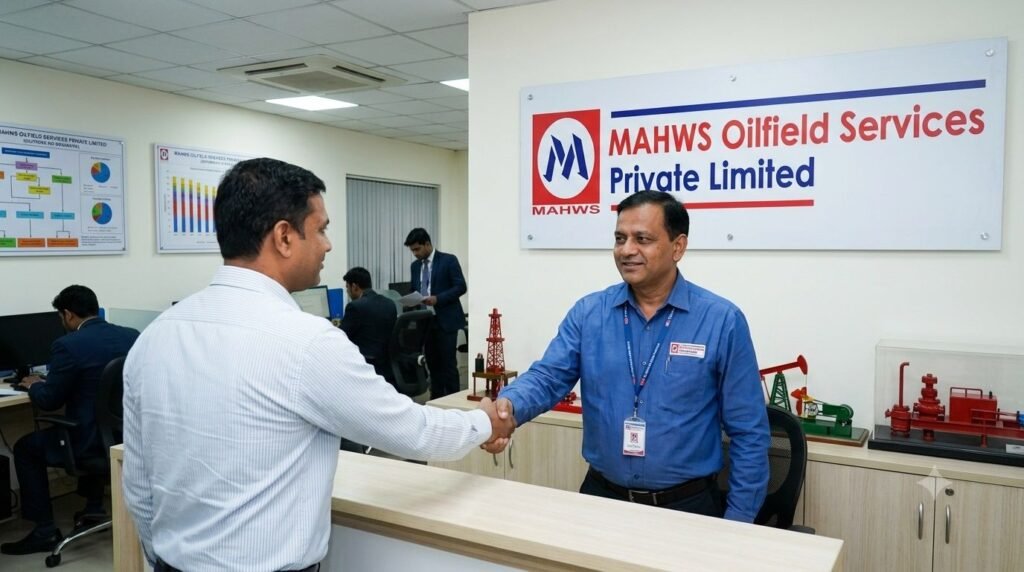
Chapter 1 – The Beginning of a Professional Journey
The story of Laki Ravat and MAHWS Oilfield Services Private Limited is fundamentally a story about professional competence, responsibility and the growing importance of internationally recognized standards in industries where safety cannot be treated as an afterthought.
Operating from the TTC Industrial Area, MIDC Industrial Area, Pawne, Navi Mumbai, Maharashtra, MAHWS Oilfield Services Private Limited belongs to an industrial environment closely connected with engineering, manufacturing, services and technically demanding operations. In such an environment, the ability of personnel to understand specialized safety requirements can become one of the most important foundations of professional credibility.
For Laki Ravat, professional growth was not simply about acquiring another certificate. It was about demonstrating that technical knowledge and practical capability could be assessed against an internationally recognized framework.
The year 2022 became an important point in this journey.
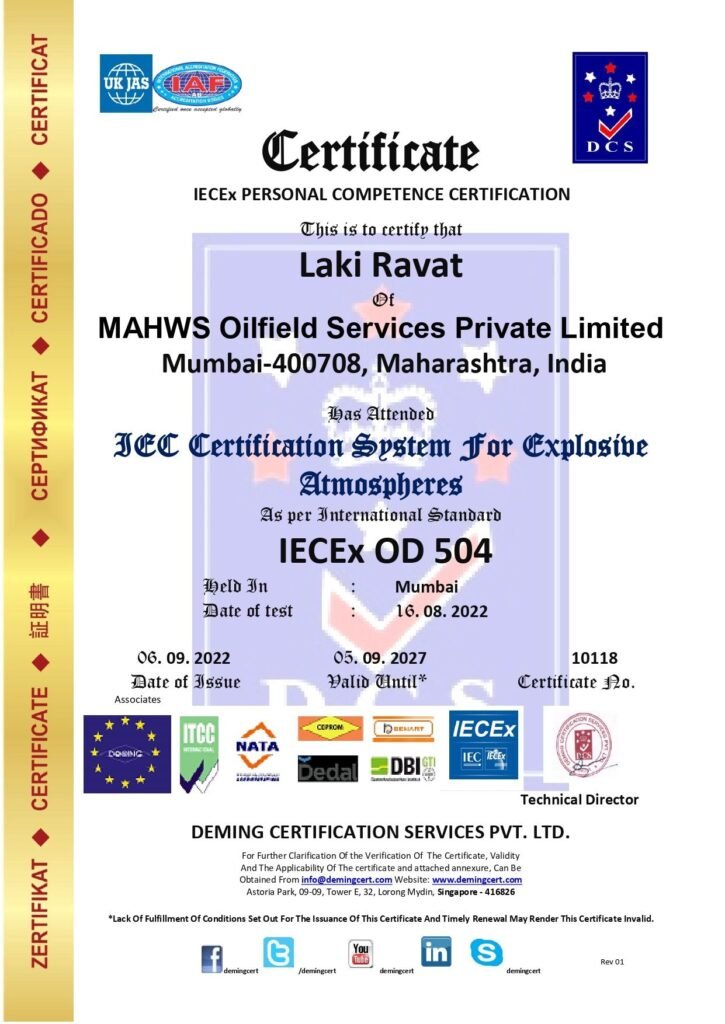
The IECEx Personnel Competence Certification associated with IECEx OD 504 represented a structured approach toward demonstrating competence in relation to explosive atmospheres. IECEx explains that its Personnel Competence Scheme provides independent validation of an individual’s ability to apply knowledge and practical skills in accordance with international standards. (https://mathewassociates.com/)
This distinction was important.
A conventional training certificate can demonstrate that someone attended a program. A competence certification has a different purpose: it provides evidence that defined knowledge and skills have been assessed.
For professionals associated with hazardous locations, that difference can influence how employers, contractors, clients and project managers perceive technical capability.
The oilfield and industrial services environment is particularly sensitive to this issue. Equipment and systems may operate where flammable gases, vapours or dusts can create hazardous conditions. In such circumstances, technical decisions have consequences beyond productivity. Installation, maintenance, inspection and operational practices can influence the overall safety of a facility.
IECEx itself emphasizes that competence depends on knowledge, skill, experience and training, and that competence can evolve or deteriorate over time, making continuing assessment important.
For Laki Ravat, therefore, the 2022 certification could be viewed as the beginning of a stronger professional identity.
The certification created a documented connection between an individual professional and a recognized competence framework. It also gave MAHWS Oilfield Services Private Limited an opportunity to associate its technical capabilities with a structured international certification environment.
The significance extended beyond the certificate document.
Certification could become part of a professional profile, a tender qualification file, a project proposal, a company presentation, a vendor-registration package or a technical capability statement.
The impact of certification often begins quietly.
There may not be an immediate transformation in revenue on the day a certificate is issued. Instead, the certificate becomes an additional building block in the company’s credibility. It can support conversations with prospective customers, create confidence among technical decision-makers and strengthen the professional profile of personnel.
For a company operating in an industrial and oilfield-related ecosystem, this credibility can be particularly valuable.
Laki Ravat’s journey can therefore be understood as a transition from simply participating in technical work to building documented evidence of competence.
The certificate valid through 2027 also created a multi-year period during which the achievement could support professional development and organizational positioning.
MAHWS Oilfield Services Private Limited could use this milestone as part of a broader philosophy: quality and safety are not merely documents prepared for audits. They are elements of professional culture.
That philosophy would become increasingly important as the organization encountered more demanding clients, technical requirements and project expectations.
The certification journey also reflected a larger transformation occurring across industrial businesses.
Customers increasingly want evidence.
They want to know whether personnel understand the equipment they handle. They want to know whether workers have appropriate competence for specialized environments. They want documented procedures, traceability, records and objective evidence.
In that environment, a recognized personnel competence certificate can serve as an important piece of evidence.
The journey of Laki Ravat therefore began not with a dramatic business expansion, but with something more fundamental: the strengthening of professional credibility.
From the 2022 certification onward, every future opportunity could potentially be viewed through a new lens.
Competence became documented.
Professional capability became easier to communicate.
And MAHWS Oilfield Services Private Limited gained another foundation upon which its future growth story could be constructed.
#LakiRavat
Chapter 2 – Understanding the Importance of Competence
The second chapter of Laki Ravat’s story begins with a simple realization: in hazardous industrial environments, competence is inseparable from safety.
Explosive atmospheres can exist where flammable gases, vapours, liquids or combustible dusts are present under conditions in which ignition may create serious consequences. IECEx describes the need for competent personnel working in hazardous locations and provides a dedicated certification scheme for assessing personnel competence. IECEx
For MAHWS Oilfield Services Private Limited, this concept could become more than a technical requirement.
It could become part of the organization’s professional culture.
Oilfield service activities often involve complex equipment, demanding operating conditions and high expectations from clients. A technical professional must be capable of interpreting requirements, recognizing hazards and applying appropriate procedures.
The value of competence therefore lies not simply in what an employee knows, but in how that knowledge is applied.
The IECEx Personnel Competence Scheme uses a modular structure. Depending upon the relevant competence profile, units can cover areas such as basic knowledge and awareness, principles of protection, classification of hazardous areas, installation, maintenance, inspection, testing, design and auditing.
IECEx OD 504 provides the specifications for the competence assessment outcomes. The document’s purpose is to support certification where competence is required in activities involving explosive atmospheres.
This framework helped place Laki Ravat’s certification into a larger professional context.
Instead of being viewed as a generic training achievement, it could be presented as evidence connected to a defined international competence structure.
That difference can be important during business development.
Imagine a potential client reviewing several service providers.
One company may say that it has experienced personnel.
Another may say that its personnel are trained.
A third may provide documented evidence of specialized competence assessed under an internationally recognized scheme.
The third company has an additional credibility element.
Certification does not automatically guarantee superior performance, nor does it replace practical experience. However, it can strengthen the evidence supporting a professional’s qualifications.
This is where the certification could begin influencing the growth story of MAHWS Oilfield Services Private Limited.
The company could incorporate Laki Ravat’s certification into capability presentations, technical profiles and qualification documents where relevant.
The certificate could also encourage internal discussions about competence.
Which activities require specialized knowledge?
Which employees require additional training?
Which procedures should be documented?
Which technical records should be maintained?
How should competency be periodically reviewed?
These questions can help transform certification from a static document into an organizational learning mechanism.
For a growing technical organization, this is valuable.
A business cannot rely indefinitely on informal knowledge transferred from one experienced person to another. As projects increase, employees change and customer expectations become more demanding, organizations need systems that preserve knowledge.
Certification can encourage such systems.
Laki Ravat’s achievement could therefore influence the way technical competence was communicated internally. New employees could see that specialized knowledge has professional value. Experienced employees could recognize the importance of maintaining evidence of their competence.
This creates a culture in which professional development becomes connected with organizational development.
Another important impact could be confidence.
Confidence is particularly valuable when working with technical customers.
A certified professional may approach a project with a stronger understanding of the expectations surrounding hazardous-area competence. This does not eliminate risk, but it can support disciplined decision-making.
The organization could also benefit from clearer communication with clients.
Instead of relying entirely on general statements such as “our engineers are experienced,” MAHWS could communicate specific competence credentials when appropriate.
This makes technical discussions more precise.
It also helps distinguish individual competence from organizational claims.
The IECEx system itself notes that certificates provide independent evidence of individual knowledge and skills and can support employers and employees in selecting appropriate people for jobs.
That principle fits naturally into Laki Ravat’s professional story.
The certificate became an asset not because it replaced experience, but because it documented a specialized dimension of professional capability.
Over time, this could contribute to stronger employee confidence, better client communication and more structured competence management.
The second chapter of the growth journey therefore represents a transition in thinking.
Certification was no longer simply something to display.
It became something to use.
#MAHWSOilfieldServices
Chapter 3 – Building Trust in a Technical Market

Every industrial business eventually encounters the same challenge: how do you convince a customer that you can be trusted?
In ordinary markets, trust may develop through brand recognition, customer reviews or years of business history.
In technically sensitive industries, trust also depends heavily on competence and evidence.
For MAHWS Oilfield Services Private Limited, the IECEx Personnel Competence Certification associated with Laki Ravat could become part of this evidence-based approach.
A customer looking at an oilfield service provider may ask questions about experience, personnel, technical capabilities, safety practices and relevant certifications.
Certification cannot answer every question.
But it can answer one important question:
Has the individual’s competence in the relevant area been independently assessed under the IECEx Personnel Competence Scheme?
IECEx explains that its scheme provides independent assessment of competence for individuals working in or associated with hazardous locations.
That independent element is important.
When a company evaluates its own employees, there is naturally an internal relationship between employer and employee.
Third-party assessment introduces another layer of confidence.
For Laki Ravat, this could become a differentiating professional asset.
The certificate could appear in professional documentation alongside educational qualifications, technical experience and project history.
When combined with organizational capabilities, it could strengthen the company’s presentation to prospective clients.
The business-development effect would likely be cumulative rather than immediate.
One proposal might not generate an order simply because a certificate appears in the technical qualification section.
However, across multiple proposals and customer conversations, evidence of competence can contribute to the overall perception of professionalism.
This is particularly relevant when customers compare suppliers.
A supplier that demonstrates attention to competence may appear better prepared for technical responsibilities.
The certification could also strengthen prequalification documentation.
Large industrial customers frequently require suppliers to provide information about technical staff, safety systems, qualifications and relevant experience before being considered for work.
A documented IECEx competence certificate can become one component of such documentation where the competency is relevant.
For MAHWS, this could create a stronger foundation for participating in increasingly demanding opportunities.
Another area of potential impact is vendor confidence.
Industrial companies often work through networks of contractors, subcontractors and specialist service providers.
When a contractor can demonstrate recognized competence, it may become easier for another organization to evaluate that contractor.
In this way, certification reduces some of the uncertainty surrounding technical capability.
The growth story of Laki Ravat therefore becomes closely connected with the concept of trust.
Trust is not created by one document.
It is built through consistent performance, safety, quality, communication and accountability.
Certification can support that trust by providing objective evidence of one part of the professional equation.
The company could also use this achievement to improve its corporate presentation.
Its website, brochures, capability statements and tender documents could communicate that personnel competence is taken seriously.
The achievement could become part of the company’s story:
“Our people are central to our technical capability, and their competence is supported by internationally recognized assessment frameworks.”
Such a message can be powerful because it shifts the focus from equipment alone to people.
Industrial customers understand that even excellent equipment can become unsafe if improperly installed, maintained, inspected or operated.
Competent personnel are therefore a crucial component of the safety chain.
IECEx emphasizes that the safety of hazardous-location facilities depends strongly on the competence of people involved in safety management, planning, installation, operation, inspection, maintenance and repair.
For MAHWS, this principle could influence the company’s approach to workforce development.
Recruitment could increasingly consider technical competency.
Employee development could become more structured.
Training needs could be mapped against job responsibilities.
Competency records could be maintained.
And senior management could increasingly view employee certification as a strategic investment rather than simply an HR activity.
The result is a stronger connection between human resources and business growth.
A technically competent workforce can contribute to better customer confidence.
Better customer confidence can support stronger business relationships.
Stronger relationships can create opportunities for repeat work.
Repeat work can contribute to sustainable growth.
Certification does not guarantee this chain, but it can strengthen one of its foundations.
For Laki Ravat, the 2022 achievement therefore became more than an individual milestone.
It became part of the company’s professional trust architecture.
#IECExCertification
Chapter 4 – From Individual Achievement to Organizational Value
A certificate is issued to an individual, but its influence does not necessarily remain individual.
This became an important part of Laki Ravat’s journey with MAHWS Oilfield Services Private Limited.
The IECEx Personnel Competence Scheme is specifically designed around individual competence. The certification is evidence that the applicant’s competence has been assessed for defined areas.
But companies can benefit when qualified individuals bring their knowledge into organizational systems.
This is where Laki Ravat’s certification could begin producing broader value.
Imagine a project environment where an experienced professional has to guide colleagues through technical requirements.
The value of that person extends beyond the work performed personally.
Knowledge can be shared.
Procedures can be reviewed.
Junior employees can learn.
Common mistakes can be discussed.
Documentation can be improved.
Technical expectations can become clearer.
Over time, an individual competency achievement can therefore contribute to organizational learning.
For MAHWS, this could be especially relevant as the company developed its service capabilities.
Growth brings complexity.
A small organization may rely heavily on a few experienced individuals. As projects increase, that model becomes difficult to sustain.
The company needs repeatable processes.
The company needs defined responsibilities.
The company needs documentation.
The company needs competence matrices.
The company needs supervision and review.
Certification can act as a catalyst for these developments.
Laki Ravat’s IECEx qualification could encourage management to identify other competency requirements across the organization.
Which personnel work in hazardous locations?
Who performs inspections?
Who handles maintenance?
Who interfaces with clients?
Who prepares technical documentation?
Who supervises field activities?
Who requires additional Ex-related competence?
Such questions help establish a systematic approach to workforce capability.
This is an important form of organizational maturity.
Instead of thinking about competence as something individual employees possess, the organization begins thinking about competence as something that must be managed.
That change can have long-term consequences.
A competence matrix, for example, can help management identify gaps before a project begins.
Training plans can then be aligned with actual business requirements.
Employees can be encouraged to pursue relevant qualifications.
Managers can assign personnel according to competence rather than availability alone.
And customers can receive more appropriate technical resources.
These practices can improve organizational reliability.
The certification also creates a potential role-model effect.
When employees see Laki Ravat’s professional development recognized through an international scheme, they may become more interested in developing their own skills.
A culture of continuous learning can emerge.
That culture can support retention because employees often value organizations that invest in their professional development.
It can also support recruitment.
Technically ambitious employees may prefer organizations that provide opportunities to work on specialized projects and develop internationally relevant competencies.
In this way, professional certification can become part of the employer value proposition.
For a company operating in an industrial location such as Navi Mumbai’s TTC Industrial Area, this can be strategically useful.
The organization exists within a broader ecosystem of engineering companies, manufacturers, service providers and industrial customers.
Standing out requires more than claiming experience.
The organization must demonstrate capability.
Competence certification can contribute to that demonstration.
There is another important organizational benefit: accountability.
When competence requirements are clearly defined, employees understand what is expected of them.
Management can also establish clearer boundaries around responsibilities.
This reduces the risk of assigning specialized work to personnel without appropriate qualifications or experience.
IECEx’s modular competence system is particularly useful in this context because the scheme recognizes different areas of competence rather than treating hazardous-area expertise as a single generic skill.
The journey therefore moved from:
Individual certificate → organizational knowledge → structured competence → stronger professional culture.
This progression could become one of the most meaningful forms of growth for MAHWS Oilfield Services Private Limited.
Revenue growth is visible.
Employee growth is visible.
New customers are visible.
But organizational maturity is sometimes less visible.
Yet it is this maturity that can help sustain future expansion.
For Laki Ravat, the IECEx certification could therefore become a professional milestone that influenced not only personal career development but also the company’s approach to people, competence and technical responsibility.
#IECExPersonnelCompetence
Chapter 5 – Strengthening the Company’s Technical Identity
Courtesy: Nauctis
By the middle of the growth journey, certification could begin influencing how MAHWS Oilfield Services Private Limited presented itself to the market.
A company’s technical identity is built through many elements: its services, personnel, experience, procedures, customer relationships and credentials.
For a specialized oilfield services organization, technical identity is particularly important.
Clients want to understand what a company actually knows how to do.
They want confidence that the organization understands the operating environment.
They want technically capable people.
They want evidence that safety is taken seriously.
Laki Ravat’s IECEx Personnel Competence Certification could contribute to this identity.
The significance of IECEx is international. IECEx describes its system as providing international confidence in certified equipment, personnel and services associated with explosive atmospheres.
That international orientation can be particularly valuable to companies connected with industries that interact with multinational clients, global engineering contractors or international supply chains.
For MAHWS, the certification could therefore become part of a broader professional narrative.
The company could say, in effect:
Our technical capability is supported by people whose specialized competence has been assessed against an internationally recognized framework.
This is more powerful than simply listing a certificate.
It explains why the certificate matters.
A strong technical identity can also help during client meetings.
When customers ask about personnel competence, the company can provide specific evidence rather than relying entirely on verbal assurances.
This can make technical conversations more productive.
Instead of spending the entire meeting establishing basic credibility, the discussion can move toward actual project requirements.
The certificate can also support the preparation of tender submissions.
Many tenders include sections relating to manpower qualifications.
The presence of specialized certification can strengthen the personnel qualification portion of a proposal where relevant.
Again, it is important not to overstate the certificate.
IECEx certification applies to defined competence areas. It does not automatically certify every activity undertaken by an individual or the entire company.
This precision is itself a sign of professionalism.
A mature organization understands exactly what its certificates mean.
That approach protects credibility.
It also helps ensure that certificates are used appropriately.
The company’s technical identity could further develop through documentation.
Professional CVs could be standardized.
Competency records could be maintained.
Training records could be linked to job roles.
Technical experience could be documented systematically.
Project completion records could be retained.
Client feedback could be recorded.
Over time, these practices could create a stronger institutional memory.
This becomes especially valuable when organizations grow.
If one experienced employee leaves, the company should not lose all of its knowledge.
Documentation allows knowledge to remain within the organization.
Laki Ravat’s certification could therefore contribute indirectly to knowledge-management practices.
Another possible development is improved internal communication.
Employees working on projects involving hazardous areas may need to understand the same terminology, procedures and expectations.
A recognized competence framework gives management a structured language for discussing those requirements.
That common language can improve coordination.
The certification could also influence the company’s approach to future investments.
Management might consider specialized training, better technical tools, improved documentation systems or additional competency certifications.
Thus, certification can create a multiplier effect.
One qualification encourages another.
One documented procedure leads to another.
One successful project increases confidence in pursuing another.
The company gradually becomes more systematic.
This is how a professional certification can contribute to business transformation.
The transformation does not happen overnight.
It develops through repeated application.
Every customer interaction, project review, technical discussion and internal training session becomes an opportunity to convert certification knowledge into practical organizational value.
For Laki Ravat, the 2022 achievement could therefore become an anchor for a stronger technical identity.
And for MAHWS Oilfield Services Private Limited, that identity could become increasingly important as the organization positioned itself for future opportunities.
#ExplosiveAtmospheres
Chapter 6 – Creating Opportunities Through Professional Credibility
Business growth often begins with opportunity.
But opportunity usually reaches companies that can demonstrate readiness.
For MAHWS Oilfield Services Private Limited, the IECEx competence achievement could become one element of that readiness.
The oilfield and industrial service market can involve technically demanding projects where customer confidence is essential. When work involves hazardous locations, personnel competency becomes an especially important consideration.
IECEx explains that its personnel competence certificates provide independent evidence of individual knowledge and skills and can assist employers and employees in selecting the right people for the right jobs.
This principle has direct relevance to business development.
Suppose a company is evaluating a specialist service provider.
The customer may review the organization’s company profile.
Then the customer may review the technical staff.
Then qualifications.
Then experience.
Then safety documentation.
Then relevant project history.
Every piece of evidence contributes to an overall decision.
Laki Ravat’s IECEx certification could therefore become one component of the company’s qualification portfolio.
The certificate might help during:
- Vendor registration
- Technical prequalification
- Tender submissions
- Client presentations
- Project staffing
- Capability statements
- Professional profile development
- Safety and competence discussions
- International business communication
The certification itself does not guarantee contract awards.
But it can help reduce uncertainty.
And reducing uncertainty is one of the central functions of professional credentials.
A customer cannot personally observe everything a service provider knows.
Instead, the customer uses evidence.
Certificates are one form of evidence.
Experience records are another.
References are another.
Quality systems are another.
Safety performance is another.
The strongest organizations combine these forms of evidence.
MAHWS could therefore integrate the IECEx achievement with broader quality and safety practices.
The result would be a more complete professional proposition.
The company might also find that certification helps in conversations with larger organizations.
Large organizations often have formal supplier-management systems.
They may require documented evidence before allowing contractors to participate in certain activities.
A recognized personnel competence certificate can become useful within that documentation environment.
This could expand the range of opportunities that the company can credibly pursue.
Another important effect is confidence during negotiation.
When a technical team knows that its competencies are documented, it can enter client discussions with stronger professional confidence.
That confidence can influence communication.
Questions can be answered more precisely.
Technical limitations can be explained honestly.
Project requirements can be discussed more systematically.
And risks can be identified earlier.
Good business development is not simply about winning work.
It is about winning the right work.
Competence certification can support this by helping companies understand the boundaries of their technical capabilities.
That can reduce the temptation to accept work beyond available competence.
Such discipline is particularly important in safety-sensitive environments.
The certification could also support international ambitions.
IECEx describes its system as having an international orientation and maintaining international confidence in certified personnel, equipment and services.
For an Indian company, internationally recognizable personnel competence can therefore become a useful element when communicating with overseas or multinational customers.
This does not mean that certification alone creates international business.
International expansion requires many other factors: commercial strategy, pricing, logistics, legal compliance, project experience, customer references and local requirements.
But certification can strengthen the technical side of that proposition.
Laki Ravat’s journey therefore illustrates an important business lesson:
Credentials are most valuable when integrated into a larger capability.
A certificate sitting inside a drawer has limited business value.
A certificate incorporated into professional development, client communication, competence management and tender documentation can become much more useful.
For MAHWS, this approach could transform the 2022 achievement into a continuing business asset.
The certificate’s validity through 2027 provides a defined period during which the qualification can support professional positioning, subject to the applicable IECEx requirements and certificate status.
Thus, the journey moves from certification to opportunity.
And opportunity, when combined with disciplined execution, can become the foundation for sustainable growth.
#OilfieldServices
Chapter 7 – Developing a Culture of Continuous Improvement
The strongest impact of certification is often not the certificate itself.
It is the change in behavior that follows.
For Laki Ravat and MAHWS Oilfield Services Private Limited, the IECEx achievement could become a starting point for continuous improvement.
IECEx recognizes that competence can evolve with experience and may deteriorate without continued development, which is why continuing training and assessment are important elements of maintaining competence.
This idea is particularly relevant in technical industries.
Standards evolve.
Equipment changes.
Technology develops.
Customer expectations change.
Work environments become more complex.
Therefore, professional competence cannot be treated as something achieved once and then forgotten.
The certification could encourage Laki Ravat to maintain a learning mindset.
Instead of asking only, “What certificate do I have?” the more important question becomes:
“What do I need to know to perform my responsibilities safely and effectively today?”
That question can influence organizational culture.
Training can become more regular.
Technical discussions can become more structured.
Lessons from projects can be documented.
Employees can be encouraged to report difficulties.
Corrective actions can be followed through.
Management reviews can consider competency needs.
These practices create continuous improvement.
The company could establish periodic competence reviews.
For example, management might evaluate whether personnel qualifications remain appropriate for current projects.
Employees could identify areas where additional training is necessary.
Supervisors could review practical performance.
Technical documentation could be updated.
Such activities can reduce the gap between theoretical knowledge and workplace application.
This is especially important because certification and training are not identical.
IECEx’s personnel scheme is an assessment-based system. The IECEx framework distinguishes certification of competence from training activities.
Understanding this distinction can make a company more mature.
Training provides learning.
Experience provides practical exposure.
Assessment provides evidence of competence.
Continuous development connects all three.
Laki Ravat’s certification could therefore encourage MAHWS to view professional development as a cycle rather than a single event.
Learn → Practice → Assess → Improve → Reassess.
Such a cycle is consistent with the broader philosophy of quality management.
It also supports employee engagement.
Technical professionals often want to see a clear path for career growth.
When a company encourages recognized competence development, employees can see how their expertise contributes to organizational success.
This can improve motivation.
It can also improve retention.
A technically skilled workforce is a valuable organizational asset.
Employees who feel that their competence is recognized may be more likely to invest in the company’s future.
The culture of continuous improvement could extend beyond personnel.
Processes can also improve.
A project that experiences a documentation problem can lead to a better documentation procedure.
A recurring technical question can lead to an internal guidance note.
A customer complaint can lead to corrective action.
An audit observation can lead to preventive measures.
A successful project can provide lessons for future projects.
This is how organizations become stronger over time.
The IECEx achievement can therefore be understood as one point in a larger improvement cycle.
The 2022 certification demonstrated a professional milestone.
The following years could focus on applying, maintaining and expanding the knowledge associated with that milestone.
This approach also protects the value of the certificate.
Rather than using it purely as marketing material, MAHWS can demonstrate that certification influences actual professional behavior.
That is ultimately more credible.
The company can say that competence is not merely claimed.
It is developed, assessed, applied and continuously improved.
For Laki Ravat, this could represent one of the most meaningful forms of professional growth.
The certificate became a reminder that technical excellence requires continuous effort.
And for MAHWS, that mindset could become an important component of long-term organizational development.
#IndustrialSafety
Chapter 8 – The Human Side of Technical Growth
Behind every certificate is a person.
Behind every technical organization are people whose knowledge, discipline and decisions influence the quality of work.
This human dimension is central to Laki Ravat’s story.
The IECEx Personnel Competence Scheme exists because hazardous-area safety depends heavily on competent people. IECEx specifically identifies personnel involved in planning, installation, operation, inspection, maintenance, repair and other safety-related activities as important to hazardous-location safety.
The certification therefore represented more than a technical achievement.
It represented professional responsibility.
For Laki Ravat, achieving certification could strengthen personal confidence.
A professionally assessed competence can provide reassurance that one’s knowledge and skills have been evaluated against defined requirements.
This confidence can influence professional behavior.
A confident professional is more likely to ask the right questions.
More likely to challenge unclear instructions.
More likely to identify risks.
More likely to communicate technical concerns.
More likely to insist on appropriate procedures.
These behaviors can have organizational value.
The company could also use Laki Ravat’s experience to mentor other personnel.
Junior employees can learn not only technical information but also professional habits.
They can learn why documentation matters.
They can learn why standards matter.
They can learn why competence boundaries matter.
They can learn why safety cannot be compromised for speed.
Mentoring can therefore multiply the impact of certification.
One person’s achievement can influence an entire team.
Over time, that team can develop a stronger professional identity.
Employees begin to see themselves not merely as workers completing assigned tasks but as technical professionals responsible for quality and safety.
This is particularly important in industries where errors can have serious consequences.
A mature technical culture encourages employees to stop when something is unclear.
It encourages reporting.
It encourages verification.
It encourages learning from mistakes.
It encourages respect for procedures.
Certification can support this culture by making competence visible.
The employee knows that technical knowledge is valuable.
The employer knows that competency development is valuable.
The customer receives stronger evidence of capability.
Everyone benefits from greater clarity.
Laki Ravat’s achievement could also become a source of organizational pride.
A company may celebrate a certification not because of the certificate paper itself, but because it represents the effort required to achieve it.
Employees may recognize that their organization is serious about professional standards.
Customers may perceive greater professionalism.
Partners may gain confidence.
This creates a positive cycle.
Professional development strengthens organizational reputation.
Organizational reputation attracts better opportunities.
Better opportunities provide employees with more experience.
Experience strengthens professional competence.
Competence strengthens reputation again.
This cycle is one of the most sustainable forms of growth.
It does not depend entirely on advertising.
It depends on capability.
The human side of certification is also about responsibility toward customers.
When a client gives a technical organization responsibility for work in a sensitive environment, that responsibility should be taken seriously.
Competence certification reinforces that message.
It tells employees that specialized work requires specialized knowledge.
It tells management that competence must be maintained.
It tells customers that the organization recognizes the importance of qualified people.
For Laki Ravat, the 2022 IECEx achievement could therefore become part of a professional legacy.
It was not simply something achieved in one year.
It became a reference point in a career.
For MAHWS Oilfield Services Private Limited, it became part of the organization’s human-capital story.
The company could continue building on this foundation by encouraging additional employees to pursue relevant competencies and by developing internal systems that convert individual expertise into collective organizational knowledge.
That is how an individual certification can gradually become a company-wide asset.
#TechnicalCompetence
Chapter 9 – Looking Toward the Future
As the validity period approached its later years, the question for Laki Ravat and MAHWS Oilfield Services Private Limited would not simply be what was achieved in 2022.
The more important question would be:
What was built because of that achievement?
Certification creates an opportunity.
The organization must decide how to use it.
By 2027, the certificate’s five-year period would represent a substantial professional chapter. During those years, the value of the certification could have been strengthened through project experience, continuing development, internal knowledge sharing and broader organizational maturity.
IECEx explains that personnel competence certificates are maintained through periodic reassessment, with its current overview noting reassessment every five years for maintaining a CoPC.
This reinforces an important lesson.
Certification is not the destination.
Competence is the destination.
The certificate is evidence of a point in that journey.
For MAHWS, future development could involve expanding technical competence across additional personnel and relevant competence units.
The IECEx scheme contains multiple units covering different hazardous-area activities, including installation, maintenance, inspection, testing, design and auditing.
The appropriate path would depend on the company’s actual activities and the responsibilities of its personnel.
This creates an opportunity for strategic workforce planning.
Instead of randomly sending employees for training, the company could identify future business requirements and map them against competency needs.
If the organization plans to expand into a particular service area, it can determine what technical competencies are necessary.
If a major customer requires specific personnel qualifications, management can prepare in advance.
If an employee is being promoted into a technical leadership role, additional competence development can be planned.
This approach transforms certification into workforce strategy.
Future growth could also involve stronger documentation.
A mature company should be able to demonstrate not only what qualifications employees hold but also how those qualifications relate to their responsibilities.
Competence matrices, training records, project experience and assessment evidence can create a structured knowledge base.
This becomes increasingly valuable as the company grows.
The company can also strengthen its external communication.
Instead of making broad claims about technical expertise, it can communicate specific competencies accurately.
That precision increases credibility.
Customers appreciate companies that understand the boundaries of their qualifications.
The future may also bring new technological challenges.
IECEx’s current framework includes a dedicated Ex 011 unit concerning basic knowledge of hydrogen-system safety, demonstrating how the competence scheme can evolve with emerging technologies.
This illustrates a broader principle for MAHWS:
The industrial environment will continue to change, so professional competence must evolve with it.
The company that learns faster can adapt faster.
The company that documents competence can communicate capability more effectively.
The company that invests in people can build greater resilience.
Laki Ravat’s 2022 certification could therefore be viewed as an early chapter in a much longer professional journey.
The objective should not simply be to preserve the certificate until 2027.
The objective should be to use the years between certification and reassessment to build experience, knowledge, systems and organizational capability.
That is how certification becomes sustainable value.
Looking ahead, the company can aspire to become increasingly recognized for professionalism, competence and responsible technical service.
The exact commercial results will depend on market conditions, customer demand, project execution and management strategy.
But the foundation remains clear.
People create capability.
Capability creates trust.
Trust creates opportunities.
Opportunities, when executed successfully, create growth.
And growth becomes sustainable when it is supported by systems and competence.
This is the future-oriented lesson of Laki Ravat’s certification journey.
#QualityCertification
Chapter 10 – The Legacy of Certification and the Growth Story
Every successful professional journey eventually reaches a point where the original achievement becomes part of a larger story.
For Laki Ravat and MAHWS Oilfield Services Private Limited, the IECEx Personnel Competence Certification issued in 2022 can be understood in exactly this way.
At the beginning, it was a professional qualification.
Then it became evidence of competence.
Then it could become a tool for client confidence.
Then it could contribute to organizational learning.
Eventually, it could become part of the company’s professional identity.
This progression demonstrates why certification can be important for industrial organizations.
The certificate itself is only one document.
The value lies in what the organization does with it.
IECEx states that its personnel competence scheme provides independent validation of an individual’s ability to apply knowledge and practical skills in line with international standards.
For Laki Ravat, this represents a clear professional message.
Competence matters.
For MAHWS, the message becomes broader.
People matter.
A company’s equipment, facilities and technology are important, but technical services ultimately depend upon people making correct decisions.
A competent workforce can identify hazards.
It can follow appropriate procedures.
It can communicate technical requirements.
It can recognize limitations.
It can seek clarification when necessary.
And it can contribute to safer project execution.
The 2022 certification therefore created an opportunity for MAHWS to reinforce a culture in which professional competence is treated as a strategic asset.
The potential business impact extends across several areas.
First is credibility.
The certification provides an objective credential associated with defined competence requirements.
Second is customer confidence.
Relevant clients can see evidence that specialized personnel competence has been assessed.
Third is employee development.
The achievement can encourage a culture of professional learning.
Fourth is organizational capability.
Knowledge gained by certified personnel can be shared across teams and incorporated into procedures.
Fifth is business development.
The qualification can become part of relevant tender, vendor-registration and capability documentation.
Sixth is long-term sustainability.
A company that continuously develops its people is better positioned to respond to changing technical requirements.
These effects are interconnected.
One cannot simply say that certification caused a particular percentage increase in revenue without financial evidence.
But one can understand how certification may strengthen the foundations upon which business growth is built.
That distinction is important.
Real business growth is multidimensional.
Revenue is only one measurement.
Growth can also mean stronger technical capability.
Better customer relationships.
More professional documentation.
Improved employee competence.
Greater project confidence.
Better market positioning.
Stronger organizational systems.
Improved ability to participate in demanding opportunities.
In this broader sense, the IECEx achievement can be considered an important component of MAHWS Oilfield Services Private Limited’s development.
Laki Ravat’s individual accomplishment becomes part of the company’s collective capability.
And the company’s investment in competence becomes part of its reputation.
The story also offers a broader lesson for professionals in hazardous-area industries.
A qualification should never be treated as the end of learning.
Instead, it should create responsibility.
The professional must continue learning.
The company must continue improving.
Management must continue investing in people.
Customers must continue receiving competent service.
And the organization must continue adapting to changing technology and standards.
IECEx’s own framework reflects this philosophy by emphasizing ongoing competence and reassessment.
The period from 2022 to 2027 can therefore be seen as a chapter of professional development rather than merely a certificate-validity period.
For Laki Ravat, it represents an opportunity to build experience upon assessed competence.
For MAHWS, it represents an opportunity to build organizational strength around qualified personnel.
For customers, it represents another piece of evidence supporting confidence in the company’s technical resources.
And for the future, it provides a foundation upon which further competency development can be constructed.
The ultimate legacy of certification is therefore not the paper certificate.
It is the culture that grows around it.
A culture that respects standards.
A culture that values competence.
A culture that documents knowledge.
A culture that develops people.
A culture that learns from experience.
A culture that puts safety and professional responsibility at the center of technical work.
That is the real growth story of Laki Ravat and MAHWS Oilfield Services Private Limited.
The journey began with an IECEx Personnel Competence Certification in 2022.
But the larger story is about what that achievement can represent: a commitment to professional competence, technical credibility, continuous learning and responsible industrial service.
As the organization moves toward the future, the strongest measure of success will not simply be how many certificates it possesses.
It will be how effectively its people use their knowledge.
It will be how consistently the organization delivers professional service.
It will be how much trust customers place in its technical teams.
And it will be how successfully MAHWS converts individual competence into collective organizational capability.
In that sense, Laki Ravat’s certification is more than a milestone.
It is a foundation.
And foundations matter because every sustainable growth story is ultimately built upon them.
From competence to confidence.
From confidence to credibility.
From credibility to opportunity.
From opportunity to growth.
And from growth to a stronger, more professionally capable organization.
That is the enduring significance of the 2022 IECEx certification journey of Laki Ravat – MAHWS Oilfield Services Private Limited.
Certification Reference Note
IECEx currently describes OD 504 as the specification for units of competence assessment outcomes under its Personnel Competence Scheme; the current listed edition is Edition 5.0, published in 2022. IECEx The IECEx scheme covers individual competence and should not be represented as automatically certifying the entire company, every employee, or every service activity. The company’s actual commercial growth, projects and financial performance would require supporting records to substantiate specific claims.
#NaviMumbaiIndustry
#HazardousAreaSafety #ExCompetency #IndustrialCertification #SafetyEngineering #OilAndGasIndustry
Take the Next Step Today
Don’t wait to enhance your business’s quality and efficiency. Partner with Sanatan Dharma Accreditation Boards and experience the transformation that comes with expert consultancy and training. Contact us today to learn more about how we can help you achieve your business goals. Reach out via phone at +91-8668266780, visit our website at sanatanboards.com, or email us at info@sanatanboards.com Let us be your guide on the journey to excellence and innovation.





