
Gangothri Industries
Table of Contents
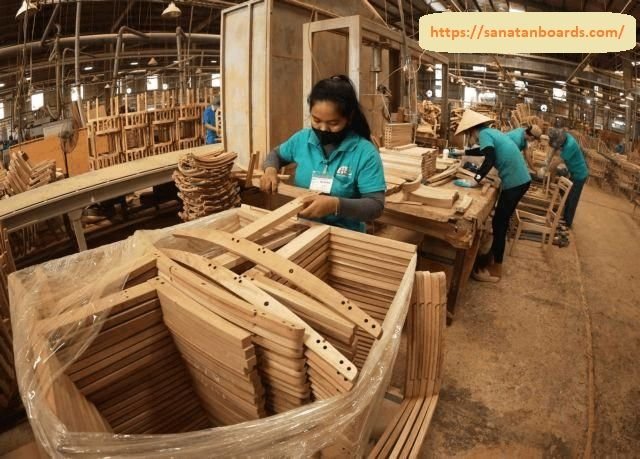
Chapter 1 – The Beginning of a Quality Journey
Gangothri Industries, located at 330/1893 A2, A3, Nellippathazham, Chevayoor, Kozhikode, Kerala, represents the story of a manufacturing enterprise that built its business around furniture designed for institutional and healthcare environments. Its journey toward formal certification became an important stage in the development of a more systematic approach to product quality, customer requirements and business processes.
The company’s product portfolio included hospital furniture and associated products such as non-revolving chairs, combination chairs, wheelchairs, revolving chairs, revolving stools, tables, over-bed tables and steel cabinets. These products serve environments where functionality, durability, ease of use and consistency are important considerations.
For a manufacturer, growth is not simply a matter of increasing production. As the number of products, customers and orders increases, the organization must also develop systems capable of maintaining consistency. A business may have experienced workers and capable management, but sustainable growth increasingly depends upon documented processes, defined responsibilities, inspection practices, customer feedback and continual improvement.
This was the larger significance of Gangothri Industries’ certification journey.
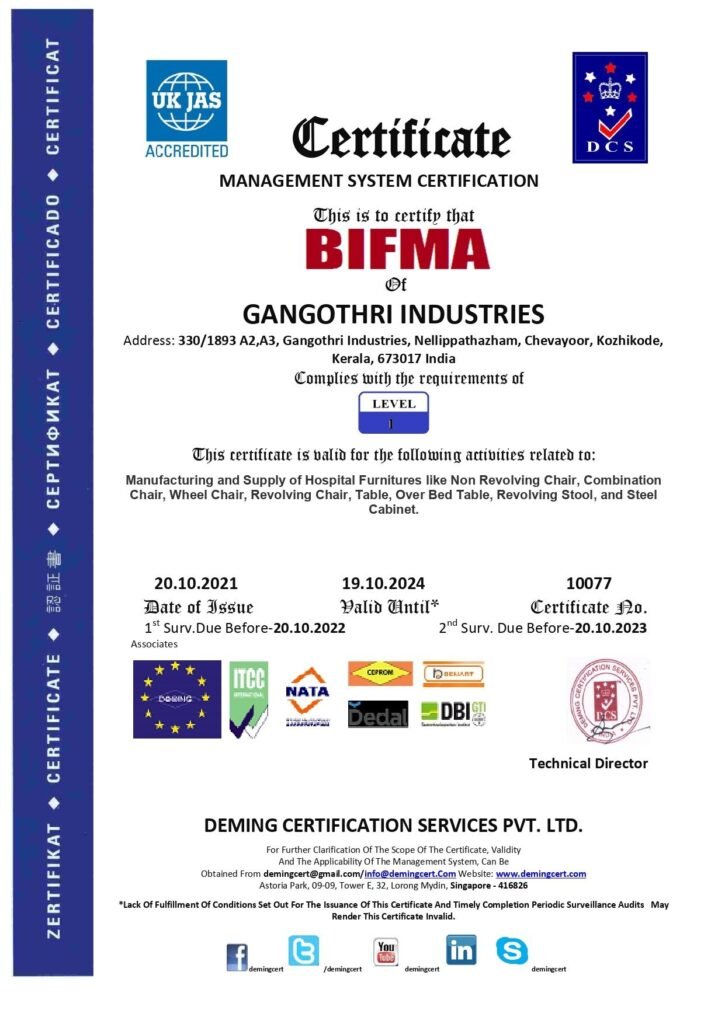
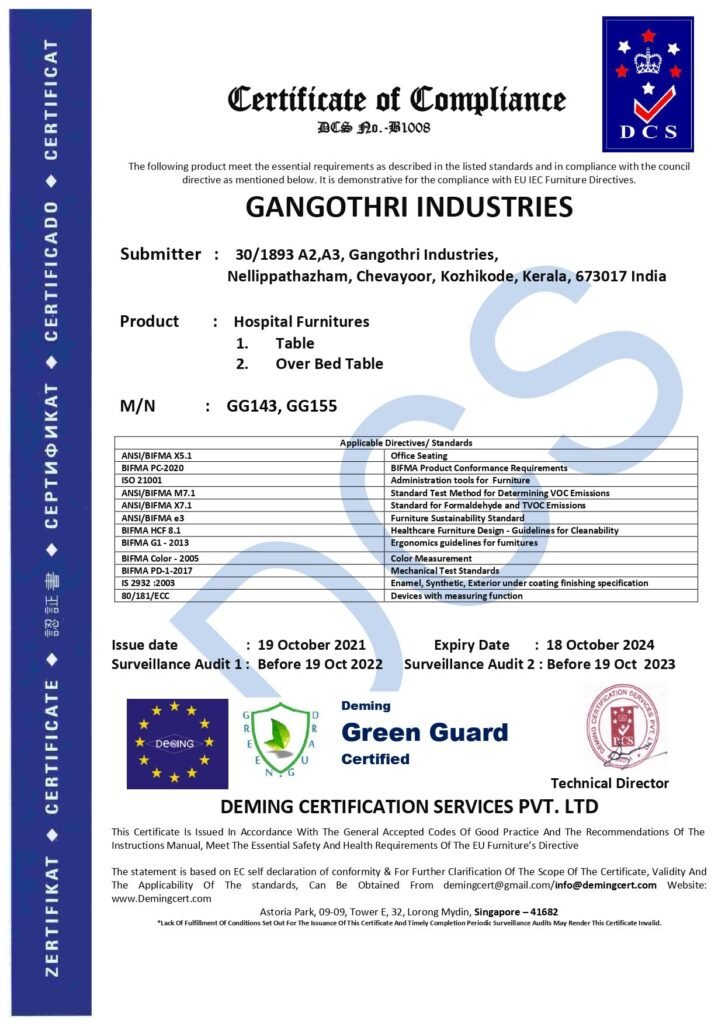
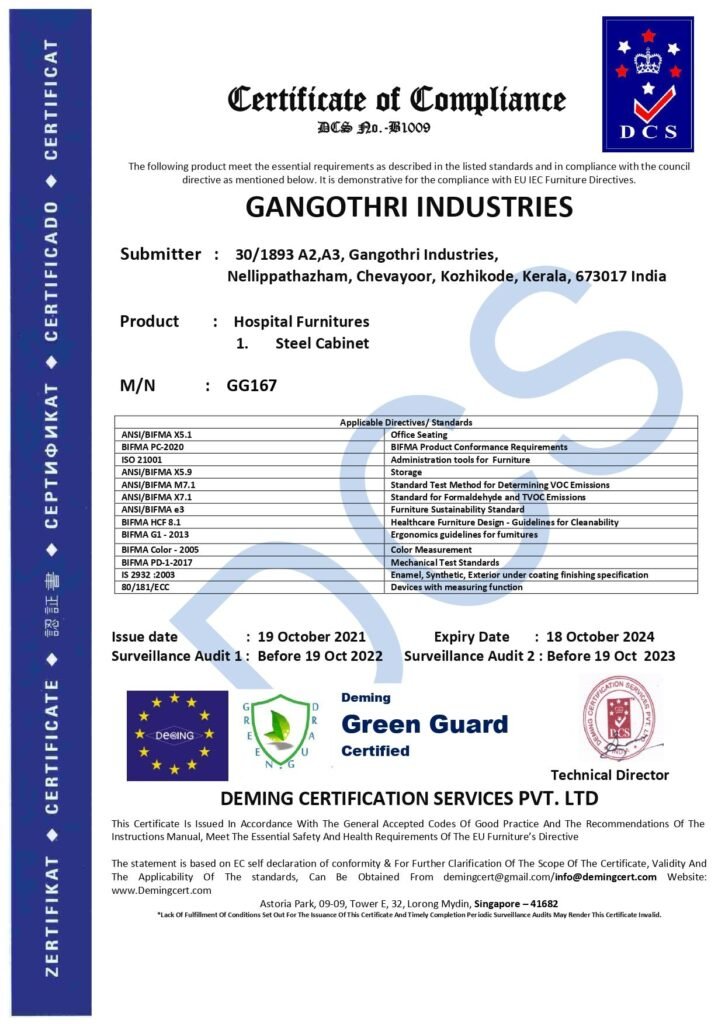
The certification documentation associated with the organization records Green Guard certification issued on 19 October 2021 and valid until 18 October 2024. Public certification records identify Gangothri Industries in Kerala and associate the certification with Deming Certification Services Pvt. Ltd.
The certification period coincided with an important stage in the company’s development. Hospital furniture is not an ordinary consumer product. Chairs, tables, cabinets and related equipment are used repeatedly, often in demanding institutional surroundings. Customers therefore need confidence not only in the appearance of a product but also in its construction, usability, consistency and ability to meet specified requirements.
The management-system approach gave the organization an opportunity to look at these requirements systematically.
Instead of viewing quality as the responsibility of a single person or department, quality could become a responsibility shared across purchasing, production, inspection, finishing, storage, dispatch and customer service. Each stage could contribute to the final result.
For the promoter and management, this represented an important shift in perspective. Certification could be used as a framework for making the organization more organized and more prepared for future business opportunities.
The company’s certification documentation also connected its products with BIFMA-related requirements and Green Guard certification. The publicly available compliance certificate identifies hospital furniture and references standards and requirements relating to office seating, storage, furniture sustainability, healthcare furniture design, ergonomics and mechanical testing.
Such documentation could help communicate product requirements in a structured way to institutional buyers.
The real value of certification, however, would depend upon implementation.
A certificate by itself cannot manufacture a chair, inspect a table or satisfy a customer. People and processes must give meaning to the certificate. Employees need to understand requirements. Materials must be controlled. Products must be checked. Nonconformities must be corrected. Records must be maintained. Customer requirements must be understood before production begins.
This was the beginning of Gangothri Industries’ quality journey.
The company’s development can therefore be viewed as a transition from simply producing furniture to building an organizational system around production. The certification milestone created a reference point from which management could strengthen internal discipline and improve confidence among customers.
For the promoter, this journey also meant thinking beyond immediate orders. The objective was to create a business capable of handling changing customer expectations and institutional requirements.
The story of Gangothri Industries after certification is consequently not about a single certificate creating instant growth. It is about how formal quality and product-compliance practices can support a manufacturing organization as it develops.
The years following certification would provide opportunities to test these systems through customer requirements, product specifications, procurement expectations, production challenges and market competition.
Quality became more than a word.
It became a management responsibility.
And for Gangothri Industries, the certification milestone marked the beginning of a new phase in which systematic working, product conformity, customer satisfaction and continuous improvement could increasingly become part of the company’s identity.
#GangothriIndustries
Chapter 2 – Understanding the Importance of ISO 9001 Principles
The introduction of a quality management approach changes the way an organization thinks about its daily work. For Gangothri Industries, the importance of this approach became especially relevant because its products were intended for institutional and healthcare applications.
Before a product reaches a hospital or another organization, several activities must work together. The customer requirement has to be understood. Materials have to be sourced. Production has to follow defined specifications. Finishing has to be controlled. Inspection has to identify defects. Packaging has to protect the product. Delivery has to occur according to the agreed requirement.
If one stage fails, the final customer experience can be affected.
A quality management system provides a structure for controlling these interconnected activities.
For the promoter of Gangothri Industries, this approach offered a way of reducing dependence on informal communication. When a business is small, many decisions can be made verbally. The owner may personally know suppliers, workers, customers and production requirements. As business activity expands, however, verbal systems become increasingly difficult to maintain.
Documentation becomes important.
Responsibilities become important.
Records become important.
Corrective action becomes important.
Customer feedback becomes important.
ISO 9001 principles emphasize these ideas through a process-oriented approach to quality management. In practical manufacturing terms, this means understanding what enters a process, what happens during the process and what comes out of it.
For Gangothri Industries, the production of hospital furniture could therefore be viewed as a sequence of controlled activities.
Raw materials enter the organization.
Production transforms those materials.
Inspection verifies requirements.
Finishing improves appearance and protection.
Final checks establish conformity.
Packaging and dispatch prepare products for customers.
Feedback provides information for future improvement.
This way of thinking creates greater visibility.
If a problem occurs, management can ask where the problem originated instead of simply correcting the final product. Was the specification misunderstood? Was the material unsuitable? Was a production instruction unclear? Was an inspection step missed? Was the product damaged during handling?
These questions help an organization move from correction toward prevention.
The certification journey therefore had significance beyond the certificate itself. It encouraged a culture in which employees could understand that their individual activities contributed to the quality of the final product.
A purchasing employee influences quality through supplier selection.
A production worker influences quality through workmanship.
An inspector influences quality through effective verification.
A storekeeper influences quality through proper handling.
A dispatch employee influences quality through packaging and identification.
Management influences quality through planning, resources and leadership.
This interconnected understanding is essential for a growing manufacturing organization.
Gangothri Industries’ documented product portfolio included multiple types of hospital furniture. The certificate documentation specifically identifies products including hospital furniture and steel cabinets, while BIFMA-related references included office seating, storage, ergonomics and healthcare furniture design requirements.
The variety of products meant that consistency could become increasingly important.
A customer ordering one product needed confidence that the same specifications would be followed each time. A customer ordering several products needed confidence that different product categories would still be produced under appropriate controls.
This is where systematic documentation becomes valuable.
Drawings, specifications, inspection criteria, purchase information, production records and customer requirements can provide common references for employees.
For the promoter, the quality-management philosophy also created an opportunity to establish measurable objectives.
Instead of simply asking whether production was completed, management could consider questions such as:
How many products were rejected?
What types of defects occurred?
How many customer complaints were received?
How quickly were complaints resolved?
Were deliveries completed on schedule?
Were suppliers meeting requirements?
Were corrective actions effective?
These questions convert quality from a general ambition into measurable management information.
Over time, such information can help management identify recurring problems.
The real benefit is not the number of documents created but the quality of decisions supported by those documents.
For Gangothri Industries, the certification journey therefore represented a movement toward more disciplined decision-making.
The promoter could focus not only on current production but also on the system supporting future production.
That distinction is important.
A business can survive through individual effort.
A growing business needs repeatable processes.
A sustainable manufacturing organization needs both capable people and capable systems.
Certification provided Gangothri Industries with a framework through which these two elements could work together.
The organization’s subsequent development would demonstrate how quality principles could be connected with market requirements, customer confidence and institutional business.
The certificate was therefore not the conclusion.
It was a foundation.
#ISO9001Certification
Chapter 3 – Strengthening Product Quality in Hospital Furniture
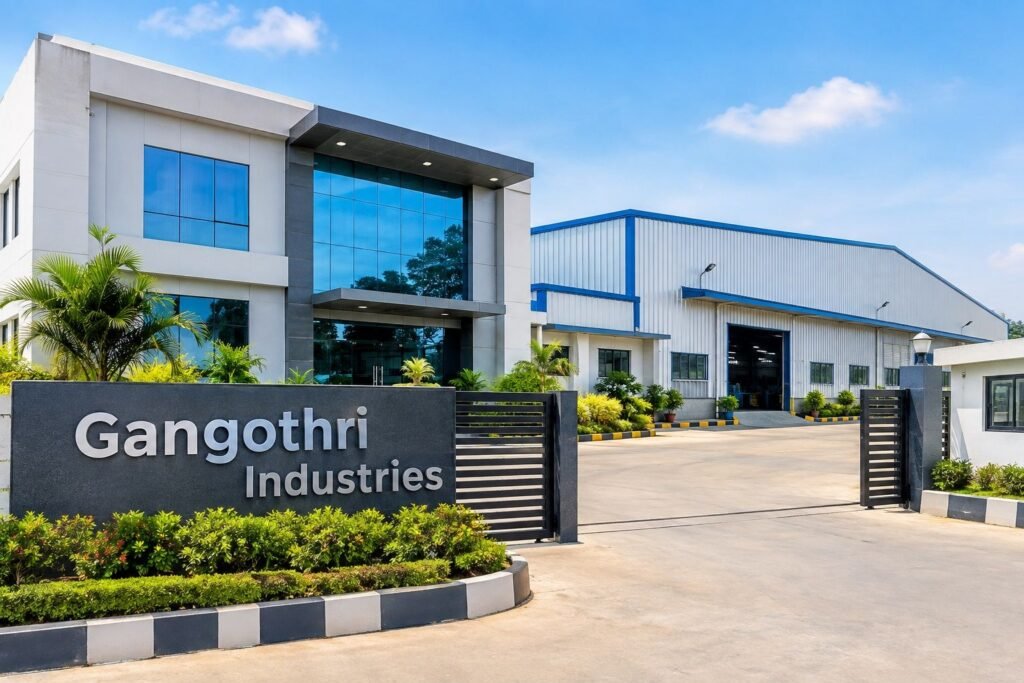
Hospital furniture presents distinctive practical requirements. Products are expected to support repeated use while remaining functional, stable, maintainable and suitable for their intended environment.
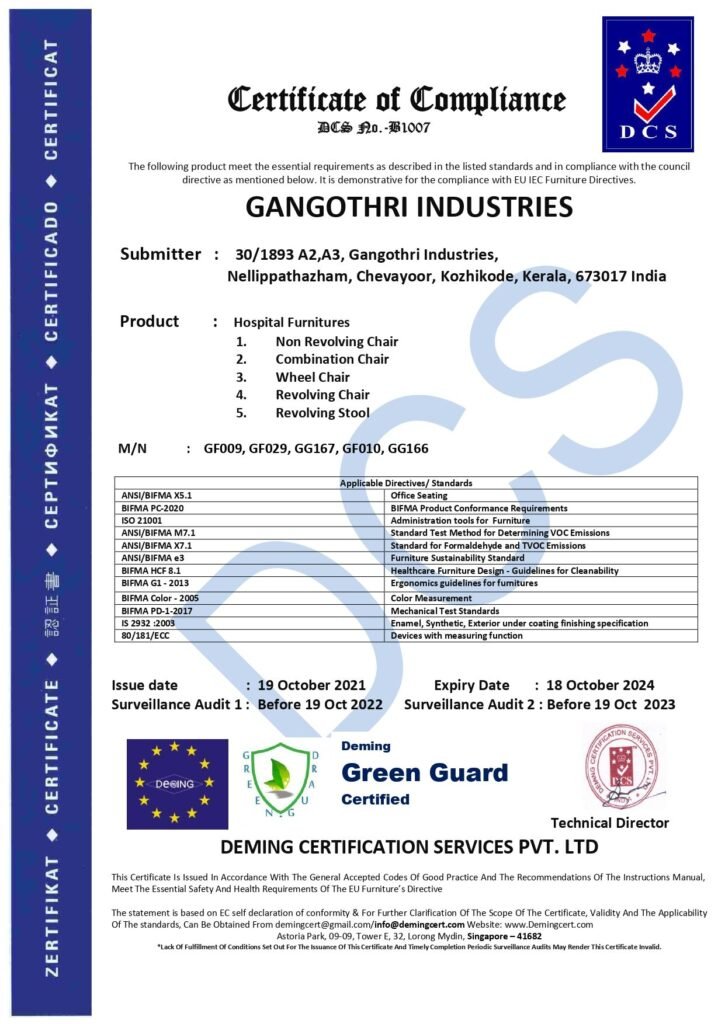
Gangothri Industries developed products covering several categories of hospital furniture. Its documented certification scope included non-revolving chairs, combination chairs, wheelchairs, revolving chairs, revolving stools, tables, over-bed tables and steel cabinets. The product models listed in the certification documentation included GF009, GF029, GG167, GF010 and GG166, along with GG143 and GG155.
Each product category presents its own manufacturing considerations.
A chair requires attention to structure, seating, balance and finishing.
A revolving chair requires additional attention to movement and associated components.
A stool requires stability and suitable construction.
A table requires structural integrity and an appropriate working surface.
An over-bed table must be designed around its intended function.
A steel cabinet requires attention to construction, doors, storage, finishing and durability.
The quality-management approach encouraged the company to view these products as controlled outputs rather than simply manufactured articles.
This distinction could influence production planning.
Specifications become references for manufacturing.
Inspection criteria become references for acceptance.
Records become evidence of completed checks.
Customer complaints become sources of improvement.
The promoter’s role was particularly important in creating this environment. Management commitment determines whether quality procedures are treated as paperwork or integrated into daily operations.
When quality becomes part of management discussions, production decisions can be considered alongside customer satisfaction, defects, delivery performance and supplier performance.
For a growing manufacturer, this creates greater organizational visibility.
One of the most important changes associated with systematic quality management is the recognition that defects have a cost. A defective product may require rework. Rework consumes labor and materials. Delays can affect delivery. Repeated complaints can consume management time. Poor consistency can affect customer confidence.
Preventing defects is therefore generally more efficient than correcting them later.
This principle encouraged greater attention to inspection at appropriate stages.
Incoming materials could be checked against requirements.
Production activities could be monitored.
Finished products could be inspected before dispatch.
Nonconforming products could be identified and controlled.
Corrective action could be introduced when recurring problems were identified.
Such practices create a feedback loop.
Production generates information.
Inspection identifies results.
Management reviews the information.
Corrective action addresses problems.
The organization learns.
Future production becomes better controlled.
For Gangothri Industries, the BIFMA-related documentation provided another layer of product conformity. The available certificate references standards including ANSI/BIFMA X5.1 for office seating, ANSI/BIFMA X5.9 for storage, BIFMA HCF 8.1 for healthcare furniture design and cleanability, BIFMA G1 for ergonomics, BIFMA PD-1 for mechanical testing, and sustainability and emissions-related requirements.
These references demonstrate the breadth of considerations that can surround furniture quality.
Furniture is no longer evaluated only by appearance.
Performance, safety, ergonomics, emissions, sustainability and usability can all become relevant depending on the product and market.
This broader understanding can strengthen a company’s ability to communicate with institutional customers.
The promoter could use certification and conformity documentation as evidence that the organization was taking product requirements seriously.
Employees could also understand why inspection mattered.
A measurement was no longer simply a technical exercise.
A finishing check was no longer merely cosmetic.
A material verification step was no longer just an internal procedure.
Each became part of the company’s commitment to consistent output.
The result was a gradual change in organizational thinking.
Instead of asking, “Can we manufacture this product?”
the organization could increasingly ask:
“What exactly does the customer require?”
“How will we manufacture it consistently?”
“How will we verify conformity?”
“How will we identify and correct problems?”
“How can we improve the process next time?”
Those questions form the foundation of continuous improvement.
For Gangothri Industries, this approach supported the development of a more structured manufacturing culture.
The company’s journey illustrates that certification can be most meaningful when it becomes connected with actual production practices.
A certificate can establish recognition.
A quality system can establish discipline.
Employees can establish execution.
Customers ultimately experience the result.
That connection between system, product and customer became one of the central themes of Gangothri Industries’ development after certification.
#BIFMACertification
Chapter 4 – The Promoter’s Role in Building a Stronger Organization
Behind every manufacturing system are people. Procedures may define activities, but management must create the environment in which employees understand and follow those procedures.
For Gangothri Industries, the promoter and management played a central role in translating certification requirements into practical business activities.
A quality-management system requires commitment.
Management must provide resources.
Employees must receive appropriate instructions.
Processes must be monitored.
Problems must be discussed.
Corrective actions must be completed.
Results must be reviewed.
Continuous improvement must remain active.
These activities require leadership because quality cannot be delegated completely to an inspection function.
If only the quality person cares about quality, the system remains weak.
If production, purchasing, stores, administration and management all recognize their responsibilities, the system becomes stronger.
The promoter’s involvement therefore represented an important part of the organization’s development.
As Gangothri Industries operated in hospital furniture and institutional products, customer requirements could vary from one order to another. Institutional customers may have specific product models, dimensions, materials, quantities, delivery requirements or documentation expectations.
A disciplined system helps management handle such variation.
Customer requirements can be reviewed before accepting an order.
Production capacity can be considered.
Materials can be planned.
Responsibilities can be assigned.
Inspection requirements can be established.
Delivery can be coordinated.
The promoter’s role becomes that of a system builder rather than simply an order manager.
This is an important stage in business growth.
In an early-stage enterprise, the owner may personally solve most problems.
In a developing organization, the owner needs systems that allow employees to solve routine problems correctly.
That transition increases organizational capacity.
It also creates continuity.
When a process is documented and understood, knowledge is less dependent on one individual.
Employees become capable of carrying responsibilities independently.
Management gains more time for planning and business development.
This can support long-term growth.
The certification journey also creates a culture of accountability.
If responsibilities are defined, employees know who is expected to perform a particular activity.
If records are maintained, management can review what happened.
If corrective actions are recorded, the organization can verify whether problems were actually addressed.
If internal audits are conducted, processes can be reviewed objectively.
These practices can make an organization more transparent internally.
The promoter can then make decisions based on information rather than assumptions.
For example, if customer complaints repeatedly concern a particular product component, management can investigate the underlying process.
If supplier-related defects increase, supplier performance can be reviewed.
If delivery delays occur, production planning and material availability can be examined.
If rework increases, the organization can investigate where defects are entering the process.
The objective is not to assign blame.
It is to understand causes.
This is one of the most valuable ideas in a quality-management system.
A recurring problem is an opportunity to learn.
For Gangothri Industries, the certification period also coincided with increased visibility in institutional procurement. A KMSCL running-contract document lists M/s Gangothri Industries as a supplier of various general furniture and identifies products including revolving chairs, visitor chairs, armless chairs and office tables.
This provides a concrete example of the type of institutional business environment in which structured production and documentation can be useful.
The document also identifies delivery and warranty-related requirements, demonstrating that institutional supply involves more than manufacturing alone.
For the promoter, this type of business requires coordination.
A product must be manufactured correctly.
It must be delivered within the agreed period.
Installation or service requirements may need attention.
Warranty obligations must be understood.
Customer communication must remain effective.
Each activity affects business reputation.
The management system therefore becomes an infrastructure supporting customer commitments.
Over time, this can contribute to organizational maturity.
Employees become more process-oriented.
Management becomes more data-oriented.
Customer interactions become more structured.
Production becomes more predictable.
Quality becomes part of business planning.
This was an important dimension of Gangothri Industries’ growth story.
The promoter’s contribution was not simply obtaining certification.
It was creating conditions under which certification principles could become part of everyday operations.
That is where the long-term value of certification can emerge.
#GreenGuardCertification
Chapter 5 – Green Guard Certification and the Environmental Dimension
Quality and environmental responsibility increasingly intersect in modern manufacturing.
A customer purchasing furniture may consider not only whether the product performs correctly but also how materials, finishes, emissions and sustainability requirements are addressed.
For Gangothri Industries, the Green Guard certification became an important part of its certification journey.
The publicly available certification record identifies Gangothri Industries as receiving Green Guard certification on 19 October 2021, with validity through 18 October 2024. The record also identifies Deming Certification Services Pvt. Ltd. as the certification service provider.
The available certificate documentation connects the certification with furniture products including hospital furniture and steel cabinets. It also references requirements relating to VOC emissions, formaldehyde and TVOC emissions, furniture sustainability, healthcare furniture design and related furniture standards.
For a furniture manufacturer, these considerations can influence material selection, finishing processes and product specifications.
Environmental responsibility therefore becomes connected to product development.
The organization must understand the requirements applicable to its products.
Suppliers may need to provide appropriate material information.
Production processes may need controls.
Records may need to be maintained.
Finished products may need to demonstrate conformity.
The promoter can use this framework to encourage employees to think about environmental requirements as part of normal production rather than as an independent activity.
This is important because sustainability cannot be created only through marketing.
It needs operational support.
Material purchasing influences environmental performance.
Finishing materials influence emissions.
Production efficiency influences waste.
Packaging influences resource consumption.
Product durability influences lifecycle value.
Waste segregation and responsible disposal influence environmental management.
Even small improvements can become meaningful when repeated throughout a production cycle.
For Gangothri Industries, the Green Guard certification therefore represented an opportunity to broaden the organization’s quality perspective.
Quality could be considered in terms of product performance.
Environmental considerations could be considered in terms of materials and emissions.
Customer satisfaction could incorporate expectations regarding responsible manufacturing.
This broader approach could also strengthen communication with institutional customers.
Healthcare institutions and public-sector organizations may have detailed procurement requirements. When suppliers can provide appropriate certification and conformity documentation, the procurement process can become more transparent.
The certification documentation associated with Gangothri Industries demonstrates that the organization had product-related conformity information available for its hospital furniture.
Such documents can help organizations communicate technical information in a standardized manner.
The environmental dimension also influenced internal awareness.
Employees could understand that manufacturing efficiency and environmental responsibility are not necessarily competing objectives.
Reducing waste can save materials.
Improving process control can reduce rework.
Reducing rework can reduce energy and labor consumption.
Better material planning can reduce unnecessary inventory.
Longer-lasting products can reduce replacement frequency.
These examples demonstrate how quality and sustainability can support one another.
The promoter’s responsibility is to create the conditions in which these connections become visible.
A quality meeting can discuss defects and waste together.
A production review can examine rework and material consumption.
A supplier review can consider both quality and material conformity.
A customer complaint can lead to both product improvement and process improvement.
The Green Guard milestone therefore contributed another dimension to Gangothri Industries’ organizational identity.
The company was not merely presenting itself as a furniture manufacturer.
It was developing a documented framework around product conformity and environmental considerations.
This helped create a stronger foundation for institutional markets.
The certification period from 2021 to 2024 can consequently be understood as a stage in which Gangothri Industries strengthened its emphasis on structured quality and product-related environmental requirements.
The certificate itself was one milestone.
The larger achievement was developing awareness among management and employees that quality includes the complete product lifecycle.
From materials to manufacturing.
From inspection to delivery.
From customer use to long-term performance.
From product conformity to responsible production.
This broader view helped shape the next stage of the company’s growth.
#HospitalFurniture
Chapter 6 – Customer Satisfaction Becomes the Measure of Success
For Gangothri Industries, the ultimate purpose of quality was not paperwork. It was customer satisfaction.
A manufacturing organization can maintain extensive procedures, but if customers receive inconsistent products, late deliveries or inadequate service, the quality system has failed to achieve its practical purpose.
The company’s product range included furniture intended for hospitals and institutional environments. Such customers require products that function as expected and remain suitable for repeated use.
Therefore, customer expectations become an important source of information.
The quality-management approach encouraged the organization to treat customer requirements systematically.
Before production, requirements could be reviewed.
During production, specifications could be followed.
Before dispatch, conformity could be checked.
After delivery, feedback could be considered.
This creates a complete customer-oriented cycle.
Customer satisfaction also includes more than product quality.
Delivery matters.
Documentation matters.
Communication matters.
Responsiveness matters.
Warranty support matters.
Problem resolution matters.
The KMSCL running-contract record provides an example of institutional procurement requirements associated with Gangothri Industries. It lists the company as a supplier of various general furniture and specifies delivery and warranty-related requirements alongside product models and quantities.
Such requirements demonstrate why a systematic organization is valuable.
Institutional orders can involve substantial quantities. The referenced KMSCL contract, for example, listed 2,000 revolving chairs, 5,000 visitor chairs, 1,000 armless chairs and 1,500 office tables among the specified products.
Large orders require planning.
Materials must be available.
Production capacity must be coordinated.
Inspection must be systematic.
Packaging must be organized.
Dispatch must be scheduled.
Documentation must be accurate.
If any one of these activities fails, the customer’s experience can be affected.
Quality management provides a framework for reducing such risks.
The promoter can monitor performance through measurable information.
For example:
What percentage of products required rework?
How many complaints were received?
How many deliveries were delayed?
Which suppliers created repeated problems?
Which products generated the most service requests?
Which corrective actions were effective?
Such questions turn customer satisfaction into a management metric.
This approach can also improve employee awareness.
A production worker may not directly speak to the customer, but the worker’s output influences the customer.
A storekeeper may not negotiate contracts, but incorrect material handling can affect product quality.
A dispatch employee may not design the product, but poor packaging can cause damage.
Every employee therefore becomes part of the customer experience.
This realization can strengthen organizational culture.
Employees understand why their work matters.
Managers understand where improvement is needed.
Customers receive more consistent communication.
The promoter receives clearer information for decision-making.
Over time, the organization can become more responsive.
Customer complaints should not automatically be viewed as negative events.
They can provide information that internal inspection may not reveal.
A customer may identify an installation difficulty.
A hospital may identify a usability issue.
A procurement department may identify documentation requirements.
A user may identify a recurring design concern.
Each piece of information can become an input to improvement.
This is one of the central principles of a mature quality culture.
The objective is not to eliminate feedback.
The objective is to learn from it.
Gangothri Industries’ certification documentation demonstrates attention to product conformity and furniture-related standards.
When combined with customer feedback, such technical requirements can help create a stronger development cycle.
Design and production can respond to actual use.
Quality checks can focus on meaningful characteristics.
Management can prioritize recurring problems.
Employees can learn from previous experience.
This is how customer satisfaction becomes connected with business growth.
A satisfied customer may return with another requirement.
An institutional customer may recommend a supplier internally.
Consistent performance can strengthen commercial relationships.
Reliable delivery can improve confidence.
Clear documentation can simplify procurement.
Responsive service can protect long-term relationships.
These outcomes should not be assumed automatically, but the systems that support them are important building blocks.
For Gangothri Industries, the quality journey therefore placed the customer at the center of organizational improvement.
The certificate provided recognition.
The product provided the physical result.
The customer provided the final test.
And every customer interaction created another opportunity for the organization to learn.
#QualityManagementSystem
Chapter 7 – Building a Culture of Continuous Improvement
Certification creates a framework, but continuous improvement gives that framework life.
For Gangothri Industries, continuous improvement could be applied across every area of the organization.
Production could improve.
Purchasing could improve.
Inspection could improve.
Storage could improve.
Documentation could improve.
Customer service could improve.
Management decisions could improve.
The important point is that improvement does not always require dramatic change.
Sometimes a small modification can prevent repeated problems.
A better production sequence may reduce handling.
A clearer work instruction may reduce mistakes.
Improved material storage may prevent damage.
A stronger inspection checklist may identify defects earlier.
Better packaging may reduce transportation damage.
A more organized record system may save administrative time.
These incremental changes can accumulate.
The promoter and management therefore had an opportunity to encourage employees to identify practical improvements.
Employees working directly with products often understand process difficulties that may not be obvious to management.
A worker may know that a particular assembly stage causes delays.
A storekeeper may know that a material is difficult to locate.
An inspector may recognize a recurring defect.
A salesperson may hear the same customer complaint repeatedly.
The quality system can provide a mechanism for capturing this knowledge.
Internal audits are particularly useful in this respect.
An audit is not simply an examination of whether documents exist.
It can provide an opportunity to compare documented processes with actual practices.
If the process is not being followed, management can ask why.
Perhaps the procedure is unclear.
Perhaps employees need training.
Perhaps resources are insufficient.
Perhaps the procedure no longer reflects actual operations.
Each situation requires a different response.
This makes corrective action important.
A corrective action should address the underlying cause rather than merely the visible symptom.
Suppose a product repeatedly requires rework because a dimension is incorrect.
Simply correcting the product may solve one instance.
Investigating why the dimension was incorrect can prevent recurrence.
Was the drawing unclear?
Was the measuring instrument appropriate?
Was the operator trained?
Was the measuring method consistent?
Was the specification communicated correctly?
These questions transform an isolated defect into a learning opportunity.
For Gangothri Industries, this approach was particularly relevant because the company handled multiple furniture categories and product models.
Different products may require different processes and controls.
The organization must therefore maintain enough flexibility to manage variation while maintaining consistency.
Continuous improvement can help achieve that balance.
The company’s product-related certification documentation includes several model references and standards associated with seating, storage, healthcare furniture, ergonomics, mechanical testing and sustainability.
These requirements create opportunities for structured improvement.
Ergonomic considerations can influence product design.
Mechanical testing can provide information about performance.
Cleanability requirements can influence healthcare furniture design.
Sustainability requirements can influence materials and processes.
Emissions-related requirements can influence finishing and material selection.
Thus, continuous improvement is not limited to production speed.
It can also involve product development.
The promoter can encourage the organization to ask whether a product can be easier to clean, easier to maintain, more comfortable, more durable or more efficient to manufacture.
These questions can create innovation without abandoning established quality controls.
Continuous improvement also influences employees.
When employees see management acting on their suggestions, participation can increase.
When employees understand the reasons behind procedures, compliance can become stronger.
When employees see recurring problems being eliminated, confidence can increase.
The result is a culture in which quality becomes everyone’s responsibility.
For a manufacturing organization, this cultural shift can be more valuable than any single procedural improvement.
Gangothri Industries’ certification journey can therefore be viewed as the beginning of a continuous learning process.
The company had a framework.
Employees provided experience.
Customers provided feedback.
Management provided direction.
Certification provided external recognition.
Together, these elements created an environment in which improvement could become systematic.
The objective was not perfection.
No manufacturing organization operates without challenges.
The objective was the ability to identify problems, understand them, correct them and learn from them.
That ability is one of the strongest foundations for long-term organizational development.
#HealthcareFurniture
Chapter 8 – Institutional Markets and New Business Opportunities
Certification can become particularly valuable when a manufacturer serves institutional customers.
Institutional procurement often involves formal specifications, documented requirements, quantities, delivery schedules, warranty provisions and product conformity expectations.
Gangothri Industries’ experience in supplying furniture illustrates this environment.
A KMSCL running-contract document identifies M/s Gangothri Industries as a supplier of various general furniture and lists multiple furniture products and quantities. The document identifies the supplier’s Kozhikode address and includes delivery, warranty and uptime-related requirements.
Such opportunities require organizational preparedness.
A company may receive a large order, but fulfilling it requires much more than production capacity.
The business needs reliable procurement.
It needs production planning.
It needs quality control.
It needs inventory management.
It needs delivery coordination.
It needs documentation.
It needs customer communication.
It may also need after-sales support.
A management system can provide structure across these activities.
For the promoter, institutional business can therefore encourage further professionalization.
Orders can be planned through formal production schedules.
Material requirements can be calculated.
Inspection stages can be established.
Documents can be organized.
Responsibilities can be assigned.
Delivery status can be monitored.
Customer feedback can be recorded.
The organization becomes less dependent on informal coordination.
This is especially important when the order volume increases.
The KMSCL document illustrates how substantial institutional requirements can become. Among the listed products were 2,000 revolving chairs and 5,000 visitor chairs, along with other furniture products.
Handling quantities at this level requires repeatability.
One product cannot be excellent while the next is inconsistent.
Every unit must meet the applicable specification.
This is where quality systems can create commercial value.
The system provides a structure for maintaining consistency across repeated production.
Certification and product-conformity documents can also support communication with procurement departments.
Gangothri Industries’ available certificate documentation identifies BIFMA-related requirements and specific hospital furniture products.
Such technical references provide a language through which manufacturers and institutional buyers can communicate.
Instead of describing quality only in general terms, product requirements can be connected with recognized standards and technical criteria.
This can strengthen the clarity of procurement discussions.
It can also encourage internal product development.
When customers ask for specific performance characteristics, the company must determine how those characteristics will be achieved and verified.
This creates a connection between market demand and technical development.
For the promoter, the growth opportunity lies not merely in securing individual orders but in developing organizational capability that can support repeated institutional business.
A single large order may increase revenue.
A capable system can increase organizational capacity.
That distinction is critical.
Business growth without operational systems can create stress.
Orders increase.
Errors increase.
Delivery pressure increases.
Customer complaints can increase.
Employees become overloaded.
Quality may decline.
A management system helps create a foundation for handling growth more systematically.
Gangothri Industries’ journey demonstrates this relationship between certification and market readiness.
The company’s certification period established formal recognition.
Its product documentation demonstrated attention to furniture-related conformity.
Its institutional supply experience demonstrated the practical importance of structured operations.
Together, these elements created a business environment in which quality and commercial development could support each other.
The promoter could therefore focus on future opportunities with greater confidence in the organization’s operational structure.
New product categories could be considered.
Existing products could be improved.
Institutional customers could be approached.
Supplier relationships could be strengthened.
Production systems could be expanded.
Employees could be trained for additional responsibilities.
The growth story thus became broader than simply increasing sales.
It became the story of building an organization capable of supporting business opportunities.
#Kozhikode
Chapter 9 – From Certification to Organizational Maturity
Every certification journey reaches a point where the organization must demonstrate that the system has become part of normal business operations.
For Gangothri Industries, the certification period from 2021 to 2024 provided an important stage in this process. Public records identify the Green Guard certification issued on 19 October 2021 and valid until 18 October 2024.
During this period, certification could serve as a reference point for management.
The organization could review processes.
Employees could develop greater awareness.
Customers could receive structured information.
Product conformity could be documented.
Environmental and furniture-related requirements could be considered.
The promoter could monitor whether procedures were producing useful results.
Organizational maturity develops gradually.
At an immature stage, processes may depend heavily on individuals.
At a more mature stage, processes become repeatable.
At a still stronger stage, data from those processes is used to improve them.
This progression is important.
Gangothri Industries’ development can be understood through this lens.
The company already had practical manufacturing knowledge.
Certification added structure.
Product standards added technical reference points.
Institutional contracts added commercial requirements.
Customer feedback added practical information.
Management review connected these elements.
The organization could then use experience to strengthen future operations.
Maturity also involves accepting that improvement is never complete.
Market expectations change.
Customer requirements change.
Materials change.
Technology changes.
Competition changes.
Regulatory requirements can change.
Healthcare environments change.
A company that stops learning can gradually lose relevance.
Therefore, the promoter must continue to encourage improvement even after certification.
This means maintaining employee training.
It means reviewing procedures.
It means evaluating suppliers.
It means monitoring complaints.
It means examining defects.
It means considering new products.
It means maintaining awareness of applicable standards.
The BIFMA-related documentation associated with Gangothri Industries demonstrates the range of technical considerations applicable to furniture, including seating, storage, ergonomics, mechanical testing, emissions and healthcare furniture design.
This illustrates why organizational maturity is important.
Different requirements cannot always be managed independently.
A product may need to satisfy functional, structural, environmental and ergonomic expectations simultaneously.
The organization therefore needs coordination.
Design must communicate with production.
Production must communicate with inspection.
Inspection must communicate with management.
Sales must communicate customer requirements.
Purchasing must understand technical requirements.
This interconnected structure is characteristic of a mature quality organization.
The promoter’s role gradually changes as maturity increases.
Instead of solving every operational problem personally, management can focus on setting objectives and reviewing performance.
Employees become responsible for process execution.
Supervisors monitor activities.
Quality personnel evaluate conformity.
Management reviews information and determines priorities.
This creates scalability.
The business becomes capable of handling greater complexity without requiring every decision to pass through one individual.
That is an important form of organizational growth.
The journey of Gangothri Industries therefore demonstrates that certification should not be viewed as an isolated event.
It is better understood as a stage in organizational development.
The certificate provides recognition at a particular point in time.
The real question is what the organization does with that recognition.
Does it improve?
Does it listen to customers?
Does it strengthen processes?
Does it train employees?
Does it improve products?
Does it reduce recurring problems?
Does it prepare for future requirements?
Those questions determine the long-term value of certification.
For Gangothri Industries, the combination of management-system certification, Green Guard certification, BIFMA-related product conformity and institutional supply activity provided multiple opportunities for organizational learning.
Each requirement could strengthen the next.
Quality strengthened consistency.
Consistency supported customer confidence.
Customer confidence supported institutional relationships.
Institutional requirements encouraged further process discipline.
Process discipline supported organizational maturity.
And maturity created a stronger foundation for future development.
The story therefore moves beyond certification.
It becomes a story of capability.
#ManufacturingExcellence
Chapter 10 – A Legacy of Quality and a Vision for the Future
The story of Gangothri Industries is ultimately a story about transformation.
It began with manufacturing.
It developed through customer requirements.
It strengthened through quality systems.
It expanded through product conformity.
It gained another dimension through environmental certification.
And it continued through institutional business.
Located in Nellippathazham, Chevayoor, Kozhikode, Kerala, Gangothri Industries developed a portfolio of hospital and institutional furniture that included chairs, wheelchairs, stools, tables, over-bed tables and steel cabinets.
The certification documentation associated with the company records Green Guard certification issued in October 2021 and valid through October 2024.
The available product-compliance documentation also identifies hospital furniture and references BIFMA-related requirements covering seating, storage, ergonomics, mechanical testing, healthcare furniture design, sustainability and emissions.
These milestones became part of the company’s professional development.
The greatest lesson is that certification should not be considered the end of a business journey.
It is the beginning of greater responsibility.
Once an organization publicly commits to quality, it must continue to maintain that quality.
Once it documents a process, it must ensure the process remains meaningful.
Once it understands customer expectations, it must continue listening.
Once it achieves product conformity, it must continue monitoring performance.
Once it enters institutional markets, it must continue strengthening its capacity.
For the promoter, this creates a long-term leadership responsibility.
The future of Gangothri Industries depends not only on equipment, materials and orders but also on people.
Employees need training.
Supervisors need leadership.
Quality personnel need technical knowledge.
Management needs reliable information.
Customers need responsive service.
Suppliers need clear requirements.
Each relationship contributes to the organization’s future.
The institutional procurement record involving KMSCL demonstrates the importance of this organizational capability. Gangothri Industries was listed as a supplier of various general furniture, including revolving chairs, visitor chairs, armless chairs and office tables, with specified quantities, delivery requirements and warranty provisions.
Such business environments can provide valuable opportunities for a manufacturer to demonstrate consistency and reliability.
The future can therefore be approached through continued improvement.
Gangothri Industries can continue strengthening its production systems.
It can continue developing products.
It can continue improving material controls.
It can continue monitoring customer satisfaction.
It can continue training employees.
It can continue reviewing supplier performance.
It can continue exploring technical standards relevant to furniture.
It can continue integrating environmental considerations into manufacturing decisions.
The company’s earlier certification experience provides a foundation for these activities.
The story also demonstrates the importance of adaptability.
The furniture industry does not remain static.
Customer expectations change.
Healthcare facilities evolve.
Institutional procurement becomes more structured.
Environmental expectations increase.
Technical requirements become more detailed.
Digital communication changes how customers evaluate suppliers.
A manufacturer that continuously learns can respond more effectively to these changes.
For Gangothri Industries, the quality journey therefore represents an ongoing commitment rather than a finished chapter.
The 2021 certification milestone belongs to the company’s history, but its lessons can remain relevant.
The importance of documented processes remains relevant.
The importance of customer satisfaction remains relevant.
The importance of product conformity remains relevant.
The importance of environmental responsibility remains relevant.
The importance of employee development remains relevant.
The importance of continual improvement remains relevant.
These principles can support the company as it moves into new markets and new stages of development.
The promoter’s contribution to this journey is measured not simply by obtaining a certificate but by building an organization capable of sustaining quality.
That requires vision.
It requires discipline.
It requires patience.
It requires investment in people.
It requires listening.
And it requires the willingness to improve even when the business is already performing well.
Gangothri Industries’ journey from certification toward organizational development illustrates this principle.
The certificate represented recognition.
The products represented capability.
The customers represented responsibility.
The employees represented execution.
Management represented direction.
Continuous improvement represented the future.
Together, these elements form the foundation of a lasting quality culture.
The story of Gangothri Industries therefore does not end with the expiry date of a certificate.
Instead, that period can be remembered as one stage in a much larger journey.
A journey from production to process.
From process to consistency.
From consistency to confidence.
From confidence to opportunity.
And from opportunity to continued improvement.
For a manufacturing organization serving healthcare and institutional markets, that journey can provide a durable foundation for future growth.
Gangothri Industries’ experience demonstrates that sustainable business development is built step by step.
One product.
One process.
One customer.
One improvement.
One lesson at a time.
And the most important achievement is not simply holding a certificate.
It is developing an organization in which quality becomes part of the way people think, work and serve their customers.
That is the legacy of the quality journey.
That is the foundation for the future.
And that is the continuing story of Gangothri Industries.
#ContinuousImprovement
#InstitutionalFurniture #FurnitureQuality #QualityCertified #KeralaManufacturing #SustainableFurniture
Take the Next Step Today
Don’t wait to enhance your business’s quality and efficiency. Partner with Sanatan Dharma Accreditation Boards and experience the transformation that comes with expert consultancy and training. Contact us today to learn more about how we can help you achieve your business goals. Reach out via phone at +91-8668266780, visit our website at sanatanboards.com, or email us at info@sanatanboards.com Let us be your guide on the journey to excellence and innovation.





