
Amar Kumar Maurya
Table of Contents
Chapter 1 – The Beginning of a Professional Journey
Every successful business has a beginning that is usually much smaller than the success it eventually seeks to achieve. Behind every established organization is a period when its promoters are required to make difficult decisions, build professional credibility, understand customer expectations and create systems that can support future growth.
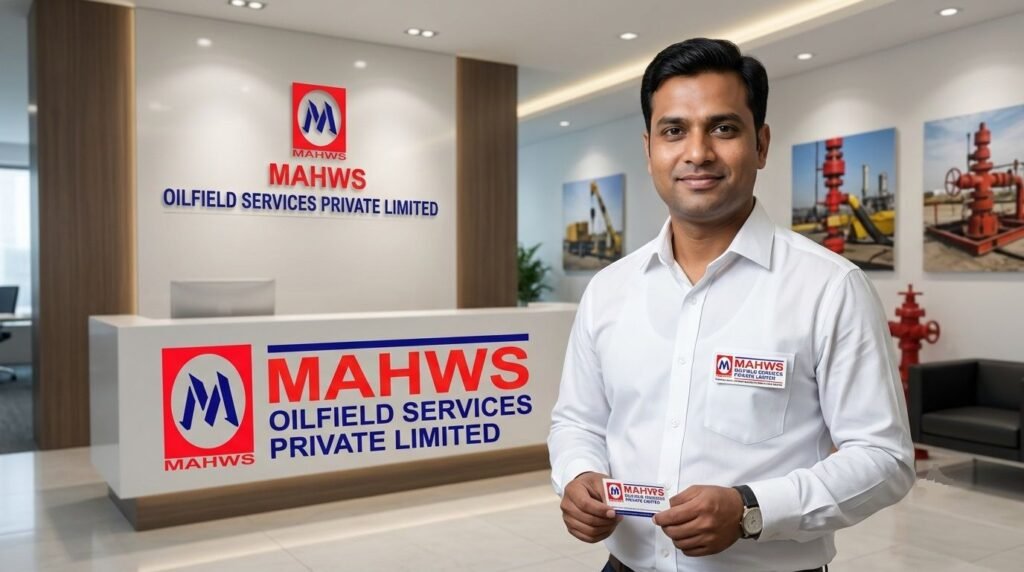
For Amar Kumar Maurya and MAHWS Oilfield Services Private Limited, the journey was closely connected with the demanding world of oilfield services and industrial operations. Located in the TTC Industrial Area, MIDC Industrial Area, Pawne, Navi Mumbai, Maharashtra, the company operated in an environment where technical competence, safety awareness, professional discipline and reliability are particularly important.
The oil and gas sector is not an ordinary commercial environment. It involves equipment, processes, installations and workplaces where hazardous or potentially explosive atmospheres may exist. In such environments, the difference between ordinary technical knowledge and demonstrated competence can become extremely important.
For Amar Kumar Maurya, professional development therefore represented more than simply acquiring another qualification. It represented a commitment to understanding specialized requirements associated with explosive atmospheres and demonstrating competence within a recognized international framework.
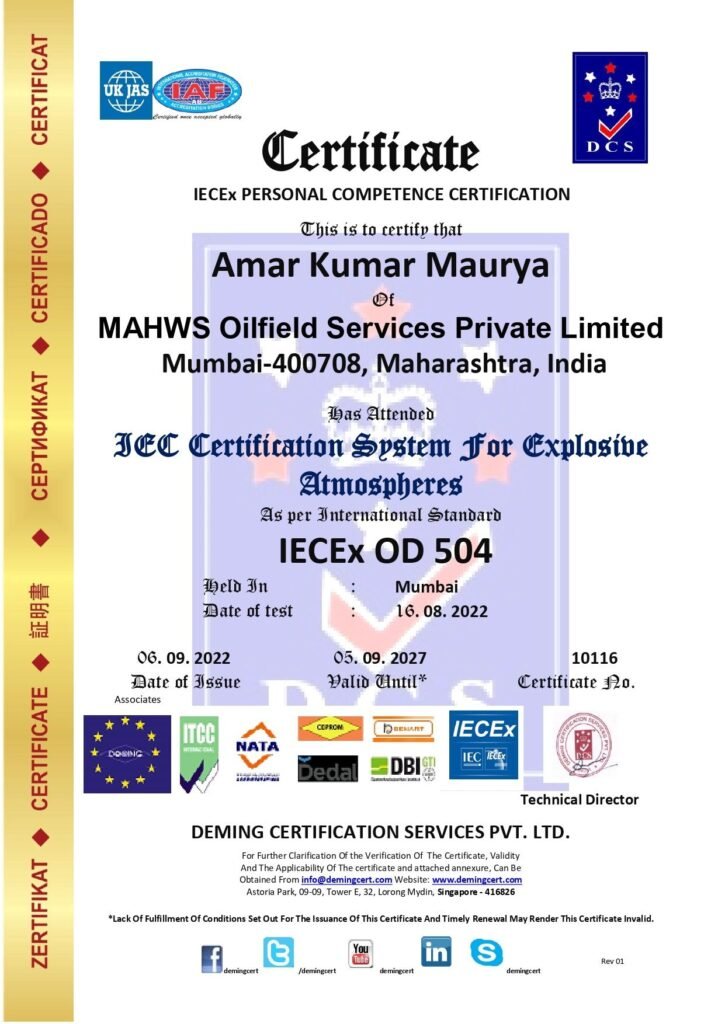
This became particularly significant with the IECEx Personal Competence Certification associated with IECEx OD 504. The certification milestone in 2022 became an important chapter in the professional story of Amar Kumar Maurya and MAHWS Oilfield Services Private Limited. (https://mathewassociates.com/)
A certification does not automatically create business growth. Instead, it can provide a platform upon which trust, professional reputation, technical capability and organizational discipline can be developed. For a company operating around industrial and oilfield environments, such qualities can influence how customers, contractors and business partners perceive technical personnel.
The certification journey encouraged a greater appreciation of structured competence. Rather than depending entirely upon experience or informal knowledge, professional activities could increasingly be viewed through documented competence, defined requirements and recognized practices.
This way of thinking could have an effect beyond the individual certificate. When the promoter of an organization develops specialized knowledge, that knowledge can gradually become part of the organization’s culture.
The year 2022 therefore represented a meaningful transition.
Amar’s professional journey could now be presented not only through practical exposure but also through a formal competence credential connected with explosive-atmosphere requirements.
For MAHWS Oilfield Services Private Limited, this provided an opportunity to strengthen its professional identity.
The company was situated within the industrial ecosystem of Navi Mumbai, an important commercial and industrial region. The location itself placed the organization close to numerous engineering, manufacturing, infrastructure, petrochemical and industrial activities. Such an environment creates opportunities, but it also creates competition.
In competitive industrial markets, companies must demonstrate why customers should trust them.
Price is one factor.
Availability is another.
Experience matters.
But technical competence and safety consciousness can become equally important, especially when work is associated with hazardous environments.
The certification journey helped establish a story around professional responsibility.
Amar Kumar Maurya could increasingly represent a professional who understood the importance of competence in specialized environments. That distinction could support the broader identity of MAHWS Oilfield Services Private Limited.
The early years of the company’s journey were therefore not simply about obtaining projects. They were about establishing a foundation.
A foundation built around knowledge.
A foundation built around discipline.
A foundation built around safety.
A foundation built around customer confidence.
The certification issued in 2022, with validity extending to 2027, provided a defined period during which this professional competence could be demonstrated, maintained and integrated into business practices.
The most important lesson from this stage was simple: sustainable growth begins with capability.
A company cannot build long-term trust merely through marketing. It must have people who can understand customer requirements and perform responsibly.
For Amar Kumar Maurya, the IECEx competence milestone became part of that professional foundation.
And for MAHWS Oilfield Services Private Limited, the foundation created an opportunity to move forward with greater confidence.
The story of growth was therefore not a story of overnight success.
It was a story of gradual professional strengthening.
The certification was one milestone in that journey.
The chapters that followed would demonstrate how competence, quality consciousness and safety-oriented thinking could influence the way a company approached opportunities in the industrial and oilfield services environment.
#MAHWSOilfieldServices
Chapter 2 – Understanding the Importance of Competence
In technical industries, competence has a meaning far deeper than simply knowing how to perform a task.
Competence combines knowledge, understanding, practical ability, judgment and responsibility.
This becomes particularly important in environments where electrical equipment or installations may operate in areas where explosive atmospheres can occur.
Oilfield facilities, petroleum installations, chemical processing environments and other industrial workplaces can contain hazardous substances under particular operating conditions. Consequently, professionals working around such environments need to understand the technical and safety implications of their activities.
The IECEx Personal Competence Certification represented an important professional milestone because it placed attention on the individual rather than simply on a company logo.
For Amar Kumar Maurya, this was significant.
A business may own equipment.
A business may have offices.
A business may possess years of commercial experience.
But the people performing or supervising technical work remain central to quality.
A competent professional can identify requirements, recognize risks, understand technical documentation and appreciate the consequences of incorrect decisions.
This mindset can gradually influence the culture of an organization.
At MAHWS Oilfield Services Private Limited, the certification could therefore be viewed as more than an individual achievement. It could become a reference point for establishing expectations about professional conduct.
One of the strongest effects of formal certification is often the encouragement of structured thinking.
Instead of asking only, “Can we do this work?”, professionals begin asking additional questions:
What are the applicable requirements?
What competence is necessary?
What documentation is required?
What risks are involved?
What evidence demonstrates conformity?
What needs to be checked before work begins?
What should be recorded after the work is completed?
These questions encourage a quality-oriented culture.
For an oilfield services organization, this approach is valuable because customers often expect service providers to demonstrate reliability, technical awareness and safety consciousness.
Certification can also help a professional communicate more effectively with customers.
A customer may not know every detail of a service provider’s technical background. A recognized competence credential provides an external reference point that can make discussions more meaningful.
It does not eliminate the need for experience.
It does not guarantee the quality of every future assignment.
It does not replace organizational procedures.
But it provides evidence that the professional has achieved a defined level of competence under the applicable certification framework.
This distinction is important.
Amar Kumar Maurya’s certification journey could therefore strengthen the professional conversation between MAHWS Oilfield Services Private Limited and its customers.
Instead of presenting only commercial capability, the company could emphasize technical responsibility.
Instead of focusing only on completing work, it could emphasize completing work correctly.
Instead of viewing safety as a separate requirement, safety could increasingly become part of professional performance.
That change in mindset can influence business growth indirectly.
A customer who sees evidence of technical competence may be more comfortable initiating discussions.
A contractor may become more confident involving the company in specialized work.
A business partner may recognize the value of having competent personnel available.
A prospective client may see certification as one element supporting vendor evaluation.
Over time, these factors can contribute to reputation.
Reputation itself is one of the most valuable assets in industrial services.
A strong reputation is not created by one certificate. It is created through repeated performance.
A company must deliver consistently.
It must communicate clearly.
It must respect safety requirements.
It must maintain documentation.
It must respond professionally to problems.
It must learn from experience.
Certification can support these behaviors by establishing a professional benchmark.
For MAHWS Oilfield Services Private Limited, the 2022 certification milestone could therefore be understood as a commitment to maintaining and developing competence.
The five-year validity period through 2027 also creates a useful framework for continuous professional development.
Rather than treating certification as the end of learning, it can be treated as the beginning of a more structured journey.
Technical standards evolve.
Customer expectations evolve.
Equipment evolves.
Industrial processes evolve.
Safety practices evolve.
Professionals must evolve with them.
For Amar Kumar Maurya, this continuing-development mindset could become a valuable component of his leadership role.
A promoter who personally understands the importance of competence can influence employees and associates to take professional development seriously.
That influence can become part of company culture.
The organization can gradually develop an environment where people understand that quality is not merely paperwork.
Quality is preparation.
Quality is competence.
Quality is communication.
Quality is control.
Quality is responsibility.
The IECEx Personal Competence Certification thus became part of a larger professional philosophy.
The philosophy was straightforward:
Competence creates confidence, and confidence creates opportunities.
The next stage of the company’s journey would involve converting that confidence into stronger professional relationships and a clearer market identity.
#AmarKumarMaurya
Chapter 3 – Building Credibility in a Competitive Industrial Market
Industrial services markets are highly competitive.
Companies often compete against organizations that have similar equipment, similar manpower and similar service offerings.
In such a market, differentiation becomes essential.
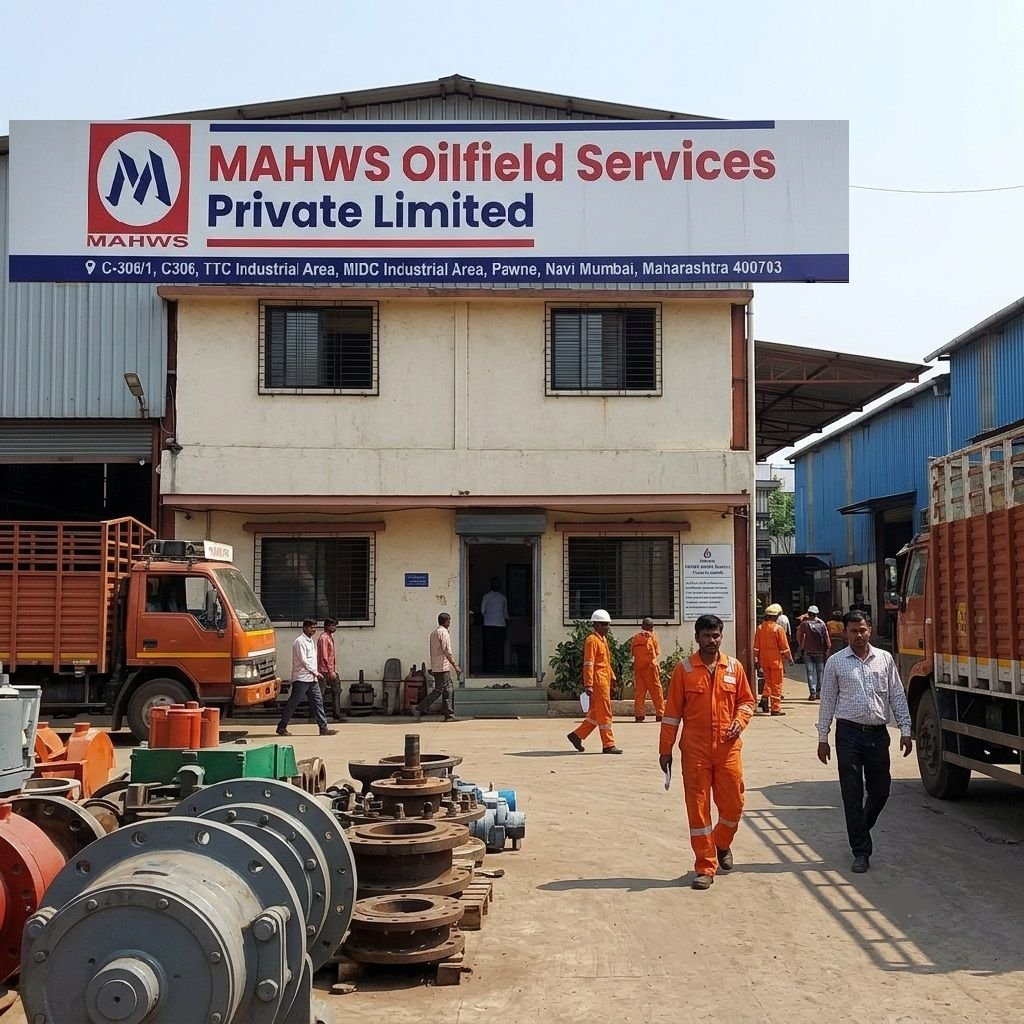
MAHWS Oilfield Services Private Limited operated from the TTC Industrial Area, Pawne, Navi Mumbai, placing it within a major industrial ecosystem. For a company in such an environment, credibility could become an important competitive advantage.
Credibility is created through evidence.
A company can say that it values safety.
It can say that its employees are technically competent.
It can say that quality is important.
But customers increasingly want evidence.
Professional certification provides one form of evidence.
The IECEx Personal Competence Certification obtained by Amar Kumar Maurya in 2022 became a part of that evidence-based professional identity.
It provided an opportunity to demonstrate that specialized competence was not merely being claimed but had been formally assessed within a recognized framework.
For customers operating in oilfield, petrochemical or hazardous industrial environments, such information can be relevant during vendor evaluation and professional discussions.
The value of certification can therefore extend into business development.
When preparing a company profile, tender response, technical proposal or professional introduction, competence credentials can help establish a stronger foundation.
Instead of introducing MAHWS Oilfield Services Private Limited simply as another service provider, the organization could emphasize the technical capabilities of its people.
That distinction matters.
Customers often evaluate service providers through multiple dimensions:
Technical capability.
Experience.
Safety.
Quality.
Responsiveness.
Documentation.
Professional qualifications.
Past performance.
Commercial terms.
Certification cannot replace all of these factors, but it can strengthen one important part of the evaluation.
For Amar Kumar Maurya, this created an opportunity to position professional competence as a component of the company’s identity.
A promoter’s qualifications can influence an organization’s culture.
If leadership demonstrates commitment to specialized knowledge, employees and associates are more likely to understand the importance of continuous learning.
This can eventually produce a multiplier effect.
One individual’s professional development can influence organizational behavior.
Organizational behavior can influence customer experience.
Customer experience can influence reputation.
Reputation can influence future opportunities.
This is how a certification can contribute indirectly to growth.
The effect is rarely immediate.
A certificate issued in 2022 does not automatically produce a new contract in 2022.
Instead, its value accumulates as it becomes part of the organization’s professional story.
Every technical discussion becomes an opportunity to demonstrate competence.
Every customer interaction becomes an opportunity to demonstrate professionalism.
Every project becomes an opportunity to convert knowledge into performance.
Every completed assignment becomes an opportunity to strengthen reputation.
This approach also encourages better documentation.
Industrial customers often require clear records.
Technical activities may involve specifications, inspection information, personnel competency records, work instructions, risk assessments, test reports and other documentation.
A professional culture that respects documentation is generally better positioned to satisfy demanding customer requirements.
Certification can therefore influence organizational discipline.
Amar Kumar Maurya could use the certification journey as a leadership example.
The message to the organization would not simply be “I have a certificate.”
The stronger message would be:
“Technical competence matters, and we must continue improving ourselves.”
That distinction transforms certification from a marketing object into a management principle.
Over time, this philosophy can influence recruitment.
When hiring or associating with technical professionals, the company may place greater emphasis on demonstrated competence and relevant experience.
It can also influence training.
Employees can be encouraged to understand hazardous-area concepts, applicable requirements and safe working practices.
It can influence customer communication.
Technical discussions can become more structured.
It can influence project preparation.
Potential risks can be considered earlier.
It can influence quality reviews.
Lessons learned can be documented and applied to future assignments.
These improvements collectively create organizational maturity.
Business growth is often a result of organizational maturity.
When a company becomes more organized, it can handle larger responsibilities.
When it can handle larger responsibilities, it can approach more demanding customers.
When it develops stronger customer relationships, repeat opportunities become possible.
When repeat opportunities increase, the business can strengthen its market position.
Thus, the certification milestone became part of a broader transformation.
The company was not simply pursuing certificates.
It was building credibility.
Credibility became an asset.
Competence became a differentiator.
Safety became a professional responsibility.
Quality became a daily practice.
For Amar Kumar Maurya, this represented a significant evolution in the way professional success could be understood.
Success was not merely about completing more work.
It was about becoming capable of handling work responsibly.
That philosophy would become increasingly important as MAHWS Oilfield Services Private Limited looked toward the future.
#IECExCertification
Chapter 4 – Quality Thinking and the Discipline of Documentation
Quality is often misunderstood as something that exists only at the end of a project.
In reality, quality begins before the work starts.
It begins with understanding requirements.
It continues through planning.
It is maintained through competent execution.
It is verified through inspection and review.
And it is demonstrated through records.
For MAHWS Oilfield Services Private Limited, the professional journey associated with IECEx Personal Competence Certification could encourage precisely this kind of structured thinking.
The certification experience highlighted the importance of demonstrating competence through defined criteria.
That principle can be extended to organizational quality.
A quality-oriented company does not depend entirely upon individual memory.
It develops processes.
It establishes responsibilities.
It maintains records.
It reviews outcomes.
It learns from mistakes.
This approach is particularly valuable in technical industries because small omissions can sometimes create significant consequences.
Documentation therefore becomes an important business asset.
A well-organized technical file can help demonstrate what was planned, what was performed and what was verified.
For customers, documentation provides confidence.
For management, it provides control.
For employees, it provides guidance.
For auditors and evaluators, it provides evidence.
For future projects, it provides organizational memory.
Amar Kumar Maurya’s certification could therefore serve as a reminder that professional competence should be supported by professional systems.
An individual may be highly knowledgeable, but if the organization has weak communication, poor records or unclear responsibilities, performance can still suffer.
The next stage of maturity is therefore institutionalizing knowledge.
Instead of allowing expertise to remain only in one person’s mind, organizations can develop procedures that allow knowledge to be shared.
This is particularly important for growing businesses.
When a company is small, the promoter may personally supervise almost everything.
As the company grows, this becomes increasingly difficult.
More customers create more communication.
More projects create more documentation.
More personnel create more coordination.
More responsibilities create greater management requirements.
Without systems, growth can create confusion.
With systems, growth can create capacity.
The quality mindset associated with certification therefore offered a useful foundation.
MAHWS Oilfield Services Private Limited could increasingly view documentation as a tool for growth rather than a burden.
Customer requirements could be reviewed before accepting work.
Technical responsibilities could be clearly identified.
Personnel competence could be considered during project planning.
Safety considerations could be integrated into preparation.
Records could be maintained systematically.
Customer feedback could be reviewed.
Lessons learned could be used for future assignments.
These practices contribute to operational consistency.
Consistency is important because customers do not want a company that performs well only when the promoter is personally present.
They want a company capable of delivering reliable service as an organization.
This is one of the major transitions from entrepreneurial activity to organizational maturity.
For Amar Kumar Maurya, leadership therefore becomes more than personally performing technical responsibilities.
It becomes the responsibility of creating an environment in which quality can be repeated.
The certification milestone could support that leadership philosophy.
A professional competence certificate demonstrates individual capability.
A mature organization seeks to transform individual capability into organizational capability.
That transformation can take time.
It requires training.
It requires documentation.
It requires communication.
It requires review.
It requires leadership commitment.
But the long-term benefits can be substantial.
A structured quality culture can reduce avoidable errors.
Better documentation can improve customer confidence.
Clear responsibilities can reduce confusion.
Competence records can improve resource allocation.
Lessons learned can prevent repeated problems.
Together, these improvements can strengthen operational performance.
The connection between certification and growth therefore becomes clearer.
Certification is not the growth itself.
Certification is one component of a system that can support growth.
For MAHWS Oilfield Services Private Limited, the 2022 milestone could therefore be viewed as part of an ongoing effort to establish stronger professional discipline.
The journey toward 2027 offered an extended opportunity to maintain that discipline.
Each year could bring new learning.
Each project could create new experience.
Each customer could provide new expectations.
Each challenge could reveal a new improvement opportunity.
This continuous-learning approach is essential in technical industries.
A company that stops learning eventually loses relevance.
A company that continues learning strengthens its ability to adapt.
For Amar Kumar Maurya, this philosophy became an important part of the professional story.
The goal was not simply to hold certification.
The goal was to build a company culture in which competence, documentation and quality became normal ways of working.
That foundation would prove valuable as the organization pursued stronger customer relationships and broader opportunities.
#IECExOD504
Chapter 5 – Safety as a Business Value
Courtesy: POWERS Pod
In hazardous industrial environments, safety cannot be treated merely as a regulatory obligation.
It is a business value.
Safety influences people.
It influences equipment.
It influences project continuity.
It influences customer confidence.
It influences reputation.
And ultimately, it influences sustainability.
The IECEx environment is particularly relevant because explosive atmospheres require specialized technical understanding.
Professionals need to appreciate the relationship between hazardous locations, equipment, installation practices, inspection and maintenance requirements, and human competence.
For Amar Kumar Maurya, the IECEx Personal Competence Certification provided a formal recognition of specialized professional capability.
This could reinforce the idea that safety begins with competent people.
A company may purchase high-quality equipment.
It may develop procedures.
It may invest in technology.
But if people do not understand the requirements, the system remains incomplete.
Competence is therefore a safety control.
This understanding can influence how MAHWS Oilfield Services Private Limited approaches its activities.
Before work begins, the company can consider whether the personnel involved possess appropriate knowledge and experience.
During work, communication and supervision can be emphasized.
After work, documentation and verification can help establish that requirements have been addressed.
Such a system creates a stronger safety culture.
A strong safety culture also affects customer relationships.
Customers in industrial sectors want service providers who understand the consequences of unsafe practices.
They want people who will raise concerns when something is unclear.
They want technical personnel who will not ignore hazards simply to finish a task faster.
Professional courage is part of competence.
Sometimes the most responsible decision is to stop and ask questions.
Sometimes it is to seek clarification.
Sometimes it is to recommend additional verification.
Sometimes it is to refuse to proceed until conditions are appropriate.
These decisions can protect people and assets.
They can also protect the company’s reputation.
For Amar Kumar Maurya, leadership in this environment could involve creating an atmosphere where employees and associates feel responsible for safety.
Safety should not depend solely on management instructions.
It should become part of professional behavior.
This is how a safety culture becomes sustainable.
Training can support it.
Toolbox discussions can support it.
Risk assessments can support it.
Competence evaluation can support it.
Incident reviews can support it.
Continuous improvement can support it.
The certification journey could therefore contribute to a wider organizational message:
Technical competence and safety responsibility must grow together.
This message can also differentiate the company.
In competitive markets, some organizations compete mainly on price.
Others compete through availability.
More mature organizations compete through reliability.
Reliability includes technical performance.
It includes safety.
It includes documentation.
It includes communication.
It includes consistency.
For an oilfield services company, reliability can be a major commercial advantage.
A customer who trusts a service provider is more likely to engage that provider again when the need arises.
Repeat relationships can become more valuable than one-time transactions.
This is where safety and business growth intersect.
A safety-oriented company can develop a reputation for professionalism.
A professional reputation can generate referrals.
Referrals can create new conversations.
New conversations can create opportunities.
Opportunities can create projects.
Successful projects can create repeat business.
The process takes time, but it is sustainable.
The IECEx certification therefore became part of a larger story of responsible growth.
It helped emphasize that MAHWS Oilfield Services Private Limited was operating in a sector where technical competence could not be separated from safety.
For Amar Kumar Maurya, the responsibility extended beyond his personal certification.
Leadership meant encouraging the organization to adopt the same seriousness.
As the business matured, the objective could become creating systems where safety expectations were understood by everyone involved.
This would reduce dependency on individual instructions.
It would create repeatable practices.
And repeatable practices are one of the foundations of organizational growth.
By viewing safety as a business value rather than merely a compliance activity, the company could strengthen its professional identity.
The result would not necessarily be visible immediately in financial statements.
Instead, it would appear through improved confidence, stronger documentation, better project preparation and more disciplined technical behavior.
These intangible improvements can become powerful over time.
They create the reputation upon which sustainable industrial businesses are built.
#PersonalCompetenceCertification
Chapter 6 – From Individual Competence to Organizational Capability
One of the greatest challenges for a growing company is converting individual expertise into organizational capability.
When a business is young, much of its knowledge may exist within the promoter.
Customers may know the promoter personally.
Technical decisions may depend on the promoter.
Project coordination may depend on the promoter.
Quality checks may depend on the promoter.
This structure can work initially.
But long-term growth requires something more.
The organization must develop systems that allow competence to be shared.
For MAHWS Oilfield Services Private Limited, Amar Kumar Maurya’s professional certification could provide an example of how individual competence can become a starting point for organizational learning.
The first step is knowledge sharing.
When specialized technical concepts are understood by leadership, they can be communicated to employees and associates.
The second step is standardization.
Important practices can be converted into procedures, checklists and documented expectations.
The third step is verification.
The organization can confirm whether people understand and follow the expected practices.
The fourth step is improvement.
Feedback from projects can be used to strengthen procedures.
This cycle transforms competence into capability.
It also reduces organizational dependency on one individual.
If only one person understands a critical requirement, the company remains vulnerable.
If several trained professionals understand it, the company becomes more resilient.
This is particularly important when customer demand increases.
Growth creates workload.
Workload creates delegation.
Delegation requires trust.
Trust requires competence.
Competence requires training and verification.
Thus, certification can indirectly influence scalability.
For Amar Kumar Maurya, the IECEx certification represented a professional benchmark.
For the organization, the opportunity was to build a broader culture around that benchmark.
This could include encouraging technical staff to pursue relevant training.
It could involve maintaining records of personnel qualifications.
It could include assigning work according to competence.
It could include reviewing technical performance.
It could also involve developing mentoring relationships.
Experienced professionals can guide younger personnel.
Younger professionals can bring new technological knowledge.
Together, they create a learning organization.
A learning organization is better positioned to adapt.
Industrial technologies change.
Customer expectations change.
Regulations and standards develop.
Equipment changes.
Digital tools become more important.
Companies that continuously learn are better prepared for these changes.
The 2022–2027 certification period could therefore be seen as a window of professional development.
Rather than considering 2022 as the final destination, MAHWS Oilfield Services Private Limited could use the period to deepen technical capability.
Each assignment could become a learning opportunity.
Each customer requirement could become a lesson.
Each technical challenge could become a chance to improve.
Each mistake could become a corrective-action opportunity.
This is the essence of continuous improvement.
The company’s growth story would therefore not be based on a single dramatic event.
It would be based on hundreds of small improvements.
Better planning.
Better communication.
Better records.
Better training.
Better technical understanding.
Better customer response.
Better follow-up.
Better internal coordination.
Together, these small improvements can produce significant organizational change.
The promoter’s role also changes during this process.
Amar Kumar Maurya would increasingly move from being only a technical professional to being a capability builder.
Leadership becomes about creating an environment where other people can succeed.
This means setting expectations.
It means encouraging accountability.
It means supporting training.
It means recognizing good performance.
It means correcting weaknesses.
It means investing in systems.
It means thinking beyond today’s project.
This long-term mindset is essential for business sustainability.
A company that focuses only on today’s revenue may struggle when market conditions change.
A company that invests in people and systems builds resilience.
MAHWS Oilfield Services Private Limited could therefore use its certification experience as a foundation for developing a stronger professional organization.
The ultimate goal would be to make quality and competence repeatable.
When competence becomes repeatable, customers experience consistency.
When customers experience consistency, trust increases.
When trust increases, relationships become stronger.
When relationships become stronger, opportunities can expand.
This is the organizational pathway from certification to growth.
It is not automatic.
It requires management commitment.
It requires investment.
It requires patience.
But it provides a much stronger foundation than relying solely on promotional claims.
For Amar Kumar Maurya, the certification milestone thus represented both achievement and responsibility.
The achievement was obtaining recognized personal competence.
The responsibility was using that competence to strengthen the organization.
That responsibility became a central theme in the company’s continuing journey.
#ExplosiveAtmosphereSafety
Chapter 7 – Customer Confidence and New Business Possibilities
Business growth depends heavily on customer confidence.
Customers must believe that a service provider can understand their requirements, perform the work correctly and manage responsibilities professionally.
In industrial environments, confidence can be particularly important because technical failures can have consequences beyond financial loss.
A customer’s decision to engage a service provider may therefore involve careful evaluation.
The customer’s questions can include:
Does the company understand the technical requirements?
Are its personnel qualified?
Can it work safely?
Can it provide documentation?
Can it meet timelines?
Can it communicate effectively?
Can it handle unexpected issues?
Can it demonstrate relevant competence?
The IECEx Personal Competence Certification of Amar Kumar Maurya provided one meaningful element in this professional evaluation.
It did not answer every question.
But it helped support the broader narrative of technical competence.
For MAHWS Oilfield Services Private Limited, the certification could therefore be included as part of company presentations, professional profiles and technical discussions where relevant.
This creates a more evidence-based approach to business development.
Instead of saying, “We are experts,” the company can demonstrate specific credentials and explain how they relate to its capabilities.
This distinction can improve communication.
Customers appreciate clarity.
They want to know what a service provider can actually do.
They want to understand the qualifications of the people involved.
They want to see evidence that the organization takes technical requirements seriously.
Professional certification can help open that conversation.
Once the conversation begins, however, performance becomes essential.
A certificate may create interest.
Performance creates trust.
Trust creates relationships.
Relationships create sustainable business.
Therefore, the real value of Amar Kumar Maurya’s certification depended on how effectively it was translated into professional performance.
This could include careful preparation before assignments.
It could include understanding customer specifications.
It could include appropriate technical communication.
It could include proper documentation.
It could include safety awareness.
It could include post-project follow-up.
Each of these activities reinforces customer confidence.
Customer confidence can also influence referrals.
Industrial professionals frequently communicate with other organizations within interconnected business networks.
A satisfied customer may recommend a competent service provider.
A professional recommendation can be more powerful than conventional advertising.
This creates a cycle of reputation-driven growth.
The company performs professionally.
Customers recognize the performance.
Customers communicate positive experiences.
New prospects become interested.
The company receives new opportunities.
The company performs again.
Over time, reputation strengthens.
Certification can support this cycle by providing an objective professional credential around which the reputation can be built.
For Amar Kumar Maurya, this meant that his personal development could contribute to the commercial identity of MAHWS Oilfield Services Private Limited.
The promoter’s professional image and the company’s image could reinforce one another.
This is particularly important for specialized service organizations.
Customers often associate the technical capability of a smaller company closely with the people who lead it.
If the promoter demonstrates professionalism, customers may perceive the organization as more serious.
If the promoter demonstrates continuous learning, customers may expect the organization to value learning.
If the promoter demonstrates safety consciousness, customers may expect the organization to take safety seriously.
Leadership therefore becomes a form of brand building.
The 2022 certification milestone could be positioned as part of this leadership story.
It demonstrated willingness to invest in specialized competence.
It demonstrated respect for recognized professional frameworks.
It demonstrated an understanding that hazardous-area work requires more than general industrial experience.
And it provided a platform for future development.
The company could also use this experience when considering new markets.
Different customers may have different expectations.
Some may require particular qualifications.
Others may look for evidence of experience.
Some may emphasize safety records.
Others may emphasize documentation.
By understanding these expectations, MAHWS Oilfield Services Private Limited could align its capabilities with market demand.
This alignment is a crucial element of business growth.
A company should not simply ask, “What services can we provide?”
It should also ask, “What problems do customers need us to solve?”
When technical competence and customer needs align, opportunities become more meaningful.
The certification could therefore help the company communicate its relevance in specialized industrial environments.
The journey from 2022 onward could be seen as a period of strengthening.
The objective was not simply to acquire customers.
It was to acquire the right kind of customer relationships—relationships based on competence, trust, reliability and professional responsibility.
This approach could create a stronger foundation for long-term business growth.
#OilAndGasIndustry
Chapter 8 – Leadership, Reputation and Professional Identity
Every growing organization eventually reaches a point where its reputation becomes one of its most valuable assets.
Reputation cannot be purchased directly.
It is earned.
It is built through repeated actions.
For Amar Kumar Maurya, professional reputation was closely connected with his role as promoter and technical professional associated with MAHWS Oilfield Services Private Limited.
The IECEx Personal Competence Certification became one of the markers of that professional identity.
It represented an investment in specialized knowledge.
It demonstrated a willingness to be evaluated against recognized competence requirements.
It also reflected an understanding that professional development is an ongoing responsibility.
Leadership is particularly important in this context.
Employees watch what leaders prioritize.
Customers observe how leaders communicate.
Business partners observe how leaders respond to problems.
If leadership demonstrates discipline, that discipline can spread.
If leadership ignores quality, the organization may gradually do the same.
If leadership values safety, safety can become embedded into organizational culture.
Amar Kumar Maurya’s certification journey therefore had significance beyond his individual professional profile.
It could influence how the company thought about competence.
This influence could appear in recruitment decisions.
A company that values competence may seek personnel with relevant technical knowledge.
It may provide additional training.
It may encourage certification.
It may establish competency records.
It may review employee development.
All these activities contribute to professional maturity.
Professional maturity, in turn, can strengthen reputation.
Reputation is especially valuable in specialized B2B markets.
Customers may not have thousands of reviews to evaluate a technical service provider.
They may rely on references, credentials, professional networks and previous experience.
Therefore, every professional interaction matters.
An email matters.
A technical proposal matters.
A meeting matters.
A report matters.
A site visit matters.
A safety discussion matters.
A customer complaint matters.
Each interaction either strengthens or weakens the company’s reputation.
The certification provided a useful reminder that professionalism must be visible in behavior, not only on paper.
For MAHWS Oilfield Services Private Limited, this could mean creating a consistent professional experience.
Customers should receive clear information.
Technical questions should receive informed answers.
Documentation should be organized.
Commitments should be respected.
Problems should be addressed promptly.
Safety concerns should be treated seriously.
These practices create trust.
Trust creates business stability.
Stability allows the company to plan.
Planning allows the company to invest.
Investment allows the company to develop.
Development allows the company to pursue larger opportunities.
This is the long-term relationship between professional identity and growth.
Leadership also involves accepting responsibility for improvement.
No company is perfect.
No professional knows everything.
The industrial world is too complex for that.
The correct response to limitations is continuous learning.
Amar Kumar Maurya’s certification could therefore represent not the end of education but the continuation of education.
New technologies may require new knowledge.
New customer sectors may require different competencies.
New standards may introduce new expectations.
Digitalization may change documentation and monitoring.
Environmental and safety expectations may become more demanding.
Organizations must adapt.
This adaptability can become a competitive advantage.
A company that learns faster than its competitors can respond faster to market changes.
A company that understands customer requirements deeply can design better services.
A company that invests in competence can reduce dependency on outdated practices.
Thus, certification can become part of a broader innovation mindset.
Innovation does not always mean inventing a new machine.
Sometimes innovation means improving a process.
Sometimes it means improving documentation.
Sometimes it means using technology to improve communication.
Sometimes it means creating a better training system.
Sometimes it means identifying risks earlier.
For MAHWS Oilfield Services Private Limited, professional growth could therefore involve many forms of innovation.
The company’s journey after 2022 could be understood as a gradual strengthening of professional identity.
From individual competence to organizational culture.
From technical knowledge to documented systems.
From certification to customer confidence.
From customer confidence to reputation.
From reputation to sustainable opportunity.
The journey is interconnected.
At the center of it is leadership.
And leadership begins with the example set by the promoter.
Amar Kumar Maurya’s certification milestone therefore became part of a broader leadership story—one in which professional competence, safety and quality could become foundations for future business development.
#IndustrialSafety
Chapter 9 – The 2022–2027 Journey of Continuous Improvement
A certification with validity extending from 2022 to 2027 represents more than a date range.
It represents a period during which competence can be maintained, applied and developed.
For Amar Kumar Maurya, the period beginning in 2022 could be viewed as an opportunity to transform certification into continuous professional improvement.
The first stage was recognition.
The IECEx Personal Competence Certification provided formal recognition of competence.
The second stage was application.
Knowledge needed to be applied in professional situations.
The third stage was learning.
Every project and technical challenge could provide additional experience.
The fourth stage was organizational integration.
Knowledge could be shared with colleagues and incorporated into company practices.
The fifth stage was continuous improvement.
The organization could regularly ask how its processes could become safer, clearer and more effective.
This cycle creates sustainable professional development.
One of the biggest dangers for any certified professional is treating certification as a final achievement.
The industrial environment does not stand still.
Technology changes.
Customer expectations change.
Work practices change.
Regulatory expectations change.
Therefore, professional competence must remain dynamic.
The period through 2027 could provide a structured timeframe for maintaining this mindset.
For MAHWS Oilfield Services Private Limited, continuous improvement could involve several areas.
Technical Development
Technical knowledge can be updated through training, study, practical experience and engagement with current industry requirements.
Safety Development
Safety practices can be reviewed regularly, with emphasis on hazard recognition and appropriate controls.
Documentation
Records can be standardized and improved so that technical activities are easier to review and demonstrate.
Customer Communication
The organization can improve how it communicates requirements, limitations, timelines and technical findings.
Personnel Competence
Employees and associates can be encouraged to develop their own qualifications and practical skills.
Management Review
Leadership can periodically review what is working well and where improvement is required.
These activities create organizational resilience.
Resilience is increasingly important in industrial businesses.
Markets can fluctuate.
Projects can be delayed.
Customer requirements can change.
Competition can increase.
Economic conditions can become uncertain.
A resilient company is not one that never faces problems.
It is one that can respond to problems without losing its professional standards.
Certification contributes to resilience by encouraging structured competence.
For Amar Kumar Maurya, this could mean developing the ability to respond confidently when customers present technical questions or specialized requirements.
Instead of reacting without preparation, the company can rely on competence, documentation and structured processes.
This increases confidence.
Confidence also affects negotiation.
A technically confident service provider can explain what it can deliver.
It can identify requirements clearly.
It can avoid making unrealistic commitments.
It can communicate risks honestly.
This professional transparency can strengthen customer relationships.
Long-term business growth depends heavily on such relationships.
Customers remember service providers who communicate clearly.
They remember companies that take responsibility.
They remember professionals who prioritize safety.
They remember organizations that provide useful documentation.
These experiences create reputation.
The 2022–2027 period can therefore be viewed as a continuous reputation-building phase.
Every year presents new opportunities to reinforce the company’s professional identity.
2022 could represent the certification milestone.
The following years could represent application and development.
By 2027, the organization could look back on the certification period not merely as a validity period but as a period of professional transformation.
The most important achievement would not simply be possessing a certificate.
It would be the organizational culture created around the values represented by that certificate.
Competence.
Safety.
Quality.
Responsibility.
Continuous learning.
Customer confidence.
These values can survive beyond the certificate itself.
They can become part of the company’s operating philosophy.
This is why certification has the potential to create long-term value.
The paper or digital certificate is only evidence.
The real value is the capability behind it.
For MAHWS Oilfield Services Private Limited, the challenge and opportunity would be to preserve that capability and continue expanding it.
The organization could also use the experience to prepare for future certifications, qualifications and customer requirements.
One certification can create awareness of other areas where systems can be strengthened.
The process becomes cumulative.
One improvement leads to another.
One training program creates interest in another.
One customer requirement reveals a process gap.
That gap leads to improvement.
The improvement strengthens future performance.
This is how mature organizations evolve.
For Amar Kumar Maurya, continuous improvement could therefore become a leadership principle.
The question is not merely:
“What have we achieved?”
The more important question is:
“What can we improve next?”
That question keeps organizations moving forward.
#HazardousAreaExpert
Chapter 10 – The Future Vision of Amar Kumar Maurya and MAHWS Oilfield Services Private Limited
The story of Amar Kumar Maurya and MAHWS Oilfield Services Private Limited is ultimately a story about professional development.
The certification milestone of 2022 created an important reference point.
The IECEx Personal Competence Certification under IECEx OD 504 represented formal recognition of specialized competence associated with explosive-atmosphere requirements.
For Amar Kumar Maurya, it was a professional achievement.
For MAHWS Oilfield Services Private Limited, it could become a foundation for organizational growth.
But the true meaning of the certification lies in what happens after it.
A certificate can be framed.
Or it can be applied.
A qualification can be listed on a profile.
Or it can influence professional behavior.
A competence credential can be used for marketing.
Or it can become part of a genuine safety and quality culture.
The strongest outcome is achieved when certification becomes embedded in daily operations.
For MAHWS Oilfield Services Private Limited, the future can therefore be viewed through several important priorities.
First is technical excellence.
The company can continue developing its understanding of specialized industrial requirements and invest in the professional development of its people.
Second is safety leadership.
In oilfield and hazardous industrial environments, safety must remain central to decision-making.
Third is quality discipline.
Documentation, planning, verification and continual improvement should remain integral to operations.
Fourth is customer trust.
The organization can continue building relationships based on transparent communication and reliable performance.
Fifth is organizational scalability.
Knowledge should increasingly be converted from individual expertise into organizational systems.
Sixth is continuous professional development.
Certification should be treated as part of an ongoing learning journey.
These priorities can create the conditions for sustainable growth.
Growth should not be measured only through revenue.
It can also be measured through capability.
How many competent professionals does the organization have?
How strong are its systems?
How satisfied are its customers?
How effectively does it respond to technical challenges?
How consistently does it maintain safety?
How well does it document its work?
How much does it learn from experience?
These are meaningful indicators of organizational maturity.
For Amar Kumar Maurya, the certification journey can therefore be seen as a leadership milestone.
It demonstrates that professional growth and business growth are connected.
A promoter who invests in competence creates stronger foundations for the organization.
A company that invests in systems creates stronger foundations for customers.
A business that earns customer confidence creates stronger foundations for future opportunities.
The journey from 2022 toward 2027 therefore becomes a story of continuous development.
The company operates in an industrial environment where professional competence matters.
Its location in the TTC Industrial Area, MIDC Industrial Area, Pawne, Navi Mumbai, places it within a region associated with significant industrial activity.
Its professional direction is connected with oilfield services.
Its certification history includes IECEx Personal Competence Certification.
These elements together form a professional identity.
But the future will depend on execution.
Every new assignment will present an opportunity to demonstrate competence.
Every customer will present an opportunity to demonstrate professionalism.
Every challenge will present an opportunity to demonstrate judgment.
Every mistake will present an opportunity to learn.
Every successful project will provide an opportunity to strengthen reputation.
This is how sustainable businesses are built.
Not through one event.
Not through one certificate.
Not through one customer.
But through repeated professional performance.
The story of Amar Kumar Maurya therefore does not end with the issuance of the certification in 2022.
That was only one milestone.
The more important story is what the certification represents.
It represents commitment to competence.
It represents respect for safety.
It represents professional responsibility.
It represents the value of structured learning.
It represents an opportunity to build customer confidence.
And it represents a foundation for continued organizational development.
For MAHWS Oilfield Services Private Limited, the years ahead can be used to strengthen these principles further.
The company can continue investing in people.
It can continue improving processes.
It can continue strengthening documentation.
It can continue understanding customer expectations.
It can continue developing specialized capabilities.
It can continue building relationships based on trust.
If these principles remain central, growth can become more sustainable.
The ultimate vision is not simply to become a larger company.
It is to become a stronger company.
A stronger company is one that customers can trust.
A stronger company is one whose professionals understand their responsibilities.
A stronger company is one that treats safety seriously.
A stronger company is one that learns continuously.
A stronger company is one that can adapt to changing industry requirements.
A stronger company is one that maintains professional integrity even when circumstances are difficult.
That is the lasting significance of the certification journey.
Amar Kumar Maurya’s IECEx Personal Competence Certification can be viewed as one chapter in the broader story of professional development and organizational growth.
The certificate provided recognition.
The work provided experience.
The customers provided expectations.
The challenges provided lessons.
The organization provided the platform.
And leadership provided direction.
Together, these elements create the possibility of sustainable progress.
The story of MAHWS Oilfield Services Private Limited is therefore not simply about certification.
It is about the transformation of competence into confidence, confidence into reputation, and reputation into long-term opportunity.
From the industrial environment of Pawne, Navi Mumbai, the journey continues.
The 2022 milestone remains an important point in that journey.
The validity through 2027 provides a defined period for continued application and development.
And beyond 2027, the greatest achievement will be whether the principles associated with competence, safety, quality and professional responsibility have become permanent parts of the organization’s culture.
That is the real measure of growth.
That is the real value of professional certification.
And that is the continuing story of Amar Kumar Maurya and MAHWS Oilfield Services Private Limited.
#TechnicalCompetence
#OilfieldServices #HazardousAreaCertification #ProcessSafety #IndustrialCertification #SafetyEngineering
Take the Next Step Today
Don’t wait to enhance your business’s quality and efficiency. Partner with Sanatan Dharma Accreditation Boards and experience the transformation that comes with expert consultancy and training. Contact us today to learn more about how we can help you achieve your business goals. Reach out via phone at +91-8668266780, visit our website at sanatanboards.com, or email us at info@sanatanboards.com Let us be your guide on the journey to excellence and innovation.





