
Glomore Electro-Tech Solution LLP
Table of Contents
Introduction: When Certification Becomes a Business Discipline
The story of Glomore Electro-Tech Solution LLP is a story about the relationship between quality, people, products and business confidence.
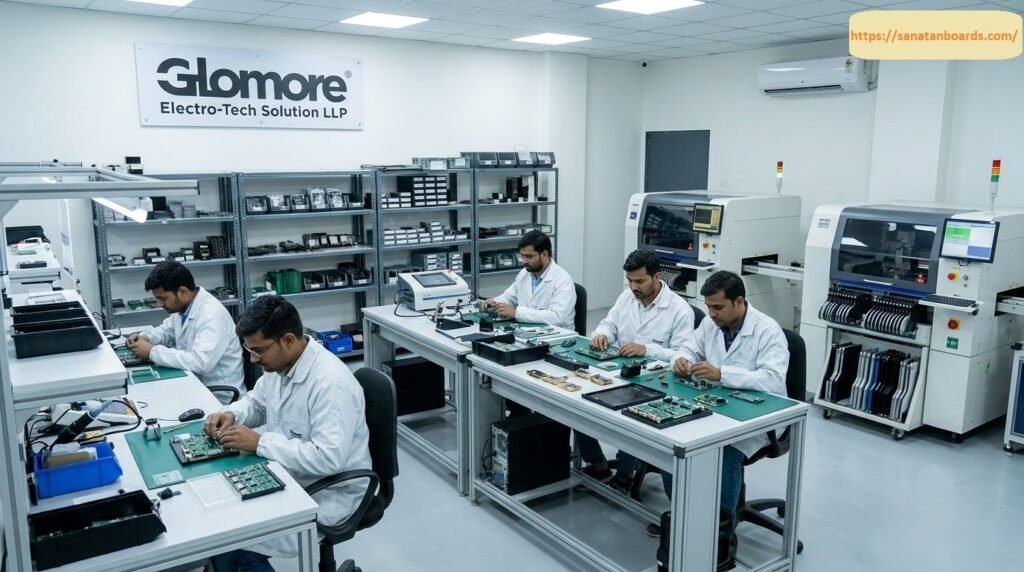
Operating from Vasai East in Maharashtra, with its head office at Kandivali East in Mumbai, Glomore Electro-Tech Solution LLP represents the kind of enterprise for which technical capability alone is not enough. In the electrical and electronic product environment, customers increasingly expect consistency, documented processes, dependable products, competent people, traceability and evidence that an organization understands its responsibilities.
For a company working with products such as Leone Relay and Cooling Fan under the Ieone and Fanon brands, every stage of business can influence the customer’s perception of quality. Product identification, specifications, incoming material control, assembly or manufacturing activities, inspection, testing, packing, dispatch, customer communication and after-sales support all contribute to the final experience.
Certification therefore becomes more than a framed document. It can become a management discipline.
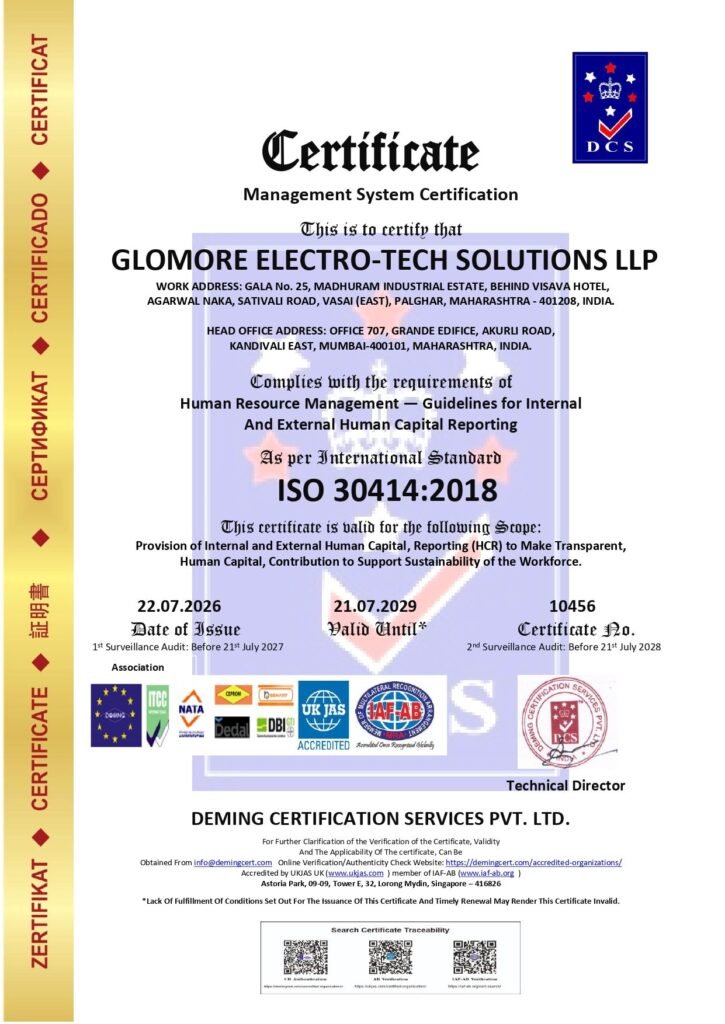
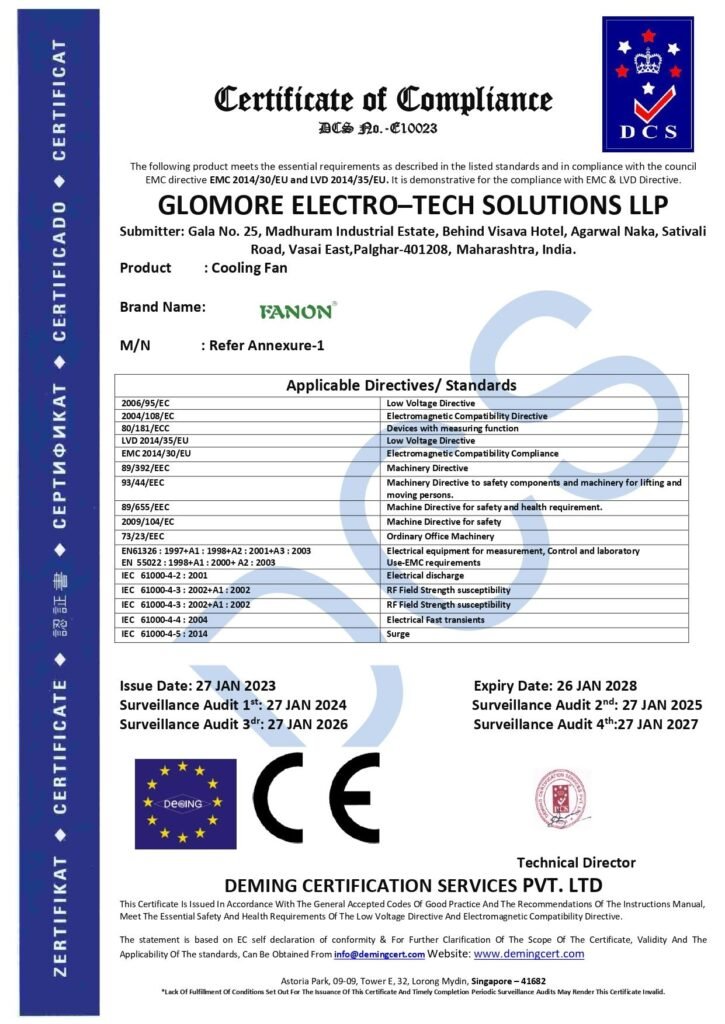
The supplied certification profile of Glomore Electro-Tech Solution LLP includes ISO 30414:2018, covering human capital reporting, together with CE Mark certification for specified product families. The certification information supplied identifies an issue date in 2022 and validity through 2029. These milestones provide an important foundation for understanding how a technical organization can strengthen its business identity through formal systems. (https://www.glomore.co.in/)
The requested story focuses on the company’s growth after its ISO 9001 certification journey. ISO 9001 is fundamentally associated with the establishment and continual improvement of a quality management system. In a business such as Glomore Electro-Tech Solution LLP, the value of such a system is not limited to inspection at the end of production. It extends to how the company defines requirements, controls processes, manages suppliers, develops employees, handles customer expectations, responds to problems and learns from performance.
The company’s ISO 30414:2018 orientation adds another important dimension: people.
Modern organizations do not grow only through machinery, technology or sales. They grow through people who understand processes and take responsibility for results. Human capital reporting encourages an organization to think more systematically about workforce composition, capability, development, productivity, organizational culture and other people-related dimensions.
At the same time, CE marking for applicable product families provides a framework for demonstrating conformity with relevant European requirements where the certification is applicable to the particular products and markets.
Together, these elements create a story of organizational maturity.
This is the story of how certification can become a catalyst for stronger internal discipline, clearer responsibilities, better documentation, improved customer confidence, stronger product positioning and a more structured approach to growth.
Chapter 1 – The Beginning: Building an Electrical Technology Business
Every successful industrial company begins with a practical problem.
In the case of Glomore Electro-Tech Solution LLP, that problem is connected to the need for dependable electrical and electronic components and equipment. Electrical products may appear small when viewed individually, but their reliability can have a disproportionate impact on the equipment in which they are installed.
A relay, for example, is part of a control environment where switching performance, compatibility, reliability and application suitability matter. A cooling fan similarly plays an important role in thermal management. If heat is not effectively removed from an electrical or electronic system, equipment performance can be affected.
This creates a demanding commercial environment.
Customers do not simply purchase a physical product. They purchase confidence that the product will perform according to the required specification.
This understanding becomes especially important as an organization moves from informal business practices toward structured operations.
For a growing company, the early period often involves founders and key employees personally managing many responsibilities. Sales discussions may happen directly with customers. Procurement decisions may depend heavily on experience. Product information may be maintained across different files. Quality checks may be performed by experienced personnel who know what to look for but have not necessarily documented every step.
Such an approach can work at a small scale.
Growth changes the equation.
When the number of customers increases, when product variants increase, when suppliers become more numerous, or when employees join the organization, informal knowledge becomes difficult to manage.
A company may then encounter questions such as:
Who is responsible for approving incoming material?
How is a product specification controlled?
How does the company ensure that the correct model is supplied?
How are customer complaints recorded?
How is corrective action assigned?
How does management know whether employees have the necessary competence?
How are changes communicated?
How can the company demonstrate that its products are being controlled systematically?
These questions form the foundation of a quality-management journey.
For Glomore Electro-Tech Solution LLP, the movement toward certification can therefore be understood as a transition from dependence on individual knowledge toward organizational knowledge.
This transition is significant.
When processes are documented, employees can understand expectations more consistently. When responsibilities are defined, accountability becomes clearer. When records are maintained, management gains evidence for decision-making. When internal audits are performed, weaknesses can be identified before they become major customer problems.
The ISO 9001 philosophy encourages precisely this type of systematic thinking.
The result is not supposed to be bureaucracy for its own sake.
The purpose is controlled, repeatable performance.
For an electrical-product business, repeatability is essential. Customers want the same product quality from one purchase to the next. They want specifications to remain consistent. They want their complaints to receive attention. They want documentation to be available when needed.
Certification helped transform these expectations into management objectives.
The story of Glomore Electro-Tech Solution LLP therefore begins not with a certificate on the wall but with a change in thinking.
Quality became a process.
And once quality became a process, growth could become more structured.
#GlomoreElectroTechSolution
Chapter 2 – The ISO 9001 Mindset: Turning Quality into a System
The most important change associated with an ISO 9001 journey is often cultural rather than visual.
A certificate can be displayed in an office.
A quality-management system must be lived throughout the organization.
For Glomore Electro-Tech Solution LLP, the quality journey could be understood as the development of a framework connecting leadership, customer requirements, resources, operational processes, measurement and improvement.
Before structured quality management, employees can sometimes solve problems through personal experience. After a formal system is introduced, the organization begins asking a different question:
“Why did this problem occur, and what process can prevent it from recurring?”
That change is fundamental.
A customer complaint, for example, should not automatically be treated simply as a sales problem. It can become an input to improvement.
If the wrong product model was supplied, the organization can investigate order-processing controls.
If a specification was misunderstood, the organization can review contract or requirement-review practices.
If a product variation originated from purchased material, supplier controls can be examined.
If an employee lacked necessary knowledge, training and competency processes can be reviewed.
This is the difference between correcting an individual incident and improving the system.
The same thinking applies to internal performance.
A company can establish objectives related to quality, customer satisfaction, process effectiveness, delivery performance, employee capability and continual improvement.
Management review then becomes a mechanism for understanding whether the organization is moving in the intended direction.
For Glomore Electro-Tech Solution LLP, the certification journey also creates a useful connection between its technical products and organizational discipline.
The company’s product portfolio includes Leone Relay and Cooling Fan products under the Ieone and Fanon brands. Such a portfolio naturally requires attention to identification, specifications, inspection, testing, documentation and customer requirements.
A structured quality system can help make these activities more consistent.
Document control becomes important because technical information must remain current.
Purchasing control becomes important because purchased components and materials can influence final product quality.
Inspection becomes important because defects must be detected before products reach customers.
Traceability becomes valuable because the organization may need to understand which product, batch, material or process was involved in a particular issue.
Corrective action becomes important because recurring problems consume resources and can damage customer confidence.
Training becomes important because even a well-designed process can fail when people do not understand it.
In this sense, ISO 9001 is not simply a quality department’s responsibility.
It becomes a company-wide operating philosophy.
The promoter and management team have a particularly important role.
Leadership establishes whether the system becomes a living business tool or merely a compliance exercise.
When management asks for evidence, reviews objectives, discusses complaints, evaluates process performance and supports employee development, employees understand that quality is important.
Over time, this can create a stronger organizational culture.
Employees begin identifying problems earlier.
Departments communicate more clearly.
Records become more reliable.
Customer requirements receive greater attention.
Corrective actions become more structured.
The organization begins learning from its own experience.
That learning capability is one of the most valuable outcomes of certification.
A company that learns quickly can adapt more effectively.
And adaptability becomes increasingly important as markets, customer expectations and technologies change.
For Glomore Electro-Tech Solution LLP, the ISO 9001 journey therefore represented an opportunity to convert quality from an intention into an organized system.
#ISO9001
Chapter 3 – Products, Specifications and the Discipline of Consistency

The true test of a quality system is ultimately connected to the product.
For Glomore Electro-Tech Solution LLP, the product portfolio includes Leone Relay and Cooling Fan products. These products are associated with multiple models and variants, making identification and specification control particularly important.
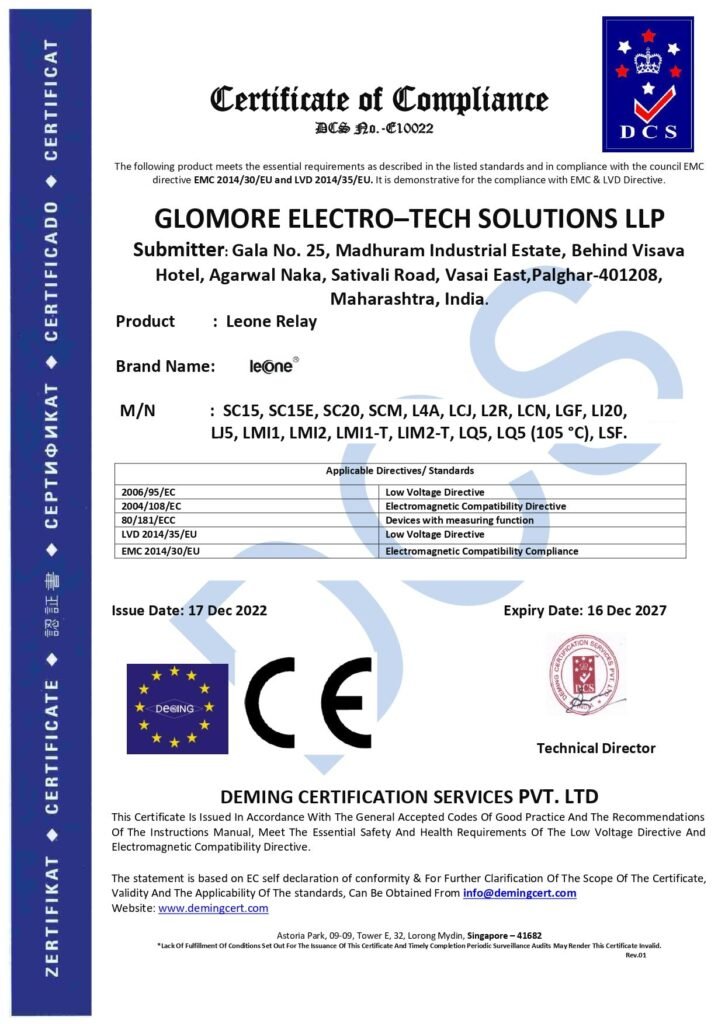
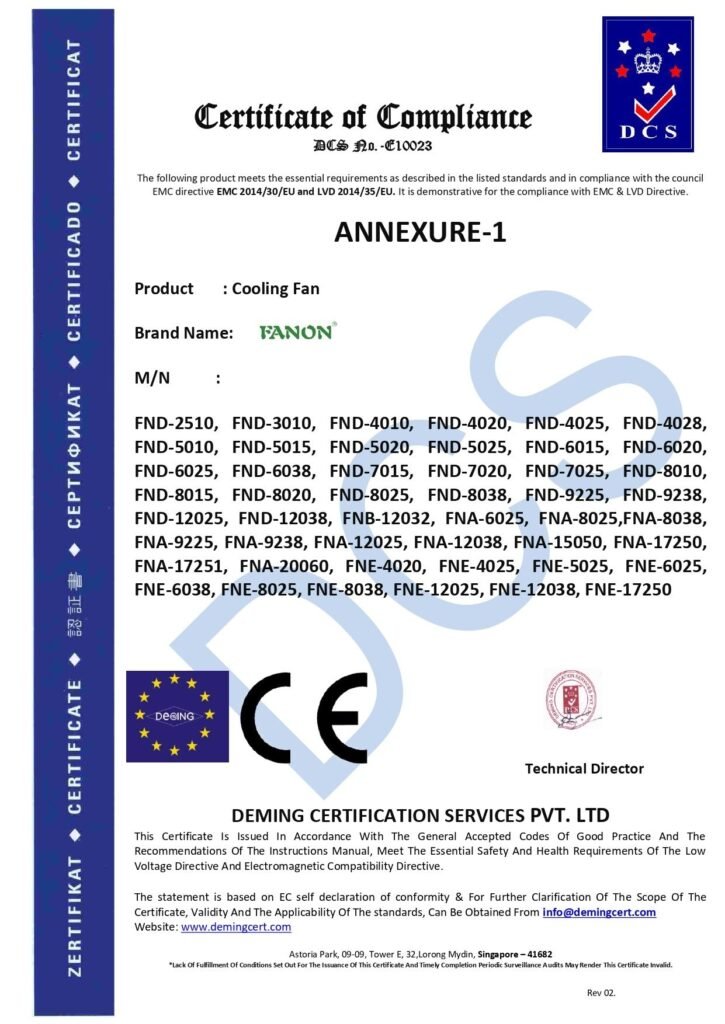
The supplied CE Mark certification information includes extensive model ranges.
The relay-related models listed include:
SC15, SC15E, SC20, SCM, L4A, LCJ, L2R, LCN, LGF, LI20, LJ5, LMI1, LMI2, LMI1-T, LIM2-T, LQ5, LQ5 (105 °C), and LSF.
The cooling-fan range includes numerous FND, FNA, FNE and related model numbers, including:
FND-2510, FND-3010, FND-4010, FND-4020, FND-4025, FND-4028, FND-5010, FND-5015, FND-5020, FND-5025, FND-6015, FND-6020, FND-6025, FND-6038, FND-7015, FND-7020, FND-7025, FND-8010, FND-8015, FND-8020, FND-8025, FND-8038, FND-9225, FND-9238, FND-12025, FND-12038, FNB-12032, FNA-6025, FNA-8025, FNA-8038, FNA-9225, FNA-9238, FNA-12025, FNA-12038, FNA-15050, FNA-17250, FNA-17251, FNA-20060, FNE-4020, FNE-4025, FNE-5025, FNE-6025, FNE-6038, FNE-8025, FNE-8038, FNE-12025, FNE-12038 and FNE-17250.
A large model portfolio creates opportunities.
It also creates risks.
The more variants a company handles, the more important accurate product identification becomes.
A quality-management approach can encourage the organization to establish controls around product information, drawings, specifications, labels, purchase requirements, inspection criteria and final documentation.
For example, an order-processing team must understand exactly which model the customer requires.
The procurement function must know which specification is relevant.
The production or assembly team must understand the applicable requirements.
The quality function must know what characteristics need verification.
The dispatch function must ensure that the correct model reaches the customer.
Each department becomes part of the same chain.
One weak link can affect the final result.
Certification encourages this chain to be visible.
It helps employees understand that quality is not created at the final inspection stage. Quality is built into the process from the moment the customer requirement enters the organization.
This approach can also improve communication between sales and technical teams.
Sales personnel may understand customer applications but not always technical details. Technical personnel may understand specifications but not commercial requirements. A documented requirement-review process can bring both perspectives together.
The same principle applies to product changes.
If a component, supplier, specification or design-related characteristic changes, the organization needs a method of evaluating the impact.
This becomes increasingly important as companies expand their product portfolios.
The CE Mark certification associated with the supplied product ranges further strengthens the importance of conformity-oriented thinking. Where CE marking is applicable, the organization needs to understand the requirements relevant to the specific products and markets rather than treating the mark simply as a marketing symbol.
For Glomore Electro-Tech Solution LLP, product certification and quality management can therefore reinforce each other.
ISO 9001 focuses on the management system.
Product conformity activities focus on the products.
Together, they can contribute to stronger customer confidence.
This is where certification begins influencing commercial growth.
A customer evaluating a supplier often considers not only price but also reliability, documentation, consistency and evidence of control.
A structured quality system can help the company communicate those strengths.
Thus, product discipline becomes business discipline.
#ISO30414
Chapter 4 – The Human Capital Transformation
A company does not operate through documents.
It operates through people.
This makes the supplied ISO 30414:2018 certification particularly relevant to the broader growth story of Glomore Electro-Tech Solution LLP.
ISO 30414:2018 provides guidelines associated with human capital reporting. Its significance lies in encouraging organizations to think systematically about their people and the information needed to understand human capital.
For a growing technical organization, this is a powerful concept.
Employees are not simply a cost recorded in an accounting system. They represent skills, experience, knowledge, problem-solving capability, customer understanding and institutional memory.
When a skilled employee understands a product deeply, that knowledge can influence quality.
When a sales employee understands customer requirements, that knowledge can influence satisfaction.
When a technical employee understands testing, that knowledge can influence product reliability.
When a manager understands organizational capability, that knowledge can influence strategic decisions.
Therefore, human capital management and quality management are closely connected.
A formal system encourages the company to define roles and responsibilities.
This makes recruitment more purposeful.
Instead of simply asking whether a candidate is available, management can ask whether the person possesses the competence required for the role.
Training becomes more structured.
New employees can be introduced to company procedures, product requirements, quality expectations, documentation practices and customer-service principles.
Competence can be evaluated rather than assumed.
Performance discussions can become more meaningful.
Employee development can become connected to business requirements.
For the promoter and management team, this creates another benefit: reduced dependence on individual memory.
As an organization grows, founders cannot personally supervise every activity.
The company must become capable of operating through systems.
Human capital reporting supports that transition by encouraging management to understand workforce-related information systematically.
This can also influence employee morale.
People generally perform better when they understand what is expected of them and how their work contributes to the organization.
A quality-management system can provide that clarity.
An employee handling inspection understands why records matter.
A procurement employee understands why supplier evaluation matters.
A sales employee understands why customer requirements must be captured accurately.
A technical employee understands why specifications must be controlled.
An administrative employee understands why records must be maintained.
The organization begins operating as an interconnected system.
This is an important part of sustainable growth.
Rapid expansion without people systems can create confusion.
Structured growth creates capability.
For Glomore Electro-Tech Solution LLP, the combination of quality-management thinking and human-capital reporting therefore represents a broader organizational philosophy.
The company is not only trying to improve products.
It is improving the system through which people create those products and services.
This can strengthen resilience.
If one employee leaves, documented processes and trained colleagues can reduce disruption.
If new employees join, structured induction can accelerate learning.
If the product range expands, defined responsibilities can support controlled implementation.
If customer requirements become more demanding, competent employees are better positioned to respond.
In this way, certification becomes connected to organizational continuity.
The company’s growth is no longer dependent only on the effort of its promoter.
It becomes a shared organizational capability.
#QualityManagementSystem
Chapter 5 – From Vasai East to a Broader Business Identity
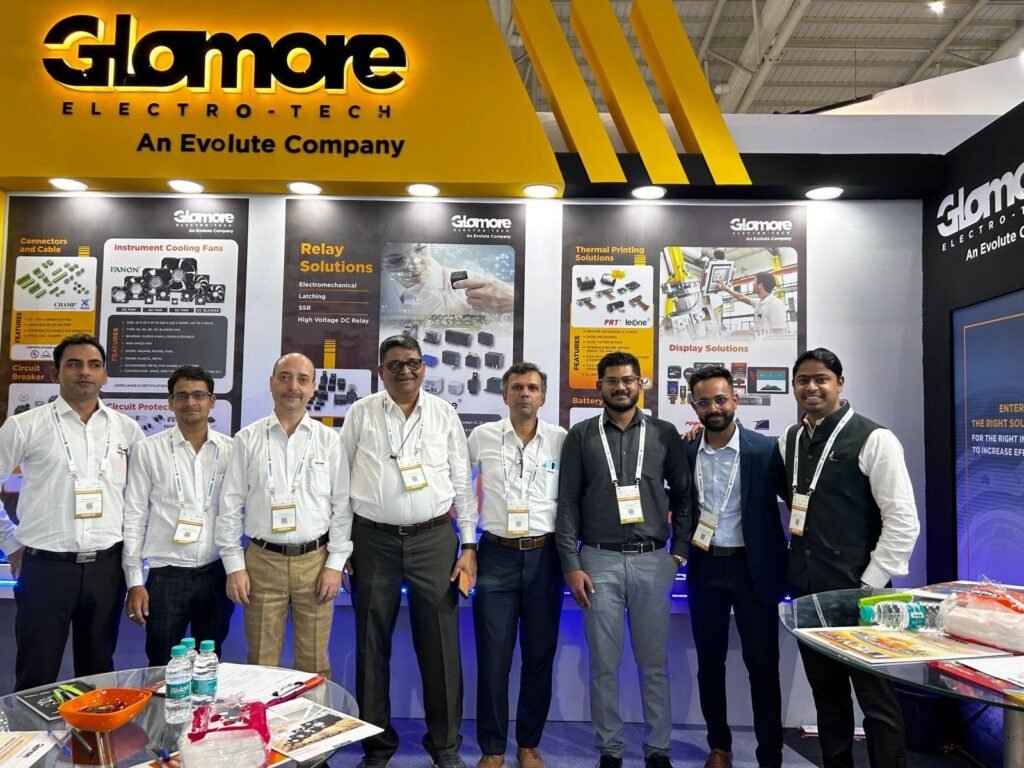
Courtesy: Glomore Electro-Tech
The operational address of Glomore Electro-Tech Solution LLP is in Madhuram Industrial Estate, Vasai East, Palghar, Maharashtra.
Its head office is located at Grande Edifice, Akurli Road, Kandivali East, Mumbai.
The presence of both an operational location and a Mumbai head office reflects an organizational structure in which technical and administrative functions can develop around different business requirements.
For an industrial enterprise, location matters.
Vasai East is part of an important industrial environment, while Mumbai provides access to a major commercial and business ecosystem.
As the organization develops, its physical addresses become more than locations.
They become part of the company’s identity.
Certification can strengthen that identity because it provides a formal framework through which the organization can present itself to customers, suppliers and business partners.
A customer approaching an industrial supplier may ask several questions:
Is the organization established?
Does it understand quality?
Can it provide consistent products?
Does it maintain documentation?
Does it have competent personnel?
Can it support technical requirements?
Does it understand conformity expectations?
A quality-management certification can help provide a structured answer.
This does not mean that certification automatically guarantees product quality or commercial success.
Instead, certification can demonstrate that the organization has established and maintains a management framework subject to defined requirements.
That distinction is important.
Business growth still depends on customer value, pricing, product performance, delivery, relationships, innovation and market conditions.
Certification supports these factors by strengthening organizational credibility.
For Glomore Electro-Tech Solution LLP, the branding of its products under Ieone and Fanon adds another dimension.
Brands need consistency.
A brand is essentially a promise.
When a customer repeatedly encounters the same brand, the customer expects a consistent level of performance and service.
A structured quality system helps the organization manage the processes behind that promise.
The company can therefore move from being perceived merely as a supplier of individual components toward being perceived as a structured technical organization.
That shift can influence conversations with distributors, industrial customers, engineering companies and other business partners.
Documentation becomes easier to organize.
Product information becomes easier to communicate.
Quality-related questions can receive structured responses.
Customer complaints can be analyzed systematically.
Internal responsibilities become clearer.
This is how certification can contribute indirectly to market development.
It becomes part of the company’s professional identity.
The journey from a local industrial operation to a broader business organization is rarely created through one dramatic event.
It happens through many small improvements.
A better process.
A clearer document.
A better-trained employee.
A stronger supplier relationship.
A more reliable inspection system.
A faster response to a complaint.
A more professional customer presentation.
Over time, these improvements accumulate.
The certificate becomes a symbol of that accumulation.
#CEMarkCertification
Chapter 6 – CE Marking and the Expansion of Product Confidence
The supplied certification profile for Glomore Electro-Tech Solution LLP includes CE Mark certification associated with its listed relay and cooling-fan product ranges.
This introduces another important chapter in the company’s growth journey: product conformity and market readiness.
CE marking is often encountered by customers as a visible symbol, but the underlying concept is more important than the symbol itself.
Where applicable, CE marking relates to conformity with relevant European Union requirements for the product concerned.
For a manufacturer or supplier, this means that the organization needs to understand the applicable regulatory framework, product requirements and conformity process.
For Glomore Electro-Tech Solution LLP, the presence of multiple model numbers means that product identification and scope management become particularly important.
A certificate covering one product or model should not automatically be interpreted as covering every product the company sells. The exact scope and applicability of certification must always be considered.
Within the supplied information, the relay and cooling-fan ranges provide evidence of a broad product family.
That breadth creates commercial potential.
Customers often prefer suppliers who can provide related product solutions rather than requiring them to work with multiple vendors.
If an organization can demonstrate structured product information, consistent quality practices and appropriate conformity documentation, it may become more attractive to industrial buyers.
The quality-management system can support this.
A controlled process can help ensure that product documentation corresponds with the correct model.
It can help define responsibilities for reviewing requirements.
It can establish methods for handling nonconforming products.
It can provide records demonstrating that inspections and checks were performed according to defined processes.
It can support corrective and preventive thinking.
The commercial impact of such discipline is cumulative.
Imagine a customer comparing two suppliers.
Supplier A provides a product at a competitive price but has inconsistent documentation and an unclear complaint process.
Supplier B offers comparable pricing while demonstrating a structured quality system, organized technical information and conformity documentation applicable to the product.
The second supplier may create greater confidence.
Confidence can influence repeat orders.
Repeat orders can influence relationships.
Relationships can influence market reputation.
Reputation can influence growth.
This is why certification should be understood as part of a broader business ecosystem.
For Glomore Electro-Tech Solution LLP, the combination of ISO 9001-style quality-management discipline, ISO 30414:2018 human-capital orientation and CE-related product conformity creates a more complete organizational story.
People.
Processes.
Products.
Conformity.
Customers.
These elements reinforce one another.
A company cannot sustainably grow by focusing on products while ignoring people.
It cannot manage people effectively while ignoring processes.
It cannot create good processes while ignoring customers.
And it cannot enter demanding markets while ignoring conformity expectations.
Certification provides a common framework for connecting these dimensions.
#ElectricalProducts
Chapter 7 – The Promoter’s Role in Organizational Growth
Behind every growing enterprise is a leadership story.
The promoter is often the person who carries the strongest personal connection to the business.
In the early years, the promoter may personally handle customers, suppliers, employees, technical questions, financial decisions and operational problems.
That personal involvement can be one of the company’s greatest strengths.
But it can also become a limitation if the company grows faster than the promoter’s ability to personally supervise every activity.
Certification can help solve this challenge.
When processes become documented, the promoter can begin transitioning from direct supervision toward management through systems.
Instead of asking, “Did this task happen?” management can ask, “What does the process require, what evidence exists, and how are we measuring performance?”
This is a significant evolution in leadership.
The promoter’s role changes from problem solver to system builder.
That does not mean personal involvement disappears.
Rather, it becomes more strategic.
Management can focus on:
customer relationships,
new markets,
product development,
supplier partnerships,
employee capability,
technology,
compliance,
business planning,
quality objectives,
and long-term growth.
Operational teams can manage defined processes.
This creates scalability.
For Glomore Electro-Tech Solution LLP, the presence of a human-capital management orientation is particularly relevant to this leadership transition.
A business becomes more valuable when knowledge is distributed across the organization.
Employees understand their responsibilities.
Managers understand performance indicators.
Technical teams understand product requirements.
Quality personnel understand system requirements.
Administrative teams understand records and reporting.
The promoter can then spend more time building the future rather than solving every issue from the past.
This is one of the most important forms of growth.
Revenue growth is visible.
Organizational maturity is less visible but often equally important.
A mature organization can handle complexity.
It can absorb new employees.
It can introduce new products.
It can work with new customers.
It can respond to complaints.
It can maintain documentation.
It can learn from mistakes.
It can survive personnel changes.
It can adapt to new requirements.
Certification encourages these capabilities.
For a promoter, the certificate therefore represents more than recognition.
It can become a reminder that the company has moved from personality-driven management toward process-driven management.
That transition can improve confidence.
The promoter can look at the organization and see not only today’s operations but tomorrow’s potential.
A company with defined systems can pursue larger opportunities with greater preparedness.
It can approach new customers more professionally.
It can participate in vendor evaluations where quality systems matter.
It can strengthen its documentation.
It can improve internal accountability.
It can communicate a clearer corporate identity.
Thus, the promoter’s growth is closely linked to organizational growth.
The company becomes more systematic.
The leader becomes more strategic.
The employees become more accountable.
The business becomes more scalable.
#CoolingFan
Chapter 8 – Customer Confidence, Repeat Business and Market Reputation
The real purpose of quality is customer satisfaction.
No management system can create sustainable growth if customers do not receive value.
For Glomore Electro-Tech Solution LLP, customer confidence can be understood through several dimensions.
First is product consistency.
A customer ordering a particular relay or cooling fan expects the product to correspond to the agreed requirements.
Second is communication.
Customers need accurate information about specifications, availability, delivery and technical matters.
Third is responsiveness.
When problems arise, customers expect the supplier to respond.
Fourth is documentation.
Industrial customers may require product information, certificates, test records or conformity-related documentation.
Fifth is reliability.
Customers prefer suppliers who reduce uncertainty.
A quality-management system can support all five.
Requirement review helps clarify customer expectations.
Controlled documentation helps maintain accurate information.
Inspection and testing help identify problems.
Corrective action provides a structured approach to complaints.
Internal audits help identify weaknesses before customers experience them.
Management review helps leadership evaluate overall performance.
Over time, these practices can influence reputation.
Reputation is not created by advertisements alone.
It develops through repeated experiences.
One customer receives the correct product.
Another receives timely technical support.
Another experiences a professional response to a complaint.
Another sees organized documentation.
Another appreciates consistent quality.
Each positive interaction contributes to the company’s reputation.
The opposite is also true.
A single recurring quality problem can damage confidence.
That is why corrective action is so important.
Suppose a particular product issue is reported repeatedly.
A weak organization might simply replace defective products.
A stronger organization asks why the problem keeps occurring.
Was there a supplier issue?
Was an inspection step insufficient?
Was a specification misunderstood?
Was a process not followed?
Was an employee inadequately trained?
Was documentation outdated?
The objective becomes elimination of root causes.
This approach protects future customers.
It also reduces repeated costs.
A company that continuously solves root causes can become more efficient.
Fewer defects mean less rework.
Fewer complaints mean less administrative effort.
Better documentation reduces confusion.
Better training reduces errors.
Better supplier controls reduce incoming problems.
Better planning improves operational coordination.
The result is a virtuous cycle.
Quality improves.
Customer confidence improves.
Efficiency improves.
Reputation improves.
Business opportunities increase.
The growth story of Glomore Electro-Tech Solution LLP can therefore be viewed as a story of increasing confidence.
Certification provides evidence of structured management.
Product conformity provides additional evidence where applicable.
Human-capital reporting demonstrates attention to organizational capability.
Together, these elements can help the company present itself as a professional and increasingly mature technical enterprise.
#LeoneRelay
Chapter 9 – Growth Through Continuous Improvement
One of the most important principles behind ISO 9001 is continual improvement.
A company should never assume that yesterday’s successful process will automatically remain sufficient tomorrow.
Markets change.
Customers change.
Technology changes.
Competitors change.
Regulations change.
Employees change.
Suppliers change.
Therefore, systems must learn.
For Glomore Electro-Tech Solution LLP, continual improvement can become a structured cycle.
First, the company identifies objectives.
Then it measures performance.
Next, it identifies gaps.
Corrective actions are implemented.
Results are reviewed.
Successful improvements are standardized.
The cycle begins again.
This approach changes the company’s relationship with problems.
Problems are no longer simply interruptions.
They become information.
A customer complaint can reveal a weakness.
An internal audit finding can reveal a process gap.
A delayed order can reveal planning issues.
A supplier defect can reveal purchasing-control weaknesses.
An employee training requirement can reveal a competency gap.
Each problem becomes an opportunity to improve the system.
This is particularly valuable for a company with a diverse product portfolio.
As the number of relay and cooling-fan models increases, complexity increases.
Complexity requires stronger controls.
The organization can continuously refine product identification, documentation, inspection, supplier management, storage, packing, dispatch and customer support.
Digital systems can further support this transformation.
Document control can become electronic.
Customer information can be organized in structured databases.
Quality records can become searchable.
Training records can be monitored.
Performance indicators can be displayed through dashboards.
Management can make decisions using evidence rather than assumptions.
This is where the human-capital component becomes valuable again.
Technology cannot replace competence.
Employees must understand how to use systems correctly.
Therefore, training becomes part of continuous improvement.
The company can identify emerging skills required for future growth.
Technical personnel can develop deeper product knowledge.
Quality personnel can strengthen auditing capabilities.
Sales personnel can improve technical communication.
Managers can strengthen data interpretation.
Administrative personnel can improve documentation systems.
The organization becomes a learning organization.
For the promoter, this creates an important strategic advantage.
Instead of asking only, “How much did we sell?” management can ask:
What improved?
What failed?
What did we learn?
Where are customers dissatisfied?
Which processes are slow?
Which suppliers are creating problems?
Which products have higher complaint rates?
Which employee capabilities need strengthening?
What opportunities are emerging?
These questions create strategic intelligence.
The company’s growth then becomes more deliberate.
It is no longer growth simply because more orders arrive.
It is growth supported by learning.
Certification becomes the framework for that learning.
The certificate may have an issue date and validity period, but the underlying philosophy is continuous.
That is the true long-term value.
A certificate has a date.
Improvement has no end date.
#Ieone
Chapter 10 – The Future: From Certification to Sustainable Business Growth
The story of Glomore Electro-Tech Solution LLP after certification is ultimately a story about potential.
The company’s supplied certification profile demonstrates a combination of quality-management aspirations, human-capital reporting and product conformity.
Its operational base is in Vasai East.
Its head office is in Kandivali East, Mumbai.
Its products include Leone Relay and Cooling Fan.
Its brands include Ieone and Fanon.
Its supplied CE Mark scope includes a broad range of relay and cooling-fan models.
Its certification information identifies 2022 as the issue year and 2029 as the validity year.
These facts establish a foundation.
The future depends on what the organization does with that foundation.
The first opportunity is stronger market positioning.
The company can use its certification and conformity credentials responsibly in presentations, quotations, technical documents and customer discussions, ensuring that claims always remain within the actual scope of each certification.
The second opportunity is product development.
Electrical and electronic markets continuously evolve. Customers seek better efficiency, reliability, compactness, thermal performance and application-specific solutions.
A company with disciplined processes is better positioned to manage product development systematically.
The third opportunity is employee development.
ISO 30414:2018 provides an important reminder that organizational growth depends on human capital.
As the company expands, management can continue developing structured recruitment, competency evaluation, training, performance measurement and employee development.
The fourth opportunity is supplier development.
Strong supplier relationships can improve consistency and reduce risks.
Supplier performance can be evaluated based on quality, delivery, responsiveness and reliability.
The fifth opportunity is customer development.
Existing customers can become long-term partners when the company consistently delivers value.
The sixth opportunity is geographical expansion.
The combination of a Vasai East operational location and Mumbai head office provides a foundation for serving a wider industrial and commercial market.
But sustainable expansion should remain controlled.
Growth without process discipline can create new problems.
Therefore, the next stage of the company’s journey should be based on the same principle that supported its certification journey:
build systems before complexity becomes unmanageable.
The long-term objective should not simply be to possess certificates.
It should be to become a company whose internal practices genuinely reflect the principles represented by those certificates.
That means making quality visible in everyday work.
It means treating customers as partners.
It means treating employees as organizational assets.
It means treating problems as opportunities to learn.
It means treating documentation as a management tool.
It means treating certification as a commitment rather than a decoration.
For the promoter, this represents a powerful transformation.
The business that began with products can become a system.
The system can become a brand.
The brand can become a reputation.
The reputation can become customer trust.
Customer trust can create repeat business.
Repeat business can create stability.
Stability can create investment.
Investment can create innovation.
Innovation can create new markets.
And new markets can create the next chapter of growth.
This is why certification can matter so deeply to an industrial organization.
It does not replace entrepreneurship.
It strengthens the structure around entrepreneurship.
It does not guarantee growth.
It creates conditions in which disciplined growth becomes more achievable.
It does not remove business risks.
It helps the organization identify and manage them more systematically.
For Glomore Electro-Tech Solution LLP, the certification journey can therefore be remembered not as a single event but as a turning point.
Before certification, quality may have depended heavily on individual experience.
After certification, quality can increasingly become an organizational capability.
Before structured human-capital reporting, employee information may have been primarily administrative.
After adopting a structured human-capital perspective, people can increasingly become part of strategic decision-making.
Before formal product-conformity recognition, market communication may have focused primarily on product availability.
With appropriate CE Mark certification, the company can communicate conformity credentials within their defined scope.
The future now depends on continual improvement.
The journey from 2022 toward the stated 2029 validity horizon provides a period in which the organization can continue strengthening its systems, people, products and market relationships.
The greatest success will not be measured only by the number of certificates.
It will be measured by the number of customers who trust the company.
By the number of employees who grow with it.
By the number of products that perform consistently.
By the number of problems prevented rather than corrected.
By the strength of the company’s processes.
By its ability to innovate.
And ultimately by its ability to create sustainable value.
Glomore Electro-Tech Solution LLP therefore stands at an important intersection of quality, technology and people.
Its story demonstrates a central principle of modern business:
Certification can open the door, but disciplined performance, capable people, consistent products and customer trust are what keep the organization moving forward.
The certificate can establish credibility.
The system can establish discipline.
The people can establish capability.
The products can establish value.
The customers can establish reputation.
And continual improvement can establish the future.
That is the deeper story behind the certification journey of Glomore Electro-Tech Solution LLP.
#Fanon
#HumanCapitalManagement #IndustrialElectronics #ProductConformity #QualityCertification #BusinessGrowth
Take the Next Step Today
Don’t wait to enhance your business’s quality and efficiency. Partner with Sanatan Dharma Accreditation Boards and experience the transformation that comes with expert consultancy and training. Contact us today to learn more about how we can help you achieve your business goals. Reach out via phone at +91-8668266780, visit our website at sanatanboards.com, or email us at info@sanatanboards.com Let us be your guide on the journey to excellence and innovation.





