
Kamlesh Chauhan
Table of Contents
Chapter 1 – The Beginning of a Quality-Oriented Journey
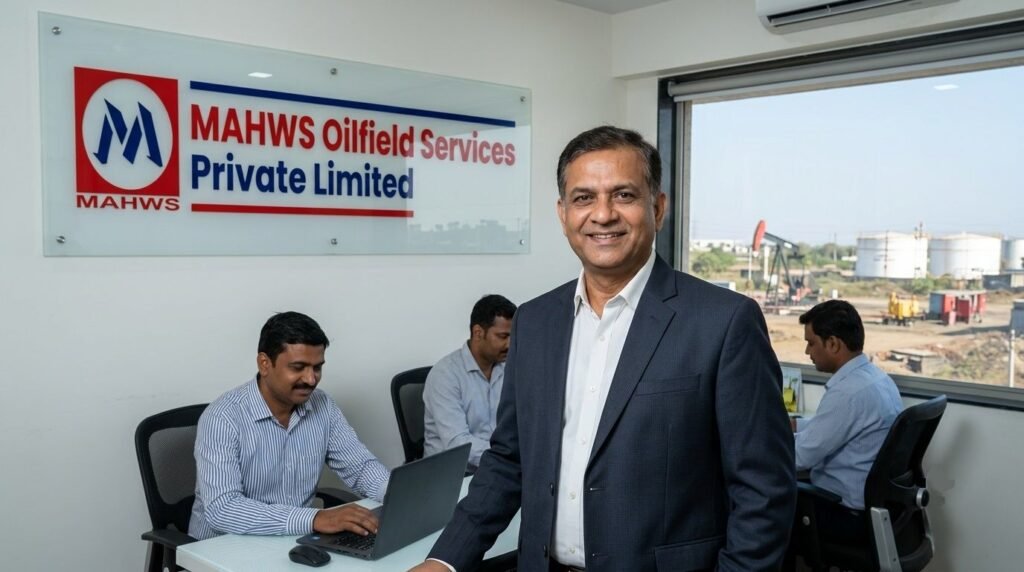
The story of Kamlesh Chauhan and MAHWS Oilfield Services Private Limited is a story about professional development, technical competence, disciplined systems and the growing importance of quality in specialized industrial services. Operating from the TTC Industrial Area of MIDC Industrial Area, Pawne, Navi Mumbai, the organization was positioned in an industrial environment where engineering knowledge, technical reliability and professional responsibility were important foundations for sustainable business.
For an organization associated with oilfield services, the concept of quality cannot be limited to paperwork. Industrial customers expect people, processes, equipment, documentation and technical activities to work together consistently. In environments connected with potentially hazardous conditions, the importance of competence becomes even greater.
Kamlesh Chauhan’s professional journey can therefore be viewed through the lens of a larger transformation: the movement from simply providing technical services toward establishing confidence in professional competence.
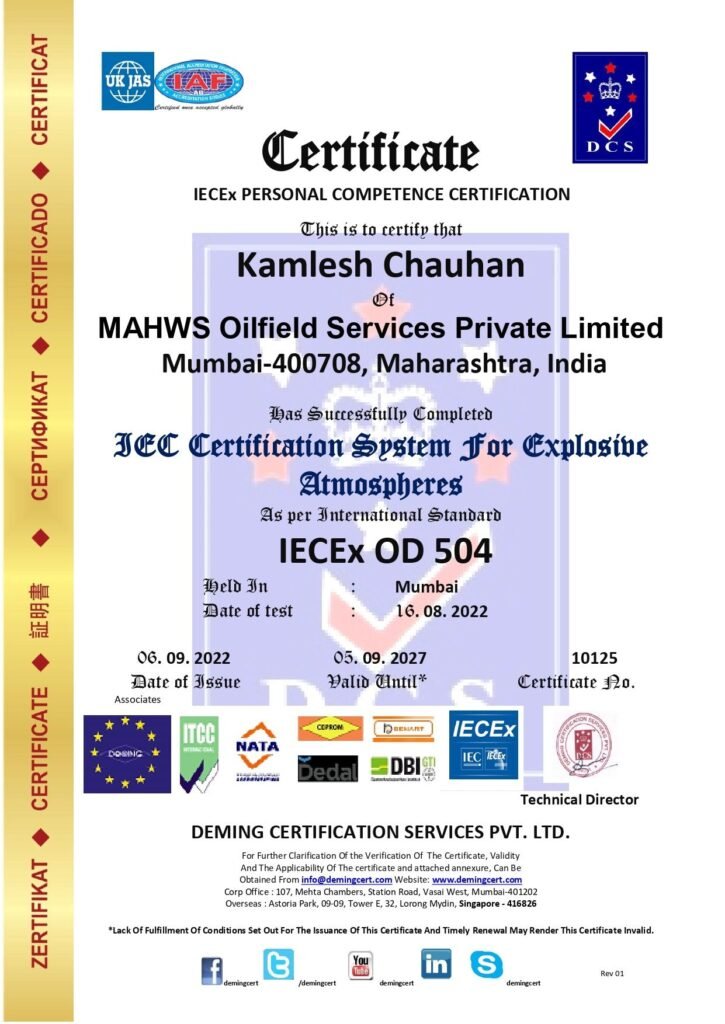
The year 2022 became an important point in this journey. The IECEx Personal Competence Certification associated with IECEx OD 504 provided a formal framework for demonstrating competence related to work involving explosive atmospheres. IECEx describes OD 504 as an operational document establishing competence requirements for personnel working with equipment for explosive atmospheres according to applicable IEC standards. (https://mathewassociates.com/)
This distinction is significant. In specialized industries, customers do not merely ask whether a company can perform a service. They increasingly want to know whether the individuals carrying out technically sensitive work possess appropriate knowledge, understanding and competence.
For Kamlesh Chauhan, certification could therefore become more than a certificate placed inside an office file. It could become part of a professional identity.
The location itself was strategically relevant. Navi Mumbai has developed as a major industrial and commercial region, with numerous companies operating across engineering, manufacturing, logistics, petrochemical, infrastructure and service sectors. Being located in the TTC Industrial Area placed MAHWS Oilfield Services Private Limited within an ecosystem where technical capability and industrial compliance could influence business relationships.
The certification journey also introduced a stronger culture of documented competence. Instead of depending exclusively upon verbal assurances or years of informal experience, a structured certification framework gives professionals a means of demonstrating capability through recognized assessment processes.
For Kamlesh Chauhan, this was an opportunity to strengthen professional credibility.
The phrase “quality” also began acquiring a broader meaning. Quality meant understanding customer requirements. Quality meant performing work according to defined methods. Quality meant maintaining records. Quality meant learning from mistakes. Quality meant communicating clearly. Quality meant understanding hazards before beginning a task. And quality meant continuously developing professional competence.
In an industrial services organization, these principles can influence everything from initial customer communication to planning, execution, reporting and follow-up.
The 2022 certification consequently represented a milestone in the professional journey of Kamlesh Chauhan. Its value was not only associated with the certificate itself, but also with the discipline and responsibility that certification represented.
The journey toward 2027 could then be viewed as a period in which competence, experience and quality consciousness could mature together.
MAHWS Oilfield Services Private Limited could use this foundation to build stronger confidence among customers and business partners. Every successful assignment could become an opportunity to reinforce the organization’s reputation. Every technical challenge could become an opportunity for learning. Every customer interaction could contribute to a stronger understanding of market expectations.
This is how certification can become connected with growth.
Growth does not always begin with a dramatic increase in revenue. Sometimes it begins with a change in mindset. A professional begins documenting activities more carefully. A company begins defining responsibilities more clearly. Employees become more conscious of technical requirements. Customer communication becomes more structured. Records become easier to retrieve. Training becomes more purposeful.
These changes may appear small individually, but collectively they can transform an organization.
For Kamlesh Chauhan, the certification milestone created such a foundation.
The journey was therefore not simply about receiving recognition in 2022. It was about developing a professional culture capable of supporting the changing requirements of oilfield and industrial services.
The certificate became a symbol of competence.
The system became a foundation for consistency.
And the professional journey became a pathway toward sustainable growth.
#KamleshChauhan
Chapter 2 – Understanding the Importance of Competence
The second stage of the story begins with an important realization: certification has meaning only when it strengthens actual professional capability.
In sectors involving explosive atmospheres, technical decisions can have serious consequences. Equipment, installation, inspection, maintenance, repair, testing and other activities may require people to understand specialized protection concepts and applicable technical requirements.
IECEx OD 504 specifically addresses units of competence assessment outcomes under the IECEx Personnel Competence Scheme. The document exists to support certification where demonstrated competence is important, including work associated with equipment used in explosive atmospheres.
For Kamlesh Chauhan, this created an opportunity to approach technical work from a competence-based perspective.
Experience remains valuable in engineering and oilfield services. However, experience without structured verification can sometimes make it difficult for customers to compare professionals objectively. A recognized competence framework provides an additional layer of confidence.
This is where the certification journey began influencing professional presentation.
When speaking with a prospective customer, technical professionals must communicate more than availability. They need to demonstrate understanding. They need to understand the customer’s operating environment, identify relevant requirements and explain how the proposed service will address them.
A competence certification can support this conversation.
It can communicate that professional development has been taken seriously.
It can also encourage a more disciplined approach to preparation.
Kamlesh Chauhan’s association with MAHWS Oilfield Services Private Limited can therefore be understood as part of an evolving professional ecosystem. The organization was not simply attempting to compete on price or availability. It could increasingly compete through knowledge, competence, reliability and professional confidence.
This was particularly relevant in oilfield-related services.
Customers working around industrial facilities often have multiple concerns. They may be concerned about operational continuity. They may be concerned about safety. They may need documentation for internal audits. They may have contractor qualification procedures. They may require competent personnel for specialized work.
In such an environment, technical competence can become a differentiating factor.
The certification also helped establish a mindset of continuous learning.
Technical standards change. Industrial technologies evolve. Customer expectations change. New hazards emerge. Digital documentation becomes more important. Organizations increasingly expect service providers to maintain records and demonstrate qualifications.
A professional who treats certification as the end of learning may eventually become outdated. A professional who treats certification as a foundation for further learning can continue developing.
For Kamlesh Chauhan, this second approach offered greater long-term potential.
The organization could gradually build internal knowledge repositories, checklists, training records, competency matrices and technical references. Such tools could make future assignments more systematic.
For example, before beginning a technically sensitive assignment, a team could review:
- customer requirements;
- applicable technical standards;
- personnel competence;
- equipment requirements;
- safety considerations;
- documentation requirements;
- inspection or verification procedures;
- reporting requirements;
- corrective-action needs.
This systematic approach can reduce confusion.
It can also improve communication.
When responsibilities are clearly defined, employees know what is expected. When records are maintained, supervisors can verify what was done. When customer requirements are documented, misunderstandings can be reduced.
The resulting quality culture can have commercial benefits.
A customer who receives clear documentation is more likely to view a service provider as professional. A customer who receives consistent communication may develop greater confidence. A customer who sees evidence of competence may consider the organization for future assignments.
Thus, certification can influence growth indirectly.
It can improve how an organization presents itself.
It can improve how employees work.
It can improve how customers perceive the organization.
And these improvements can gradually support business development.
For Kamlesh Chauhan, the certification journey therefore represented an important shift from experience-based credibility toward documented professional competence.
That shift was especially valuable because MAHWS Oilfield Services Private Limited operated in a technical environment where competence and trust were naturally connected.
The certificate was not the destination.
It was a platform.
From that platform, professional knowledge could be strengthened, customer relationships could be developed and organizational processes could mature.
The real opportunity lay in converting certification into everyday behavior.
That meant being punctual.
It meant maintaining technical records.
It meant respecting procedures.
It meant communicating limitations honestly.
It meant learning from nonconformities.
It meant asking questions before beginning uncertain work.
It meant treating every assignment as an opportunity to strengthen professional reputation.
These behaviors are often invisible when a company is evaluated only through a certificate.
Yet they are precisely the behaviors that create sustainable professional growth.
For Kamlesh Chauhan, the certification therefore became a reminder that competence is not a single event.
It is a continuing responsibility.
And that responsibility became one of the important foundations of the company’s growth story.
#MAHWSOilfieldServices
Chapter 3 – From Certification to Customer Confidence

A certification becomes commercially meaningful when customers understand the value behind it.
For MAHWS Oilfield Services Private Limited, the IECEx Personal Competence Certification could serve as an important communication tool when presenting professional capabilities to industrial customers.
In competitive markets, customers frequently compare service providers on several parameters simultaneously. Price matters. Availability matters. Experience matters. But for specialized technical work, confidence matters enormously.
The question is simple:
“Can this person or organization perform the required work competently and responsibly?”
Certification can help answer that question.
For Kamlesh Chauhan, this meant developing a professional approach to customer interaction. Instead of describing capability in general terms, conversations could be supported by documented competence and a clearer explanation of the technical scope.
This can change the character of a business discussion.
A customer may initially contact a service provider because of a recommendation, online search, previous relationship or urgent requirement. During the conversation, the customer begins evaluating credibility.
Professional documentation becomes important.
Certificates can be presented alongside experience profiles, technical qualifications, project records, service descriptions and other relevant evidence.
The objective is not to overwhelm the customer with documents. The objective is to create confidence.
MAHWS Oilfield Services Private Limited could therefore develop a more structured customer-facing process.
The first stage could involve understanding the customer’s requirement.
The second could involve identifying the appropriate technical competence.
The third could involve reviewing site conditions and operational constraints.
The fourth could involve preparing a service plan.
The fifth could involve execution.
The sixth could involve reporting and closure.
This structure turns service delivery into a repeatable process.
Repeatability is an important part of quality.
If two similar customers receive completely different service experiences, the organization becomes dependent upon individual personalities. But if the organization establishes common processes, the customer experience can become more consistent.
Kamlesh Chauhan’s certification journey could contribute to this consistency by encouraging stronger attention to competence and defined technical responsibilities.
Another benefit could emerge during contractor qualification.
Large industrial companies often maintain supplier and contractor evaluation procedures. They may ask service providers to submit technical qualifications, certifications, experience records, training documents and safety information.
A recognized competence certification can become part of this documentation package.
This does not guarantee selection for any project. However, it can strengthen the professional profile presented during evaluation.
Over time, the accumulation of such documentation can create an organizational knowledge base.
A customer qualification file might include:
- company profile;
- technical scope;
- personnel competency certificates;
- relevant training records;
- service methodology;
- safety procedures;
- quality procedures;
- inspection and reporting formats;
- previous project references where legitimately available;
- statutory or contractual documents.
Such organization can improve response time.
If a prospective customer requests documentation, the company does not have to start preparing everything from the beginning. A structured document system allows information to be retrieved efficiently.
This is where certification can begin producing operational benefits.
The same discipline that improves customer confidence can also improve internal efficiency.
Kamlesh Chauhan could therefore use the certification as an anchor for a wider professional system.
Another important effect was the strengthening of personal credibility.
In technical industries, the reputation of a company is often connected to the reputation of its people.
Customers remember individuals who solve problems.
They remember individuals who communicate clearly.
They remember individuals who arrive prepared.
They remember individuals who understand technical risks.
They remember individuals who provide complete documentation.
They remember individuals who accept responsibility.
For a promoter such as Kamlesh Chauhan, professional credibility could therefore become one of the company’s most valuable intangible assets.
Every assignment could contribute to that reputation.
A successfully completed job could lead to another inquiry.
A satisfied customer could provide a referral.
A technically competent response could strengthen a relationship.
A well-prepared report could differentiate the company from competitors.
These effects may compound over time.
Growth can therefore happen through trust.
The certification helped create a formal symbol around that trust.
IECEx’s personnel competence scheme is specifically intended to provide a means for individuals working in or associated with explosive-atmosphere environments to demonstrate competence.
For MAHWS Oilfield Services Private Limited, this provided a strong professional narrative.
The story was no longer simply:
“We provide oilfield services.”
It could become:
“We approach specialized industrial services through competence, structured processes, technical awareness and documented professional development.”
That message can be powerful.
It communicates seriousness.
It communicates responsibility.
And it communicates an intention to build a sustainable organization.
For Kamlesh Chauhan, this was an important stage of growth.
The certificate opened a door.
Customer confidence provided a pathway.
Professional service delivery created momentum.
And organizational discipline provided the foundation for continued development.
#ISO9001Certification
Chapter 4 – Building a Stronger Professional Identity
As the organization developed its certification-based approach, another transformation could take place: the strengthening of its professional identity.
Every company has an identity, whether it consciously develops one or not.
Some companies become known for low prices.
Some become known for rapid response.
Some become known for technical expertise.
Some become known for reliability.
For MAHWS Oilfield Services Private Limited, competence and specialized technical capability could become important elements of its identity.
Kamlesh Chauhan’s IECEx Personal Competence Certification gave the organization a meaningful technical credential around which this identity could develop.
The importance of professional identity becomes clear when considering how customers select specialized service providers.
A company entering an industrial facility may be required to demonstrate that its personnel understand relevant safety and technical requirements. The customer may also need assurance that the contractor can maintain appropriate records.
Professional identity therefore needs to be supported by evidence.
The certificate became one piece of that evidence.
But the broader transformation involved using the certificate as motivation for stronger organizational practices.
A quality-oriented organization learns to ask questions such as:
What is the customer’s actual requirement?
What could go wrong?
Which competencies are needed?
What documentation must be maintained?
Who is responsible for each activity?
How will the work be verified?
How will deviations be handled?
What can be improved next time?
These questions encourage maturity.
They also reduce dependence upon improvisation.
In an oilfield service environment, unexpected conditions can arise. A customer may modify a requirement. Site access may change. Equipment may not be available. Technical information may be incomplete. Scheduling may shift.
A mature service organization needs to respond without losing control.
That is why documented procedures and competent personnel work together.
Certification supports competence.
Systems support consistency.
Leadership connects the two.
For Kamlesh Chauhan, leadership involved more than obtaining a credential. It involved demonstrating through actions that technical quality mattered.
Employees and associates observe leadership behavior.
If management insists upon proper documentation, teams learn that documentation matters.
If management insists upon competent personnel, teams learn that competence matters.
If management encourages training, teams learn that learning matters.
If management treats customer complaints as opportunities for improvement rather than threats, teams learn to solve problems openly.
Over time, these behaviors form culture.
Culture is difficult to measure but easy for customers to experience.
A customer experiences culture through communication, punctuality, technical responses, documentation, transparency and problem-solving.
This is where the certification journey could become a broader organizational transformation.
The 2022 certification could act as a reference point.
By the middle of the certification validity period, the organization could evaluate how its processes had evolved.
Were customer requirements being documented more effectively?
Were technical records easier to retrieve?
Were employees receiving relevant training?
Were lessons from previous assignments being captured?
Were customer concerns being analyzed?
Were technical documents being reviewed before use?
Were responsibilities clearly assigned?
Such internal questions encourage continual improvement.
The objective is not perfection.
The objective is controlled improvement.
For a growing company, this distinction matters.
A small organization may initially depend heavily upon its founder or promoter. Kamlesh Chauhan may personally handle customer communication, technical coordination, documentation, follow-up and business development.
As the organization grows, this model becomes difficult to sustain.
The company must gradually transfer knowledge from individuals into systems.
That means creating standard formats.
It means documenting processes.
It means training additional personnel.
It means defining authority.
It means establishing review mechanisms.
The certification journey could therefore support a transition from a person-dependent organization toward a system-supported organization.
This is one of the most important forms of business maturity.
A company that depends completely on one person may struggle to scale.
A company that develops competent people and repeatable systems has greater potential to grow sustainably.
For Kamlesh Chauhan, the long-term value of certification could therefore be found in this transformation.
The certificate demonstrated individual competence.
The organizational system could extend that philosophy.
And the promoter’s leadership could connect individual competence with collective capability.
This created a more sustainable foundation for MAHWS Oilfield Services Private Limited.
The journey from certification to professional identity was therefore not immediate.
It developed through repeated actions.
One properly completed report.
One well-handled customer requirement.
One training session.
One corrective action.
One technical lesson.
One successful project.
One satisfied customer.
Each event contributed to the organization’s reputation.
Over time, these small improvements could become a powerful business asset.
#IECExCertification
Chapter 5 – Quality as a Business Development Strategy
Courtesy: Nauctis
The fifth chapter of Kamlesh Chauhan’s story focuses on an important business principle: quality can become a strategy for growth.
Many organizations treat quality as a compliance activity. They maintain documents because a customer asks for them or because an audit requires them.
A more mature organization understands that quality can improve business performance.
For MAHWS Oilfield Services Private Limited, the certification journey created an opportunity to adopt this second perspective.
The company’s work environment involved specialized technical expectations. Therefore, quality could be linked directly to customer confidence, technical competence and professional reputation.
A quality-oriented service process begins before the work starts.
The customer requirement must be understood.
The scope must be defined.
Competence must be evaluated.
Resources must be identified.
Risks must be considered.
The team must understand what successful completion looks like.
Only then should execution begin.
This approach can prevent a common problem in service businesses: misunderstanding the customer’s requirement.
Suppose a customer asks for a specialized technical service but the provider assumes a different scope. Even technically excellent work may then fail to satisfy the customer.
Quality therefore begins with listening.
For Kamlesh Chauhan, this principle could become part of customer management.
Instead of immediately proposing a solution, the organization could first ask:
What is the customer’s application?
Where will the work be performed?
What equipment or systems are involved?
What documentation is required?
What standards or contractual requirements apply?
What is the expected timeline?
Who will review the final deliverables?
These questions demonstrate professionalism.
They also help the organization prepare better quotations and service plans.
Better preparation can reduce rework.
Reduced rework can improve efficiency.
Improved efficiency can support better customer experience.
Better customer experience can support repeat business.
Thus, quality can create a chain reaction.
Another area of development could be documentation.
Technical service companies frequently generate significant amounts of information. If information is poorly organized, employees may spend unnecessary time searching for records.
A structured document-management system can improve productivity.
Files can be organized by customer, project, date, service type and responsible personnel.
Templates can be standardized.
Revision control can be introduced.
Approval responsibilities can be defined.
Records can be backed up.
This creates organizational memory.
Organizational memory becomes increasingly valuable as a company grows.
When a new employee joins, they can learn from established procedures.
When an old employee leaves, important knowledge does not disappear completely.
When a repeat customer returns, previous information can be retrieved.
When a problem occurs, historical records can support investigation.
Certification therefore encourages more disciplined thinking about information.
For Kamlesh Chauhan, the business-development value of this discipline could become increasingly visible.
A professional company is easier to present to larger customers.
A documented company is easier to evaluate.
A competent company is easier to trust.
A responsive company is easier to recommend.
These characteristics can contribute to market expansion.
The company could potentially pursue opportunities in broader industrial networks, subject always to customer qualification and applicable contractual requirements.
The certification itself does not guarantee business.
That point is important.
Certification is not a promise of revenue.
It is not a guarantee of customer selection.
It is not proof that a company will automatically expand.
Instead, certification provides evidence that can support a professional proposition.
The organization must still deliver.
Kamlesh Chauhan’s role as a promoter therefore remained central.
Leadership determines whether certification becomes a wall decoration or a working management philosophy.
If the certificate is displayed but processes remain informal, its value may be limited.
If the certificate becomes part of a larger culture of competence, learning, documentation and improvement, its value can become much greater.
This philosophy can also influence employee motivation.
Professionals generally want their expertise to be recognized.
A structured competence framework gives employees a pathway for development.
They can identify required competencies.
They can undertake training.
They can participate in assessments.
They can maintain records.
They can build professional confidence.
This can support retention and capability development.
For a technical organization, competent employees are strategic assets.
Replacing experienced personnel can be costly.
Developing internal competence can therefore support continuity.
The quality journey also encourages the organization to think beyond immediate assignments.
What kind of company should MAHWS Oilfield Services Private Limited become over the next five years?
What technical areas should it strengthen?
Which customer segments should it understand better?
What capabilities should employees develop?
What systems should be digitized?
What documentation should be standardized?
These questions turn quality into strategy.
For Kamlesh Chauhan, the 2022 certification could therefore be viewed as one milestone in a much larger business-development journey.
It provided credibility.
The organization could convert that credibility into processes.
Processes could create consistency.
Consistency could strengthen customer confidence.
Customer confidence could support relationships.
Relationships could create opportunities.
And opportunities could support growth.
That is the business value of a quality-oriented culture.
#IECExOD504
Chapter 6 – The Human Side of Professional Growth
Behind every certificate is a person.
Behind every company is a team.
And behind every business transformation are people who learn, adapt and accept responsibility.
For Kamlesh Chauhan, the certification journey was therefore also a personal growth story.
Technical certifications require preparation, discipline and commitment. The professional must understand the relevant subject matter, meet competency requirements and demonstrate the required level of knowledge or practical ability.
This creates a learning mindset.
Learning is particularly important in explosive-atmosphere environments because technical requirements are not static. IECEx documentation evolves over time. The IECEx OD 504 document itself has undergone revisions, reflecting changes and additions within the competence framework.
This demonstrates an important lesson for professionals: certification is not the end of learning.
For Kamlesh Chauhan, maintaining professional relevance could therefore involve continuing education, technical reading, practical experience and awareness of evolving requirements.
The same philosophy could be extended across MAHWS Oilfield Services Private Limited.
Instead of asking employees only whether they have completed a task, management can also ask whether they understand why the task is performed in a particular way.
This distinction separates task execution from professional competence.
An employee who understands the reason behind a procedure is better positioned to respond when conditions change.
Training therefore becomes important.
A company can organize internal knowledge-sharing sessions.
Experienced personnel can explain practical lessons.
Employees can review previous assignments.
Technical documents can be discussed.
Common mistakes can be analyzed.
Customer feedback can be converted into learning.
This creates a learning organization.
The human side of quality is also connected with communication.
Technical professionals must communicate with customers, colleagues, supervisors and site personnel.
Poor communication can create misunderstandings.
Clear communication can prevent them.
For Kamlesh Chauhan, leadership could therefore include setting expectations for professional communication.
Employees can be encouraged to document instructions.
Important decisions can be confirmed in writing.
Changes in scope can be recorded.
Unclear technical requirements can be escalated rather than guessed.
These simple habits can reduce risk.
They can also improve trust.
A customer feels more confident when the service provider communicates transparently.
The same applies internally.
Employees feel more confident when responsibilities are clear.
Professional growth therefore includes emotional and behavioral maturity as well as technical knowledge.
A competent technical professional must also be reliable.
That means arriving prepared.
Following commitments.
Respecting confidentiality.
Protecting customer information.
Maintaining records.
Accepting responsibility for mistakes.
Escalating issues promptly.
These behaviors contribute to reputation.
For Kamlesh Chauhan, the certificate could therefore become a personal reminder of professional responsibility.
It represented a commitment to competence.
The organization could build on that commitment by establishing broader expectations.
Another important element was mentorship.
As experienced professionals develop, their knowledge can be transferred to younger employees.
This is especially important in specialized industrial sectors.
A company that does not transfer knowledge becomes vulnerable when experienced personnel leave.
A company that actively transfers knowledge becomes more resilient.
Kamlesh Chauhan could therefore encourage the development of internal technical documentation and practical learning.
For example, after completing an assignment, the team could conduct a short review:
What went well?
What was difficult?
What did the customer appreciate?
What problem occurred?
How was it resolved?
What should we do differently next time?
This simple practice can generate valuable organizational knowledge.
Over months and years, these lessons can accumulate.
They become part of the company’s intellectual capital.
The human side of certification also includes confidence.
A professional who understands his competency can communicate more confidently with customers.
Confidence, however, must not become overconfidence.
The strongest professionals know the limits of their expertise.
They know when to consult another expert.
They know when additional information is required.
They know when a task should not be undertaken without proper resources.
This balance between confidence and humility is central to technical professionalism.
For Kamlesh Chauhan, it could become part of the leadership culture at MAHWS Oilfield Services Private Limited.
The goal was not simply to create people who could say, “I am certified.”
The goal was to create professionals who could say:
“I understand my responsibility.”
“I know the requirements.”
“I will work within my competence.”
“I will document what I do.”
“I will learn from experience.”
“I will continue developing.”
This is the deeper meaning of competence.
It is not a certificate alone.
It is a professional attitude.
And when that attitude becomes part of an organization, it can contribute to long-term growth.
#PersonalCompetenceCertification
Chapter 7 – Expanding Opportunities Through Professional Credibility
As MAHWS Oilfield Services Private Limited developed its professional profile, the certification could become an important element in identifying new business opportunities.
Industrial customers often prefer service providers who can demonstrate relevant competence. The IECEx personnel competence scheme exists specifically to provide a recognized framework for demonstrating competence in work associated with explosive atmospheres.
For Kamlesh Chauhan, this created a stronger foundation for presenting technical capability.
Business expansion, however, requires more than obtaining a credential.
The organization must identify markets where its capabilities are relevant.
Potential opportunities may emerge through industrial contractors, engineering companies, oilfield operators, equipment suppliers, maintenance organizations, inspection organizations and other businesses working in hazardous environments.
The company’s ability to participate in such opportunities depends upon its actual competence, resources, customer requirements and contractual scope.
The certification can support the conversation.
It can help communicate seriousness.
It can provide evidence of professional development.
But execution remains the decisive factor.
This principle influenced how MAHWS Oilfield Services Private Limited could approach business development.
Rather than pursuing every possible customer, the organization could focus on opportunities where its technical strengths were genuinely relevant.
Targeted business development is usually more effective than indiscriminate expansion.
The company could prepare technical capability profiles.
These profiles could explain:
- areas of competence;
- relevant certification;
- technical experience;
- service methodology;
- documentation practices;
- safety awareness;
- personnel capability;
- geographical service capacity;
- customer support approach.
Such information can make the organization easier to evaluate.
Digital communication could also become important.
A professional website, company profile, digital certificate presentation and structured inquiry process can help customers understand the organization’s capabilities before initiating a discussion.
The certification could become part of this digital identity.
For example, a potential customer searching for specialized personnel competence may encounter the organization and immediately understand that technical qualification is treated seriously.
Again, this does not guarantee business.
It creates an opportunity for consideration.
This distinction is essential.
The organization still has to demonstrate actual capability.
A quotation must be accurate.
A service plan must be realistic.
The team must be competent.
The work must be performed correctly.
The documentation must be complete.
The customer must receive the expected result.
When these elements come together, professional credibility can turn into commercial relationships.
Over time, a successful relationship can become a repeat relationship.
Repeat business is particularly valuable because the customer already understands the service provider.
The organization already understands the customer’s expectations.
Communication becomes faster.
Preparation becomes easier.
Trust becomes stronger.
This can improve operational efficiency.
For Kamlesh Chauhan, developing repeat relationships could therefore be one of the practical outcomes of a strong quality culture.
The company could also learn from customer feedback.
A customer who says that a report is difficult to understand is providing useful information.
A customer who requests faster documentation is identifying an improvement opportunity.
A customer who appreciates technical explanation is showing what creates value.
Feedback should therefore be treated as data.
The organization can categorize feedback into technical, documentation, communication, timing, safety and commercial areas.
Patterns can then be identified.
If multiple customers request the same improvement, management can prioritize it.
This creates a feedback loop.
Customer requirement leads to service.
Service leads to feedback.
Feedback leads to improvement.
Improvement leads to better service.
Better service supports customer confidence.
Customer confidence can support future opportunities.
This cycle is central to sustainable growth.
The certification can act as one of the foundations supporting the cycle.
For Kamlesh Chauhan, another opportunity could be the development of a broader professional network.
Technical professionals often learn from industry peers.
Associations, training programs, seminars, conferences and professional interactions can expose the company to emerging technologies and customer expectations.
Participation in such activities can strengthen knowledge and visibility.
The objective should not simply be promotional.
Professional networking is most valuable when it produces learning and collaboration.
As the company grows, it can also consider expanding its internal competency portfolio, provided that the necessary training, assessment and certification requirements are met.
This could reduce dependency on a narrow technical capability.
However, expansion should be controlled.
Adding services without adequate competence can damage reputation.
Therefore, growth must remain connected to capability.
That principle could become one of Kamlesh Chauhan’s strongest leadership lessons:
Grow where you are competent. Develop competence before expanding scope.
This approach balances ambition with responsibility.
It allows the organization to pursue new opportunities without compromising its professional standards.
Thus, the period following certification could become a period of measured expansion.
Not expansion for its own sake.
But expansion built upon competence, quality and customer confidence.
#ExplosiveAtmospheres
Chapter 8 – From Individual Competence to Organizational Capability
One of the most important transitions in a growing company occurs when individual competence becomes organizational capability.
At the beginning of a professional journey, customers may approach a company because they trust one individual.
That individual may be the promoter.
That individual may be Kamlesh Chauhan.
Customers may associate his name with technical knowledge, responsiveness and reliability.
This is valuable.
But if the company is to grow sustainably, that knowledge must gradually become part of the organization.
The certification journey provided an opportunity to begin that transformation.
The first step was documentation.
Knowledge should be written down wherever practical.
Processes should be defined.
Technical references should be organized.
Forms should be standardized.
Records should be maintained.
Training should be documented.
Responsibilities should be clear.
The second step was delegation.
Kamlesh Chauhan could not remain the only person responsible for every activity indefinitely.
As the organization develops, different personnel can take responsibility for customer coordination, technical preparation, documentation, field execution, quality review and administration.
Delegation creates capacity.
But delegation without competence creates risk.
Therefore, competency development must accompany delegation.
This is where the principles behind IECEx personnel competence become particularly relevant.
The organization needs to understand which activities require specialized competence and ensure that people performing those activities possess appropriate qualifications and experience.
The third step was review.
A mature organization does not simply complete work and move on.
It reviews outcomes.
Were requirements met?
Were records complete?
Were there deviations?
Did the customer raise concerns?
Did the team identify a safety issue?
Was there rework?
What should be changed?
This review process converts experience into improvement.
The fourth step was standardization.
If a process works well, it can become a standard method.
For example, customer inquiries can follow a common format.
Technical documents can use standardized templates.
Reports can follow controlled structures.
Review points can be established.
This reduces unnecessary variation.
The fifth step was digitalization.
Modern industrial service companies can benefit from digital document management, cloud-based records, customer relationship management, digital training records and electronic approval workflows.
Digitalization should not be introduced simply because technology is available.
It should solve a problem.
If employees spend too much time searching for files, improve document management.
If customer follow-up is inconsistent, improve CRM.
If certificates are difficult to retrieve, create a digital certificate repository.
If training records are scattered, create a competency database.
This practical approach creates measurable value.
For Kamlesh Chauhan, the larger goal could therefore be building an organization that continues performing well even when he is not personally involved in every decision.
That is a major indicator of business maturity.
A company becomes stronger when its systems carry part of the responsibility previously carried by one person.
This does not reduce the importance of leadership.
It increases it.
The promoter’s role evolves from doing everything personally toward designing systems, developing people and making strategic decisions.
This evolution can support growth.
The certification experience could therefore influence leadership philosophy.
Kamlesh Chauhan could increasingly focus on questions such as:
Where should the organization be five years from now?
What competencies will future customers require?
Which employees can become technical leaders?
Which processes need improvement?
Which services should be strengthened?
What risks could threaten reputation?
How can customer relationships become stronger?
These are strategic questions.
The organization moves from operational survival toward structured development.
This transformation can also support succession.
If knowledge is documented and people are trained, future leaders can develop.
The company becomes less vulnerable to the absence of one person.
That is particularly important for a private company seeking long-term continuity.
The IECEx certification issued in 2022 and indicated as valid through 2027 can therefore be viewed as a period during which the organization had an opportunity to strengthen both personal competence and organizational systems.
The certificate provided a defined professional milestone.
The years following it provided time to build on that milestone.
The real achievement would not simply be reaching the end of the certificate’s validity period.
The real achievement would be becoming a stronger organization because of what was learned during the certification period.
This is why certification should be treated as a journey.
A certificate has a date.
Competence must continue.
A procedure has a revision number.
Improvement must continue.
A customer has a contract.
Relationships must continue.
A business has a current size.
Development must continue.
For Kamlesh Chauhan, this philosophy could become the basis of the next phase of MAHWS Oilfield Services Private Limited.
The company could evolve from a technically capable organization into a structured technical service organization.
That distinction represents genuine organizational growth.
#OilfieldServices
Chapter 9 – The Road Toward 2027 and Beyond
The 2022 certification created a five-year horizon extending toward 2027. Such a period provides an organization with enough time to evaluate whether certification has produced meaningful changes in professional behavior, organizational systems and customer confidence.
For Kamlesh Chauhan, the approach toward 2027 could therefore be considered a period of reflection and preparation.
The first question is:
What has changed since certification?
Has technical knowledge increased?
Have procedures improved?
Has documentation become stronger?
Have employees received additional training?
Has customer communication improved?
Has the organization developed stronger technical capabilities?
These questions can help distinguish certification as a one-time achievement from certification as a transformation process.
The second question is:
What remains to be improved?
Every organization has gaps.
Perhaps documentation can be faster.
Perhaps customer response can be improved.
Perhaps more personnel need training.
Perhaps digital systems need strengthening.
Perhaps internal audits can become more systematic.
Perhaps technical knowledge should be expanded.
Recognizing gaps is not a sign of weakness.
It is a sign of maturity.
A quality-oriented organization does not claim perfection.
It identifies opportunities for improvement.
For MAHWS Oilfield Services Private Limited, the years approaching 2027 could therefore become a period of strengthening.
The company could review its competency matrix.
A competency matrix can identify which employees are qualified for which technical activities, what additional training they need and where the organization depends upon only one specialist.
This information supports workforce planning.
The company could also review customer feedback.
Which customers return?
Which services receive the strongest response?
Where do delays occur?
Which documentation requirements are most demanding?
Which technical capabilities are increasingly requested?
Such information can help guide investment.
Investment does not necessarily mean large capital expenditure.
It can mean investing in people.
Training can be an investment.
Technical literature can be an investment.
Digital systems can be an investment.
Better documentation can be an investment.
Professional networking can be an investment.
These investments strengthen capability.
Another important area is risk management.
An oilfield service organization must understand that reputation can be damaged quickly by poor technical performance or inadequate communication.
Therefore, prevention is better than correction.
Before accepting a project, the company should confirm that it has appropriate competence and resources.
If it does not, it should identify how the gap will be addressed or decline the work.
This is an important leadership discipline.
Not every opportunity is a good opportunity.
A company can grow faster by accepting everything in the short term, but this can create quality problems later.
Sustainable growth requires selectivity.
For Kamlesh Chauhan, the certification experience could reinforce this principle.
The company’s reputation should be protected carefully.
A single successful project can create an opportunity.
A single serious failure can damage trust.
Therefore, quality must remain central as the business grows.
The approach toward 2027 could also involve strengthening the company’s external presentation.
A professional corporate profile can clearly communicate:
who the organization is;
what it does;
where it operates;
what technical capabilities it possesses;
which certifications are held;
what competence its personnel have;
what industries it supports;
how customers can contact it.
This information can make the company easier to evaluate.
It also helps create consistency across proposals, websites, presentations and customer communications.
For a promoter, this creates a stronger business-development platform.
The future may also bring new technologies.
Digital inspection tools, remote collaboration, advanced monitoring, data analytics and improved documentation systems may influence industrial services.
The company can evaluate such technologies according to actual customer needs.
Technology should strengthen competence rather than replace it.
Human judgment remains important in technical environments.
The path beyond 2027 should therefore be based upon three principles:
Competence.
Consistency.
Continuous improvement.
Competence ensures that people understand their responsibilities.
Consistency ensures that customers receive dependable service.
Continuous improvement ensures that the organization does not become stagnant.
For Kamlesh Chauhan, these principles could become the foundation for the next phase of leadership.
The goal should not simply be to renew or replace a certificate.
The goal should be to reach the next certification cycle as a stronger professional and organizational entity.
That means learning from the previous five years.
It means preserving successful practices.
It means correcting weaknesses.
It means investing in people.
It means protecting customer trust.
And it means remaining open to new opportunities.
The period from 2022 to 2027 can therefore be viewed as a bridge.
On one side stands the organization before certification.
On the other side stands the organization after years of applying the principles represented by certification.
The distance between those two points is created by daily decisions.
Every day, quality either becomes stronger or weaker.
Every assignment either strengthens or damages reputation.
Every employee either develops or stagnates.
Every customer interaction either builds or reduces trust.
Growth is therefore cumulative.
The certificate may mark the beginning.
The work creates the journey.
#QualityManagement
Chapter 10 – The Legacy of Certification and the Future of MAHWS Oilfield Services
The story of Kamlesh Chauhan and MAHWS Oilfield Services Private Limited ultimately comes back to one fundamental idea: certification has value when it changes the way people work.
The IECEx Personal Competence Certification associated with IECEx OD 504, issued in 2022 and stated as valid through 2027, represents an important milestone in the professional journey described in this case story.
IECEx OD 504 establishes competence requirements and assessment outcomes within the IECEx personnel competence framework for explosive-atmosphere work.
For Kamlesh Chauhan, the significance of this certification can be understood at several levels.
At the personal level, it represents professional competence.
At the organizational level, it provides an opportunity to strengthen quality systems.
At the customer level, it can support confidence.
At the business level, it can contribute to a stronger professional market position.
But the deepest value is cultural.
Certification encourages an organization to think differently.
Instead of asking only:
“Can we do this work?”
the organization begins asking:
“Do we have the right competence?”
“Do we understand the requirement?”
“Are our processes controlled?”
“Can we demonstrate what we did?”
“Can we learn from the result?”
These questions create maturity.
For MAHWS Oilfield Services Private Limited, such maturity can become the basis of sustainable growth.
The company can build its future around competent people.
It can develop structured processes.
It can improve customer communication.
It can strengthen documentation.
It can invest in training.
It can learn from experience.
It can adopt appropriate technology.
And it can protect its professional reputation.
Kamlesh Chauhan’s role in this journey is particularly important.
A promoter is not merely the person who starts a company.
A promoter shapes its culture.
Employees observe what leadership rewards.
Customers observe what leadership delivers.
Partners observe how leadership communicates.
Therefore, leadership behavior becomes part of the company’s brand.
If Kamlesh Chauhan continues to emphasize technical competence, transparency, responsibility and customer satisfaction, those principles can become embedded in the organization’s identity.
This creates a legacy.
A certificate eventually reaches its validity date.
A culture does not.
A document can be renewed.
Professional reputation must be earned continuously.
A procedure can be revised.
Competence must continue developing.
That is why the period after certification is often more important than the day certification is received.
The certificate opens the door.
The organization must walk through it.
For MAHWS Oilfield Services Private Limited, that journey can involve strengthening its role within the technical and oilfield service ecosystem of Navi Mumbai and beyond.
The company’s location in the TTC Industrial Area provides an industrial setting in which specialized engineering and service capabilities can find meaningful application.
The future can therefore be approached with ambition, but also discipline.
Growth should be supported by capability.
New customers should be supported by proper resources.
New employees should be supported by training.
New services should be supported by competence.
New markets should be approached with preparation.
New technology should be adopted with purpose.
This creates balanced growth.
The most sustainable businesses are rarely built through one dramatic event.
They are built through thousands of small decisions.
A technician checking a document before starting work.
A supervisor reviewing a report.
A manager listening carefully to a customer.
An employee asking for clarification instead of making an assumption.
A promoter investing in training.
A team recording a lesson learned.
A company correcting a process after receiving feedback.
These actions may appear ordinary.
Together, they create excellence.
That is the deeper story behind Kamlesh Chauhan’s certification journey.
The achievement is not merely that a professional certification existed from 2022 to 2027.
The achievement is the possibility of what that certification represented.
It represented commitment.
It represented competence.
It represented professional responsibility.
It represented a willingness to work within recognized requirements.
And it represented an opportunity to build greater customer confidence.
As the organization moves forward, the lessons from the certification period can remain relevant.
Quality should continue.
Learning should continue.
Documentation should continue.
Customer care should continue.
Technical development should continue.
Leadership should continue evolving.
If these principles remain central, the organization can build a future based not only on business opportunity but on professional trust.
For Kamlesh Chauhan, this becomes the real measure of growth.
Growth is not only the number of projects completed.
It is the number of people who become more capable.
Growth is not only the number of customers.
It is the strength of customer relationships.
Growth is not only turnover.
It is the organization’s ability to deliver consistent value.
Growth is not only geographical expansion.
It is the expansion of knowledge and capability.
And growth is not only obtaining certificates.
It is living by the principles those certificates represent.
The story of MAHWS Oilfield Services Private Limited can therefore be understood as a continuing journey.
The 2022 certification is one important chapter.
The years leading toward 2027 provide an opportunity to demonstrate how competence can become capability.
And the years after 2027 can build upon those lessons.
The ultimate objective is a company that customers can trust, employees can grow with, partners can respect and leadership can be proud of.
For Kamlesh Chauhan, that is the lasting potential of certification.
A certificate may hang on a wall.
But its real impact is created when its principles become part of everyday work.
Competence becomes confidence.
Confidence becomes trust.
Trust becomes relationships.
Relationships create opportunities.
Opportunities support growth.
And when growth is supported by quality, competence and continuous improvement, it becomes sustainable.
That is the story of Kamlesh Chauhan and the professional growth journey of MAHWS Oilfield Services Private Limited after its certification milestone.
The journey does not end with the certificate.
It begins with it.
#BusinessGrowth
#IndustrialSafety #TechnicalCompetence #OilAndGasIndustry #CertificationJourney #NaviMumbaiBusiness
Take the Next Step Today
Don’t wait to enhance your business’s quality and efficiency. Partner with Sanatan Dharma Accreditation Boards and experience the transformation that comes with expert consultancy and training. Contact us today to learn more about how we can help you achieve your business goals. Reach out via phone at +91-8668266780, visit our website at sanatanboards.com, or email us at info@sanatanboards.com Let us be your guide on the journey to excellence and innovation.





