
Indal Kumar
Table of Contents
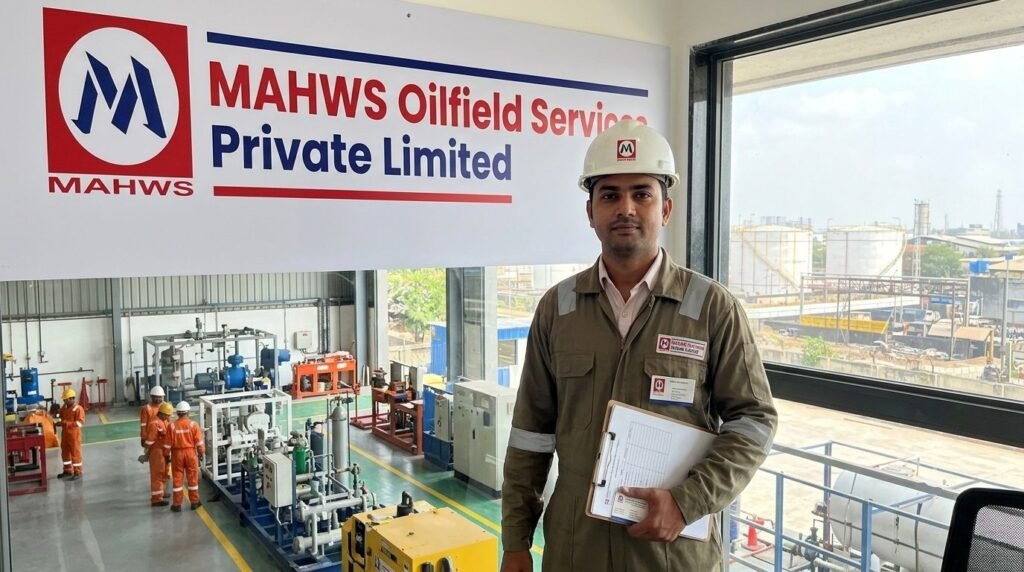
Chapter 1 – The Beginning of a Professional Journey
Every successful professional journey begins with a willingness to work in an environment where ordinary standards are not enough. For Indal Kumar and MAHWS Oilfield Services Private Limited, the journey was closely connected with the demanding world of oilfield services, industrial operations, technical competence, and safety.
Located at C-306/1, C306, TTC Industrial Area, MIDC Industrial Area, Pawne, Navi Mumbai, Maharashtra, MAHWS Oilfield Services Private Limited operated in an industrial ecosystem where technical knowledge and responsible working practices were particularly important. Navi Mumbai and the wider Mumbai industrial region are home to companies connected with engineering, manufacturing, oil and gas, petrochemicals, logistics, fabrication, maintenance, and industrial services. For an organization serving such an environment, professional competence could not be treated simply as a qualification written on paper.
Indal Kumar’s association with MAHWS Oilfield Services Private Limited represented this understanding. In oilfield-related activities, workers and technical personnel may encounter environments where flammable gases, vapours, liquids, or combustible materials can create hazardous conditions. IECEx explains that explosive atmospheres can occur in industries such as oil refineries, rigs, processing plants, tankers, drilling ships, and FPSOs.
This made competence a central part of the professional journey.
The decision to pursue IECEx Personnel Competence Certification therefore represented more than an attempt to obtain an additional certificate. It reflected a commitment to demonstrate that technical work associated with explosive atmospheres required knowledge, skill, experience, assessment, and continuing professional development. (https://mathewassociates.com/)
IECEx OD 504 is particularly relevant because it specifies units of competence and assessment outcomes for personnel working with equipment for explosive atmospheres. Its purpose is to support certification when competence is required in activities associated with explosion-protected equipment.
For Indal Kumar, this framework provided a structured way of looking at technical responsibility.
Before certification, professional capability can sometimes remain difficult for an external client to evaluate. A company may know that its personnel possess practical experience, but a customer, contractor, principal employer, or project manager may need objective evidence. Certification can help convert professional knowledge into independently assessed evidence.
That distinction became important in the story of MAHWS Oilfield Services Private Limited.
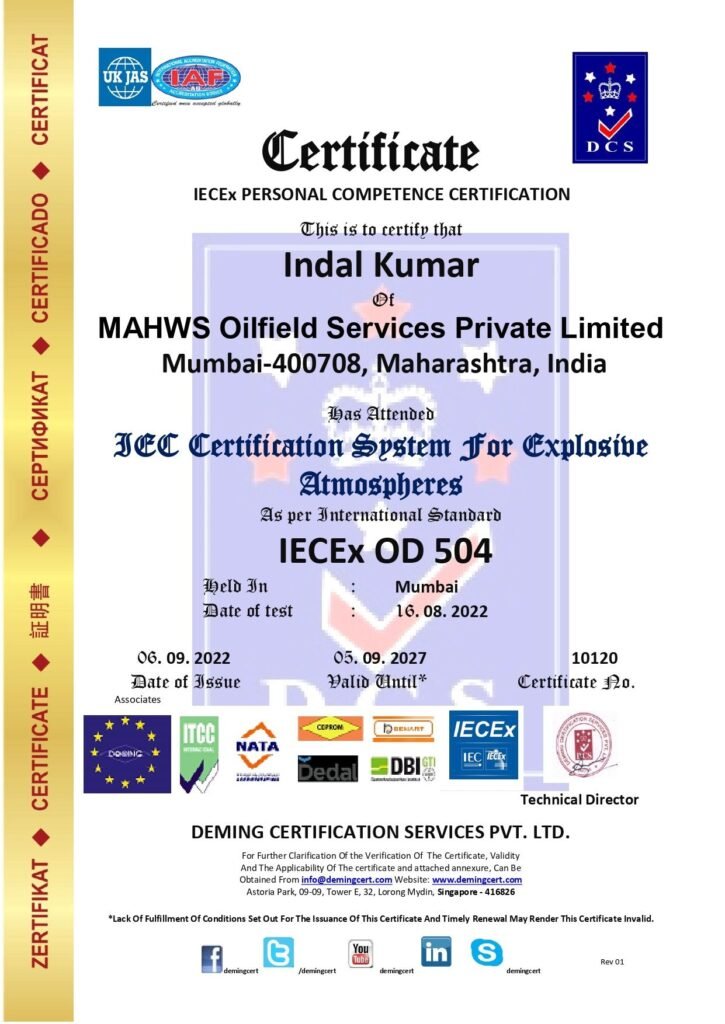
The year 2022 became a significant milestone. The IECEx Personnel Competence Certification associated with IECEx OD 504 was issued with validity extending to 2027 according to the certification information supplied for this case study.
The certification created an important professional reference point.
It did not mean that certification alone guaranteed business growth. Instead, it provided an additional foundation upon which technical credibility could be developed. In industries where safety, compliance, competency, and reliability influence decisions, such foundations can become valuable parts of a company’s professional identity.
For Indal Kumar, the certification journey could therefore be understood as a transition from simply demonstrating experience to demonstrating competence through a recognized certification framework.
The significance of that transition became clearer when considering the nature of hazardous-area work.
In an ordinary working environment, an incorrect assumption may result in equipment failure, delay, or rework. In an explosive atmosphere, however, an inappropriate installation, maintenance activity, inspection, or equipment decision can have much more serious consequences. This is why explosion protection relies on specialized equipment, systems, procedures, and competent personnel.
IECEx describes competence as involving knowledge, skill, experience, and training, and notes that competence may evolve or deteriorate over time, making continued assessment and development important.
This philosophy aligned naturally with a professional organization such as MAHWS Oilfield Services Private Limited.
The certification became part of a larger story: the story of professional discipline.
Indal Kumar could now carry forward an externally assessed competency credential into a working environment where customers increasingly expected technical personnel to understand the implications of hazardous locations, explosion protection, and safe working practices.
The achievement also encouraged a different internal mindset.
A certificate should not become something that is framed on an office wall and forgotten. Its real value emerges when the principles behind it influence everyday decisions.
For MAHWS Oilfield Services Private Limited, this meant looking at technical assignments through the lens of competence, documentation, risk awareness, and responsibility.
The 2022 certification therefore became a milestone from which a longer professional journey could develop.
From this point onward, the story was no longer simply about Indal Kumar obtaining a certification.
It was about how certification could strengthen professional confidence, contribute to organizational credibility, encourage disciplined technical practices, and support the company’s ambitions within the oilfield and industrial-services environment.
The years from 2022 to 2027 could consequently be viewed as a period in which the certification served as a continuing reference for professional competence.
The foundation had been established.
The next challenge was to turn that foundation into everyday professional value.
#IndalKumar
Chapter 2 – Understanding the Importance of Competence in Explosive Atmospheres
The oil and gas industry operates in environments where safety cannot be separated from technical competence. Equipment, electrical systems, instruments, wiring, maintenance activities, inspections, and operational procedures can all have implications when a hazardous atmosphere is present.
This was one of the most important lessons behind Indal Kumar’s certification journey.
The IECEx Personnel Competence Scheme was developed specifically to provide a means of assessing competence for personnel involved in work associated with equipment used in explosive atmospheres. IECEx identifies the scheme as relevant across different industries rather than restricting it to one particular sector.
For an oilfield-services organization, this perspective is highly relevant.
Oilfield facilities can include areas where flammable substances are processed, stored, transported, or handled. Such environments require careful attention to equipment selection and the methods used to install, maintain, inspect, test, repair, or manage explosion-protected equipment.
The certification journey encouraged Indal Kumar to see competence as a practical responsibility rather than merely an academic concept.
Knowledge alone is not always sufficient.
A person may understand terminology but still lack the practical ability to perform a task correctly. Conversely, a person may have years of field experience but benefit from formal assessment that confirms whether that experience aligns with defined competency requirements.
IECEx’s personnel competence framework recognizes this relationship between knowledge, skill, experience, and assessment.
This created an important professional bridge for MAHWS Oilfield Services Private Limited.
The organization could increasingly present itself not merely as a service provider but as an organization that understood the importance of competent personnel.
That distinction matters when dealing with industrial customers.
A prospective customer evaluating an oilfield-services provider may ask questions such as:
Can the personnel understand hazardous-area requirements?
Do they recognize the importance of explosion protection?
Can they work according to applicable procedures?
Do they understand the limitations of their competence?
Can they identify situations requiring additional technical support?
Are records and evidence maintained?
Does the organization take safety seriously?
Certification cannot automatically answer every one of these questions. However, an appropriate competence certification can provide meaningful evidence that a person has undergone a defined assessment process.
For Indal Kumar, this became an important element of professional credibility.
The certification also helped reinforce the concept that hazardous-area competence is specialized.
IECEx’s current personnel competence information describes multiple units addressing different functions, including basic awareness, principles of protection, hazardous-area classification, installation, maintenance, overhaul and repair, testing, inspection, design, and audit inspection.
This structure demonstrates why a simple statement such as “experienced technician” may not adequately describe competence in an explosive atmosphere.
Different tasks require different knowledge and skills.
A professional may have competence in one area but not another. IECEx recognizes that certificates may have limitations relating to equipment type, equipment group, protection technique, or voltage range.
This concept of defined competence helped establish a more mature professional approach.
For MAHWS Oilfield Services Private Limited, technical credibility could increasingly be connected with knowing not only what a person could do, but also what fell outside the person’s certified competence.
That awareness is a sign of professional maturity.
The certification therefore contributed to a culture in which asking questions became a strength rather than a weakness.
If a technical requirement was unclear, the appropriate response was not to assume.
If equipment required specialist knowledge, the appropriate response was not to improvise.
If a task involved a different protection technique or equipment category, the appropriate response was to verify competence and requirements.
Such thinking is particularly valuable in safety-critical industries.
Over time, these principles can influence documentation, communication, project planning, supervision, customer interaction, and workforce development.
The certification also helped position Indal Kumar’s professional identity within an international framework.
IECEx explains that its personnel competence certificates are designed to provide confidence to the international Ex community regarding the ability of certified personnel to undertake relevant work according to the technical and quality-system requirements of the scheme.
For a company connected with oilfield services, international recognition can be professionally meaningful.
Even when a project is located within India, customers may operate according to international standards or work with multinational contractors. A certification connected with an internationally recognized framework can therefore become a useful part of professional documentation.
The 2022 milestone thus became an important bridge between practical experience and formalized competency.
It helped create a language through which technical capability could be communicated.
For Indal Kumar, the certification represented professional accountability.
For MAHWS Oilfield Services Private Limited, it represented another building block in organizational credibility.
And for customers, it offered an additional piece of evidence that competence was being taken seriously.
This was the beginning of the company’s broader growth story.
#MAHWSOilfieldServices
Chapter 3 – The 2022 Certification Milestone
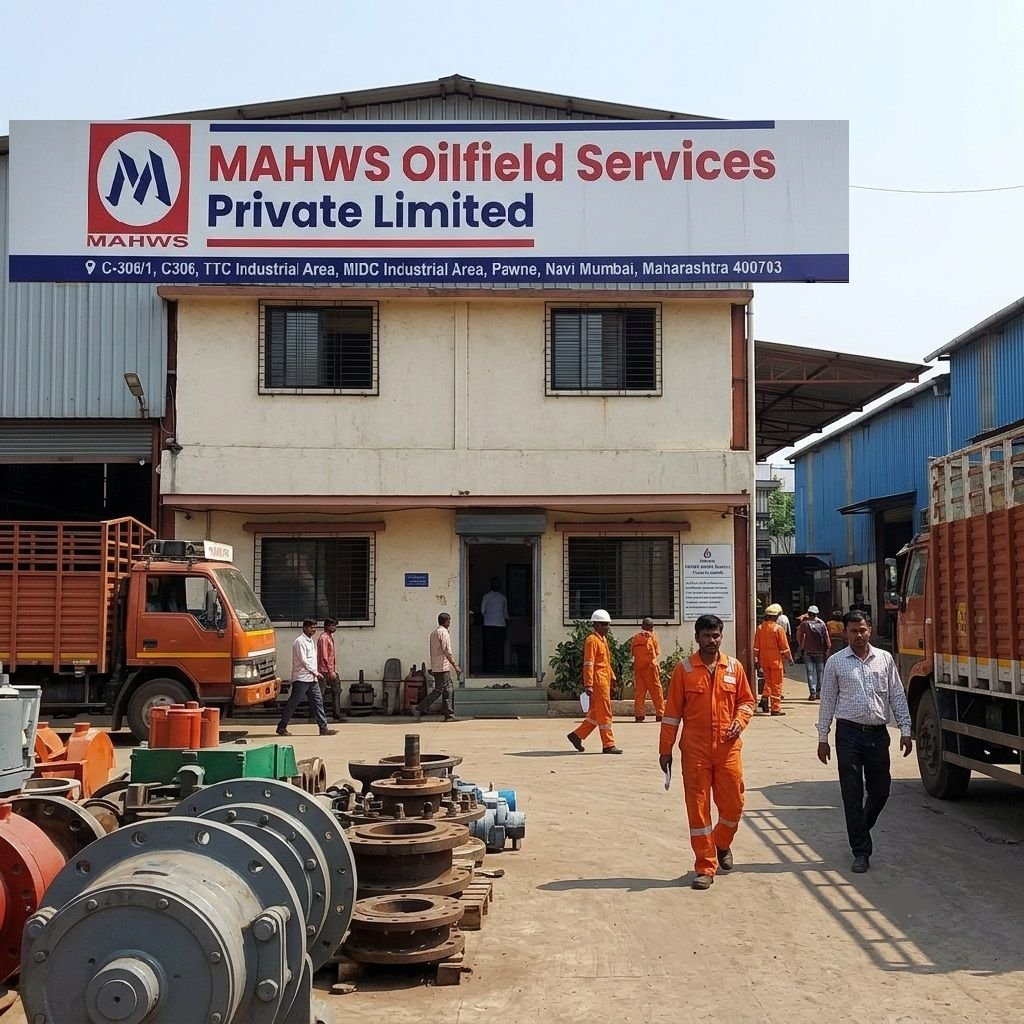
The year 2022 marked a turning point in the professional story of Indal Kumar and MAHWS Oilfield Services Private Limited.
The certification associated with IECEx OD 504 – IECEx Personnel Competence Certification – provided a formal milestone around which future professional development could be organized.
IECEx OD 504 establishes specifications for units of competence assessment outcomes within the IECEx Personnel Competence Scheme. The document has evolved through successive editions, reflecting changes and additions within the competence framework.
For the company, obtaining certification meant entering a professional environment where competence was considered through a structured assessment framework.
This was particularly valuable because the oilfield-services sector requires technical personnel to work responsibly around equipment and processes that may be associated with hazardous environments.
The certificate became part of Indal Kumar’s professional profile.
But the more important achievement was the discipline behind it.
Certification requires preparation.
Preparation requires understanding.
Understanding requires study, experience, practical application, and a willingness to be evaluated.
This process itself can change the way a professional approaches work.
A person preparing for competency assessment must think carefully about technical principles. Why is explosion protection necessary? What are the hazards? What can cause ignition? How should equipment be handled? What limitations apply to a particular type of equipment? What procedures should be followed?
These questions transform certification from a paperwork exercise into a learning process.
For Indal Kumar, the 2022 milestone could therefore serve as evidence of a professional commitment to structured technical competence.
For MAHWS Oilfield Services Private Limited, the certification could be incorporated into capability profiles, technical presentations, customer discussions, tender documentation, and professional credentials where appropriate.
Again, certification itself should not be interpreted as a guarantee of a company’s overall performance.
Instead, it became one component of the company’s professional identity.
That distinction is important.
A successful organization grows through many factors: quality of service, customer relationships, responsiveness, project execution, technical capability, workforce discipline, safety culture, documentation, financial management, leadership, and continuous improvement.
Certification can strengthen some of these areas, but it cannot replace them.
Indal Kumar’s story demonstrates this principle.
The IECEx credential created an opportunity.
The company still had to convert that opportunity into professional value.
One of the first areas where certification could make a difference was communication.
Customers often want to know who will perform technical work and what qualifications those people possess.
Instead of giving a general assurance, MAHWS Oilfield Services Private Limited could point to an identifiable competence credential.
This created a more structured conversation.
The company could explain the nature of the certification and the relevance of explosive-atmosphere competence to its technical activities.
It could distinguish certified competence from general experience.
It could encourage customers to consider competency as part of contractor selection.
The certificate also became a reminder that professional competence needs maintenance.
IECEx’s guidance emphasizes that competence can develop over time but can also deteriorate, making continuing training and assessment important.
This principle encouraged a longer-term perspective.
The certification was issued in 2022 and supplied information indicates validity through 2027.
Rather than viewing 2027 as simply an expiry date, the period could be viewed as a professional development cycle.
Each project undertaken during the validity period could become an opportunity to strengthen knowledge.
Each technical challenge could become a learning experience.
Each customer requirement could reveal another area where procedures or documentation could improve.
Each new technology could create a reason to update knowledge.
This mindset transformed the certificate into a living professional reference.
For Indal Kumar, the certification could support confidence when interacting with technical teams, project managers, customers, contractors, and industrial stakeholders.
For the company, it could reinforce the message that competent people are essential to quality service.
This was particularly relevant because MAHWS Oilfield Services Private Limited operated from the TTC Industrial Area in Pawne, Navi Mumbai, an environment surrounded by industrial activity.
The location itself placed the organization within a broader ecosystem where engineering and technical competence could influence business relationships.
The certification therefore became a professional bridge between the company and the expectations of industrial customers.
It represented readiness.
It represented responsibility.
It represented a willingness to have technical capability assessed.
Most importantly, it represented the beginning of a longer journey.
The certificate was not the destination.
It was the foundation for the next phase.
#IECExCertification
Chapter 4 – Building Trust Through Technical Credibility
Business growth is often described in terms of sales, contracts, customers, equipment, and employees.
But before those things grow, trust often has to grow.
For an oilfield-services organization, trust is especially important because customers may depend on technical service providers for work that affects operational continuity and safety.
Indal Kumar’s IECEx Personnel Competence Certification contributed to the credibility-building process of MAHWS Oilfield Services Private Limited.
It gave the company a professional story that could be communicated to stakeholders.
The story was straightforward:
Technical work associated with explosive atmospheres requires competence.
Competence can be assessed.
Indal Kumar had obtained certification under the IECEx Personnel Competence framework.
Therefore, the certification became evidence supporting a broader commitment to technical professionalism.
This type of evidence can be particularly useful when a company introduces itself to a new customer.
Instead of presenting only a company profile, the organization can demonstrate the qualifications of its people.
This helps humanize technical capability.
Customers do not ultimately work with certificates.
They work with people.
They rely on engineers, technicians, supervisors, inspectors, coordinators, and managers.
Consequently, the competence of individuals can influence how customers perceive an organization.
Indal Kumar’s certification became one such professional credential.
It could also encourage the company to maintain better technical records.
Documentation is often underestimated.
However, in technical industries, records can help demonstrate what was done, who performed it, what standards or procedures were considered, and what evidence was generated.
A competence-oriented culture naturally encourages stronger attention to documentation.
The question becomes:
Can the company demonstrate what it says?
That question can lead to improvements in project files, personnel records, training records, technical reports, checklists, inspection documentation, and customer communication.
The certification also helped strengthen the language used in professional proposals.
Instead of relying entirely on general claims such as “experienced staff” or “quality service,” the company could describe specific competence credentials where applicable.
That level of specificity can make technical communication more credible.
IECEx documentation also makes clear that personnel competence certification is different from training alone. The scheme concerns assessment of competence, while training may be undertaken separately.
This distinction is valuable.
A training certificate may demonstrate attendance or completion of a course.
A competency certification is intended to provide evidence that defined competencies have been assessed.
For MAHWS Oilfield Services Private Limited, understanding this difference could improve the way qualifications were communicated to customers.
The company could avoid exaggerated claims.
It could accurately describe what the certification covered.
It could respect the boundaries of the certified competence.
This creates trust.
Trust is not created by saying everything can be done.
Trust is created by clearly explaining what can be done, how it will be done, and when additional expertise is required.
Indal Kumar’s professional journey therefore became an example of responsible technical positioning.
The company could use the certification as a starting point for a broader culture of competence.
Employees could be encouraged to identify areas where additional training was needed.
Managers could consider competence when allocating technical assignments.
Customers could be informed about relevant credentials.
Technical personnel could become more conscious of the boundaries of their responsibilities.
The organization could also use the certification experience to support future quality-management initiatives.
ISO 9001, for example, emphasizes systematic approaches to processes, competence, customer focus, and continual improvement. While the IECEx Personnel Competence Certification and ISO 9001 address different aspects of organizational assurance, they can complement a company’s broader quality culture when implemented appropriately.
The combination of quality thinking and technical competence can create a strong professional foundation.
This became an important part of the growth story.
The company’s growth was not necessarily about becoming bigger overnight.
It was about becoming more credible.
It was about becoming more systematic.
It was about becoming better prepared for demanding customers.
It was about developing the confidence to participate in increasingly technical discussions.
Indal Kumar’s certification became one of the milestones supporting that transformation.
The journey demonstrated that professional growth can begin with a single individual’s commitment.
When that commitment is incorporated into organizational processes, its influence can become much broader.
A certified professional can influence colleagues.
Colleagues can influence procedures.
Procedures can influence project execution.
Project execution can influence customer confidence.
Customer confidence can influence future opportunities.
That chain illustrates how a competence credential can become part of a wider organizational growth story without claiming that the certificate itself directly caused specific commercial outcomes.
For MAHWS Oilfield Services Private Limited, this distinction was important.
The certification created credibility.
The organization had to earn trust through performance.
And the journey continued.
#IECExOD504
Chapter 5 – From Individual Competence to Organizational Capability
Courtesy: Nauctis
One of the most meaningful stages in any professional growth story occurs when individual capability becomes organizational capability.
Indal Kumar’s IECEx certification began as an individual professional achievement.
However, its wider value emerged when the lessons behind that certification influenced MAHWS Oilfield Services Private Limited as an organization.
The first lesson was that competence should be clearly defined.
In technical environments, the word “competent” can sometimes be used casually.
But IECEx’s approach demonstrates that competence is connected with specific work functions.
The personnel competence framework contains defined units addressing activities such as installation, maintenance, repair, testing, inspection, design, and audit inspection.
This provides an important organizational lesson.
A company should understand what each person is expected to do.
It should understand what skills are required for those responsibilities.
It should identify whether the individual has appropriate qualifications, experience, training, and assessed competence.
This can improve workforce planning.
Suppose a customer requires specialized work involving hazardous-area equipment.
The company should not simply select the first available technician.
Instead, management can ask:
What is the task?
What equipment is involved?
What protection concept is relevant?
What competence is required?
Who possesses that competence?
Are there limitations?
Is supervision necessary?
Is additional specialist support required?
These questions encourage a much more professional approach to manpower deployment.
For MAHWS Oilfield Services Private Limited, Indal Kumar’s certification could therefore become a reference point for developing similar thinking throughout the organization.
The second lesson was that competence should be documented.
Documentation makes capability visible.
A company may have highly skilled people, but if their credentials and experience are poorly documented, customers may struggle to evaluate them.
A systematic personnel file can include qualifications, certificates, experience records, training history, competency assessments, and project exposure where appropriate.
This can improve tender preparation and customer responses.
It can also help management identify competency gaps.
The third lesson was continuous development.
IECEx guidance recognizes that competence can change with time.
Technology changes.
Standards evolve.
Equipment changes.
Industrial processes change.
Customer expectations change.
Therefore, competence cannot be considered permanently complete.
This created an important cultural opportunity for MAHWS Oilfield Services Private Limited.
The company could encourage technical personnel to keep learning.
The fourth lesson was safety awareness.
In explosive atmospheres, safety cannot be treated as a separate department’s responsibility.
Every technical decision can have safety implications.
An electrician, instrument technician, maintenance engineer, inspector, supervisor, or project coordinator can influence risk.
The fifth lesson was professional humility.
Knowing the limits of one’s competence is itself a form of competence.
A certified person should not assume that certification permits every possible task.
IECEx recognizes that competency can be restricted according to equipment type, equipment group, protection technique, and other factors.
This principle can protect both employees and customers.
The organizational benefit of such thinking is significant.
It reduces the temptation to treat all technical assignments as interchangeable.
It encourages careful job allocation.
It strengthens supervision.
It improves customer communication.
It can reduce avoidable misunderstandings.
It also creates a culture in which asking for expert assistance is respected.
For Indal Kumar, this was an important evolution.
The certification was no longer simply an item on an individual profile.
It became a professional example.
Other personnel could see the benefits of developing specialized competence.
Management could recognize the value of certification and structured training.
Customers could see evidence of technical seriousness.
The company could develop a stronger identity around competence.
This is how individual certification can contribute to organizational development.
The process may be gradual.
There may not be a dramatic transformation immediately after certification.
Instead, small changes accumulate.
A better personnel record here.
A more detailed technical proposal there.
A clearer customer explanation.
A more careful job assignment.
A stronger safety briefing.
A better project close-out report.
A new technical training initiative.
A more systematic competency matrix.
Over time, these small improvements can create meaningful organizational capability.
That was the deeper value of Indal Kumar’s certification.
It represented a starting point for institutional learning.
The certificate had an individual name.
But the lessons could belong to the entire company.
#PersonnelCompetenceCertification
Chapter 6 – Strengthening Customer Relationships and Market Confidence
A technical service company grows when customers trust it enough to engage repeatedly.
For MAHWS Oilfield Services Private Limited, professional credibility was therefore not simply a matter of reputation. It was part of the company’s ability to participate in conversations with industrial customers.
Indal Kumar’s IECEx certification gave the company another credential with which to communicate technical seriousness.
Customers operating around hazardous areas often have concerns extending beyond price.
They may consider safety, competence, reliability, documentation, responsiveness, technical knowledge, project experience, and compliance requirements.
The certification helped address one part of that evaluation: personnel competence.
IECEx states that its Personnel Competence Scheme is intended to provide confidence that certified personnel maintain the ability to undertake relevant work or provide services in accordance with the technical and quality-system requirements of the scheme.
That principle could become useful in customer conversations.
When introducing Indal Kumar’s professional credentials, MAHWS Oilfield Services Private Limited could explain the relevance of IECEx competence to explosive-atmosphere work.
The conversation could then move from generic claims to specific technical areas.
This helped create a more professional customer relationship.
The company could demonstrate that it understood the difference between ordinary industrial work and work requiring specialized awareness of explosion protection.
This distinction also improved the quality of questions the company could ask customers.
Instead of immediately discussing only commercial requirements, technical personnel could explore the nature of the work environment.
What type of facility is involved?
What equipment is being handled?
What hazardous-area classification applies?
What type of protection is relevant?
What are the customer’s inspection and maintenance requirements?
What documentation is expected?
What personnel competencies are required?
What limitations or exclusions need to be considered?
These questions can improve project understanding.
They also demonstrate professionalism.
A customer is more likely to trust a service provider that asks the right technical questions before promising a solution.
This is where certification can indirectly support business growth.
It creates a knowledge framework.
That framework can influence conversations.
Better conversations can lead to better project understanding.
Better project understanding can contribute to better execution.
Better execution can contribute to customer satisfaction.
Customer satisfaction can contribute to repeat business and referrals.
However, it is important not to claim specific contracts or revenue growth without evidence.
The appropriate conclusion is that certification strengthened the foundation from which such opportunities could be pursued.
The certification also had value in documentation.
When customers requested company profiles, employee credentials, technical qualifications, or competency information, MAHWS Oilfield Services Private Limited could include relevant certification information where applicable.
This could make the company profile more informative.
In competitive markets, small differences in professional presentation can influence perception.
Two companies may offer similar services.
One may provide only a basic company profile.
The other may present a structured profile containing qualifications, competence credentials, technical capabilities, procedures, and documented experience.
The second profile can create greater confidence.
Indal Kumar’s certification became one element of this professional presentation.
The certification period from 2022 to 2027 also created continuity.
Instead of being a one-time achievement, the credential could remain part of the professional profile during the validity period.
This allowed the company to consistently communicate its commitment to competence.
The story also demonstrates an important lesson about market positioning.
A company should not try to be everything to everyone.
Technical credibility is strongest when the organization clearly understands its area of competence.
IECEx certification reinforced that principle.
It provided a recognized vocabulary for discussing competence related to explosive atmospheres.
It also encouraged the company to be precise about the limits of its technical capabilities.
Precision builds credibility.
Over time, customers may begin to associate the company with responsible technical service.
That association is valuable.
A strong reputation is rarely created through one advertisement.
It is created through repeated evidence.
One successful project.
One satisfied customer.
One professional report.
One competent technician.
One safety-conscious decision.
One well-maintained record.
One honest response when a requirement falls outside the company’s competence.
Indal Kumar’s certification became part of this collection of evidence.
The growth story of MAHWS Oilfield Services Private Limited therefore moved beyond certification itself.
The certificate became a tool for professional communication.
It helped explain the company’s approach.
It helped demonstrate individual competence.
And it supported the broader objective of building long-term customer confidence.
#ExplosiveAtmospheres
Chapter 7 – Professional Development During the Certification Period
The period between 2022 and 2027 can be viewed as more than a certificate-validity window.
It can also be understood as a period of professional development.
A competence certificate creates an expectation that the individual will continue to maintain and develop relevant knowledge.
IECEx guidance specifically notes that competence may evolve and may deteriorate, emphasizing the importance of continued training and assessment.
This concept became increasingly important for Indal Kumar.
Industrial technology does not remain static.
New equipment enters the market.
Manufacturers introduce new designs.
Customers modify facilities.
Safety practices evolve.
Standards are revised.
Project requirements become more demanding.
A professional who stops learning can eventually find that yesterday’s knowledge is insufficient for tomorrow’s assignment.
Therefore, the certification could be used as a foundation for continuing professional development.
Indal Kumar could treat each project as an opportunity to reinforce technical understanding.
Questions arising during practical work could become subjects for study.
Customer requirements could reveal areas requiring deeper knowledge.
New equipment could motivate further learning.
Technical discussions with experienced colleagues could improve practical understanding.
This created a cycle:
Experience created questions.
Questions created learning.
Learning improved competence.
Improved competence strengthened professional confidence.
Professional confidence improved technical communication.
Technical communication strengthened customer relationships.
The organization could benefit from this cycle as well.
MAHWS Oilfield Services Private Limited could encourage technical employees to maintain personal development plans.
A competency matrix could identify skills across the workforce.
Training requirements could be recorded.
Certificates could be monitored.
Renewal dates could be tracked.
Project experience could be documented.
This creates a more systematic approach to human-resource development.
Such systems can become particularly valuable as an organization grows.
A small company may rely heavily on the memory of a few senior employees.
As the company expands, that approach becomes risky.
Information should move from people’s memories into documented systems.
This was another organizational lesson arising from the certification journey.
The company could create internal knowledge resources covering common technical topics.
It could encourage toolbox discussions.
It could establish technical review meetings.
It could document lessons learned from projects.
It could encourage personnel to report uncertainties instead of hiding them.
These activities can strengthen safety culture.
The certification also helped create a professional identity for Indal Kumar.
He was not simply someone working in an industrial company.
He became a certified professional within a specialized international competence framework.
That distinction can influence confidence.
It can influence how colleagues perceive technical responsibility.
It can influence how customers perceive the organization.
It can also influence personal ambition.
Certification can encourage a person to seek greater responsibility.
A technician may become interested in supervision.
A supervisor may develop interest in inspection.
An engineer may pursue additional units of competence.
A technical professional may become interested in quality management.
This creates career development.
For MAHWS Oilfield Services Private Limited, employee development can also contribute to organizational resilience.
If knowledge is distributed among several competent people, the organization becomes less dependent on a single individual.
That is especially important in technical industries.
The long-term objective is not merely to have one certified person.
It is to develop a culture in which competence is continuously strengthened.
Indal Kumar’s certification can therefore be regarded as an example for others.
The journey begins with one person.
Then the organization learns.
Then additional people develop.
Eventually, competence becomes part of the company’s identity.
The 2022–2027 certification period could therefore become a chapter in a longer story of professional development.
The certificate provided recognition.
The years following certification provided opportunity.
The opportunity was to transform recognition into knowledge.
Knowledge into practice.
Practice into capability.
Capability into trust.
And trust into sustainable professional growth.
#OilfieldServices
Chapter 8 – The Role of Quality, Safety, and Continuous Improvement
The growth of a technical company cannot be separated from quality.
Quality is not simply the absence of defects.
It is the ability to consistently deliver what customers require while controlling risks and improving processes.
For MAHWS Oilfield Services Private Limited, the IECEx certification journey created an opportunity to connect technical competence with broader quality thinking.
Indal Kumar’s certification demonstrated competence in a specialized field.
The organization could build upon this by strengthening internal processes.
One of the most important principles was process discipline.
A technically skilled employee can still make mistakes if procedures are unclear.
Likewise, a good procedure can fail if employees are not competent.
Quality therefore requires both capable people and effective processes.
This is where the philosophy behind ISO 9001 can complement technical competence.
ISO 9001 focuses on a systematic quality-management approach, while IECEx Personnel Competence Certification focuses specifically on defined competence associated with explosive atmospheres.
The two should not be confused, but they can support complementary objectives.
For MAHWS Oilfield Services Private Limited, this could mean establishing clear procedures for:
Personnel competence verification.
Assignment of technical responsibilities.
Customer requirement review.
Project planning.
Technical documentation.
Equipment identification.
Inspection and testing.
Nonconformity management.
Corrective action.
Training.
Document control.
Customer feedback.
Management review.
Continual improvement.
Indal Kumar’s certification could become one input into this broader quality system.
For example, before assigning an employee to a specialized task, management could verify the individual’s qualifications and competence.
This would reduce the possibility of assigning unsuitable personnel.
Similarly, after a project, the company could review whether the work was completed according to customer requirements and internal procedures.
If problems occurred, corrective actions could be identified.
This creates a learning organization.
The organization does not simply ask, “Did we finish?”
It asks, “What did we learn?”
That question is powerful.
Suppose a customer repeatedly requests a specific type of technical documentation.
The company can standardize it.
Suppose technicians repeatedly face the same technical uncertainty.
The company can develop a guidance document.
Suppose a particular type of equipment generates recurring inspection issues.
The company can create additional training.
Suppose a project reveals a gap in competence.
The company can identify appropriate training or specialist support.
This is continual improvement in practice.
Safety benefits from the same philosophy.
Instead of waiting for an incident, the company can learn from near misses, observations, customer feedback, technical deviations, and employee suggestions.
Competence and safety therefore become connected.
The certification also reinforced the importance of understanding boundaries.
A quality system should prevent people from performing tasks for which they lack appropriate competence.
This is not a limitation.
It is a control.
Professional organizations recognize that refusing an unsuitable assignment can sometimes be the safest and most responsible decision.
For Indal Kumar, this was part of professional maturity.
The objective was not to demonstrate that he could do everything.
The objective was to demonstrate that he understood the requirements and could work responsibly within his competence.
This philosophy can positively influence organizational reputation.
Customers often appreciate suppliers who are transparent about capabilities.
Overpromising may win an assignment temporarily.
Underpromising and then delivering professionally can build a relationship.
The company could therefore position quality as a long-term business strategy.
The certification became evidence of one part of that strategy.
Continuous learning became another.
Documentation became another.
Customer feedback became another.
Safety awareness became another.
Process improvement became another.
Together, these elements created a more mature organization.
The growth story of MAHWS Oilfield Services Private Limited thus became broader than an individual certification.
It became a story about developing systems around people.
People create capability.
Processes make capability repeatable.
Documentation makes capability visible.
Measurement makes performance understandable.
Improvement makes the organization stronger.
This is the foundation of sustainable professional growth.
As the certification approached its stated 2027 validity period, the organization had an opportunity to review what had been achieved and identify the next stage of development.
The certificate was important.
But the culture created around it was even more important.
#IndustrialSafety
Chapter 9 – Indal Kumar’s Professional Legacy and the Company’s Future
Every certification has a technical purpose.
But for the individual receiving it, certification can also become part of a professional legacy.
For Indal Kumar, the IECEx Personnel Competence Certification issued in 2022 and valid through 2027 represented an important stage in his professional development.
It demonstrated a willingness to work within a structured competency framework.
It represented commitment to technical learning.
It created a documented professional credential.
It also provided an example that could influence others within MAHWS Oilfield Services Private Limited.
Professional legacy is not necessarily measured by job title or financial success.
It can be measured by the standards a person establishes.
If a certified professional insists on proper documentation, colleagues may adopt better documentation practices.
If a certified professional refuses to compromise on safety, others may become more safety-conscious.
If a certified professional continues learning, colleagues may become more interested in development.
If a certified professional acknowledges the limits of competence, the organization may develop a culture of responsible decision-making.
This is how one person’s professional behavior can influence an organization.
Indal Kumar’s certification therefore had potential significance beyond his individual profile.
It could become part of the company’s institutional memory.
Future employees could see the certification as an example of the type of competence the organization values.
Future managers could use it as a benchmark for personnel development.
Future customers could see it as part of the company’s history of technical professionalism.
The company’s future could also be shaped by the broader IECEx environment.
The IECEx personnel competence scheme continues to define multiple competency areas covering activities associated with explosive atmospheres.
This means organizations working in relevant industries need to remain attentive to evolving technical expectations.
For MAHWS Oilfield Services Private Limited, the future could involve developing additional competencies, strengthening quality systems, expanding technical services, investing in employee development, and improving customer communication.
The company could also continue building relationships with industrial organizations requiring specialized services.
The location in Pawne, Navi Mumbai places the company within an important industrial region.
That environment can provide opportunities, but it also creates competition.
To compete effectively, the organization must demonstrate value.
Price is one form of value.
Technical competence is another.
Reliability is another.
Responsiveness is another.
Documentation is another.
Safety is another.
Professional integrity is another.
The strongest companies combine these elements.
Indal Kumar’s certification contributed to the technical-competence dimension.
The company could build the other dimensions around it.
The 2027 validity point could also become a strategic review moment.
Instead of waiting until certification renewal becomes urgent, management could begin reviewing competency requirements early.
What has changed since 2022?
What new equipment has entered the company’s work environment?
What additional technical services are being offered?
What new customer expectations exist?
Which employees need additional training?
Which competency units are relevant to future activities?
Which internal procedures need updating?
These questions could guide the next stage.
The goal should not be merely to renew a certificate.
The goal should be to improve the organization.
That is the deeper meaning of certification.
A certificate has a date.
Competence must continue.
A certificate has a scope.
Professional responsibility extends through daily work.
A certificate provides recognition.
Performance provides reputation.
For Indal Kumar, this distinction defines the legacy of the certification.
The achievement was not simply that a certificate was issued in 2022.
The achievement was the opportunity to use that credential as a platform for continuous professional development.
For MAHWS Oilfield Services Private Limited, the lesson was equally important.
Growth should be sustainable.
Growth should be supported by competent people.
Growth should be supported by systems.
Growth should be supported by customer trust.
Growth should be supported by safety.
Growth should be supported by continual learning.
This created a vision for the company’s future.
Not simply a bigger company.
A better company.
A company capable of taking on more demanding technical responsibilities while remaining conscious of its competence boundaries.
A company that can demonstrate qualifications rather than simply claim expertise.
A company that can turn technical knowledge into dependable service.
That was the professional legacy emerging from the 2022 certification milestone.
#TechnicalCompetence
Chapter 10 – A Continuing Journey of Growth, Competence, and Excellence
The story of Indal Kumar and MAHWS Oilfield Services Private Limited is ultimately a story about transformation.
The transformation did not happen because a certificate was issued.
It happened because certification created an opportunity to strengthen professional thinking.
In 2022, the IECEx Personnel Competence Certification associated with IECEx OD 504 became a significant milestone.
The certification was supplied as valid through 2027.
During that period, the organization could use the credential as part of its professional development, customer communication, technical capability, and quality culture.
The story began with an individual.
Indal Kumar pursued a recognized competency framework.
The framework required attention to knowledge, skills, experience, and defined work functions.
The achievement then became relevant to the organization.
MAHWS Oilfield Services Private Limited could use the experience to reinforce the importance of competence.
From there, the influence could expand.
Competence could influence procedures.
Procedures could influence project execution.
Project execution could influence customer satisfaction.
Customer satisfaction could influence reputation.
Reputation could influence future opportunities.
This does not mean that certification automatically produces commercial success.
No responsible case study should make such a claim without evidence.
Instead, the certification should be understood as an enabling factor within a larger business system.
A company’s growth depends on many elements.
Leadership matters.
Customers matter.
Employees matter.
Technology matters.
Financial management matters.
Marketing matters.
Quality matters.
Safety matters.
Technical competence matters.
Certification can support some of these areas by providing evidence of defined competence.
That evidence can be valuable.
IECEx’s framework was developed specifically to address competence associated with equipment used in explosive atmospheres. The scheme covers multiple specialized units, reflecting the fact that different technical activities require different competencies.
For an oilfield-services organization, that specialization is important.
It encourages professionals to understand that hazardous-area work should be approached systematically.
The certification journey also reinforces a larger principle:
Safety is not merely a procedure.
Safety is a professional behavior.
A competent person understands why a requirement exists.
A mature organization creates systems that help people follow those requirements consistently.
A responsible company recognizes when a task exceeds its competence.
A professional employee continues learning.
A quality-oriented organization learns from mistakes.
A customer-focused company listens.
These principles can collectively create sustainable growth.
For Indal Kumar, the IECEx credential can therefore be remembered as an important chapter in his professional journey.
It represents knowledge.
It represents assessment.
It represents responsibility.
It represents technical credibility.
It represents an investment in professional development.
For MAHWS Oilfield Services Private Limited, the certification can be viewed as one of the building blocks in the company’s continuing journey.
The company’s address at C-306/1, C306, TTC Industrial Area, MIDC Industrial Area, Pawne, Navi Mumbai, Maharashtra, places its story within a highly industrial setting where technical services, engineering capabilities, and professional standards are important.
The company can continue building on its foundation by strengthening workforce competence, maintaining accurate records, improving procedures, developing customer relationships, and pursuing continual improvement.
The period leading toward 2027 offers an opportunity for reflection.
What did the organization learn?
Which technical capabilities became stronger?
Which processes improved?
Which customer expectations became clearer?
Which employees developed?
Which new areas should be explored?
These questions are more important than simply asking whether the certificate remains valid.
A certificate is an important document.
But a culture of competence is a long-term asset.
That culture can survive beyond the certificate’s validity period.
It can influence future employees.
It can influence future customers.
It can influence future projects.
It can influence future leadership decisions.
And ultimately, it can become part of the company’s identity.
The journey of Indal Kumar and MAHWS Oilfield Services Private Limited therefore illustrates a powerful principle of modern industrial business:
Certification should be the beginning of improvement, not the end of it.
The real value of professional certification appears when knowledge is applied responsibly.
It appears when customers receive better technical communication.
It appears when employees understand their responsibilities.
It appears when management assigns work according to competence.
It appears when safety is prioritized.
It appears when documentation becomes stronger.
It appears when lessons are converted into improvements.
It appears when professional credibility becomes consistent performance.
The 2022 certification marked the beginning of that opportunity.
The years through 2027 provide a period in which the organization can continue developing it.
Indal Kumar’s achievement can therefore be seen not as an isolated certificate but as part of a larger story of professional growth.
A story that began with competence.
A story that developed through responsibility.
A story strengthened through quality.
A story supported by safety.
A story communicated through credibility.
And a story that continues toward the future.
For MAHWS Oilfield Services Private Limited, the ultimate objective is not simply to say that its personnel are certified.
The objective is to build an organization in which competence is visible in everyday work.
That is where certification becomes meaningful.
That is where professional development becomes organizational capability.
That is where capability becomes customer confidence.
And that is where confidence can become sustainable business growth.
The journey of Indal Kumar demonstrates that professional excellence is not achieved in one day.
It is built step by step.
One qualification.
One project.
One lesson.
One improvement.
One customer.
One responsible decision at a time.
The IECEx Personnel Competence Certification provided an important foundation.
The future belongs to how that foundation is used.
And for Indal Kumar and MAHWS Oilfield Services Private Limited, that future remains an opportunity to continue learning, continue improving, continue serving customers responsibly, and continue building a stronger reputation within the industrial and oilfield-services environment.
The certificate may have a defined validity period.
But the commitment to competence does not need to expire.
That is the real growth story.
That is the lasting value of the certification.
And that is the continuing journey of Indal Kumar and MAHWS Oilfield Services Private Limited.
#ISO9001Certification
#OilAndGasIndustry #HazardousAreaSafety #ExEquipment #SafetyCertification #IndustrialQuality
Take the Next Step Today
Don’t wait to enhance your business’s quality and efficiency. Partner with Sanatan Dharma Accreditation Boards and experience the transformation that comes with expert consultancy and training. Contact us today to learn more about how we can help you achieve your business goals. Reach out via phone at +91-8668266780, visit our website at sanatanboards.com, or email us at info@sanatanboards.com Let us be your guide on the journey to excellence and innovation.





