
Selama 8-8-6
Table of Contents
Introduction
Agriculture is one of the most important foundations of human civilization. Behind every successful harvest stands a long chain of farmers, researchers, manufacturers, distributors, agronomists and agricultural-product specialists who work together to transform scientific knowledge into practical solutions for growers.
In this environment, the role of agricultural-input manufacturers is particularly important. Products supplied to farmers must not only perform their intended agricultural function; they must also be supported by appropriate information concerning safe handling, storage, transportation, emergency response and responsible use.
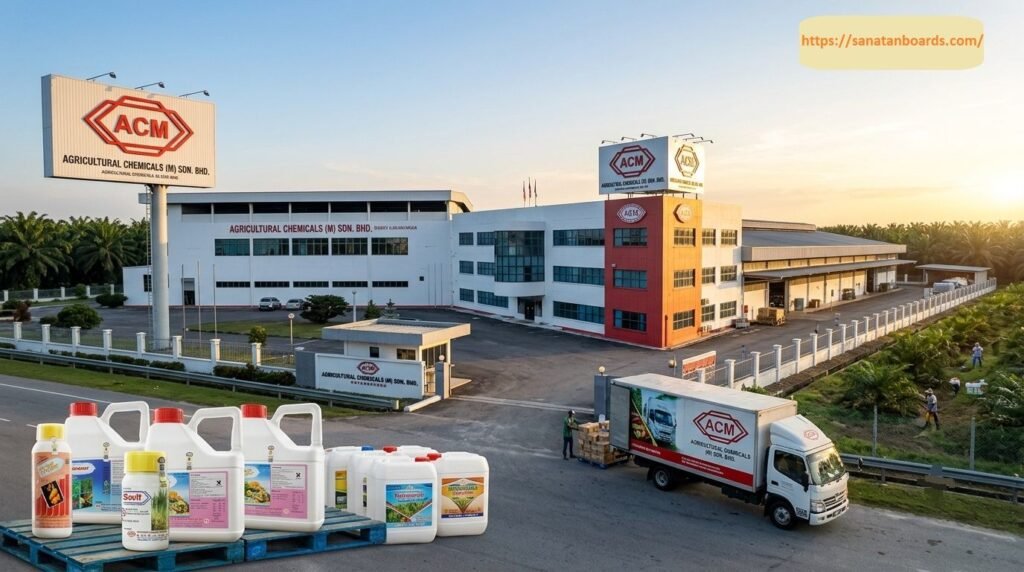
Agricultural Chemicals (M) Sdn. Bhd., commonly known as ACM, represents a long-standing presence in Malaysia’s agricultural and agrochemical sector. Public industry information identifies the company as an established Perai-based agrochemical manufacturer and supplier, with roots going back to 1969. ACM has developed from its original pesticides-formulation activities into a broader agricultural solutions business involving agrochemicals, farm machinery and related services. (http://www.agrichem.com.my/)
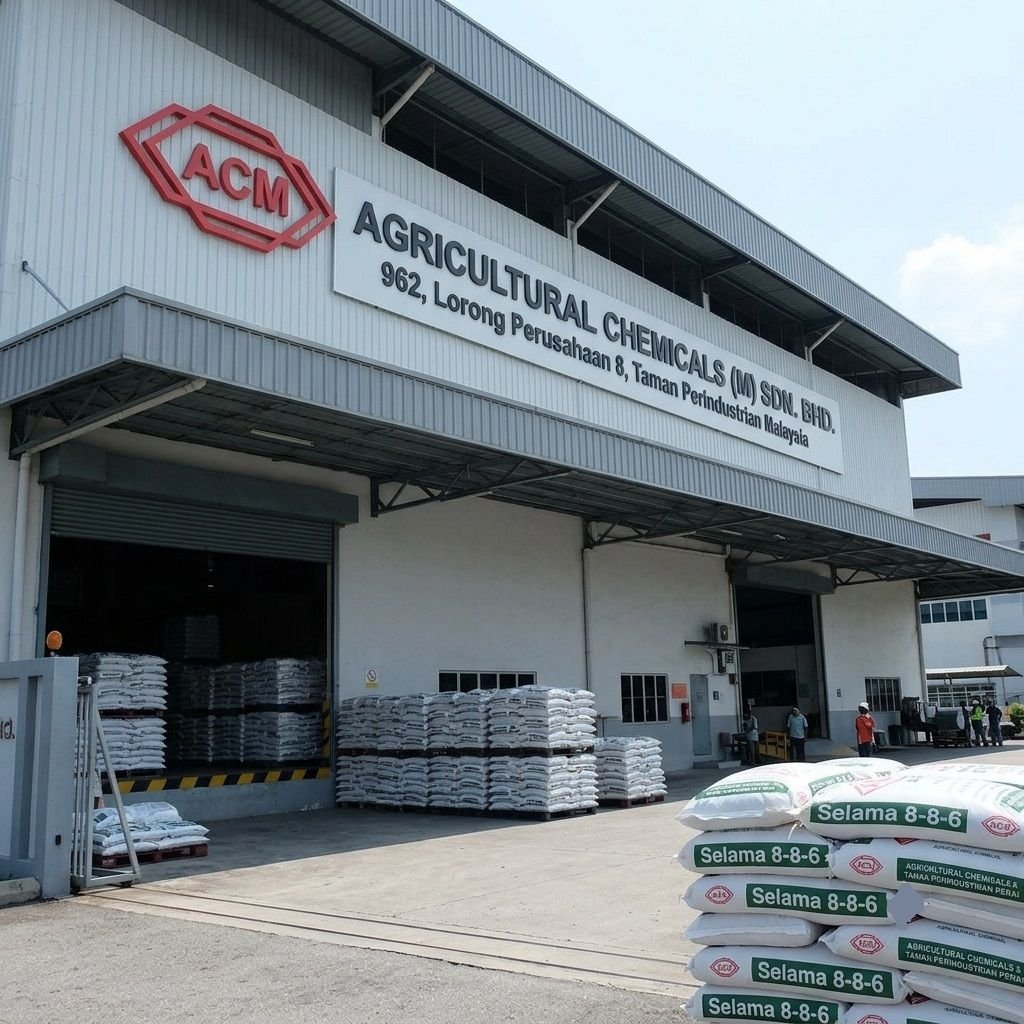
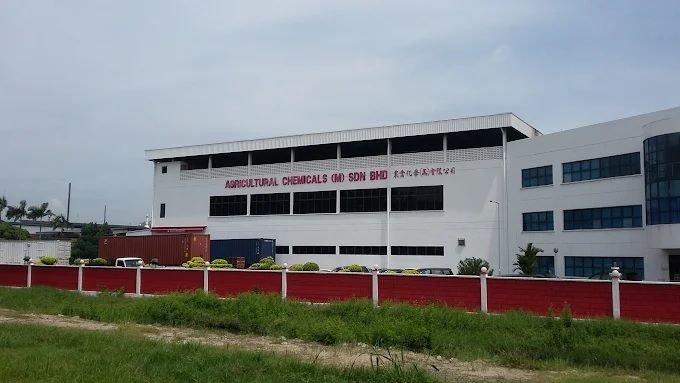
The company’s Perai location at 962, Lorong Perusahaan 8, Taman Perindustrian Perai, is associated with its manufacturing and business operations. Industry directories also identify ACM among Malaysian chemical-industry members and agricultural-sector organizations.
Within this larger story is the documentation and certification of Selama 8-8-6, a Liquid NPK Foliar Fertilizer. The MSDS/SDS documentation identifies the product as a plant-nutrition product containing nitrogen, phosphate, potassium and other micronutrients. The documented safety information emphasizes responsible handling, personal protective equipment, first-aid procedures, accidental-release response and appropriate disposal.
The 2022 certification milestone can therefore be viewed as more than a technical document. It represents a commitment to organizing product-safety information in a structured form and making that information useful to employees, distributors, agricultural professionals, customers and other stakeholders.
The following ten chapters tell the story of how a quality-and-safety mindset can strengthen an established agricultural company. The story combines the supplied certification information with publicly available company background and presents the resulting growth journey as a corporate case narrative.
Chapter 1 – The Beginning of an Agricultural Vision
The story of Agricultural Chemicals (M) Sdn. Bhd. begins with agriculture itself.
Malaysia’s agricultural economy has always depended upon a combination of land, climate, farming knowledge, technology and carefully selected agricultural inputs. As farming practices became more sophisticated, the demand for reliable crop-protection products, fertilizers, machinery and technical services increased.
Against this background, Agricultural Chemicals (M) Sdn. Bhd. was established in 1969. Public company information describes ACM as a Japanese-Malaysian joint venture that began with pesticides formulation and subsequently expanded into a broader agricultural business.
The significance of such a journey cannot be understood merely through the passage of time. A company operating in agriculture for decades must continually adapt. Farmers change their expectations. Cropping systems evolve. Regulatory requirements develop. Scientific knowledge expands. International trade creates new opportunities while also introducing new expectations concerning quality and documentation.
For an agricultural-input company, growth therefore cannot depend only on selling more products. Long-term growth requires credibility.
Credibility comes from many sources: consistent product quality, technical knowledge, responsible manufacturing, customer service, research, field support, documentation and the ability to communicate clearly about products.
The development of ACM’s operations in Perai reflects this long-term industrial orientation. The company’s address at 962, Lorong Perusahaan 8, Taman Perindustrian Perai, became associated with a business serving the agricultural sector from an established industrial base. The Chemical Industries Council of Malaysia identifies ACM as a manufacturing company involved in agrochemicals and farm machinery, while its member information lists agriculture as the target industry.
The company’s development was not limited to one category of agricultural product. Industry information indicates activities covering agrochemicals, fertilizers, horticultural supplies, agricultural machinery and related consultancy and advisory services.
This broader approach created an environment in which product quality and product information became increasingly important.
One of the central lessons of agricultural business is that the customer is rarely purchasing a product in isolation. A farmer purchasing an agricultural input is also purchasing confidence that the product has a defined purpose, that it can be handled responsibly and that the supplier understands agricultural requirements.
That principle becomes particularly important when dealing with formulated chemical and nutrient products.
A liquid fertilizer such as Selama 8-8-6 is intended to support plant nutrition, but its commercial success also depends upon responsible communication. The product must be correctly identified. Its intended use must be understood. Relevant hazards must be communicated. Handling and storage requirements must be available. Emergency measures must be documented.
This is where a structured Material Safety Data Sheet becomes valuable.
The MSDS associated with Selama 8-8-6 identifies it as a liquid NPK foliar fertilizer and gives its recommended usage as plant nutrition. It also identifies Agricultural Chemicals (M) Sdn. Bhd. as the supplier.
The 2022 certification milestone therefore fits naturally into the company’s broader development.
For an established agricultural organization, documentation is not simply paperwork. It becomes part of the infrastructure supporting responsible business.
The certification of the Selama 8-8-6 MSDS can be interpreted as one of those infrastructure-building milestones: a point at which technical product knowledge, safety information and formal documentation came together in a structured manner.
The journey from an agricultural chemical manufacturer to a broader agricultural solutions provider required precisely this type of evolution.
The company’s history demonstrates that sustainable growth is built layer by layer. Manufacturing capability provides the foundation. Product knowledge adds strength. Customer relationships create stability. Technical support creates differentiation. And quality and safety documentation help transform all of those capabilities into measurable confidence.
By 2022, Selama 8-8-6 represented more than a liquid fertilizer product. It represented a product that could be accompanied by defined safety information and responsible-use guidance.
That became an important part of the next stage of ACM’s journey.
#AgriculturalChemicals
Chapter 2 – Understanding the Importance of Product Quality
The agricultural industry operates under conditions that are very different from many other industries.
A factory can control many variables inside its production environment. Agriculture cannot control everything outside the factory.
Weather changes. Soil conditions vary. Crops respond differently to environmental conditions. Farmers have different levels of technical knowledge. Storage and transportation conditions can differ. Products can move through several hands before reaching the final user.
For this reason, agricultural manufacturers have a special responsibility to communicate product information clearly.
The development of Selama 8-8-6 as a liquid NPK foliar fertilizer illustrates this principle.
The product’s identity is straightforward: it is a liquid foliar fertilizer intended for plant nutrition, containing nitrogen, phosphate, potassium and other micronutrients according to the available SDS information.
Yet the simplicity of the product’s agricultural purpose does not eliminate the need for careful safety communication.
A professional product-information system must answer questions such as:
What is the product?
Who supplies it?
What is it intended for?
What hazards may arise during handling?
What protective equipment should be used?
What should happen if the product enters the eyes?
How should accidental releases be managed?
How should containers and waste be handled?
These questions become particularly important for agricultural chemical products because workers may encounter them during manufacturing, filling, transportation, storage, distribution and application.
The documented SDS for Selama 8-8-6 includes hazard identification and precautionary information. It identifies risks including skin irritation, serious eye damage and possible respiratory irritation, and recommends measures such as gloves, protective clothing, safety goggles and face protection.
The existence of such information changes the relationship between the company and the product.
Without formal documentation, safety knowledge can remain scattered among experienced employees.
With documentation, knowledge becomes transferable.
A trained production worker can refer to written instructions. A warehouse employee can understand the relevant precautions. A distributor can receive consistent information. An emergency responder can identify the product. A customer can better understand responsible handling.
This is one of the most important ways in which quality systems contribute to organizational maturity.
Quality is not simply about whether a product works.
Quality also includes whether the organization can consistently define, control, document and communicate what it is doing.
For a company with decades of agricultural experience, formal documentation provides a bridge between institutional knowledge and modern management practices.
That bridge becomes increasingly important as organizations grow.
A small company can sometimes depend upon direct communication between the owner, technical manager and workers. A larger company cannot rely on personal memory alone.
As organizations expand, responsibilities become distributed.
Production departments handle manufacturing.
Quality departments handle specifications and records.
Warehouse teams manage storage.
Sales teams communicate with customers.
Technical teams provide agricultural guidance.
Procurement teams interact with suppliers.
Regulatory personnel monitor compliance requirements.
Management oversees the entire system.
Each department needs reliable information.
The MSDS becomes one connecting document among these functions.
For Selama 8-8-6, the 2022 certification therefore contributed to a culture in which product identity and safety information could be communicated consistently.
This is particularly meaningful for a company whose business extends across agricultural products and services.
Industry sources identify ACM as a manufacturer and supplier serving agriculture and list a broad range of agricultural products and brands.
As the product portfolio becomes broader, the importance of disciplined documentation becomes greater.
The company must distinguish one product from another.
Different products may have different hazards.
Different formulations may require different storage conditions.
Different markets may expect different technical documents.
Different customers may ask for specific certifications or supporting documentation before purchasing.
Therefore, documentation becomes a competitive asset.
A company that can quickly provide clear, professional and consistent product information is often better positioned to build trust.
This trust is especially important when entering new markets.
Agricultural Chemicals (M) Sdn. Bhd. has publicly listed export markets including Thailand, the Philippines, Vietnam, Indonesia, Singapore, Myanmar, Taiwan, Cambodia and Sri Lanka.
International business naturally increases the importance of technical documentation.
A product crossing borders must be understood by people who may not know the manufacturer personally.
A well-prepared safety document can therefore become a form of communication across languages, cultures and supply chains.
The 2022 certification of the Selama 8-8-6 MSDS fits within this broader concept.
It strengthened the documentation surrounding the product and supported a more professional approach to product responsibility.
For ACM, quality was no longer only an internal objective.
It became part of the company’s external identity.
#AgriculturalChemicalsMalaysia
Chapter 3 – The Selama 8-8-6 Product Story
Every agricultural product has a story.
Before a product reaches a farmer’s field, it passes through stages of formulation, testing, manufacturing, packaging, storage, transportation, marketing and distribution.
Selama 8-8-6 became one such product within Agricultural Chemicals (M) Sdn. Bhd.’s agricultural portfolio.
The product is identified as a Liquid NPK Foliar Fertilizer, with nitrogen, phosphate, potassium and other micronutrients described in the available safety documentation. Its recommended usage is plant nutrition.
The name “Selama” also connects naturally with ACM’s agricultural research background. Public company information states that ACM established its 62-acre Selama Research Centre in Selama, Kedah, in 1978. The research centre includes tropical crops such as paddy, vegetables, oil palm, rubber, ornamental plants, pineapple, fruit trees and other short-term crops.
This agricultural connection provides useful context for understanding why product development and technical support are important to ACM’s business model.
Agricultural products are ultimately evaluated in real agricultural environments.
A product may appear technically impressive in a laboratory, but farmers need practical value.
They want solutions that can fit into real cropping systems.
They need understandable application information.
They expect consistency.
And increasingly, they expect suppliers to demonstrate responsibility toward safety and the environment.
A product safety document supports this relationship by making important information accessible.
For Selama 8-8-6, the MSDS provided a formal framework around the product.
Section 1 identified the product and supplier.
Section 2 addressed hazards.
Other sections of the document addressed areas such as first aid, accidental release and handling precautions.
This systematic structure is important because it transforms product knowledge into a usable reference.
Imagine a warehouse employee discovering a damaged container.
Instead of depending entirely on memory, the employee can refer to established safety instructions.
Imagine a new employee joining the organization.
Instead of learning everything informally, the employee can be trained using documented information.
Imagine an overseas distributor asking about product hazards.
The company can provide formal technical information.
Imagine a customer requesting documentation before purchasing.
The existence of an organized SDS helps demonstrate professionalism.
These seemingly small interactions can accumulate into major commercial benefits.
A company does not build its reputation through one dramatic event.
It builds reputation through thousands of consistent interactions.
Every accurate label.
Every properly prepared shipment.
Every professional technical document.
Every correctly handled customer question.
Every training session.
Every quality inspection.
Together they create an organizational identity.
For ACM, the Selama 8-8-6 documentation formed part of this identity.
The 2022 issue date marked a formal milestone in the product’s documented safety journey.
The supplied certification information specifies non-expiry validity, meaning the certificate was intended as a continuing certification reference rather than one restricted to a short annual period.
This does not eliminate the need for organizations to review safety information when formulations, regulations or hazard classifications change. Instead, it highlights the importance of maintaining documentation responsibly throughout the product lifecycle.
This distinction is important.
A certificate may have a stated validity status, but good management requires continuous attention.
Quality systems are living systems.
They must evolve.
The company therefore had an opportunity to use the Selama 8-8-6 certification as more than an archived document.
It could use it as a training resource.
It could integrate the information into warehouse procedures.
It could support sales documentation.
It could strengthen customer communication.
It could improve emergency preparedness.
It could help employees understand why protective equipment matters.
This is where certification begins producing organizational value.
The real value of a certificate is not the paper.
The real value is the behavior created around it.
A well-managed certification encourages employees to ask better questions.
What are the hazards?
How do we control them?
How do we communicate them?
How do we train people?
How do we keep records?
How do we respond to incidents?
How do we improve?
Those questions create a culture of continual improvement.
For a company operating in agrochemicals, this culture is especially important.
Agriculture is changing rapidly.
Farmers are demanding more efficient inputs.
Environmental expectations are increasing.
International customers expect better documentation.
Regulators expect responsible chemical management.
Consumers increasingly care about sustainable food production.
Manufacturers therefore need to balance productivity with responsibility.
Selama 8-8-6 became part of that larger transformation.
It demonstrated how a product could be supported not only by its agricultural purpose but also by structured safety information.
That combination of agricultural usefulness and responsible product management helped create a stronger foundation for future growth.
#Selama886
Chapter 4 – Certification as a Turning Point
Certification often appears simple from the outside.
A company prepares documents.
A product is reviewed.
A certificate is issued.
The document is filed.
The process appears complete.
But inside a mature organization, certification can become a turning point.
It can influence how employees think about their responsibilities.
It can strengthen management discipline.
It can improve communication.
It can create greater confidence among customers.
For Agricultural Chemicals (M) Sdn. Bhd., the 2022 certification of the Selama 8-8-6 MSDS represented such an opportunity.
The certification related to a Material Safety Data Sheet Certificate, supporting the documentation of the company’s Liquid NPK Foliar Fertilizer sold under the trade name Selama 8-8-6.
The available SDS documentation shows a structured approach to product identification, hazard communication, precautionary measures and emergency information.
This type of documentation is particularly important in chemical manufacturing because safety depends upon information being available before an incident occurs.
A worker should not have to discover the correct procedure during an emergency.
A distributor should not have to guess how a product should be handled.
A customer should not have to search through informal sources to understand basic safety precautions.
A formal SDS solves part of this communication problem.
It creates a common reference point.
The certification therefore strengthened an important bridge between manufacturing and responsible use.
This bridge also supported internal training.
Employees could be trained to understand the significance of product hazards.
Warehouse personnel could be reminded about protective equipment.
Sales employees could better understand what technical questions customers might ask.
Management could use documentation as part of broader quality and safety reviews.
Over time, these improvements can influence company culture.
The company begins to think not only about production targets but also about controlled processes.
Not only sales volume but customer confidence.
Not only product availability but product responsibility.
This is a major transition in organizational maturity.
The importance of this transition becomes even clearer when considering ACM’s long history.
A company established in 1969 has accumulated decades of knowledge.
However, knowledge accumulated over decades can be difficult to preserve unless it is documented.
Employees retire.
Managers change.
New technologies arrive.
Markets evolve.
Documents create continuity.
The 2022 certification therefore contributed to institutional memory.
It captured important product information in a structured format that could continue serving the organization even as people and circumstances changed.
This is one reason quality documentation is often more valuable than it initially appears.
A document created today can prevent confusion years later.
It can support an audit.
It can assist an emergency response.
It can answer a customer question.
It can help train a new employee.
It can support an export shipment.
It can demonstrate responsible business practices.
The business impact is therefore indirect but significant.
Certification also influences external perception.
When a company can demonstrate organized product documentation, customers may perceive it as more professional.
For international buyers, documentation can be especially important.
ACM has listed multiple export markets across Asia, including Thailand, the Philippines, Vietnam, Indonesia, Singapore, Myanmar, Taiwan, Cambodia and Sri Lanka.
International customers often evaluate suppliers based not only on product price but also on reliability, technical support, documentation and responsiveness.
A professional SDS can contribute to that evaluation.
It communicates that the supplier recognizes the importance of safe handling.
It gives distributors a reference document.
It supports product stewardship.
It helps reduce uncertainty.
Therefore, certification becomes part of market development.
It can support a company that wants to grow beyond its traditional customer base.
The certification journey can also create a stronger relationship between quality and marketing.
Marketing often communicates benefits.
Safety documentation communicates responsibility.
Together, they create a more complete product story.
For Selama 8-8-6, the message becomes:
This is a liquid foliar fertilizer intended for plant nutrition, and it is accompanied by structured information concerning responsible handling and safety.
That is more powerful than simply saying the product exists.
It shows that the company understands the entire product lifecycle.
From formulation to manufacturing.
From packaging to transportation.
From distribution to use.
From use to disposal.
That lifecycle perspective became one of the most important benefits of the certification milestone.
#LiquidNPKFertilizer
Chapter 5 – Strengthening the Promoter’s Vision
Courtesy: HCS Info Sharing Corner
Behind every long-lasting organization is a leadership philosophy.
Corporate growth does not happen automatically.
Machines do not create strategy.
Buildings do not create customer relationships.
Certificates do not create commitment.
People do.
In the case of Agricultural Chemicals (M) Sdn. Bhd., the company’s decades-long development demonstrates an organizational commitment to agriculture and agricultural solutions. Public company information describes ACM as a Japanese-Malaysian joint venture established in 1969 and notes its development from pesticides formulation into agrochemicals, farm machinery and environmental health products.
The company’s leadership challenge has therefore always been larger than manufacturing.
It has involved understanding where agriculture is going.
The modern agricultural sector demands productivity, but productivity alone is not sufficient.
Farmers increasingly require solutions that are efficient, practical and responsibly managed.
Agricultural companies must therefore think about quality, safety, environmental stewardship, technical knowledge and customer service simultaneously.
The 2022 certification of Selama 8-8-6 provided a practical example of this philosophy.
The product’s MSDS transformed technical knowledge into a formal document.
That document could then support employees, customers and business partners.
Leadership can use such milestones to reinforce organizational values.
A certificate can be displayed.
But more importantly, its principles can be communicated.
Management can tell employees:
Safety information must be accurate.
Product identity must be clear.
Handling instructions must be followed.
Protective equipment must be used.
Customer questions must be answered responsibly.
Records must be maintained.
These principles eventually become part of organizational culture.
A strong safety culture is particularly important in chemical manufacturing.
Employees working with formulated products must understand that small mistakes can have consequences.
A mislabeled container can create confusion.
Poor storage can create hazards.
Improper personal protection can expose workers.
Inadequate spill response can increase environmental risks.
Incomplete documentation can delay emergency response.
Therefore, safety management must become part of everyday behavior.
The Selama 8-8-6 SDS provided a practical reference for this culture. The available document identifies precautionary measures including avoiding breathing spray, washing exposed body parts after handling, using the product in well-ventilated conditions and wearing suitable protective equipment.
Such instructions become meaningful when management turns them into workplace behavior.
Training becomes important.
Supervisors must lead by example.
Employees must understand why procedures exist.
Records must show that training occurred.
Incidents and near misses must be reviewed.
Corrective actions must be implemented.
Continuous improvement must be encouraged.
This is how certification moves from documentation to culture.
The promoter or leadership team also has another responsibility: ensuring that quality does not become separated from commercial growth.
Sometimes businesses treat quality as a cost.
A more mature organization sees quality as an investment.
Good documentation can reduce customer uncertainty.
Good training can reduce mistakes.
Good procedures can improve consistency.
Good product information can support exports.
Good technical service can strengthen loyalty.
Good safety practices can protect employees and reputation.
Therefore, quality contributes to growth.
This philosophy aligns with ACM’s broader development.
The company has expanded its agricultural capabilities beyond a single product category. Industry sources describe its activities as including agrochemicals, agricultural machinery and related agricultural services.
Such diversification requires strong organizational systems.
As product categories increase, complexity increases.
As markets increase, customer expectations increase.
As exports increase, documentation requirements increase.
As workforce size increases, communication challenges increase.
The answer is stronger systems.
This is why the 2022 certification can be considered part of a larger management journey.
It supported a culture where product responsibility was documented.
It encouraged greater consistency.
It created a reference point for employees and customers.
It contributed to professional credibility.
And it reinforced the leadership message that agricultural innovation must be supported by responsible management.
The promoter’s real achievement was therefore not merely obtaining a certificate.
The deeper achievement was creating conditions in which certification could become useful.
The document became a tool.
The tool became a process.
The process became a habit.
The habit became a culture.
And the culture supported growth.
#NPKFertilizer
Chapter 6 – From Documentation to Customer Confidence
Customers rarely see the internal work behind a product.
They see the packaging.
They see the label.
They see the price.
They speak to sales representatives.
They receive technical documents.
They use the product.
Their perception of the manufacturer is formed through these interactions.
For Agricultural Chemicals (M) Sdn. Bhd., customer confidence became increasingly important as the company expanded its agricultural activities and markets.
The company is listed by the Chemical Industries Council of Malaysia as a manufacturer and supplier of agrochemicals and farm machinery, with agriculture identified as its target industry. The same source lists a range of export markets across Asia.
International markets introduce a new level of scrutiny.
A buyer may ask:
Is the supplier reliable?
Can the supplier provide product documentation?
Are safety instructions available?
Can the supplier respond to technical questions?
Is the product properly identified?
Can the company support distributors?
These questions are not answered only by advertising.
They are answered through evidence.
An MSDS is one piece of that evidence.
For Selama 8-8-6, the document identifies the product as a liquid NPK foliar fertilizer and provides structured information concerning hazards and precautions.
This can reduce uncertainty.
Suppose a distributor is considering adding Selama 8-8-6 to its agricultural portfolio.
The distributor wants to understand what the product is.
The distributor also needs to know how it should be handled and what safety measures are required.
A structured SDS helps answer those questions.
The same document can support warehouse operations.
It can help employees understand appropriate precautions.
It can support emergency preparedness.
It can be retained as part of product records.
It can accompany technical discussions.
Therefore, the document creates value at multiple points in the supply chain.
This is an important lesson in quality management:
One well-designed process can produce benefits across several departments.
The quality team benefits because documentation is controlled.
The sales team benefits because customers receive technical information.
The warehouse benefits because handling information is available.
The safety team benefits because hazards are documented.
Management benefits because organizational knowledge is formalized.
Customers benefit because uncertainty is reduced.
The certificate therefore creates a multiplier effect.
Customer confidence can also influence repeat business.
Agricultural customers are often cautious about changing products.
A farmer or distributor who trusts a supplier may prefer to continue purchasing from that supplier rather than experiment with an unknown source.
Trust develops through consistent experience.
If products arrive correctly.
If documentation is accurate.
If technical staff respond quickly.
If complaints are handled professionally.
If safety information is available.
If product quality remains consistent.
Then confidence grows.
Over time, confidence becomes loyalty.
Loyalty becomes repeat business.
Repeat business contributes to stable revenue.
Stable revenue provides resources for research, employee development, technology and market expansion.
Thus, a safety document can indirectly contribute to commercial growth.
This does not mean that certification alone creates sales.
No certificate can guarantee market success.
Rather, certification strengthens the foundation on which market success can be built.
The 2022 certification of Selama 8-8-6 therefore represented an investment in credibility.
It showed that product safety information had been organized and formally documented.
For an agricultural chemical manufacturer, that is significant.
The company’s participation in industry associations also supports this professional identity. Agricultural Chemicals (M) Sdn. Bhd. appears in the membership directory of the Chemical Industries Council of Malaysia and the Malaysian CropLife & Public Health Association.
Such industry participation places the company within a wider professional ecosystem.
In that ecosystem, responsible product management becomes part of competitiveness.
The future of agriculture will depend increasingly on companies that can combine scientific capability with responsible business practices.
Selama 8-8-6 illustrates that principle.
Its story is not simply about NPK nutrients.
It is also about communication.
It is about making product knowledge accessible.
It is about helping people understand safe handling.
It is about building confidence between manufacturer and user.
And it is about transforming technical documentation into a business asset.
#MSDSCertification
Chapter 7 – Operational Excellence and Workplace Discipline
Growth places pressure on operations.
When a company is small, a manager may know every process personally.
When a company becomes larger, personal oversight becomes impossible.
Systems become essential.
Agricultural Chemicals (M) Sdn. Bhd.’s long history and broad agricultural activities demonstrate why operational discipline is important.
Public information identifies ACM as a company established in 1969, with manufacturing operations in Perai and a broader portfolio of agrochemicals, agricultural machinery and related products.
The more diverse the business becomes, the more important standardized procedures become.
Consider the journey of a liquid fertilizer.
Raw materials must be received.
Materials must be identified.
Formulation must be controlled.
Production equipment must be operated correctly.
Quality checks must be performed.
Containers must be filled.
Labels must be applied.
Finished products must be stored.
Orders must be prepared.
Products must be transported.
Customers must receive appropriate information.
Every stage contains potential risks.
A quality-oriented organization attempts to control those risks systematically.
The Selama 8-8-6 MSDS contributes to this system because it defines key safety information.
The document’s hazard and precautionary sections can become part of employee training.
For example, employees can be trained to recognize the importance of avoiding exposure, using appropriate personal protective equipment and responding correctly to accidental contact.
This is where certification can influence workplace discipline.
Workers begin to see documentation not as an administrative requirement but as a practical tool.
A warehouse employee understands why a particular product must be handled carefully.
A production operator understands why protective equipment matters.
A supervisor knows where to locate emergency information.
A new employee has a reference document during training.
The result is greater consistency.
Operational excellence also depends on records.
If something goes wrong, management needs to know what happened.
When was the product manufactured?
Which batch was involved?
What raw materials were used?
Who performed the inspection?
What training had the employee received?
What corrective action was taken?
Good documentation makes investigation possible.
Investigation makes improvement possible.
Improvement reduces recurrence.
This cycle is central to quality management.
Certification can therefore help create a mindset of prevention rather than reaction.
Instead of waiting for an incident, the organization identifies potential risks.
Instead of waiting for customer complaints, the organization improves documentation.
Instead of waiting for employees to make mistakes, the organization trains them.
Instead of treating every issue as an isolated event, management looks for systemic causes.
That is operational maturity.
The same philosophy can support environmental responsibility.
Chemical products must be handled carefully throughout their lifecycle.
The available Selama 8-8-6 SDS includes disposal-related precautionary information, including reference to applicable local regulations for containers and waste.
Responsible disposal is important because product stewardship does not end when the customer receives the product.
It extends through use and post-use handling.
This broader perspective strengthens the company’s reputation.
A modern agricultural-input company must consider not only agricultural performance but also the impact of its operations on workers, communities and the environment.
Operational excellence therefore becomes a strategic advantage.
It reduces waste.
It supports consistency.
It improves employee confidence.
It supports customer service.
It strengthens compliance.
And it creates a platform for growth.
For ACM, the 2022 certification milestone provided one more building block in that platform.
The company could use the product documentation to strengthen internal systems and reinforce the idea that quality and safety are everyone’s responsibility.
This principle can be summarized simply:
Quality begins with a product, but excellence begins with the system surrounding the product.
Selama 8-8-6 became part of that system.
#ProductSafety
Chapter 8 – Expansion, Innovation and the Future of Agriculture
Agriculture never stands still.
Climate conditions change.
Consumer expectations change.
Technology changes.
Farm sizes change.
Labor availability changes.
Regulations change.
Markets change.
Agricultural companies must therefore innovate continuously.
Agricultural Chemicals (M) Sdn. Bhd.’s development demonstrates this adaptive approach.
From its origins in pesticides formulation, ACM expanded into agrochemicals, farm machinery and environmental health products. Public information also highlights the company’s Selama Research Centre, established in 1978, as a facility supporting research involving a variety of tropical crops.
Research is important because agricultural products must ultimately solve real-world problems.
A fertilizer must fit crop requirements.
A crop-protection product must address specific agricultural challenges.
Machinery must improve efficiency.
Technical services must help farmers make better decisions.
This creates a continuous feedback loop:
Farmers identify problems.
Technical teams study them.
Researchers develop solutions.
Manufacturing teams produce products.
Field teams evaluate performance.
Customers provide feedback.
Management identifies opportunities.
The cycle begins again.
Quality documentation supports this cycle because it ensures that product information evolves along with product knowledge.
Suppose a formulation changes.
The technical documentation must be reviewed.
Suppose hazard classification changes.
The safety document must be updated.
Suppose regulations change.
The company must assess the impact.
Suppose the product enters a new market.
Documentation may need to support additional requirements.
This is why a mature organization cannot treat an SDS as a static document.
The document is part of product stewardship.
The 2022 Selama 8-8-6 certification provided a formal reference point.
From that point onward, the company could continue reviewing the document as part of responsible product management.
The future of agricultural business will increasingly depend upon this type of discipline.
Farmers are seeking higher efficiency.
Sustainability is becoming more important.
Digital agriculture is expanding.
Data-driven farming is becoming more common.
Precision application is improving.
Specialty fertilizers and biostimulants are receiving greater attention.
Agricultural companies must therefore integrate traditional expertise with modern innovation.
ACM’s broad agricultural orientation gives it a foundation for such development.
Industry information identifies its business across agrochemicals, fertilizers, machinery, horticulture and advisory activities.
The company’s export presence also provides an international platform.
Markets such as Thailand, Vietnam, Indonesia, Singapore and the Philippines have different agricultural conditions and commercial requirements.
Serving diverse markets encourages organizations to develop flexibility.
A company must understand local agriculture.
It must understand distribution systems.
It must understand regulatory expectations.
It must communicate product information effectively.
And it must maintain consistent quality.
This is where the lessons of Selama 8-8-6 become relevant beyond one product.
The product demonstrates how agricultural innovation can be supported by structured safety documentation.
The certification demonstrates how technical information can become a business asset.
The company’s broader journey demonstrates how agricultural expertise can evolve into a diversified solutions model.
Looking forward, this combination can support continued growth.
Innovation without quality can create risk.
Quality without innovation can create stagnation.
Growth without responsibility can create instability.
The strongest agricultural organizations combine all three:
Innovation + Quality + Responsibility.
This formula provides a useful vision for ACM’s future.
The company can continue developing agricultural solutions while maintaining disciplined product stewardship.
It can expand markets while maintaining documentation.
It can introduce new technologies while preserving safety.
It can strengthen farmer relationships while investing in research.
The 2022 certification can therefore be viewed not as an endpoint but as a foundation.
Every certification milestone creates an opportunity to ask:
What can we improve next?
What information can be clearer?
What risks can be better controlled?
What customers can we serve?
What new agricultural challenges can we address?
That mindset transforms certification into continuous improvement.
And continuous improvement is one of the most powerful engines of long-term corporate growth.
#QualityManagement
Chapter 9 – Building a Legacy of Trust
Corporate legacy is not measured only by age.
A company may exist for decades without building trust.
Another company may operate for a shorter period but create a strong reputation.
Legacy is created when customers, employees, partners and communities believe that an organization will continue to deliver responsibly.
Agricultural Chemicals (M) Sdn. Bhd.’s history since 1969 provides a substantial foundation for such a legacy. Public sources describe the company as having developed from pesticides formulation into a broader agricultural solutions organization.
The 2022 certification of Selama 8-8-6 adds another layer to this history.
The product’s safety documentation demonstrates an effort to organize information around responsible handling and communication.
The importance of this becomes clearer when viewed through the perspective of multiple stakeholders.
For employees, documentation creates confidence.
They know where to find information.
For customers, documentation creates transparency.
They can understand the product and its precautions.
For distributors, documentation supports professional product handling.
For management, documentation supports control.
For auditors and regulators, documentation provides evidence of organized product information.
For emergency responders, accurate product identification and safety information can be valuable.
Thus, one document can serve many audiences.
This is the power of structured quality information.
A company builds trust by repeatedly demonstrating that it takes these responsibilities seriously.
The journey is cumulative.
One correct shipment.
One accurate technical answer.
One well-trained employee.
One properly controlled process.
One professionally prepared document.
One customer complaint handled correctly.
One improvement implemented.
Each action adds another layer to the organization’s reputation.
Over many years, those layers become legacy.
The company’s participation in Malaysian chemical and agricultural industry organizations reinforces its place within the professional agricultural ecosystem. ACM is listed by CICM as an ordinary member, and it is also listed among members of the Malaysian CropLife & Public Health Association.
Such participation is valuable because agriculture is not an isolated industry.
Manufacturers depend upon farmers.
Farmers depend upon suppliers.
Suppliers depend upon researchers.
Researchers depend upon agricultural knowledge.
The entire ecosystem depends upon trust.
Responsible chemical management strengthens that trust.
The Selama 8-8-6 MSDS contributes to that responsibility by identifying hazards and precautionary measures.
The available documentation, for example, advises appropriate personal protective equipment and includes first-aid and accidental-release information.
These details are practical expressions of responsibility.
They tell workers and users that safety matters.
They communicate that the product should be handled deliberately rather than casually.
This culture can extend beyond a single product.
Once employees become accustomed to formal product-safety documentation, the same mindset can influence other products.
The organization becomes more attentive to labeling.
More attentive to training.
More attentive to records.
More attentive to risk.
More attentive to customer communication.
That is how one certification can influence organizational culture.
The legacy of Agricultural Chemicals (M) Sdn. Bhd. can therefore be understood as a combination of agricultural knowledge and organizational learning.
Its history provides experience.
Its research capabilities provide technical knowledge.
Its manufacturing operations provide practical capacity.
Its customer relationships provide market understanding.
Its certifications and documentation provide evidence of professional systems.
Together, these elements form a strong foundation for the future.
The story of Selama 8-8-6 is therefore not simply a story about a fertilizer.
It is a story about how a product becomes part of a larger quality system.
It is about how documentation becomes part of corporate credibility.
And it is about how responsible product stewardship can support long-term trust.
#AgriculturalInnovation
Chapter 10 – The Road Ahead: Growth Through Quality and Responsibility
Every successful company eventually reaches a point where the question changes.
In the beginning, the question is:
How do we survive?
Then:
How do we grow?
Later:
How do we remain relevant?
For Agricultural Chemicals (M) Sdn. Bhd., decades of operation demonstrate that the organization has already passed through several stages of this journey.
Established in 1969, ACM developed from a pesticides formulator into a broader agricultural business involving agrochemicals, farm machinery and related agricultural services. Its operations in Perai and its research activities in Selama reflect a long-term connection with Malaysian agriculture.
The certification of the Selama 8-8-6 MSDS in 2022 represents one milestone within that larger story.
The product is a Liquid NPK Foliar Fertilizer intended for plant nutrition.
Its documented safety information identifies relevant hazards and provides precautions for responsible handling.
But the real significance of the certification is larger than the document itself.
It demonstrates the value of organizing technical knowledge.
It supports workplace safety.
It improves customer communication.
It strengthens professional credibility.
It contributes to product stewardship.
And it can support market development.
The future will require even more of this discipline.
Agricultural companies will increasingly operate at the intersection of food security, environmental responsibility, technological innovation and commercial competitiveness.
Farmers will expect products that provide value.
Distributors will expect reliable documentation.
International customers will expect professional communication.
Employees will expect safe workplaces.
Regulators will expect responsible chemical management.
Communities will expect environmental responsibility.
Companies that respond successfully to these expectations will have an advantage.
ACM is positioned within a sector where these demands are especially relevant.
The company’s publicly listed export markets demonstrate international reach, while its agricultural product and service portfolio demonstrates diversification.
The road ahead can therefore be built around several principles.
1. Continuous Product Improvement
Agricultural products must evolve with agricultural needs.
Research and field experience should continue informing product development.
2. Stronger Safety Culture
Every employee should understand that safety is part of quality.
Product information should be accessible, current and properly communicated.
3. Responsible Documentation
Certificates and technical documents should not remain passive files.
They should be integrated into training, operations, sales and customer support.
4. Customer-Centered Innovation
The ultimate purpose of agricultural innovation is to solve customer problems.
Farmers should remain central to product development and technical service.
5. International Competitiveness
As markets become increasingly interconnected, professional documentation and quality systems will remain important competitive tools.
6. Environmental Responsibility
Agricultural-input manufacturers must increasingly consider the complete product lifecycle, from production to use and disposal.
7. Employee Development
A company’s systems are only as strong as the people operating them.
Training, technical education and leadership development should remain priorities.
These principles can transform certification from an isolated achievement into a continuous management philosophy.
The story of Agricultural Chemicals (M) Sdn. Bhd. demonstrates an important truth:
Corporate growth is not created by certificates alone. It is created by what an organization does with the knowledge, discipline and confidence represented by those certificates.
The 2022 Selama 8-8-6 certification can therefore be remembered as a milestone in a much larger journey.
A product received structured safety documentation.
Employees gained clearer information.
Customers gained greater transparency.
The organization strengthened its professional image.
The supply chain benefited from better communication.
And management gained another tool for responsible product stewardship.
From the industrial environment of Perai to agricultural fields across Malaysia and international markets, the company’s journey reflects the changing nature of agricultural business.
The agriculture industry of the future will not be defined only by chemicals, fertilizers or machinery.
It will be defined by knowledge.
It will be defined by responsible innovation.
It will be defined by quality.
It will be defined by safety.
It will be defined by sustainability.
And above all, it will be defined by trust.
Agricultural Chemicals (M) Sdn. Bhd. has built its story over decades.
The certification of Selama 8-8-6 adds another chapter to that story.
The next chapter will depend upon the organization’s ability to continue learning, improving and innovating.
The past provides experience.
The present provides capability.
The future provides opportunity.
And quality provides the bridge between them.
#SustainableAgriculture
Conclusion
The growth story of Agricultural Chemicals (M) Sdn. Bhd. is ultimately a story of evolution.
From its establishment in 1969, the company developed from pesticides formulation into a broader agricultural solutions organization. Its Perai operations, agricultural research activities, product portfolio and international market presence demonstrate the scale of its development.
Within this journey, the 2022 Material Safety Data Sheet certification for Selama 8-8-6 Liquid NPK Foliar Fertilizer represents an important quality and product-stewardship milestone.
The certification helped formalize information concerning the product’s identity, hazards, handling precautions, first-aid measures and emergency response.
Its greatest value, however, lies not in the certificate itself.
Its value lies in the culture it can support.
A culture of documentation.
A culture of safety.
A culture of customer confidence.
A culture of continuous improvement.
And a culture in which agricultural innovation is matched by responsibility.
For Agricultural Chemicals (M) Sdn. Bhd., this is the foundation upon which future growth can continue.
The journey that began decades ago continues toward a future where agriculture requires greater efficiency, stronger safety, better technology and deeper sustainability.
Selama 8-8-6 is one product within that journey.
The 2022 certification is one milestone.
But the larger achievement is the continued development of an organization capable of combining agricultural knowledge, manufacturing expertise, technical documentation, customer service and responsible business practices.
That is the true story of growth after certification.
Quality creates confidence.
Confidence creates relationships.
Relationships create opportunity.
Opportunity creates growth.
And responsible growth creates a lasting legacy.
Agricultural Chemicals (M) Sdn. Bhd.’s journey demonstrates how these principles can work together to create a stronger future for the company, its customers and the agricultural communities it serves.
#AgrochemicalIndustry #FertilizerIndustry #ChemicalSafety #QualityAssurance #AgricultureMalaysia
Take the Next Step Today
Don’t wait to enhance your business’s quality and efficiency. Partner with Sanatan Dharma Accreditation Boards and experience the transformation that comes with expert consultancy and training. Contact us today to learn more about how we can help you achieve your business goals. Reach out via phone at +91-8668266780, visit our website at sanatanboards.com, or email us at info@sanatanboards.com Let us be your guide on the journey to excellence and innovation.





