
Helpline Swayamrojgar Seva Sahakari Sanstha Maryadit
Table of Contents
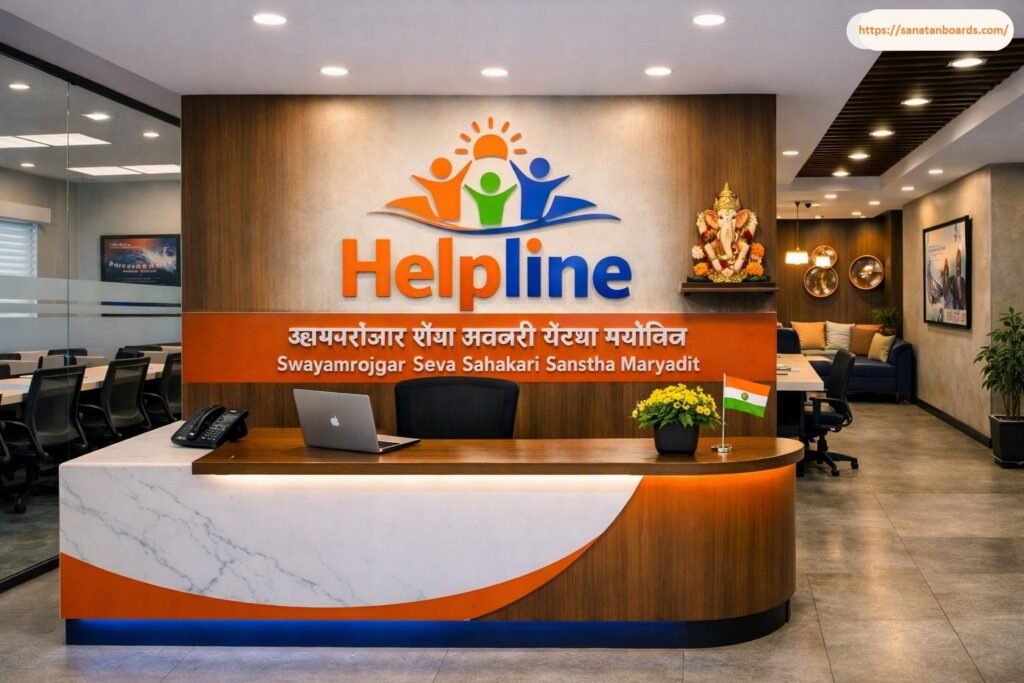
Introduction
The story of Helpline Swayamrojgar Seva Sahakari Sanstha Maryadit is a story about the relationship between organized processes, professional responsibility and the continuous pursuit of quality. Operating from Ravet Pradhikaran in Pune, the organization worked across areas requiring attention to service quality, safety, food-related operations, supply activities and professional coordination.
Its stated scope brought together two important areas: Fire Safety Engineering & Fire Risk Assessment and Catering Sales, Supply, Trading & Manufacturing of Food Items etc. These activities involve different operational requirements, but they share one important foundation—reliability.
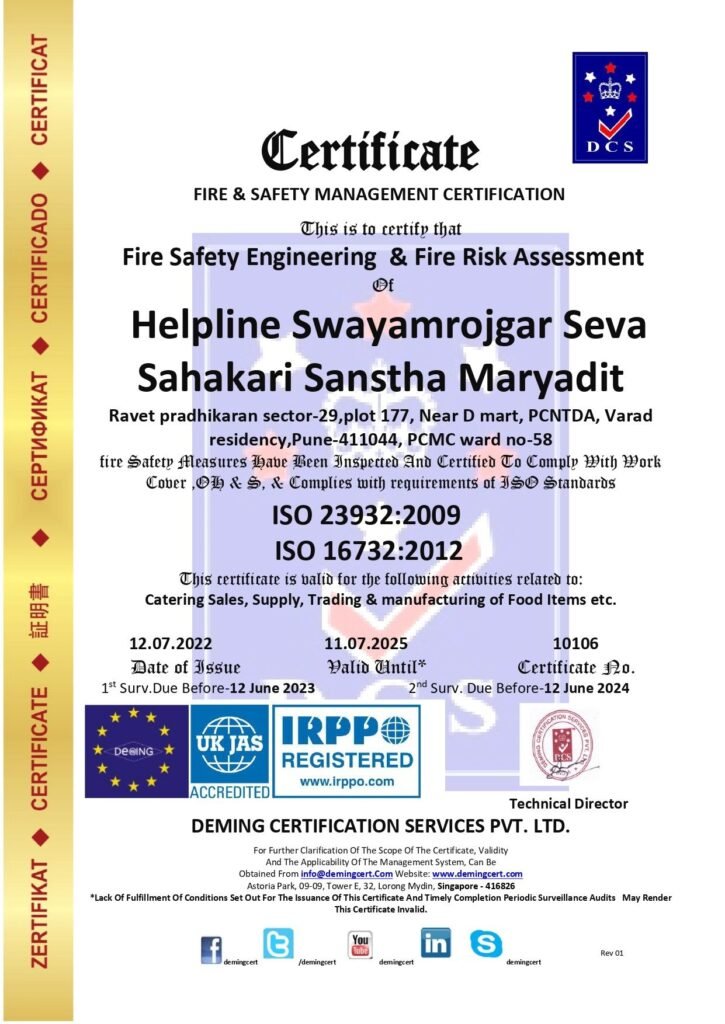
In 2022, the organization reached an important milestone associated with standards including ISO 23932:2009 and ISO 16732:2012. The certification period was stated as extending from 2022 to 2025. For an organization working in safety-related and service-oriented fields, the significance of such a milestone can be understood not simply as receiving a certificate, but as an opportunity to examine processes, responsibilities, documentation, customer requirements and continual improvement.
The following chapters present a narrative of how quality-oriented thinking can influence an organization, its promoter, its employees and its relationship with customers. The story is written as a growth narrative based on the organization’s stated scope and certification information; specific financial increases, employee numbers or customer acquisitions are not assumed where they were not provided.
Chapter 1: The Beginning of a Quality-Oriented Journey
Every organization begins with an idea. Sometimes that idea is connected to a business opportunity, sometimes to employment generation, and sometimes to a desire to provide a useful service to society. Helpline Swayamrojgar Seva Sahakari Sanstha Maryadit represents an organizational journey in which service activities developed around practical requirements such as safety engineering, risk assessment, catering, supply, trading and food-item manufacturing.
The organization’s address at Ravet Pradhikaran, Sector-29, near D-Mart in Pune, Maharashtra, places its operations within a developing urban environment. Pune and the surrounding PCMC region have experienced substantial residential, commercial and industrial development. Such an environment creates demand for organized service providers capable of understanding safety, supply and operational requirements.
For the promoter and management team, growth could not depend only on obtaining work. It also required the development of systems through which work could be planned, delivered and reviewed.
Fire Safety Engineering and Fire Risk Assessment are areas where systematic thinking is particularly important. A fire-related risk assessment cannot be treated as an informal observation. It involves understanding hazards, considering possible consequences, identifying risk-control measures and communicating findings appropriately. Similarly, catering and food-related activities require attention to procurement, storage, handling, production, delivery and customer expectations.
These diverse activities created an environment in which quality management could provide a common framework.
The decision to move toward a recognized quality-oriented system therefore represented an important stage in the organization’s development. Certification can encourage an organization to ask fundamental questions.
What are our processes?
Who is responsible for each activity?
How are customer requirements identified?
How are records maintained?
How are problems handled?
How do we verify whether the work has been completed correctly?
How can the organization improve?
These questions are simple, but their disciplined application can transform the way an organization functions.
For the promoter, the certification journey could also represent a change in management thinking. Instead of depending entirely on individual experience, an organization can begin developing systems that allow responsibilities to be understood by teams.
This is particularly important for an organization involved in multiple service categories. When different activities are performed simultaneously, inconsistency can become a challenge. A structured approach can help bring common principles into different operations.
The certification milestone recorded in 2022 became part of this journey. It provided a formal point around which the organization could organize its quality objectives, documentation and operational practices.
The real value of certification, however, lies beyond the certificate itself. A certificate can demonstrate that a system has been assessed against applicable requirements. The continuing challenge is to ensure that the system remains useful in daily work.
For Helpline Swayamrojgar Seva Sahakari Sanstha Maryadit, the years following 2022 can therefore be viewed as a period in which quality thinking became increasingly connected with service delivery.
The promoter’s role was central. Leadership determines whether procedures remain documents on paper or become part of everyday organizational culture.
Employees also become important participants. A process works only when people understand their responsibilities and have the information necessary to perform them.
Customers remain the ultimate reference point. Whether the service concerns fire risk assessment or food-related supply, customers expect reliability, responsiveness and professional conduct.
The organization’s certification journey thus began with a simple but significant principle: quality must become part of the way work is organized, not merely something displayed on a wall.
#HelplineSwayamrojgar
Chapter 2: Understanding the Importance of Fire Safety Engineering
Fire safety is fundamentally connected with risk. Buildings, workplaces, commercial premises, industrial facilities and public environments can contain multiple sources of potential fire hazards. Electrical systems, combustible materials, cooking processes, machinery, storage arrangements and human activities can all influence risk.
For an organization involved in Fire Safety Engineering and Fire Risk Assessment, professional discipline is therefore essential.
The organization’s stated scope placed fire safety and fire risk assessment among its principal activities. This meant that the quality of its work could influence how clients understood their own risks and what preventive measures they considered.
The certification journey encouraged a structured approach to activities.
A fire risk assessment begins with information. The assessor needs to understand the nature of the premises, processes, occupancy, equipment, materials and existing safety arrangements. From there, hazards can be identified and evaluated.
Documentation becomes important because professional recommendations should be traceable. A client should be able to understand what was assessed, what observations were made and what recommendations resulted from the assessment.
This approach also supports communication within the organization.
Suppose one employee performs an inspection and another prepares the final documentation. Without a defined process, important information could potentially be lost between the two stages. A structured quality system encourages clear responsibility, review and verification.
For the promoter, this creates an opportunity to move from person-dependent operations toward process-dependent operations.
That distinction is significant.
A person-dependent organization may perform well when an experienced individual is personally involved. But sustainable growth requires systems that allow multiple people to work consistently.
Quality management can help establish this foundation.
The organization’s reference to ISO 23932:2009 and ISO 16732:2012 also connected its activities with recognized approaches to fire safety engineering and fire risk concepts. In a professional environment, familiarity with recognized standards can help create a common technical language.
The promoter could use this environment to encourage employees to develop technical knowledge.
Training became important.
An employee working in fire risk assessment needs to understand not only the administrative procedure but also the technical meaning behind the work. Learning about hazards, consequences, risk reduction and safety measures can improve professional confidence.
Customer communication is equally important.
A technical report can contain valuable information, but its usefulness depends partly on how clearly findings are communicated. Clients may not always have specialized technical knowledge. Therefore, professional service requires the ability to translate technical observations into understandable recommendations.
This created another dimension of growth.
The organization was not merely delivering a document. It was developing a service relationship in which technical knowledge, communication and process discipline worked together.
The certification framework could also support internal review. If a mistake or inconsistency was identified, the organization could investigate the reason rather than simply correcting the immediate document.
Was information collected incorrectly?
Was the inspection incomplete?
Was the report reviewed?
Was a requirement misunderstood?
Was responsibility unclear?
Such questions support corrective action and learning.
Over time, this way of thinking can influence organizational culture.
Employees begin to understand that mistakes are opportunities to improve processes. Managers begin to look for causes rather than blame. Promoters begin to see quality as a management tool rather than only a certification requirement.
For Helpline Swayamrojgar Seva Sahakari Sanstha Maryadit, the development of its fire safety activities could therefore be connected with a broader professional objective: creating confidence through systematic work.
The certification milestone provided an external reference point, but daily implementation remained an internal responsibility.
That distinction would become important as the organization continued to develop.
#ISOCertification
Chapter 3: Catering, Food Supply and the Challenge of Consistency
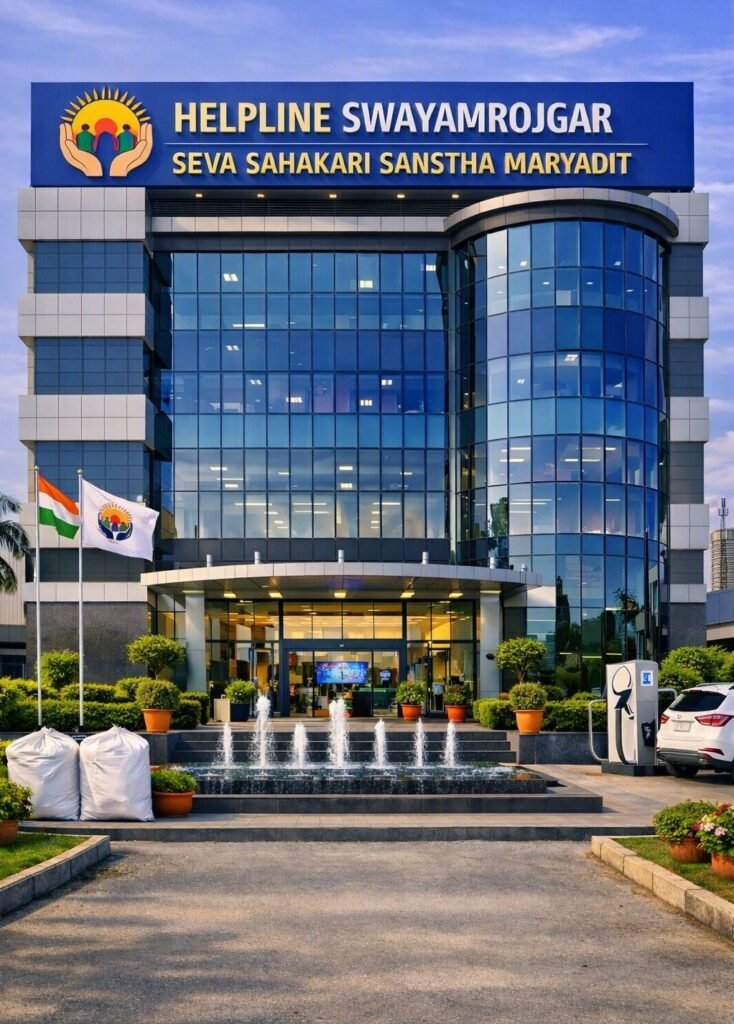
Alongside fire safety activities, Helpline Swayamrojgar Seva Sahakari Sanstha Maryadit had a broad stated scope covering catering sales, supply, trading and manufacturing of food items.
At first glance, food-related operations may appear very different from fire safety engineering. Yet both require careful management.
In food-related activities, customers expect consistency.
They expect the correct product, appropriate quantity, timely delivery, suitable handling and dependable communication.
Supply activities involve coordination with vendors, transportation, storage and delivery. Trading requires attention to purchasing and customer requirements. Manufacturing introduces additional process considerations. Catering adds another dimension because food may be prepared for specific customers, events or service requirements.
As the organization’s activities expanded, process discipline became increasingly relevant.
The quality-management approach encouraged the organization to consider how orders were received, how requirements were confirmed and how responsibilities were assigned.
For example, when a customer placed an order, the organization could establish a structured process for recording the requirement. Product specifications, quantity, delivery expectations and other relevant information could be verified before execution.
Procurement could also become more organized.
Vendor selection and evaluation are important components of reliable supply operations. If raw materials or products do not meet expectations, the quality of the final service may be affected.
Inventory management also matters.
Food-related businesses must pay attention to storage conditions, stock rotation and handling practices. The precise controls required depend on the nature of the products and applicable regulations, but the general principle remains consistent: materials should be controlled throughout the process.
For the promoter, this was an opportunity to connect operational discipline with customer satisfaction.
A quality system does not manufacture customer satisfaction automatically. Instead, it provides a framework through which customer requirements can be understood and managed.
Employees also benefit from clarity.
When responsibilities are clearly defined, workers know who is responsible for procurement, inspection, preparation, packing, delivery and customer communication.
This reduces unnecessary dependence on verbal instructions.
Documentation can also support learning. If a customer raises a complaint, records can help the organization understand what happened.
Was the wrong item supplied?
Was there a delay?
Was a specification misunderstood?
Was there an issue during transportation?
Was the order communicated incorrectly?
A systematic organization can use such information to identify recurring problems.
This is where the concept of continual improvement becomes practical.
Instead of seeing a complaint simply as negative feedback, management can treat it as information about the performance of a process.
The organization could then examine whether a change was necessary.
Perhaps order forms needed improvement. Perhaps vendor evaluation needed strengthening. Perhaps staff training needed updating. Perhaps delivery coordination required clearer responsibility.
Such improvements may appear small individually, but together they can strengthen organizational reliability.
The promoter’s role was to establish a culture in which employees understood that quality was everyone’s responsibility.
This is particularly relevant to a cooperative or service-oriented organization whose work depends on coordination among people.
Quality therefore became more than a technical concept. It became an organizational habit.
The certification period beginning in 2022 provided a formal framework within which these habits could be developed.
As the organization worked across different activities, a consistent management approach could help create a common foundation.
Fire safety engineering demanded technical discipline.
Food-related operations demanded process consistency.
Supply activities demanded coordination.
Customer service demanded responsiveness.
Quality management connected these requirements through a shared focus on planned processes, responsibilities, records and improvement.
#ISO9001
Chapter 4: The Promoter’s Role in Building Organizational Discipline
Courtesy: livestreamingservices,mumbai
No quality system can become effective without leadership.
For Helpline Swayamrojgar Seva Sahakari Sanstha Maryadit, the promoter and management team had an important role in converting certification requirements into practical organizational behavior.
Leadership begins with priorities.
If management treats quality as a formality, employees are likely to do the same. But when management actively discusses procedures, reviews performance and asks employees about operational problems, quality becomes part of organizational culture.
The certification milestone created an opportunity for this transformation.
Management could begin by defining responsibilities.
Every organization contains numerous activities that may appear small individually but collectively determine performance. Customer communication, quotation preparation, order confirmation, procurement, technical inspection, documentation, billing, delivery and complaint handling all contribute to the final customer experience.
When responsibilities are unclear, activities may overlap or be missed.
A quality-oriented system encourages clarity.
Employees can understand what is expected from them and how their work connects with the work of others.
The promoter also has an important role in resource allocation.
Training requires time.
Documentation requires effort.
Technical work may require equipment, software or professional resources.
Internal reviews require management attention.
Quality improvement therefore requires investment—not necessarily only financial investment, but also managerial commitment.
For a growing organization, this can be challenging. Employees may feel that documentation takes time away from operational work.
Management must therefore explain why records matter.
A record is not merely paperwork. It can provide evidence of what was done, who performed it, what was observed and what action was taken.
This is particularly relevant in fire safety work.
Technical assessments should be traceable.
Similarly, in food-related operations, order and supply records can help establish accountability.
The promoter can also encourage employees to report problems early.
A culture in which employees fear reporting mistakes may cause problems to remain hidden. A culture that encourages responsible reporting allows management to identify issues before they become larger.
Corrective action then becomes part of learning.
The promoter’s involvement also affects customer relationships.
Customers often judge an organization not only by the final product or service but by the professionalism of communication.
Timely responses, clear documentation, transparent commitments and responsible follow-up can strengthen trust.
The certification framework provided a useful structure for examining these areas.
Management reviews could provide opportunities to consider performance, customer feedback, process effectiveness, risks, resources and improvement opportunities.
Such reviews help leadership move beyond day-to-day firefighting.
Instead of responding only to immediate problems, management can look for patterns.
If several customers experience similar delays, the issue may be process-related.
If reports repeatedly require correction, the review procedure may need improvement.
If employees frequently ask the same questions, instructions may need clarification.
This analytical approach supports sustainable growth.
The promoter’s development is therefore closely connected with organizational development.
As the organization becomes more systematic, leadership also evolves. The promoter moves from personally managing every detail toward building systems through which teams can perform effectively.
This transition is one of the important stages in organizational maturity.
Certification does not guarantee growth, but it can provide a framework that encourages disciplined management.
For Helpline Swayamrojgar Seva Sahakari Sanstha Maryadit, the 2022 milestone could therefore be viewed as part of a broader management journey: developing an organization capable of delivering different services through common principles of responsibility, consistency and continual improvement.
#FireSafetyEngineering
Chapter 5: Employees, Training and the Human Side of Quality
Behind every procedure is a person.
Documents may define processes, but employees perform them. For this reason, employee competence is one of the most important elements in any quality-oriented organization.
Helpline Swayamrojgar Seva Sahakari Sanstha Maryadit operated across activities requiring different types of knowledge. Fire safety work required technical understanding. Catering and food operations required practical skills. Supply and trading required coordination. Administrative activities required documentation and communication.
The organization therefore had an opportunity to develop a diverse skill base.
Training could be approached systematically.
New employees could be introduced to their responsibilities. Existing employees could receive refresher training. Technical personnel could remain familiar with applicable standards and professional practices.
The objective was not simply to complete training sessions.
The real question was whether training improved performance.
After training, employees should be able to apply what they learned in their daily work.
For fire safety activities, this might involve improving inspection methods, documentation or risk communication.
For catering and food-related operations, it might involve better process control, order handling or customer communication.
For administrative employees, it might involve stronger record management.
Competence also includes awareness.
Employees need to understand why their responsibilities matter.
A person handling a customer order should recognize that inaccurate information can affect procurement and delivery.
A person preparing a technical report should understand that unclear documentation can affect the client’s ability to understand recommendations.
A person managing records should understand that missing information can make later verification difficult.
When employees understand the connection between their work and the organization’s objectives, quality becomes more meaningful.
The promoter can support this by creating an environment in which employees are encouraged to ask questions.
Learning should not stop after induction.
Continuous improvement requires continuous learning.
Employees can contribute ideas because they often see operational problems directly. A worker involved in day-to-day activity may identify an inefficiency that management has not noticed.
For example, an employee might recognize that a particular form contains unnecessary information while missing an important field. Another might identify repeated delays caused by unclear communication between departments.
Such observations can lead to practical improvements.
This also creates employee engagement.
People become more invested in an organization when they feel that their experience is valued.
The quality system can therefore serve as a bridge between management objectives and employee participation.
Another important area is accountability.
Training alone is insufficient if responsibilities are unclear. Employees need to know who approves documents, who verifies information and who communicates with customers.
Defined responsibilities create ownership.
Ownership improves reliability because people understand that their work has consequences for others.
For a multi-activity organization such as Helpline Swayamrojgar Seva Sahakari Sanstha Maryadit, this coordination becomes particularly important.
The fire safety team may work differently from the catering team, but both ultimately contribute to the organization’s reputation.
Customers experience the organization as one entity.
Therefore, consistency in communication and professionalism matters across departments.
The certification journey could encourage management to look at employee competence not as a one-time requirement but as a long-term organizational asset.
A trained employee can contribute more effectively.
A knowledgeable employee can identify risks earlier.
A responsible employee can improve customer confidence.
A team that shares quality values can support organizational stability.
Thus, one of the most meaningful aspects of the organization’s quality journey was the human dimension.
Behind every assessment, every supply order, every customer interaction and every record was a person trying to perform a responsibility correctly.
Building those people was part of building the organization.
#FireRiskAssessment
Chapter 6: Customer Confidence and Professional Service
Business growth depends on relationships.
An organization can have technical expertise, trained employees and documented procedures, but it must still earn the confidence of customers.
For Helpline Swayamrojgar Seva Sahakari Sanstha Maryadit, customer expectations could differ significantly depending on the service involved.
A fire safety client may expect professional assessment, clear findings and useful recommendations.
A catering customer may focus on product requirements, quantity, quality, timing and service.
A trading or supply customer may focus on availability, accuracy, communication and delivery.
Despite these differences, one expectation remains common: reliability.
Quality management provides a structured way of understanding customer requirements.
Before accepting an assignment or order, the organization can clarify what is required.
During execution, it can monitor whether requirements are being met.
After delivery, it can gather feedback and respond to complaints.
This creates a cycle.
Requirement → Planning → Execution → Verification → Feedback → Improvement.
The cycle is simple, but its disciplined application can create a strong foundation.
For the promoter, customer feedback becomes a management resource.
A complaint should not automatically be interpreted as failure. It can reveal where a process needs attention.
For example, if a customer repeatedly asks for clearer reports, the organization can examine its reporting format.
If customers experience uncertainty about delivery schedules, communication procedures can be reviewed.
If customers have difficulty understanding technical recommendations, the organization can improve presentation and explanation.
The purpose is not merely to satisfy the immediate complaint. It is to prevent repetition.
This approach can also strengthen customer retention.
Customers often value predictability. They want to know that the organization will respond professionally when something unexpected occurs.
A strong service culture therefore includes responsiveness.
The certification milestone may also contribute to professional positioning.
When an organization demonstrates that its processes have been assessed against recognized requirements, it can provide customers with additional information about its commitment to systematic management.
However, the certificate itself should not replace actual performance.
Customers ultimately experience the organization through its people, communication and service.
Therefore, management must ensure that certification claims remain accurate and appropriately presented.
The organization can also use its quality framework to establish clear service boundaries.
This is important because different customers may have different expectations. Clear scope and clear commitments reduce misunderstanding.
For fire safety assignments, technical scope should be understood before work begins.
For catering and supply activities, product and delivery requirements should be confirmed.
Clarity at the beginning can prevent disputes later.
Another aspect of customer confidence is documentation.
Professional records can demonstrate that an organization follows an established process.
They can also help customers understand the history of an assignment or order.
This becomes particularly important when customers need to refer back to earlier assessments, recommendations or transactions.
Through these practices, quality management can become a customer-facing asset.
The customer may never see the internal procedure manual. They may never attend an internal review meeting. But they experience the results of those systems through accuracy, communication, consistency and responsiveness.
For Helpline Swayamrojgar Seva Sahakari Sanstha Maryadit, this created a pathway from internal discipline to external confidence.
Growth, in this context, was not simply about increasing business volume.
It was also about becoming an organization capable of serving customers with greater consistency.
#QualityManagement
Chapter 7: Managing Risk as an Organizational Philosophy
Risk management was particularly relevant to Helpline Swayamrojgar Seva Sahakari Sanstha Maryadit because Fire Safety Engineering and Fire Risk Assessment were part of its stated scope.
But risk thinking can extend beyond technical fire assessments.
Every organization faces risks.
There can be operational risks, supply risks, customer risks, documentation risks, financial risks, human-resource risks and compliance-related risks.
A mature organization does not wait for every risk to become a problem.
Instead, it tries to identify potential problems in advance and determine appropriate controls.
This way of thinking can influence everyday management.
Consider procurement.
If an important supplier becomes unavailable, operations may be affected. An organization can therefore evaluate suppliers, maintain appropriate alternatives where practical and monitor supplier performance.
Consider customer orders.
Incorrect requirements can lead to wrong procurement or delivery. Verification at the order stage can reduce this possibility.
Consider technical assessments.
Incomplete information can affect the quality of a risk assessment. A structured inspection process can help ensure that relevant information is considered.
Consider documentation.
Missing records can make verification difficult. Document-control practices can help reduce this risk.
Risk management therefore becomes a common language across departments.
The promoter can encourage employees to ask a simple question:
What could go wrong, and what can we do about it before it happens?
This question encourages preventive thinking.
Preventive thinking is valuable because correction after failure can be more expensive than prevention.
In fire safety work, prevention is naturally central. The purpose of risk assessment is to understand hazards and support risk reduction.
The same principle can be applied to organizational management.
The quality system can help identify processes where preventive controls are useful.
Internal audits can provide another mechanism.
An internal audit is not merely an inspection of employees. Properly used, it is a structured opportunity to determine whether processes are being followed and whether they remain effective.
Findings can lead to corrective action.
Corrective action should address causes.
If a report contains an error, simply correcting the report solves the immediate problem. Understanding why the error occurred may prevent similar mistakes.
Was the checklist unclear?
Was training insufficient?
Was the review process skipped?
Was the deadline unrealistic?
Was responsibility unclear?
Root-cause thinking helps management distinguish between symptoms and causes.
For the promoter, this represents an important evolution in management style.
Instead of repeatedly solving the same problem, the organization can seek to eliminate or reduce its underlying cause.
This contributes to institutional learning.
Over time, lessons from one project can improve future projects.
The same principle can apply to food-related operations. If a particular supply issue repeatedly occurs, the organization can examine supplier controls or order-verification procedures.
Risk management thus connects technical work with business management.
The standards referenced by the organization gave additional importance to systematic consideration of fire risk. But the broader organizational lesson was that quality and risk should be considered together.
An organization becomes more resilient when it understands its vulnerabilities.
For Helpline Swayamrojgar Seva Sahakari Sanstha Maryadit, this risk-oriented thinking could support a more disciplined approach to planning, service delivery and improvement.
Growth then becomes more than expansion.
It becomes the development of an organization better prepared to handle complexity.
#FoodSupply
Chapter 8: The Certification Milestone and Organizational Recognition
The year 2022 became a significant point in the organization’s documented history.
The certification information provided for Helpline Swayamrojgar Seva Sahakari Sanstha Maryadit records an issue year of 2022 and validity through 2025. The associated standards listed were ISO 23932:2009 and ISO 16732:2012.
For the organization, reaching this milestone could be viewed as recognition of a structured approach to its stated scope.
Certification can create a useful organizational discipline because it places attention on defined requirements, documented processes and evidence.
But certification is not the end of a quality journey.
It is better understood as one stage in a continuing cycle.
Once a system has been established, the organization needs to maintain it.
Procedures should remain relevant.
Records should be maintained.
Employees should remain competent.
Customer feedback should be reviewed.
Corrective actions should be followed through.
Risks should be reconsidered when circumstances change.
Management should periodically evaluate whether the system is delivering useful results.
For the promoter, this can change the meaning of certification.
Instead of asking, “Do we have a certificate?” management can ask, “What has the system helped us improve?”
This is a much more valuable question.
Perhaps processes have become clearer.
Perhaps responsibilities have become more defined.
Perhaps documentation has improved.
Perhaps customer communication has become more consistent.
Perhaps employees have become more aware of risk.
These improvements may not always appear in financial statements, but they can contribute to organizational capability.
Certification can also strengthen the organization’s professional identity.
When dealing with customers, suppliers, employees and other stakeholders, the organization can communicate that it takes systematic management seriously.
However, credibility depends on maintaining alignment between claims and actual practice.
A certificate creates expectations.
Customers may expect professionalism.
Employees may expect clear processes.
Management must therefore continue supporting the system.
The period from 2022 to 2025 can be viewed as an important chapter in the organization’s quality journey.
During this period, the organization had the opportunity to strengthen the relationship between standards and everyday operations.
The promoter could encourage a culture of continual improvement.
Employees could contribute observations.
Customers could provide feedback.
Internal reviews could identify gaps.
Management could prioritize improvements.
The organization could learn from both successful projects and problems.
This creates an organizational memory.
Instead of beginning from zero whenever a new employee joins or a new project begins, the organization can rely on established procedures and lessons from previous experience.
That is one of the practical benefits of process maturity.
For a company or institution involved in multiple activities, organizational memory is especially valuable.
Fire safety work has its own technical requirements.
Catering and food operations have their own operational requirements.
Supply and trading involve their own coordination challenges.
A common quality framework can help manage these differences without requiring every department to operate independently.
The certification milestone therefore became more than a formal event.
It could serve as a reference point in the organization’s evolution from individual effort toward organized systems.
The certificate represented recognition at a particular time.
The real growth opportunity lay in what the organization did with the systems behind it.
#CateringServices
Chapter 9: From Certification to Continual Improvement
Many organizations initially approach certification because customers, markets or management objectives create a need for formal recognition.
But once certification is achieved, another question emerges:
What comes next?
For Helpline Swayamrojgar Seva Sahakari Sanstha Maryadit, the answer could be continual improvement.
Continual improvement does not necessarily mean dramatic transformation.
Often, improvement occurs through many small changes.
A better checklist.
A clearer customer form.
A faster response process.
More effective training.
Improved supplier evaluation.
Better document control.
More consistent internal review.
Clearer technical reporting.
Each improvement can contribute to the organization’s overall performance.
The promoter can create a culture in which employees regularly identify opportunities for improvement.
This requires openness.
Employees should feel comfortable discussing inefficiencies.
Managers should be willing to consider suggestions.
Not every suggestion will be implemented, but every useful suggestion can become a learning opportunity.
Data can support this process.
Customer complaints can be tracked.
Training records can be reviewed.
Audit findings can be analyzed.
Process delays can be monitored.
Supplier performance can be considered.
The organization can then identify areas where attention is needed.
For example, if repeated customer complaints concern communication, management can improve communication procedures.
If repeated technical-report corrections occur, additional technical review may be introduced.
If supply delays occur regularly, procurement planning may need attention.
This approach creates a feedback loop.
Measure → Review → Improve → Implement → Measure Again.
The promoter’s own development can follow the same cycle.
Leadership becomes increasingly analytical.
Instead of depending solely on intuition, management can use information from the organization.
This does not eliminate experience. Rather, it combines experience with evidence.
The organization can also become more adaptable.
Markets change.
Customer expectations change.
Technology changes.
Regulatory requirements can change.
Employees change.
Suppliers change.
A rigid organization may struggle with these developments.
A quality-oriented organization has an opportunity to review its processes and adapt them.
For Helpline Swayamrojgar Seva Sahakari Sanstha Maryadit, its combination of technical safety work and food-related commercial activities makes adaptability particularly important.
The organization must understand the different requirements of each area while maintaining consistent management principles.
The certification period ending in 2025 therefore should not be viewed as the end of the story.
Instead, it represents a point in time from which the organization can evaluate what it learned and how it wants to develop further.
The strongest legacy of a certification system is not necessarily the certificate itself.
It is the organizational capability created while preparing for, implementing and maintaining the system.
Employees learn to document.
Managers learn to review.
Teams learn to communicate.
Customers receive more structured service.
Problems become opportunities for corrective action.
Risks become subjects for preventive planning.
This is how certification can contribute to organizational maturity.
For the promoter, the journey can become one of continuous leadership development.
The question changes from “How do we obtain certification?” to “How do we build an organization that deserves customer confidence every day?”
That question has no final answer.
It must be asked repeatedly.
And that is precisely what makes continual improvement a long-term growth philosophy.
#BusinessGrowth
Chapter 10: The Road Ahead – Building a Sustainable Organization
The journey of Helpline Swayamrojgar Seva Sahakari Sanstha Maryadit illustrates an important principle: organizational growth is not defined only by size.
Growth can also mean greater professionalism.
It can mean clearer processes.
It can mean stronger employee competence.
It can mean better customer communication.
It can mean improved risk awareness.
It can mean a more disciplined leadership approach.
The organization’s documented certification milestone in 2022, with validity through 2025, became an important part of this journey. Its stated scope—Fire Safety Engineering & Fire Risk Assessment and Catering Sales, Supply, Trading & Manufacturing of Food Items etc.—demonstrates the breadth of activities requiring organized management.
The reference to ISO 23932:2009 and ISO 16732:2012 connects the organization’s fire-safety work with recognized technical frameworks.
The long-term challenge, however, is always implementation.
Standards provide frameworks.
People create performance.
Leadership creates culture.
Customers provide feedback.
Continuous improvement creates sustainability.
For the promoter, the future can therefore be built around several principles.
The first is professional integrity.
When an organization makes commitments, it should strive to deliver them responsibly. Clear communication about scope, capability and deliverables supports trust.
The second is technical competence.
Fire safety engineering and risk assessment require ongoing professional learning. As knowledge develops, personnel should continue strengthening their understanding.
The third is service consistency.
Catering, supply, trading and food manufacturing activities depend on reliable execution. Standardized processes can help reduce avoidable variation.
The fourth is employee development.
A growing organization needs people who can take responsibility. Training, experience and participation can help create this capability.
The fifth is customer feedback.
Customers provide information about how the organization is actually performing. Listening to them creates opportunities for improvement.
The sixth is risk awareness.
Risk should be considered before problems occur, not only after they happen.
The seventh is continual improvement.
No process should be considered permanently perfect. Organizations must remain willing to review and refine their methods.
The story of Helpline Swayamrojgar Seva Sahakari Sanstha Maryadit is therefore not simply a story about obtaining a certification.
It is a story about the possibility of using quality systems as a foundation for organizational development.
The promoter’s journey can be understood as a movement from individual leadership toward system-based leadership.
Employees can move from simply completing tasks toward understanding how their work contributes to organizational objectives.
Customers can experience an organization that places greater emphasis on consistency and accountability.
The organization itself can build institutional knowledge that remains useful as people, projects and market conditions change.
The certification period from 2022 to 2025 represents one documented chapter in this broader journey. The lessons associated with that period can continue to influence future organizational development, subject to the organization’s actual practices and future certification status.
In the end, sustainable growth is not created by a certificate alone.
It is created when the principles represented by the certification become part of everyday behavior.
It is created when a technical assessment is performed carefully.
When a customer requirement is recorded accurately.
When a supplier is evaluated responsibly.
When an employee receives appropriate training.
When a mistake is investigated instead of ignored.
When a complaint becomes an improvement opportunity.
When management reviews performance honestly.
When risks are identified before they become incidents.
And when every member of the organization understands that quality is not the responsibility of one department.
It belongs to everyone.
For Helpline Swayamrojgar Seva Sahakari Sanstha Maryadit, the certification milestone can therefore be remembered as an important stage in the organization’s continuing evolution.
From its base in Ravet Pradhikaran, Pune, the organization developed a professional identity connected with fire safety, risk assessment, catering, food supply, trading and manufacturing activities.
Its future growth will depend on how effectively it continues to combine technical knowledge with organized management, customer service with accountability, and business opportunity with responsible processes.
The most valuable achievement of a quality journey is ultimately not the framed certificate.
It is the organization that grows behind it.
That organization is built through people, processes, learning, responsibility and continual improvement.
#PuneBusiness
And that is the foundation upon which Helpline Swayamrojgar Seva Sahakari Sanstha Maryadit can continue to write the next chapter of its story.
Quality creates discipline.
Discipline creates consistency.
Consistency creates confidence.
Confidence creates opportunity.
And continual improvement turns opportunity into sustainable organizational growth.
#QualityAssurance #RiskManagement #ContinualImprovement #SafetyManagement #OrganizationalGrowth
Take the Next Step Today
Don’t wait to enhance your business’s quality and efficiency. Partner with Sanatan Dharma Accreditation Boards and experience the transformation that comes with expert consultancy and training. Contact us today to learn more about how we can help you achieve your business goals. Reach out via phone at +91-8668266780, visit our website at sanatanboards.com, or email us at info@sanatanboards.com Let us be your guide on the journey to excellence and innovation.





