
Figo India Pvt Ltd
Table of Contents
Chapter 1 – The Beginning of a Quality Journey
Every manufacturing company has a story that begins long before a certificate is issued.
For Figo India Pvt. Ltd., that story was rooted in manufacturing products that are part of everyday life. Detergents, dishwashing detergents, floor surface cleaners, hand wash and toilet cleaners may appear to be ordinary products when seen from the consumer’s perspective. Yet behind every bottle, container, pouch or batch is a chain of decisions involving raw materials, formulation, processing, equipment, people, packaging, storage, dispatch and customer expectations.
At its facility at Plot No. 12, Survey No. 61/2, Village-Masat, Silvassa, Figo India Pvt. Ltd. operated in a sector where consistency mattered enormously.
A cleaning product is expected to perform its intended function every time. A detergent should clean. A dishwashing product should remove grease and food residues. A floor cleaner should provide effective cleaning appropriate to its intended use. A hand wash should offer a consistent product experience. A toilet cleaner should be manufactured with controlled characteristics and appropriate handling.
For the customer, the expectation is simple.
The product purchased today should not feel completely different from the product purchased previously.
For the manufacturer, achieving that consistency is much more complicated.
The company therefore had to think beyond manufacturing individual batches. It needed to think in terms of a manufacturing system.
This was an important distinction.
A business can produce good products without having a mature management system. However, sustainable quality requires more than occasional good results. It requires defined processes, responsibilities, controls, records, trained personnel, monitoring and improvement.
That philosophy became particularly important as Figo India Pvt. Ltd. developed its quality-management approach.
The decision to pursue ISO 9001:2015 certification in 2022 can therefore be understood not merely as a decision to obtain a certificate but as part of a broader effort to organize the company’s manufacturing and management practices around consistent quality.
The ISO 9001:2015 framework is generic and can be applied to organizations of different sizes and sectors. Its central objective is not simply documentation; it is the establishment and continual improvement of a quality-management system capable of consistently meeting requirements.
For Figo India, this meant looking carefully at its own operations.
Where did raw materials come from?
How were they received?
How were they identified and stored?
How were production instructions communicated?
How was a batch controlled?
Who was responsible for quality checks?
What happened when a product did not meet requirements?
How were customer complaints handled?
How could the company demonstrate that processes were being followed?
These questions transformed quality from an isolated department activity into a management responsibility.
The company’s manufacturing scope was diverse enough to require disciplined process control. Detergents and cleaning products can involve different formulations, different packaging requirements and different customer expectations. A systematic approach was therefore useful for ensuring that manufacturing did not depend entirely on individual memory or informal communication.
The quality journey also connected naturally with the company’s GMP orientation.
Good Manufacturing Practice emphasizes preventive controls designed to reduce contamination, mix-ups and errors and commonly addresses areas such as sanitation, personnel, equipment, documentation, process controls and complaint handling.
For a company involved in cleaning-product manufacturing, this way of thinking provides an important operational foundation.
The factory becomes more than a place where ingredients are mixed and products are packed.
It becomes a controlled environment.
Raw materials need identity.
Processes need instructions.
Equipment needs care.
People need competence.
Products need inspection.
Records need traceability.
Nonconformities need action.
Customers need responses.
Management needs information for decisions.
This was the environment in which Figo India’s ISO 9001:2015 journey developed.
The 2022 certification represented a formal milestone in that journey.
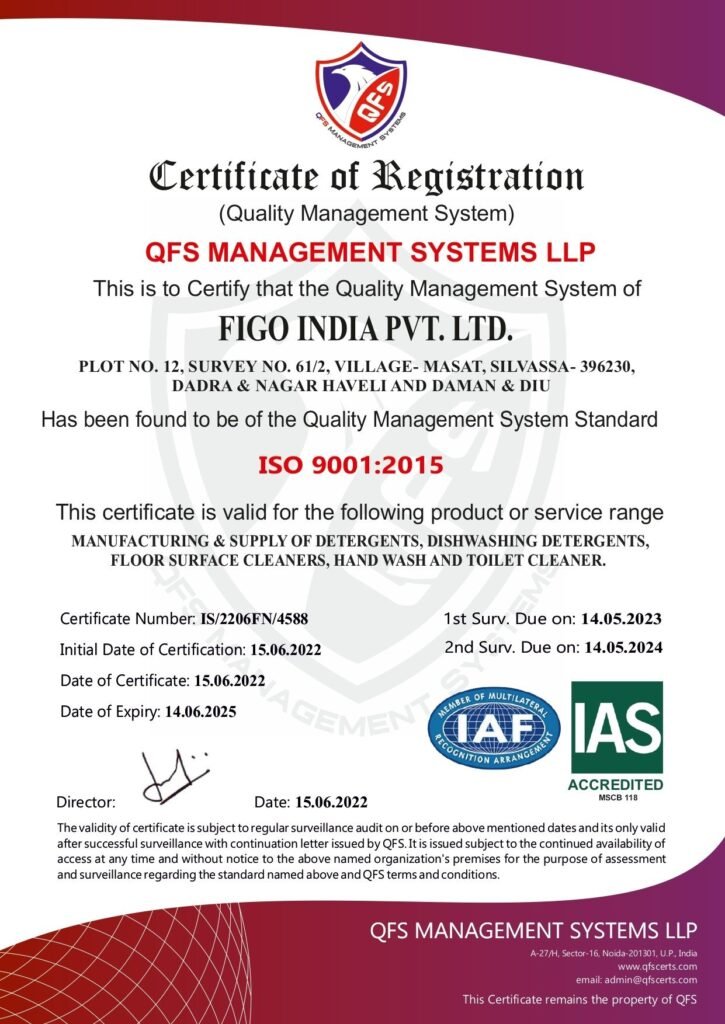
The certificate associated with QFS Management Systems LLP established a documented ISO 9001:2015 quality-management framework for the company’s manufacturing and supply activities.
But the real value of certification was not supposed to remain on paper.
A certificate can be displayed on a wall.
A quality system has to be demonstrated every day.
That distinction became the foundation of the next stage of Figo India’s development.
From Product Manufacturing to Process Manufacturing
Before a quality system becomes part of an organization’s culture, people often think in terms of products.
After a quality system becomes established, people increasingly think in terms of processes.
Instead of asking only, “Did we make the product?”, employees begin asking:
“Did we follow the approved process?”
“Was the correct material used?”
“Was the batch identified correctly?”
“Was the equipment suitable?”
“Was the required inspection completed?”
“Was the product released correctly?”
“What did we learn from the last problem?”
That change in thinking can have a profound effect on an organization.
It allows management to identify where problems originate instead of merely reacting to their consequences.
For Figo India, the combination of GMP orientation and ISO 9001:2015 created a framework in which manufacturing discipline could be connected with organizational discipline.
Quality was no longer simply a final inspection activity.
It became a journey beginning before production and continuing beyond dispatch.
The Human Side of Certification
Certification also changes the relationship between management and employees.
A quality system does not operate by itself.
It depends on people.
Production workers must understand procedures.
Stores personnel must understand identification and storage.
Quality personnel must understand inspection and records.
Maintenance personnel must understand equipment reliability.
Supervisors must understand process control.
Management must understand performance information.
Sales and customer-service personnel must communicate customer requirements accurately.
When these responsibilities are connected, the organization becomes less dependent on informal instructions.
People know what is expected of them.
They know what records are required.
They know when to stop a process.
They know whom to inform.
They understand that quality belongs to everyone.
This is one of the important principles underlying ISO’s quality-management approach: customer focus, leadership, engagement of people, process approach, improvement and evidence-based decision-making work together rather than functioning as isolated concepts.
The First Stage of Growth
The first form of growth after certification is not necessarily financial.
It can be organizational growth.
A company becomes more structured.
Responsibilities become clearer.
Records become more meaningful.
Processes become more repeatable.
Problems become easier to investigate.
Customers receive more consistent communication.
Management receives better information.
Employees develop greater awareness.
And the organization begins to understand its own operations more clearly.
This kind of growth may not immediately appear in a balance sheet.
Yet it can become the foundation upon which commercial growth is built.
For Figo India Pvt. Ltd., the 2022 certification became a milestone representing this movement from informal control toward a more systematic quality culture.
The certificate was the visible symbol.
The real transformation was the system behind it.
#FigoIndia
Chapter 2 – Understanding the Manufacturing System
The next chapter of Figo India’s story began with a deeper understanding of the manufacturing process.
Manufacturing detergents and cleaning products involves a sequence of interconnected activities.
A product does not suddenly appear at the end of a production line.
It begins with planning.
Planning leads to procurement.
Procurement leads to receipt and inspection.
Approved materials move into storage.
Production planning determines what is manufactured.
Materials are issued.
The manufacturing process begins.
The batch is controlled.
The product is checked.
Packaging follows.
Finished goods are identified.
Storage and dispatch complete the cycle.
Customer feedback then returns information to the organization.
The cycle begins again.
ISO 9001 encourages organizations to understand such activities as interconnected processes rather than unrelated tasks. This process approach is intended to make outcomes more consistent and predictable.
For Figo India, this approach was particularly relevant because its products covered multiple categories.
The company’s stated scope included:
- Detergents
- Dishwashing detergents
- Floor surface cleaners
- Hand wash
- Toilet cleaners
Each category might have different formulation characteristics and customer expectations.
The management system therefore needed to provide enough control to ensure consistency while remaining practical for daily manufacturing.
Raw Materials: The Beginning of Quality
Quality begins before manufacturing.
If an incorrect or unsuitable raw material enters a production process, the final product may be affected regardless of how carefully the manufacturing operation is performed.
This makes purchasing and incoming material control important parts of a quality system.
A systematic organization needs to understand its suppliers.
It needs to establish purchasing requirements.
It needs to identify materials.
It needs to maintain appropriate records.
It needs to establish acceptance criteria where applicable.
And it needs to prevent unidentified or unsuitable materials from accidentally entering production.
This does not mean every raw material has to be treated identically.
Different materials may have different risks and different controls.
The important principle is controlled decision-making.
A material should not enter production simply because someone assumes it is correct.
It should be identifiable.
It should have the necessary documentation or verification.
It should be stored appropriately.
It should be available for the intended production requirement.
This thinking helps reduce preventable errors.
Storage and Identification
In a manufacturing environment, storage is often underestimated.
Yet storage can influence quality significantly.
Materials may arrive at different times.
Different batches may have different identification numbers.
Packaging materials can look similar.
Finished products can have similar names.
Labels can differ.
Containers can have different specifications.
Without clear identification, mistakes become possible.
A mature quality-management system therefore encourages disciplined identification and traceability.
For Figo India, this mindset was especially relevant because the company manufactured multiple cleaning-product categories.
A controlled storage system helps create a clear physical connection between:
Supplier → Material → Batch → Production → Finished Product → Customer
That chain becomes valuable whenever an investigation is necessary.
Production Planning
Production planning is where commercial requirements meet manufacturing capability.
A customer order may specify:
- Product
- Quantity
- Packaging
- Delivery schedule
- Specifications
- Label requirements
- Other agreed requirements
The production function must convert those requirements into an executable plan.
This creates a need for communication between departments.
Sales cannot work independently of production.
Production cannot work independently of stores.
Stores cannot work independently of purchasing.
Quality cannot work independently of production.
Dispatch cannot work independently of finished-goods control.
The quality system therefore acts as a connecting framework.
Batch Manufacturing
Batch manufacturing requires discipline.
The batch needs identification.
The manufacturing instructions need to be understood.
Materials need to be issued correctly.
The process needs to be monitored.
Equipment needs to be suitable.
Personnel need to follow instructions.
Records need to be maintained.
If something unexpected occurs, the deviation needs to be recognized and addressed.
This is where documentation becomes useful.
Documentation is sometimes misunderstood as bureaucracy.
In reality, good documentation can serve as organizational memory.
A production record tells the company what happened.
An inspection record tells the company what was checked.
A complaint record tells the company what the customer experienced.
A corrective-action record tells the company what was changed.
An audit record tells the company what was observed.
Together, these records create a history of the organization’s performance.
Quality Is More Than Final Inspection
One of the important changes that a management system can bring is the movement away from relying exclusively on final inspection.
Imagine a batch reaches the final stage and is found to have a problem.
At that point, the company has already consumed:
- Raw materials
- Labour
- Machine time
- Energy
- Packaging
- Production capacity
- Warehouse space
- Administrative resources
If the problem can be prevented earlier, the organization saves more than the cost of correcting the final product.
This is the logic behind preventive quality management.
Quality should be designed into the process.
For Figo India, this perspective could influence the way production, quality and management teams approached their responsibilities.
Instead of asking only whether the finished product was acceptable, they could ask whether the process itself was controlled.
The Role of GMP Thinking
The GMP certificate listed in the company’s certification history added another important dimension.
Good Manufacturing Practice is fundamentally concerned with controlled manufacturing conditions and prevention of problems. Government guidance on GMP describes controls relating to areas including personnel qualifications, sanitation, cleanliness, equipment verification, process validation, recordkeeping and complaint handling.
For manufacturing organizations, this creates a culture in which cleanliness and organization are not merely cosmetic issues.
They are quality issues.
Equipment cleanliness matters.
Workplace cleanliness matters.
Material identification matters.
Personnel hygiene matters.
Waste handling matters.
Storage matters.
Documentation matters.
This becomes particularly relevant when a company manufactures products used for cleaning and hygiene-related purposes.
The organization manufacturing the product must itself demonstrate manufacturing discipline.
The Quality Loop
Figo India’s management system can be understood as a continuous loop:
Customer requirement
↓
Planning
↓
Purchasing
↓
Incoming control
↓
Production
↓
Inspection
↓
Packaging
↓
Storage
↓
Dispatch
↓
Customer feedback
↓
Analysis and improvement
↓
Better planning
The loop does not end.
Every customer complaint can become information.
Every internal audit observation can become information.
Every rejected batch can become information.
Every delay can become information.
Every supplier issue can become information.
The question is what the company does with that information.
That is where growth begins.
#ISO9001
Chapter 3 – Certification as a Management Transformation

The certificate received in 2022 marked an important point in Figo India’s corporate history.
But certification itself was not the final destination.
It was a framework for disciplined management.
ISO 9001 is built around the idea that organizations should establish, implement, maintain and continually improve a quality-management system.
For Figo India, this meant that quality needed to become connected with management decisions.
Leadership and Direction
Every management system begins with leadership.
Employees need to understand why quality matters.
They need to understand what the organization is trying to achieve.
They need to know what customers expect.
They need to know that management takes procedures seriously.
Leadership therefore cannot be reduced to signing documents.
Leadership is demonstrated through decisions.
If a production target conflicts with a quality requirement, management must establish the correct priority.
If equipment requires maintenance, management must provide appropriate support.
If employees need training, management must make training possible.
If a customer complaint reveals a systemic problem, management must investigate rather than simply blame an individual.
This creates trust.
Quality Objectives
Once an organization begins working systematically, broad statements about quality need to become measurable objectives.
For a manufacturing company, objectives may relate to areas such as:
- Product conformity
- Customer satisfaction
- Complaint reduction
- Delivery performance
- Supplier performance
- Production efficiency
- Training
- Maintenance
- Internal audit performance
- Corrective-action effectiveness
The exact objectives must be appropriate to the organization.
The important point is that quality becomes measurable.
What gets measured can be discussed.
What can be discussed can be improved.
Risk-Based Thinking
Manufacturing always contains risk.
A raw material may be unavailable.
A supplier may deliver inconsistent material.
A machine may fail.
A batch may deviate from requirements.
Packaging may be incorrect.
A label may be wrong.
A delivery may be delayed.
A customer may raise a complaint.
A document may be outdated.
A trained employee may leave.
The purpose of risk-based thinking is not to eliminate every possible risk.
That would be unrealistic.
Instead, the company identifies important risks and determines appropriate controls.
This makes management more proactive.
Rather than waiting for problems to happen, the organization asks:
“What could go wrong?”
“What would happen if it did?”
“How likely is it?”
“What controls do we already have?”
“What additional action is appropriate?”
That mindset can improve decision-making.
Documented Information
Another important change is the treatment of information.
A mature organization needs to know which document is current.
Employees should not accidentally use an obsolete instruction.
Records should be protected.
Changes should be controlled.
Responsibilities should be clear.
This may sound administrative, but it has practical consequences.
Imagine that a production instruction has changed.
If the old version remains in circulation, two operators might perform the same task differently.
Variation appears.
Variation can become a quality problem.
Document control therefore supports manufacturing consistency.
Training and Competence
No management system is stronger than the people operating it.
Figo India therefore had a reason to view training not as a one-time certification activity but as an ongoing business requirement.
Employees may need training in:
- Product knowledge
- Manufacturing procedures
- Safety
- Hygiene
- Equipment operation
- Quality inspection
- Documentation
- Material identification
- Nonconformity handling
- Customer requirements
- Internal audit awareness
Training should be followed by understanding and competence.
The goal is not merely to conduct a training session.
The goal is to enable employees to perform their roles correctly.
Internal Audits
Internal audits provide another important mechanism.
An audit is not supposed to be a search for people to blame.
It is a systematic examination of whether processes are being followed and whether the management system is effective.
For Figo India, internal auditing could help identify questions such as:
Are records complete?
Are procedures being followed?
Are materials correctly identified?
Are measuring instruments controlled?
Are customer complaints being addressed?
Are corrective actions effective?
Are employees aware of applicable requirements?
Are previous findings closed?
This creates an internal feedback mechanism.
The company does not have to wait for an external audit to discover weaknesses.
It can discover and address them itself.
Corrective Action
When a problem occurs, the simplest response is often to correct the immediate problem.
But correction and corrective action are not always the same.
Suppose an incorrect label is discovered.
The immediate correction may be to replace the label.
But management should also ask:
Why did the incorrect label reach the production area?
Was the label poorly identified?
Was document control inadequate?
Was the approval process unclear?
Was there insufficient verification?
Was the employee unfamiliar with the change?
The deeper question is:
How can the organization prevent recurrence?
That question is central to continual improvement.
Management Review
Management review brings the system together.
Leadership can review:
- Audit results
- Customer feedback
- Process performance
- Product conformity
- Supplier performance
- Corrective actions
- Risks and opportunities
- Objectives
- Resource requirements
- Improvement opportunities
This turns quality information into management information.
Instead of quality being a separate department’s responsibility, it becomes part of business strategy.
Certification and Confidence
ISO describes certification as one way an organization can demonstrate its commitment and ability to provide consistent quality, although certification itself is not mandatory for implementing ISO 9001.
For Figo India, having an ISO 9001:2015 certificate issued through QFS Management Systems LLP in 2022 provided a formal external recognition of the company’s quality-management framework.
The value of that recognition could extend beyond the certificate.
It could support conversations with customers.
It could strengthen supplier relationships.
It could help organize internal processes.
It could provide evidence of management commitment.
And it could give the company a structured foundation for future improvement.
#ISO9001Certification
Chapter 4 – Building Consistency Across Product Categories
Courtesy: Figo India
Figo India’s manufacturing scope covered several categories, and each category brought its own expectations.
This made consistency an important business objective.
Detergents
Detergent manufacturing requires controlled formulation and processing.
Customers expect cleaning performance.
The company therefore needs to maintain appropriate controls over materials, formulation, production and finished-product characteristics.
A consistent process provides the foundation for consistent results.
Dishwashing Detergents
Dishwashing products are judged directly by users.
A customer may notice cleaning performance, fragrance, appearance, viscosity, packaging and overall product experience.
Even when two batches are technically similar, variation in visible or sensory characteristics can affect customer perception.
A quality system helps create discipline around such expectations.
Floor Surface Cleaners
Floor surface cleaners are used across different environments.
The customer’s expectations may include cleaning performance, appearance, fragrance, ease of use and packaging convenience.
Again, consistency matters.
Hand Wash
Hand-wash products introduce another dimension.
The product is used directly by consumers.
Therefore, manufacturing hygiene, product consistency, packaging and customer expectations become particularly important.
Toilet Cleaners
Toilet cleaners have specific functional expectations and require appropriate handling during manufacturing.
The organization must therefore maintain controlled manufacturing practices, appropriate storage and clear handling procedures.
The Common System Behind Different Products
Although the products differ, the underlying quality system can remain connected.
The common structure includes:
Planning → Purchasing → Production → Quality Control → Packaging → Storage → Dispatch → Feedback → Improvement
This is one of the strengths of a process-based management system.
Different products can pass through the same management framework while retaining product-specific controls.
Product Specifications
A specification provides a reference point.
Without a clear specification, quality becomes subjective.
With an appropriate specification, the organization has a basis for determining whether a product meets its intended requirements.
Specifications can help guide:
- Raw material requirements
- Process parameters
- Finished-product checks
- Packaging requirements
- Labelling
- Acceptance criteria
- Customer requirements
The exact technical requirements depend on the product.
But the management principle remains the same:
Define what is required, control how it is produced, verify the result, and retain appropriate evidence.
Reducing Variation
Variation is natural in manufacturing.
The goal is not necessarily to pretend that variation does not exist.
The goal is to understand and control important sources of variation.
Sources can include:
- Raw materials
- Equipment
- Methods
- People
- Environment
- Measurement
- Packaging
- Storage
A structured quality system makes it easier to investigate these factors.
If a customer reports that a product behaves differently from an earlier batch, the company can ask systematic questions.
Was the raw material source different?
Was the batch made using the same process?
Was equipment functioning correctly?
Were production records complete?
Were inspection results acceptable?
Was the packaging identical?
Was storage appropriate?
This is much more effective than simply guessing.
The Importance of Records
Records create evidence.
A well-maintained record can tell the story of a batch long after production has finished.
This becomes valuable when customers ask questions.
It becomes valuable when an internal investigation occurs.
It becomes valuable during audits.
It becomes valuable when management wants to identify trends.
Records therefore contribute directly to organizational learning.
Growth Through Repeatability
One of the hidden benefits of standardization is scalability.
A company may produce successfully when volumes are manageable and experienced employees personally supervise every activity.
But as a company grows, that approach becomes increasingly difficult.
More customers create more orders.
More products create more complexity.
More employees create more communication requirements.
More suppliers create more purchasing variables.
More production creates more opportunities for variation.
Standardization provides a foundation for managing that complexity.
For Figo India, the ISO 9001 framework could therefore support growth by making processes less dependent on individual memory.
The organization could increasingly rely on systems.
The Factory as a Learning Organization
The ultimate objective was not to create paperwork.
It was to create learning.
If a batch problem occurs, the organization learns.
If an audit identifies a weakness, the organization learns.
If a customer complaint identifies an expectation, the organization learns.
If a supplier repeatedly fails to meet requirements, the organization learns.
If a process improvement reduces waste, the organization learns.
This learning accumulates.
Over time, the company becomes more mature.
That is one of the most valuable forms of growth.
#GMPCertification
Chapter 5 – The Promoter, Leadership and a Culture of Responsibility
A company’s quality journey ultimately depends on leadership.
Although the supplied certification information does not identify the promoter by name, the growth story of Figo India can still be understood through the role of its leadership and management team.
The people guiding the company had to make quality a business priority.
From Intention to System
Every company can say that quality is important.
The challenge is turning that statement into daily practice.
Leadership demonstrates commitment through actions.
If management establishes procedures but ignores them, employees quickly learn that the system is symbolic.
If management follows the system, reviews performance and acts on findings, employees understand that quality is real.
This creates culture.
Leadership as an Example
Suppose an employee discovers a manufacturing problem.
There are two possible organizational reactions.
The first is to ask:
“Who made the mistake?”
The second is to ask:
“Why did our system allow this mistake to happen, and what can we learn?”
The second approach does not eliminate individual accountability.
But it adds a systems perspective.
That is valuable because recurring problems often have multiple causes.
An operator may make an error because:
- The instruction was unclear.
- The material was poorly identified.
- The workplace was confusing.
- Training was incomplete.
- The equipment was difficult to operate.
- The workload was excessive.
- A change was not communicated.
- Verification was missing.
Leadership therefore has a responsibility to create conditions in which employees can perform correctly.
Customer Focus
Customer focus is central to quality management.
A customer does not purchase an ISO certificate.
A customer purchases a product.
Therefore, certification has value only when it supports better products, better consistency, better service or stronger confidence.
For Figo India, customer focus could include:
- Understanding product requirements
- Confirming specifications
- Meeting agreed delivery requirements
- Responding to complaints
- Protecting product quality
- Maintaining communication
- Learning from feedback
Customer feedback should not automatically be treated as criticism.
It can be treated as information.
Supplier Relationships
Leadership also has to recognize that quality begins outside the factory.
Suppliers influence manufacturing performance.
If incoming materials vary, production may vary.
If deliveries are unreliable, production planning may suffer.
If documentation is incomplete, traceability may be affected.
A systematic supplier-management approach therefore helps the company develop a stronger supply chain.
This can involve supplier evaluation, purchase requirements, incoming checks and performance monitoring.
Employee Engagement
A quality system can become powerful when employees begin participating in improvement.
An operator who works with a machine every day may know something that management does not.
A stores employee may understand a recurring identification problem.
A quality inspector may notice a trend before it becomes a customer complaint.
A production supervisor may know where delays occur.
An employee suggestion can therefore become a source of improvement.
Leadership needs to create channels for such knowledge to reach decision-makers.
The Promoter’s Long-Term Vision
The story of a manufacturing company is often described through machines, buildings, products and markets.
But another important element is vision.
A company grows when leadership begins thinking beyond the next order.
Questions become broader:
Where should the organization be in five years?
What kind of customers should it serve?
What product categories should it develop?
How can quality be protected while capacity grows?
What skills will employees need?
Which processes require investment?
What risks could affect the business?
How can the company remain competitive?
Quality management can support this long-term thinking because it forces organizations to consider risks, objectives, performance and improvement.
Quality as Reputation
Reputation is built slowly.
A customer may forgive a single problem when the company responds responsibly.
But repeated inconsistency can weaken trust.
A quality system provides mechanisms for reducing the possibility of recurring problems and demonstrating that the organization takes them seriously.
This can strengthen the foundation of commercial relationships.
The Cultural Shift
Perhaps the most important leadership achievement after certification is cultural.
Employees begin to understand that:
Quality is not the inspector’s job alone.
Cleaning is not only housekeeping’s job.
Documentation is not only the quality department’s job.
Customer satisfaction is not only the sales team’s job.
Improvement is not only management’s job.
Everyone contributes.
That understanding creates a stronger organization.
#QualityManagement
Chapter 6 – GMP, Hygiene and Manufacturing Discipline
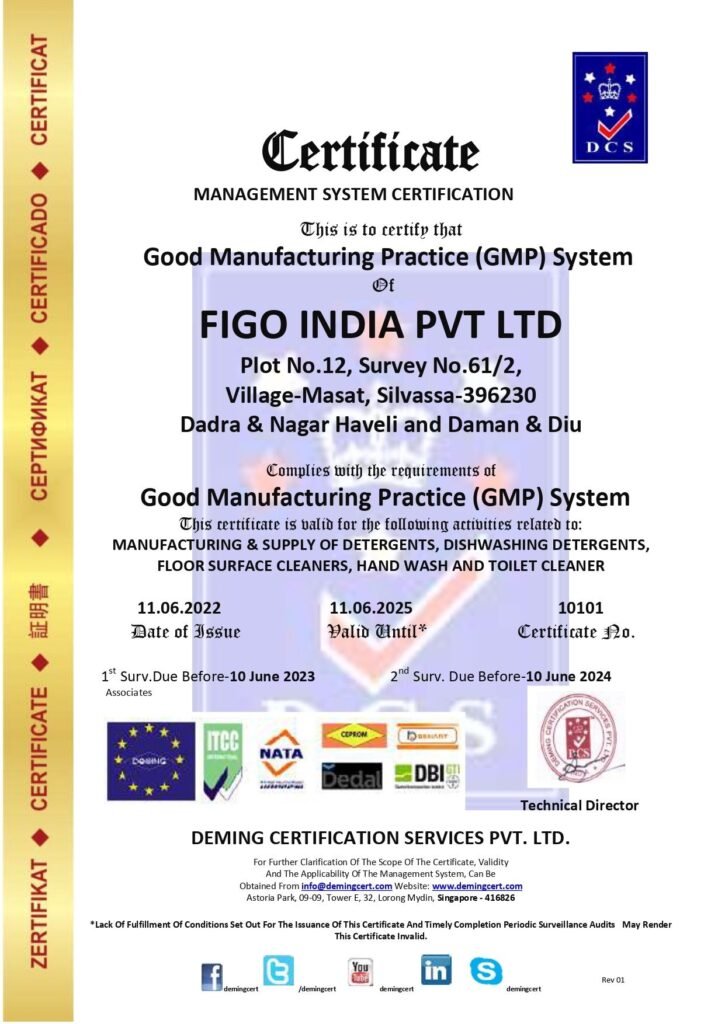
The second major theme in Figo India’s certification story is Good Manufacturing Practice.
The GMP system certificate listed in the supplied information complements the ISO 9001 quality-management framework by emphasizing controlled manufacturing practices.
The two systems should not be viewed as identical.
ISO 9001 focuses broadly on the organization’s quality-management system.
GMP is associated with manufacturing practices and controls intended to reduce risks such as contamination, mix-ups and errors. Government guidance describes GMP as a proactive quality approach covering matters including sanitation, personnel qualifications, cleanliness, equipment verification, process controls, recordkeeping and complaint handling.
For Figo India, these principles were highly relevant to the manufacturing environment.
Cleanliness as a Quality Requirement
A factory manufacturing cleaning products must maintain controlled manufacturing conditions.
Cleanliness supports product integrity.
An organized workplace reduces the possibility of mix-ups.
Proper waste handling supports hygiene.
Equipment cleaning supports controlled production.
Appropriate storage reduces contamination and confusion.
These activities are not separate from quality.
They are part of quality.
BIS manufacturing guidance for products covered by certain Indian conformity-assessment schemes similarly demonstrates how hygiene expectations can include cleanable surfaces, separation of storage and production areas, hand hygiene, waste management, pest control and cleaning schedules.
Although that particular BIS document concerns medical textiles rather than Figo India’s product range, it illustrates a broader manufacturing principle: hygienic and controlled premises are an important part of product conformity where applicable.
Equipment
Equipment is another foundation.
Machines must be appropriate for their intended use.
They require maintenance.
Where measurement is involved, measuring devices may require appropriate control and calibration.
Equipment failures can create:
- Production delays
- Quality variation
- Safety risks
- Increased costs
- Customer-delivery problems
A preventive maintenance approach can help reduce unexpected breakdowns.
Personnel Hygiene and Awareness
Employees interact directly with manufacturing processes.
Therefore, personnel need appropriate awareness of hygiene and manufacturing discipline.
Training can cover:
- Personal hygiene
- Protective equipment
- Material handling
- Cleaning procedures
- Spill response
- Waste segregation
- Safe chemical handling
- Emergency procedures
- Reporting requirements
Training creates awareness.
Supervision reinforces it.
Records provide evidence.
Cross-Contamination and Mix-Ups
Where multiple products are manufactured, prevention of mix-ups becomes important.
Product identity needs to remain clear.
Materials should be correctly identified.
Containers should be appropriately labelled.
Production areas should be organized.
Equipment cleaning should be controlled where required.
Documentation should identify the intended product.
These controls help maintain manufacturing discipline.
Batch Traceability
Traceability gives the organization the ability to connect a finished product with relevant production information.
The depth of traceability depends on the company’s processes and applicable requirements.
But the principle is powerful.
If a customer raises a question, management should be able to investigate.
Where did the material come from?
Which production batch was involved?
What records exist?
What inspections were performed?
What packaging was used?
What corrective action is required?
Traceability transforms uncertainty into evidence-based investigation.
Complaint Handling
Complaints can reveal issues that internal inspections do not detect.
The customer uses the product in the real world.
Therefore, customer feedback is valuable information.
A structured complaint process can capture:
- Complaint date
- Customer information
- Product identification
- Batch information
- Nature of complaint
- Investigation
- Root cause
- Corrective action
- Customer response
- Closure
The objective is not simply to close complaints quickly.
It is to understand them.
Hygiene and Reputation
For a manufacturer of detergents, cleaners and hand-wash products, manufacturing hygiene contributes to customer confidence.
Customers expect professional manufacturing.
They expect consistency.
They expect responsible handling.
They expect products to be manufactured under controlled conditions.
GMP practices help translate these expectations into operational discipline.
The Integrated System
Figo India’s quality story therefore involved two complementary ideas.
ISO 9001:
How does the organization manage quality systematically?
GMP:
How does the organization maintain disciplined manufacturing practices?
Together, these ideas create a stronger operational framework.
The organization can think about:
- Quality
- Hygiene
- Process control
- Documentation
- Personnel
- Equipment
- Customer satisfaction
- Continuous improvement
The result is a manufacturing culture rather than merely a manufacturing process.
#ManufacturingExcellence
Chapter 7 – Customer Trust and Market Development
A manufacturing company’s growth ultimately depends on its ability to create and maintain customer relationships.
Certification can contribute to this process by providing evidence of organizational discipline.
However, it is important to distinguish between certification and guaranteed commercial success.
ISO 9001 does not automatically produce sales.
It creates a framework intended to help organizations consistently meet requirements and improve their management processes.
The commercial value arises when that framework is converted into reliable performance.
Trust Begins With Consistency
A customer wants confidence.
If the customer places one order and receives an acceptable product, that is positive.
If the customer places repeated orders and receives consistent products, confidence becomes stronger.
Consistency is therefore a commercial asset.
For Figo India, the management system could support this by strengthening process control.
Professional Documentation
Customers often require information.
They may want product specifications.
They may ask about quality procedures.
They may require certificates.
They may request technical documents.
They may raise complaints.
A company with organized documentation can respond more efficiently.
This makes the organization appear more professional because its internal structure supports external communication.
Supplier Confidence
The same principle applies to business partners.
A supplier wants to know that requirements are clear.
A distributor wants predictable product availability.
A customer wants predictable quality.
A manufacturing partner wants confidence in the company’s systems.
A documented quality system can support these relationships by creating clearer processes.
Market Opportunities
For a growing manufacturer, new market opportunities often create new requirements.
A prospective customer may ask:
Do you have a quality-management system?
Do you have documented manufacturing controls?
How do you manage complaints?
How do you evaluate suppliers?
How do you control nonconforming products?
How do you maintain records?
How do you manage changes?
These questions can be easier to answer when the company has a mature system.
Quality as a Business Language
One of the benefits of certification is that it creates a common language.
Management talks about objectives.
Quality talks about conformity.
Production talks about process controls.
Stores talks about identification.
Purchasing talks about supplier performance.
Sales talks about customer requirements.
Management review connects these perspectives.
The organization becomes more coordinated.
Building Long-Term Relationships
A one-time sale creates revenue.
A long-term customer relationship creates continuity.
Quality management can support relationships by creating mechanisms for:
- Consistent production
- Complaint resolution
- Customer feedback
- Delivery monitoring
- Corrective action
- Continual improvement
The customer therefore sees not only a product but an organization capable of responding when something changes.
The Importance of Customer Complaints
A complaint can be emotionally difficult.
But from a quality-management perspective, it is data.
Suppose a customer complains about packaging.
The company investigates.
It discovers that the packaging material changed.
That discovery leads to supplier review.
Suppose a customer complains about product consistency.
The company investigates.
It discovers that a process variable was not adequately controlled.
That discovery leads to process improvement.
In both cases, the complaint becomes a source of learning.
From Reactive to Proactive
A reactive organization waits for complaints.
A proactive organization studies trends.
It asks:
Which complaints occur repeatedly?
Which products generate more issues?
Which suppliers create more problems?
Which processes have more deviations?
Which delivery routes create delays?
Which corrective actions recur?
This is where data becomes valuable.
Management Decisions Based on Evidence
ISO’s quality-management philosophy includes evidence-based decision-making as one of the core principles.
For Figo India, this could mean moving away from decisions based solely on assumptions.
Instead of saying:
“We think this supplier is reliable.”
Management can review supplier performance.
Instead of saying:
“Customers seem satisfied.”
Management can examine complaints and feedback.
Instead of saying:
“Production is efficient.”
Management can review production records and performance indicators.
Evidence improves the quality of decisions.
A Stronger Commercial Identity
Over time, a systematic quality approach can become part of a company’s identity.
Figo India is not simply a manufacturer of cleaning products.
It can present itself as a manufacturer committed to controlled processes, quality management and continual improvement.
The distinction matters.
In competitive markets, companies need more than products.
They need credibility.
Quality management can contribute to that credibility.
#DetergentManufacturing
Chapter 8 – Continuous Improvement and Operational Maturity
Certification is sometimes treated as a finish line.
For Figo India, it was better understood as a beginning.
ISO 9001 emphasizes continual improvement as part of the quality-management system.
This creates a powerful principle:
Every process can be improved.
Improvement Does Not Always Mean Major Investment
Continuous improvement does not necessarily require expensive machinery.
Sometimes improvement is simple.
A label is redesigned to reduce confusion.
A storage location is reorganized.
A checklist is simplified.
A maintenance schedule is improved.
A training record is standardized.
A customer complaint form is clarified.
A supplier evaluation process becomes more systematic.
A production instruction becomes easier to understand.
Small changes can accumulate.
Waste Reduction
Quality and efficiency are connected.
When a process creates defects, the company may consume resources without creating useful output.
Waste can involve:
- Materials
- Packaging
- Labour
- Energy
- Time
- Machine capacity
- Transportation
- Rework
- Disposal
Reducing defects therefore has both quality and business implications.
Rework
Rework is often invisible until examined closely.
A product that must be corrected consumes additional resources.
If the organization repeatedly reworks similar problems, the process may require improvement.
The quality system provides a mechanism to identify such patterns.
Corrective Action as Learning
Corrective action should ideally address causes rather than symptoms.
For example:
Problem: Incorrect product label.
Immediate correction: Replace the label.
Investigation: Why did the incorrect label enter production?
Root cause: Identification and verification process was insufficient.
Corrective action: Strengthen label-control and verification requirements.
Effectiveness check: Verify that the problem does not recur.
This creates organizational learning.
Preventive Thinking
Modern management systems emphasize risk-based thinking rather than relying solely on after-the-fact correction.
Figo India could therefore consider potential failure modes before problems occurred.
Examples might include:
- Supplier failure
- Equipment breakdown
- Material shortage
- Packaging shortage
- Incorrect labelling
- Process variation
- Customer specification changes
- Staff competency gaps
- Documentation errors
Each risk can be considered in relation to its potential significance and appropriate controls.
Employee Suggestions
Employees can become an important source of improvement.
An operator might suggest a better material-handling arrangement.
A stores employee might suggest clearer identification.
A quality employee might identify a recurring inspection issue.
A maintenance employee might recommend preventive action.
A supervisor might identify a bottleneck.
Management can create channels through which these ideas are captured and evaluated.
Performance Indicators
Improvement becomes easier when performance is visible.
Possible indicators for a manufacturing organization can include:
- Customer complaints
- On-time delivery
- Rejection
- Rework
- Supplier performance
- Internal audit findings
- Corrective-action closure
- Training completion
- Equipment downtime
- Production performance
The exact indicators should reflect business needs.
The purpose is not to create unnecessary measurement.
The purpose is to create useful information.
Management Review as a Growth Engine
Management review can turn operational information into strategic decisions.
Imagine management discovers that a particular process repeatedly generates delays.
The issue can be investigated.
Perhaps the problem is equipment.
Perhaps material availability.
Perhaps planning.
Perhaps staffing.
Perhaps communication.
Once the cause is understood, management can decide what resources are appropriate.
This is how a quality system supports business management.
The Culture of Asking Why
One of the strongest indicators of maturity is the willingness to ask “why.”
Why did the complaint occur?
Why was the delivery delayed?
Why did the batch require rework?
Why did the supplier fail?
Why was the document outdated?
Why did the inspection miss the issue?
Why did the same problem recur?
Asking “why” moves the organization from reaction toward understanding.
Maturity Over Time
Operational maturity develops gradually.
First, the organization establishes procedures.
Then employees learn them.
Then management measures performance.
Then problems are identified.
Then corrective actions are implemented.
Then the organization begins preventing recurrence.
Eventually, improvement becomes normal.
That is the real long-term value of a quality-management system.
#QualityAssurance
Chapter 9 – Growth Beyond the Certificate
The certification period supplied for Figo India extends from 2022 to 2025.
Those years can be viewed as an important stage in the company’s quality journey.
The certificate itself had a defined validity period.
The quality culture, however, should not have an expiry date.
The Difference Between a Certificate and a System
A certificate can have an issue date.
A certificate can have a validity period.
A management system is ongoing.
If procedures stop being followed when an audit ends, the system becomes symbolic.
If improvement continues between audits, the system becomes part of the organization.
For Figo India, this distinction is important.
The real achievement was not simply obtaining certification.
It was embedding systematic thinking into manufacturing.
The Post-Certification Mindset
After certification, management can ask:
What have we learned?
Which processes work well?
Where do problems occur?
What do customers value?
Which suppliers need attention?
Which employees need training?
Which processes can be simplified?
Which risks have changed?
What should the company improve next?
These questions create forward momentum.
Building Organizational Resilience
Businesses face disruptions.
Raw materials can become difficult to obtain.
Transportation can be interrupted.
Customer requirements can change.
Employees can leave.
Equipment can fail.
Market conditions can change.
A systematic management approach can help organizations respond because responsibilities, processes and information are clearer.
Resilience is not the ability to prevent every disruption.
It is the ability to respond effectively.
The Role of Leadership in the Next Stage
Leadership must keep quality connected to business strategy.
If the company expands, the quality system must expand.
If products change, processes must change.
If customers change, requirements must be reviewed.
If technology changes, competence may need to change.
If regulations change, compliance requirements must be reviewed.
Quality systems therefore need to evolve.
Digitalization
Modern manufacturing increasingly depends on digital information.
Even when a company begins with paper records, opportunities may emerge to digitize:
- Inventory
- Production records
- Complaints
- Maintenance
- Training
- Supplier performance
- Audit findings
- Corrective actions
Digitalization can improve accessibility and analysis when implemented appropriately.
But technology does not replace management discipline.
A poorly controlled digital system can create the same problems as poorly controlled paper.
The process must come first.
Expanding the Product Portfolio
A quality-management framework can also provide structure when new products are introduced.
Before launching a new product, the company can ask:
What are the customer requirements?
What raw materials are required?
Can suppliers provide them consistently?
What manufacturing equipment is required?
What process controls are needed?
What inspections are required?
What packaging is appropriate?
What training is needed?
What risks exist?
This structured approach reduces the likelihood that growth will create uncontrolled complexity.
Scaling Without Losing Quality
One of the biggest challenges for manufacturing companies is maintaining quality while increasing business.
Growth creates pressure.
More orders.
More production.
More suppliers.
More employees.
More customers.
More products.
More logistics.
Without systems, complexity can overwhelm the organization.
With systems, growth can be managed more deliberately.
That is why quality management can be considered infrastructure for growth.
Reputation as an Asset
A company’s reputation is accumulated through repeated experiences.
Customers remember whether:
- Products were consistent.
- Problems were resolved.
- Commitments were honoured.
- Communication was professional.
- Documentation was available.
- Complaints received attention.
Quality therefore becomes part of brand identity.
The strongest reputation is not created by advertising alone.
It is created by repeated performance.
Beyond 2025
The supplied certificate was valid through 2025.
Because the current date is 2026, the historical certification period should not be presented as proof of a current certificate without updated certification evidence.
What can be said confidently is that the 2022–2025 period represents a documented stage in Figo India’s quality-management history based on the information supplied.
For the company’s continuing story, the next question is not simply whether another certificate exists.
The more meaningful question is:
What did Figo India build from the management system?
If the organization retained the discipline of process control, customer focus, documentation, risk management and continual improvement, then the benefits of that journey can extend beyond the certificate’s validity period.
#ContinuousImprovement
Chapter 10 – The Figo India Legacy of Quality and Future Growth
The story of Figo India Pvt. Ltd. is ultimately a story about transformation.
It begins with manufacturing.
It develops through systems.
It becomes stronger through discipline.
And it continues through improvement.
The company’s 2022 ISO 9001:2015 certification through QFS Management Systems LLP and its GMP certification created a documented milestone in that transformation.
But the deeper story lies in what certification represents.
A Manufacturing Company Becomes a Quality Organization
There is a difference between making products and managing quality.
Making products is an operational activity.
Managing quality is an organizational philosophy.
It asks the company to understand customers.
It asks management to establish direction.
It asks employees to understand responsibilities.
It asks processes to be defined.
It asks performance to be evaluated.
It asks problems to be investigated.
It asks improvement to become continuous.
That is a much broader responsibility.
The Five Product Categories as a Quality Commitment
Figo India’s stated manufacturing scope covers detergents, dishwashing detergents, floor surface cleaners, hand wash and toilet cleaner.
These products belong to everyday life.
They are used in homes, workplaces, commercial facilities and other environments.
Because customers use them directly, consistency matters.
A manufacturer therefore carries a responsibility to control the process that creates the product.
Quality begins with raw materials.
It continues through manufacturing.
It continues through packaging.
It continues through storage.
It continues through distribution.
And ultimately, it reaches the customer.
The Importance of GMP
The GMP component of Figo India’s certification story reinforces the importance of manufacturing discipline.
GMP is built around proactive controls intended to reduce contamination, mix-ups and errors and to support safe, consistent manufacturing practices. (fda.assam.gov.in)
This philosophy is particularly valuable in environments where product quality depends on controlled handling, cleanliness, equipment, people and processes.
The Importance of ISO 9001
ISO 9001 adds the management-system dimension.
It asks the organization to consider its context, leadership, planning, support, operation, performance evaluation and improvement.
This means the organization can look beyond individual batches.
It can examine the entire system.
The Promoter and Leadership Story
Although the promoter’s personal name and biography were not provided in the supplied information, the leadership story can still be described through the organization’s direction.
Leadership’s most important contribution was not simply seeking certification.
It was recognizing that long-term growth requires a foundation of controlled processes.
The leadership decision to pursue a recognized management system can be interpreted as an investment in organizational maturity.
Quality as an Investment
Quality costs money.
Training costs money.
Maintenance costs money.
Inspection costs money.
Documentation requires time.
Audits require resources.
Improvement requires investment.
But poor quality also costs money.
Defects cost money.
Rework costs money.
Complaints cost money.
Returns cost money.
Delays cost money.
Lost customers cost money.
A quality-management system helps an organization think about these costs systematically.
Growth Through Trust
The strongest form of growth is sustainable growth.
A customer who trusts a supplier may return.
A distributor who trusts a manufacturer may continue the relationship.
An employee who trusts management may contribute improvement ideas.
A supplier who understands requirements may perform more consistently.
Trust therefore spreads throughout the business ecosystem.
Quality supports that trust.
Growth Through Systems
A company can survive through individual effort.
A company grows sustainably through systems.
When one experienced employee leaves, the process should not disappear with that person.
When a new employee joins, training should make the process understandable.
When production expands, procedures should provide structure.
When a new product is introduced, quality planning should support it.
When a customer complains, the investigation should follow a defined path.
Systems make organizational knowledge transferable.
Growth Through Learning
Every organization experiences problems.
The difference between a mature and immature organization is often what happens next.
An immature organization hides the problem.
A developing organization corrects the problem.
A mature organization learns from the problem.
Figo India’s quality journey provides the framework for this third approach.
The Future of Figo India
The next stage of growth can logically build upon several foundations:
1. Stronger process control
Every important manufacturing process can continue to be reviewed and improved.
2. Supplier development
Supplier performance can be monitored and improved through communication and objective evaluation.
3. Employee competence
Training can remain a continuing investment.
4. Customer feedback
Complaints and suggestions can continue to provide information for improvement.
5. Product development
New products can be introduced through structured planning and risk evaluation.
6. Digital systems
Appropriate digital tools can strengthen traceability, records and analysis.
7. Preventive maintenance
Equipment reliability can support production continuity.
8. Data-driven management
Management decisions can increasingly rely on trends and objective evidence.
9. Continual improvement
The organization can treat improvement as a permanent activity rather than a certification requirement.
10. Quality culture
The ultimate objective can remain the development of a culture in which every employee understands the relationship between their work and customer satisfaction.
A Story of Sustainable Progress
The most important lesson from Figo India’s certification journey is that growth does not always begin with expansion.
Sometimes it begins with discipline.
A better record.
A clearer procedure.
A cleaner workplace.
A more reliable supplier.
A trained employee.
A corrected process.
A customer complaint that leads to improvement.
A management review that identifies a risk.
A production team that prevents a problem instead of correcting it afterward.
These improvements may seem small individually.
Together, they create organizational strength.
The Meaning of the 2022 Certification
The year 2022 therefore represents more than a date on a certificate.
It represents a stage in Figo India’s movement toward systematic quality management.
The ISO 9001:2015 certificate from QFS Management Systems LLP provided formal recognition of the company’s quality-management framework during the stated certification period.
The GMP certification complemented this journey with attention to manufacturing practices.
The result was a stronger framework for managing:
- Products
- Processes
- People
- Suppliers
- Customers
- Documentation
- Risks
- Corrective actions
- Improvement
The Larger Business Lesson
Figo India’s story illustrates a broader lesson relevant to manufacturing companies.
Certification should not be viewed as an ornament.
It should be viewed as a management tool.
The certificate may be displayed.
But the system must operate.
The procedures must be followed.
The records must tell the truth.
The audits must identify weaknesses.
The management must act.
The employees must participate.
The customer must benefit.
That is when quality becomes meaningful.
Final Reflection
At Plot No. 12, Survey No. 61/2, Village-Masat, Silvassa, the story of Figo India Pvt. Ltd. is ultimately a story of manufacturing responsibility.
The company works in a field where its products become part of everyday cleaning and hygiene routines.
That creates an obligation to take consistency seriously.
The journey from manufacturing to structured quality management is therefore not merely about certification.
It is about building an organization capable of learning.
It is about turning experience into procedures.
It is about turning problems into corrective action.
It is about turning customer feedback into improvement.
It is about turning leadership commitment into organizational culture.
And it is about turning a quality certificate into a living management system.
ISO’s own guidance describes a quality-management system as a mechanism that can improve communication, collaboration and consistency while supporting continual improvement.
That description captures the central theme of Figo India’s journey.
The certificate was a milestone.
The system was the achievement.
The culture was the real growth.
And continual improvement remains the path forward.
For Figo India Pvt. Ltd., the period beginning with its 2022 ISO 9001:2015 certification can therefore be remembered as an important chapter in its organizational development: a period in which manufacturing, management, quality, customer expectations and continual improvement were brought closer together.
The story does not end when a certificate reaches its validity date.
A mature quality culture continues.
It evolves with customers.
It evolves with products.
It evolves with technology.
It evolves with markets.
It evolves with employees.
And most importantly, it evolves with the organization’s understanding of quality itself.
For a manufacturing enterprise, that is perhaps the most important form of growth of all.
Figo India’s journey demonstrates that sustainable business development is built not only through producing more, but through producing consistently, managing systematically, learning continuously and earning customer confidence one process at a time.
#BusinessGrowth
10-Point Summary of Figo India Pvt. Ltd.’s Quality-Growth Journey
- 2022 certification milestone – Figo India Pvt. Ltd. obtained the stated ISO 9001:2015 certification through QFS Management Systems LLP.
- GMP orientation – The GMP System Certificate added emphasis on disciplined manufacturing practices.
- Process approach – Manufacturing activities could be managed as interconnected processes rather than isolated tasks.
- Raw-material control – Systematic purchasing, identification and handling became important foundations of manufacturing quality.
- Production consistency – Defined processes and records support repeatable manufacturing.
- Customer focus – Product requirements, complaints and feedback become inputs for improvement.
- Employee involvement – Training, awareness and responsibility strengthen the quality culture.
- Corrective action – Problems can be investigated for causes rather than merely corrected temporarily.
- Continual improvement – Audits, performance information and management review create opportunities for systematic improvement.
- Long-term growth – The greatest benefit of the certification journey is the development of a quality-oriented organization capable of adapting and improving.
Closing Case-Study Statement
Figo India Pvt. Ltd.’s ISO 9001:2015 and GMP journey represents a movement from product-focused manufacturing toward a more structured culture of quality, process control, customer focus and continual improvement. The 2022–2025 certification period can be viewed as an important chapter in the company’s development, providing a management framework through which manufacturing discipline and business growth could be connected.
The principles of ISO 9001 support exactly this type of approach: consistent conformity, customer satisfaction, process control, evidence-based decision-making and continual improvement.
#QualityDrivenGrowth #CleaningProductsIndustry #ProcessImprovement #CustomerSatisfaction #OperationalExcellence
Take the Next Step Today
Don’t wait to enhance your business’s quality and efficiency. Partner with Sanatan Dharma Accreditation Boards and experience the transformation that comes with expert consultancy and training. Contact us today to learn more about how we can help you achieve your business goals. Reach out via phone at +91-8668266780, visit our website at sanatanboards.com, or email us at info@sanatanboards.com Let us be your guide on the journey to excellence and innovation.





