
Chiranjiv Dev
Table of Contents
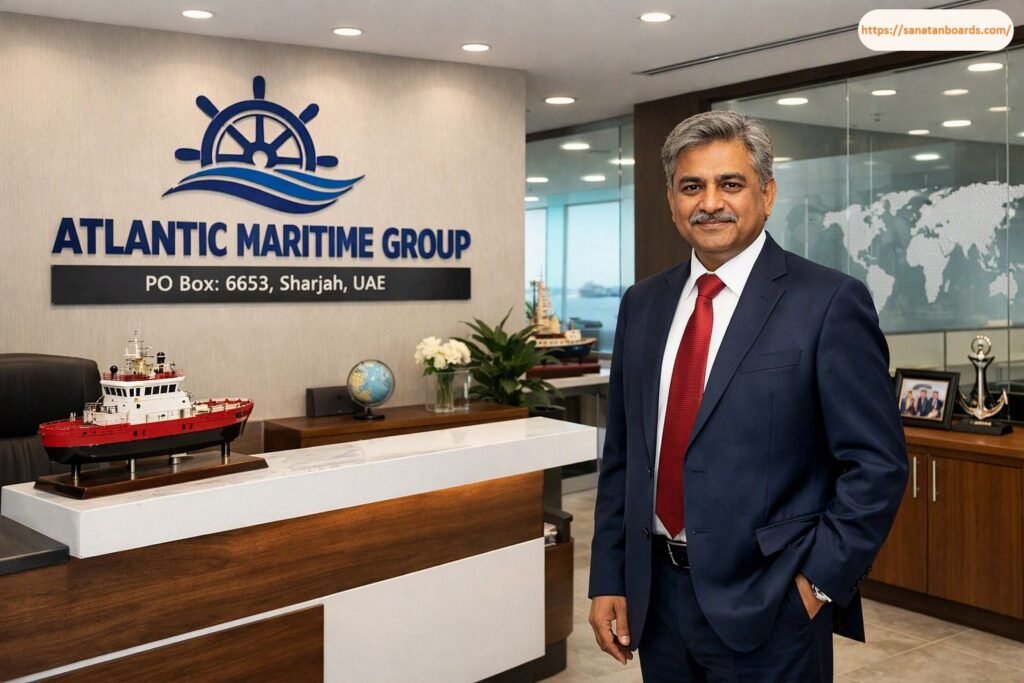
Chiranjiv Dev and the Journey of Professional Growth After Offshore Crane Operator Competency Certification
Introduction
In offshore operations, success is rarely the result of one person’s effort alone. Behind every vessel movement, lifting operation, maintenance activity and marine-support project stands a network of trained people, engineered equipment, documented procedures and carefully managed risks. Among the most demanding responsibilities in this environment is the operation of an offshore crane.
A crane operating offshore is very different from an ordinary lifting machine working on stable ground. The vessel may move with waves and wind. Loads may swing because of changing environmental conditions. Communication between deck personnel, crane operators and supervisors must remain clear. Equipment condition must be continuously understood. Every lift requires discipline, concentration and respect for established operating procedures.
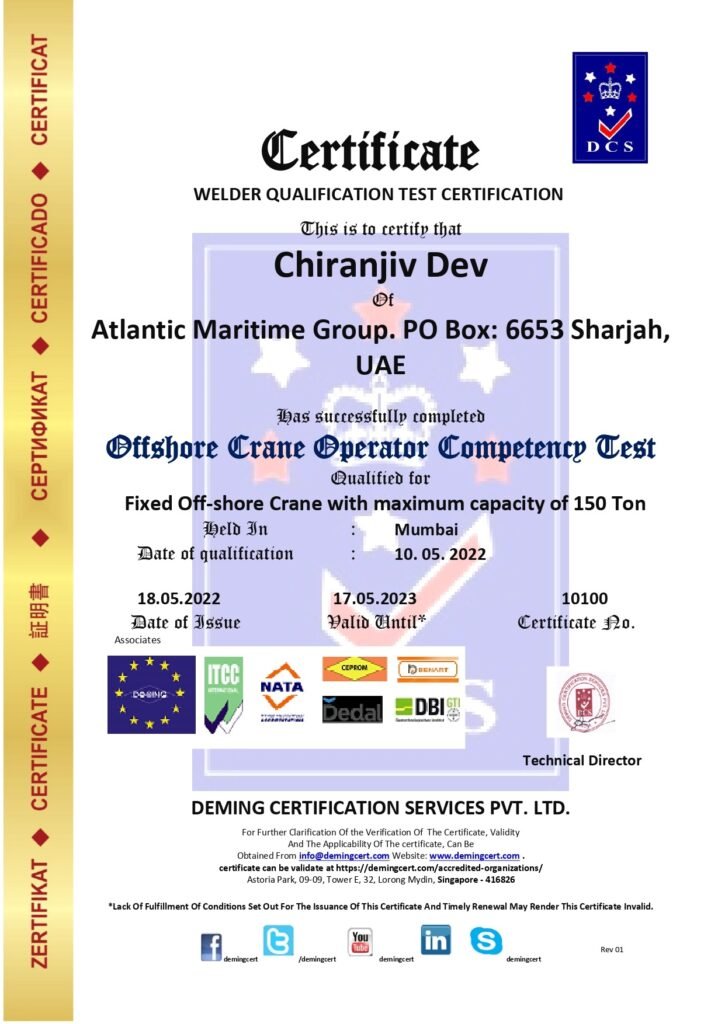
For Chiranjiv Dev, professional development in this environment reached an important milestone in 2022 when he completed an Offshore Crane Operator Competency Test. The certification record identifies Chiranjiv Dev and associates the competency with Atlantic Maritime Group FZE, P.O. Box 6653, Sharjah, United Arab Emirates. The documented certificate was issued on 18 May 2022 and was valid until 17 May 2023. The scope is identified as an Offshore Crane Operator Competency Test, with the broader work context involving a fixed offshore crane with a maximum capacity of 150 tonnes.
Atlantic Maritime Group FZE operates within a demanding offshore environment. The company describes itself as an integrated offshore marine logistics, subsea, ship-repair, maintenance and fabrication service provider serving Middle Eastern markets. Its operations include marine logistics services as well as ship repair, maintenance and fabrication.
The story of Chiranjiv Dev is therefore not simply a story about receiving a certificate. It is a story about competence, responsibility, professional credibility, safety awareness, continuous learning and the relationship between individual capability and organizational performance.
The ten chapters that follow present this journey as a professional growth narrative.
Chapter 1: Entering the World of Offshore Operations
The sea teaches a different kind of discipline.
On land, many activities appear predictable. A vehicle travels along a road. A machine operates on a prepared floor. A load can often be positioned using stable reference points. Offshore operations remove much of that certainty.
The sea moves.
The vessel moves.
The load can move.
Wind changes.
Visibility changes.
Communication can become difficult.
And every person involved in an operation must understand that a small error can develop into a serious event.
For an offshore crane operator, this environment creates a special professional responsibility. The operator is not simply controlling levers or buttons. The operator is managing a complex interaction between machinery, load, weather, vessel movement, deck personnel, communication systems and established procedures.
Chiranjiv Dev’s association with Atlantic Maritime Group placed his professional activities within this demanding marine environment. Atlantic Maritime Group FZE is based at Hamriyah Free Zone in Sharjah, UAE, and operates as part of a wider offshore marine-services group. Public company information describes its activities as including marine logistics, ship management, ship repair, maintenance and fabrication.
This environment provided an important foundation for professional development.
The first lesson of offshore work is that competence cannot be treated as a theoretical concept.
A person may understand how a crane works. A person may know terminology related to lifting operations. A person may have experience around heavy equipment. But offshore crane operation requires the ability to translate knowledge into controlled action.
That difference between knowledge and demonstrated competence is significant.
A crane operator must understand the equipment before operating it. The operator must know the controls, limitations, operating characteristics and applicable procedures. At the same time, the operator must remain aware of the people around the lifting area.
A successful lifting operation begins before the crane moves.
It begins with preparation.
It begins with communication.
It begins with checking.
It begins with understanding the load.
It begins with understanding the equipment.
It begins with asking whether the planned operation can be carried out safely.
For Chiranjiv Dev, this professional philosophy became increasingly important as his responsibilities developed.
The work context involving a fixed offshore crane with a maximum capacity of 150 tonnes represented a substantial level of responsibility. A crane with such capacity is not merely a piece of equipment; it is an important part of offshore logistics and lifting capability.
Large lifting equipment can support the movement of machinery, materials and other heavy components. But its usefulness depends directly on the competence of the people operating and supervising it.
This is where professional certification becomes meaningful.
A competency certification does not replace experience. Instead, it provides a structured method for demonstrating that an individual has been assessed against defined competency requirements.
In 2022, Chiranjiv Dev’s Offshore Crane Operator Competency Test therefore became an important professional milestone.
The documented certification record identifies the certification as an ISO/IEC 17024 personnel-competency certification, rather than an ISO 9001 management-system certificate.
That distinction matters.
ISO 9001 concerns a quality management system within an organization. ISO/IEC 17024, in contrast, relates to conformity assessment for persons and the certification of individual competence.
For an offshore crane operator, the latter is directly relevant because the focus is on the person performing the work.
The certificate became evidence that Chiranjiv Dev had undergone a formal competency assessment associated with offshore crane operation.
But the true value of the achievement went beyond the printed document.
A certificate can hang on a wall.
Competence must be demonstrated every time the operator approaches the controls.
That realization shaped the next stage of Chiranjiv Dev’s professional journey.
The certification became a reminder that every lift begins with responsibility.
Every movement must be deliberate.
Every instruction must be understood.
Every unusual condition must receive attention.
And every completed operation should contribute to a culture in which safety and professionalism are treated as essential parts of productivity.
This was the beginning of a new chapter in his professional identity.
He was not simply someone working around a crane.
He was developing as a certified offshore crane professional.
#ChiranjivDev
Chapter 2: Understanding the Responsibility of a 150-Tonne Offshore Crane
A crane’s capacity is one of the first figures that attracts attention.
A 150-tonne maximum capacity sounds impressive, and it is. But experienced lifting professionals understand that capacity is only one part of the equation.
The real challenge is using the equipment within its permitted operating parameters.
The operator must understand load charts, operating conditions, crane configuration, radius, environmental conditions and the limitations established for the equipment.
Offshore lifting adds another dimension.
The platform or vessel is not perfectly stationary.
The load can respond to wave motion.
The crane’s movement must be coordinated with deck operations.
Personnel may be working nearby.
The operator therefore needs a strong sense of situational awareness.
For Chiranjiv Dev, the competency assessment represented an opportunity to demonstrate more than familiarity with crane controls. It represented an assessment of professional capability in an offshore environment.
The phrase “operator competency” carries an important meaning.
Competency includes knowledge.
It includes practical ability.
It includes judgment.
It includes understanding of procedures.
It includes the ability to communicate.
And it includes knowing when an operation should not proceed.
The strongest operators are not those who move loads fastest. They are those who can maintain control while respecting the boundaries of the equipment and the operation.
This approach also aligns with the broader culture described by Atlantic Maritime Group. The company states that safety is a core value and emphasizes HSSE excellence and continuous improvement within its management systems.
That organizational environment provides a meaningful context for an individual’s competency.
An operator cannot work effectively in isolation.
The crane operator interacts with riggers.
The operator communicates with banksmen or signalers.
The operator receives instructions from supervisors.
The operator may coordinate with deck teams and other technical personnel.
Each person contributes to the lifting process.
A competent operator therefore understands communication as part of crane operation itself.
Imagine a typical lifting operation.
A heavy component is prepared on deck.
The lifting team inspects the lifting arrangement.
The load is connected.
Personnel move to their designated positions.
The operator receives the signal to begin.
The crane starts moving.
At that moment, attention becomes critical.
The operator must observe the load.
The operator must monitor crane behavior.
The operator must respond to signals.
The operator must avoid sudden movements.
The operator must remain aware of the surrounding operation.
The goal is controlled movement.
This discipline is particularly important when the load is heavy.
A 150-tonne-rated crane can provide tremendous lifting capability, but the operator does not simply think about maximum capacity. The operator thinks about the specific load and the conditions of the lift.
This professional mindset is one of the major changes that competency certification can reinforce.
Before formal assessment, a person may think primarily in terms of “operating the crane.”
After structured competency assessment, the professional perspective becomes broader:
“How do I ensure that this operation is properly planned, controlled and executed?”
That shift from mechanical operation to operational responsibility is significant.
For Chiranjiv Dev, the certification therefore became part of a larger professional development journey.
It strengthened the connection between personal competence and organizational objectives.
A company engaged in offshore services depends upon competent personnel. Equipment may be modern, vessels may be capable, and procedures may be comprehensive, but the quality of execution depends upon people.
An operator who understands the equipment can recognize abnormal conditions.
An operator who understands procedures can follow established controls.
An operator who communicates effectively can coordinate with the lifting team.
An operator who understands limitations can prevent pressure for productivity from overriding operational discipline.
This is how individual competency becomes an organizational asset.
The 2022 certification was therefore more than an examination result.
It represented a professional commitment.
It said that the operator’s role deserved formal recognition.
It reinforced the importance of competence.
And it established a documented milestone that could be referred to in professional records.
The certificate was issued on 18 May 2022 and, according to the certification record, remained valid until 17 May 2023.
The dates themselves tell another story.
Competency is not something that should be treated as permanent.
Skills require maintenance.
Knowledge changes.
Equipment changes.
Procedures change.
Work environments change.
That is why professional operators must remain committed to learning even after receiving certification.
The certificate could confirm an achievement at a particular point in time.
Chiranjiv Dev’s continuing performance would determine the lasting value of that achievement.
#OffshoreCraneOperator
Chapter 3: Certification as a Professional Turning Point
There are moments in a career when experience becomes documented achievement.
For Chiranjiv Dev, 2022 was one of those moments.
The Offshore Crane Operator Competency Test provided a formal structure for recognizing his professional capability.
The certification record gives the credential a clear identity: Offshore Crane Operator Competency Test, associated with Chiranjiv Dev and Atlantic Maritime Group FZE.
This mattered because offshore industries frequently depend on documented competence.
A project manager needs to know whether personnel are suitably qualified.
A client needs confidence that people assigned to critical activities have relevant competence.
A company needs records demonstrating that personnel have received appropriate training or assessment.
And an individual needs credentials that can support professional progression.
Certification therefore creates a common language.
Instead of saying only, “I have experience operating cranes,” an individual can point to a formal competency assessment.
That does not eliminate the importance of practical experience.
In fact, certification and experience complement one another.
Experience teaches an operator how real situations behave.
Certification provides structured assessment.
Together, they can contribute to professional confidence.
For Chiranjiv Dev, this professional confidence was important.
The offshore environment can be demanding even for experienced workers.
Operations may involve unusual loads.
Weather conditions can change.
Equipment may behave differently under different conditions.
Communication may involve several teams.
The operator must therefore remain mentally prepared and professionally disciplined.
A competency assessment encourages this discipline because it requires the candidate to demonstrate knowledge and ability rather than simply claim experience.
The certificate also created a professional record that could be referenced in future opportunities.
This is especially relevant in an industry where projects can change quickly and personnel may work across vessels, locations and assignments.
An operator’s professional portfolio can include experience records, training certificates, competency credentials, medical fitness records, safety training and other qualifications.
The Offshore Crane Operator Competency Test became one part of that portfolio.
It helped define Chiranjiv Dev not merely by his employment but by a specific technical competency.
This distinction can influence professional identity.
Employment tells people where a person works.
Competency tells people what a person has been assessed to do.
That difference can be valuable.
At Atlantic Maritime Group, the broader operating environment was also evolving. The group’s public corporate history shows a development from ship repair and fabrication activities into a broader integrated offshore marine service provider. Its services include marine logistics, ship management, repair, maintenance, fabrication and project-related services.
Such an environment creates demand for people with specialized competencies.
Offshore operations require many different technical skills.
Marine engineers maintain systems.
Deck teams handle equipment and materials.
Survey teams perform specialized activities.
Crane operators perform critical lifting functions.
Project managers coordinate activities.
Safety professionals establish and monitor controls.
Each competency supports the wider system.
The certification therefore represented a connection between Chiranjiv Dev’s individual professional growth and the wider needs of offshore operations.
This is where the story of certification becomes a story of organizational development.
Companies grow when they build capabilities.
People grow when they develop skills.
The two processes reinforce one another.
A company that invests in competence creates a stronger workforce.
A worker who invests in competence becomes more prepared to accept responsibility.
The relationship is mutually beneficial.
The 2022 assessment can therefore be understood as a milestone in this continuing cycle.
It was an acknowledgment that offshore crane operation requires professional standards.
It also encouraged a mindset of continuous improvement.
After certification, an operator should not think, “I have completed my learning.”
Instead, the better mindset is:
“I have reached another level of professional responsibility, and I must continue developing.”
That mindset would become increasingly important as the industry evolved.
The offshore sector has always depended on technical capability, but modern operations also place growing emphasis on documentation, safety management, environmental awareness, operational efficiency and competency assurance.
The professional crane operator must therefore understand more than the machine.
The operator must understand the system.
The crane is part of a vessel.
The vessel is part of a project.
The project is part of a client relationship.
The client relationship is part of the company’s reputation.
And reputation depends upon reliable performance.
This is how a single competency certificate can have meaning far beyond one page of paper.
It represents a commitment to professional standards.
For Chiranjiv Dev, the certificate became a milestone from which further professional growth could be measured.
#OffshoreCrane
Chapter 4: Safety Becomes a Professional Habit
Safety in offshore operations cannot be reduced to a poster on a wall.
It must become a habit.
A professional crane operator develops habits that support safe operations.
Checking.
Confirming.
Communicating.
Observing.
Stopping when necessary.
Reviewing.
Learning.
These actions may appear simple, but their consistency is what gives them value.
Atlantic Maritime Group publicly identifies safety as one of its core values and emphasizes HSSE excellence and continuous improvement.
For Chiranjiv Dev, working within such an environment meant that technical competence could not be separated from safety responsibility.
Consider the beginning of a lifting operation.
Before the crane moves, the operator needs to know what is being lifted.
What is the weight?
Where is the center of gravity?
How is the load connected?
What is the planned lifting path?
Who is giving signals?
Where are personnel positioned?
What environmental conditions exist?
What limitations apply to the crane?
These questions represent the thinking process behind a controlled lift.
A certificate cannot perform these checks.
A procedure cannot perform them automatically.
The person operating the equipment must understand their importance.
This is why competency is fundamentally human.
Technology can assist.
Sensors can provide information.
Monitoring systems can provide warnings.
Modern cranes may include sophisticated controls.
But the operator remains responsible for interpreting the situation and acting appropriately within the established operating system.
For Chiranjiv Dev, professional growth therefore involved developing a safety-oriented mindset.
Safety-oriented does not mean avoiding work.
It means performing work in a controlled manner.
Offshore companies exist to perform real operations. Materials must be moved. Equipment must be maintained. Vessels must be serviced. Projects must be completed.
Safety and productivity should not be treated as enemies.
Well-controlled operations can support both.
A disciplined lifting operation reduces unnecessary movement.
Clear communication reduces confusion.
Proper preparation reduces delays.
Equipment checks can identify issues before they become failures.
Competent personnel can recognize problems earlier.
Thus, safety practices can contribute to operational efficiency.
This was one of the important lessons associated with Chiranjiv Dev’s professional development.
A crane operator who works carefully is not necessarily slow.
A crane operator who checks conditions is not wasting time.
A crane operator who stops an operation because conditions are unsafe is protecting the operation itself.
The true measure of professional maturity is understanding when speed is appropriate and when caution is necessary.
This principle became especially relevant in heavy lifting.
When a small load is moved, an error may be inconvenient.
When a large load is moved, the consequences can be much more serious.
The larger the operation, the greater the importance of planning and communication.
The 150-tonne maximum crane capacity therefore represents not only mechanical capability but professional responsibility.
Chiranjiv Dev’s competency assessment gave formal recognition to his role within this system.
The story also demonstrates why competency certification should be understood as part of a broader management approach.
A certificate alone cannot create safety.
A safety culture requires management commitment.
It requires procedures.
It requires training.
It requires competent people.
It requires equipment maintenance.
It requires communication.
And it requires learning from experience.
Atlantic Maritime Group’s public vision and values emphasize continuous learning and improvement as well as safety and environmental stewardship.
This provides a useful framework for understanding the professional environment in which Chiranjiv Dev’s competency existed.
The certificate marked an achievement.
The daily application of its principles created the real value.
That distinction is important in every technical profession.
A person can possess a certificate without developing a strong professional mindset.
Conversely, an experienced worker may have substantial practical knowledge but benefit from formal assessment that documents and structures that competence.
The strongest professional development occurs when both come together.
For Chiranjiv Dev, the competency certification became part of that combination.
It documented competence.
Work experience provided context.
Safety culture provided direction.
Continuous learning provided momentum.
Together, these factors created a platform for future growth.
#CraneOperatorCompetency
Chapter 5: The Connection Between Individual Competence and Company Performance
A company does not operate through certificates.
It operates through people.
Every organization has systems, equipment, policies, contracts and financial resources. Yet these elements become productive only when people know how to use them effectively.
In offshore marine services, the connection is particularly visible.
A vessel may have powerful equipment, but skilled people are needed to operate and maintain it.
A crane may have a high lifting capacity, but a competent operator is needed to use it.
A project may have a detailed plan, but trained personnel are needed to execute that plan.
This is why the professional development of Chiranjiv Dev can be viewed within the larger context of organizational capability.
Atlantic Maritime Group has evolved over decades into an integrated offshore service provider. Public company information states that its UAE business activities began in 1997 and that the organization developed from ship repair, fabrication and marine services into a broader integrated offshore marine service provider.
This evolution illustrates an important business principle.
As a company expands its service capability, the competence requirements of its workforce also become more complex.
More services require more skills.
More projects require more coordination.
More sophisticated equipment requires greater technical understanding.
More demanding clients require stronger documentation and assurance.
Individual competency therefore becomes part of organizational competitiveness.
Chiranjiv Dev’s certification contributed to this professional capability by formally documenting a specialized skill.
Imagine a project manager preparing a team for an offshore assignment.
The manager needs people whose competencies match the work.
If crane operations are required, the manager needs suitable crane personnel.
If heavy lifting is involved, the operator must understand the equipment and operational limitations.
If the client requests evidence of competence, documented certification becomes valuable.
In such circumstances, an individual certificate can become a practical business resource.
It supports competence assurance.
It strengthens personnel documentation.
It helps demonstrate professional preparedness.
It can contribute to client confidence when presented appropriately alongside experience and other required credentials.
This is one reason why professional certification can influence career development.
The certificate does not guarantee promotion.
It does not guarantee higher revenue.
It does not automatically create new contracts.
But it can strengthen the evidence supporting a professional’s suitability for certain responsibilities.
That distinction is important.
The growth story of Chiranjiv Dev should therefore not be interpreted as a claim that one certificate directly caused a measurable financial increase.
Rather, the certificate can be understood as one element within a broader process of professional capability development.
Professional growth usually results from several factors.
Experience.
Training.
Performance.
Discipline.
Communication.
Technical knowledge.
Safety awareness.
Teamwork.
Certification.
Leadership.
Together, these factors create professional value.
For a company, the benefit comes from combining these individual capabilities into reliable operations.
A strong operator contributes to a strong team.
A strong team supports reliable project execution.
Reliable project execution supports customer confidence.
Customer confidence supports business relationships.
Long-term relationships can contribute to organizational sustainability.
Thus, the chain from individual competence to company growth is indirect but meaningful.
Chiranjiv Dev’s journey demonstrates this principle.
His 2022 competency certification became a documented part of the professional capability available within the offshore work environment.
The certificate was issued under a personnel-certification framework rather than a company management-system framework.
That means its primary focus was the individual.
But the value of an individual competency extends beyond the individual.
Organizations depend upon competent people.
This is especially true in industries where errors can affect safety, equipment, schedules, clients and reputation.
The professional therefore carries a responsibility that goes beyond personal career advancement.
Competence becomes a contribution to the organization.
This perspective can change how a worker views certification.
It is not merely something to add to a CV.
It is a commitment to perform responsibly.
It is evidence of professional discipline.
It is an invitation to continue learning.
And it can become part of the organization’s broader competency-management system.
For Chiranjiv Dev, this was an important stage of professional maturity.
The certificate was his achievement.
Its application became part of the organization’s capability.
#OffshoreOperations
Chapter 6: Building Confidence Through Demonstrated Competence
Confidence is important in technical work.
But professional confidence must be based on competence.
There is a difference between confidence that comes from familiarity and confidence that comes from demonstrated ability.
A person may feel comfortable around machinery because they have worked with it for years.
A competency assessment introduces another dimension.
It asks the professional to demonstrate knowledge and ability against defined expectations.
For Chiranjiv Dev, the Offshore Crane Operator Competency Test provided that formal assessment.
The certificate record confirms the professional competency designation and its validity period.
This achievement could strengthen professional confidence because it provided external recognition of a specific technical capability.
That confidence matters in offshore operations.
The operator must make decisions calmly.
The operator must communicate clearly.
The operator must maintain concentration.
The operator must recognize abnormal situations.
The operator must know the boundaries of the equipment.
Confidence helps the operator perform these responsibilities without unnecessary hesitation.
But good professional confidence has an important characteristic: it does not create complacency.
An experienced operator should never assume that previous success guarantees future safety.
Every operation is different.
Every load is different.
Every environment can be different.
Every vessel can respond differently.
Therefore, the operator must approach each lift with attention.
This is where continuous learning becomes important.
Atlantic Maritime Group identifies continuous learning among its stated values and links it with improvement and adaptability.
For Chiranjiv Dev, continuous learning could mean reviewing procedures, learning from operational experiences, participating in training, maintaining familiarity with equipment and keeping professional knowledge current.
A certification valid for a defined period also reinforces the idea that competence must be maintained.
The 2022 credential was valid for one year, through May 2023.
A defined validity period encourages professionals and organizations to think about reassessment and continued competence.
This is particularly important in technical professions.
Imagine an operator who receives certification and then stops learning.
Over time, procedures may change.
Equipment may be upgraded.
Regulatory expectations may change.
New safety practices may emerge.
Technology may change.
A professional who remains static can gradually become less prepared.
By contrast, a professional who treats certification as a starting point rather than an endpoint can continue developing.
This is the attitude that can turn a credential into a career-development tool.
For Chiranjiv Dev, the certification created a documented milestone around which future professional learning could be organized.
It could become part of his competency record.
It could support discussions about training needs.
It could be referenced when preparing professional documentation.
It could contribute to the overall evidence of technical capability.
In a larger sense, the story illustrates a central principle of modern workforce development:
Competence must be demonstrated, maintained and continually improved.
This principle applies far beyond crane operations.
Engineers must maintain technical knowledge.
Auditors must understand changing standards.
Welders must maintain qualification.
Medical professionals must maintain competence.
Pilots must maintain training.
Marine personnel must maintain operational readiness.
In each field, professional growth is a continuing journey.
The offshore environment simply makes the importance of this principle particularly visible.
The crane operator sits at a critical intersection between machinery and people.
A decision made at the controls can affect an entire lifting operation.
Therefore, professional confidence must always be accompanied by humility.
The operator should know what he knows.
He should also know what he does not know.
He should ask when clarification is necessary.
He should stop when conditions are unclear.
He should communicate when circumstances change.
This is not weakness.
It is professionalism.
The 2022 certification therefore represented more than an assessment passed.
It represented an opportunity to build a professional identity around demonstrated competence.
For Chiranjiv Dev, that identity could continue developing through experience and learning.
#MarineIndustry
Chapter 7: Certification, Documentation and Client Confidence
Courtesy: Sailor’s HuB
Modern offshore businesses operate in a documentation-intensive environment.
A client may want evidence of personnel qualifications.
A contractor may request competency records.
A project may require specific training certificates.
A vessel operator may maintain detailed personnel files.
These requirements create an environment where professional documentation matters.
For Chiranjiv Dev, the Offshore Crane Operator Competency Test provided a formal document identifying his competency.
The public certification record identifies certificate information associated with Chiranjiv Dev and Atlantic Maritime Group FZE.
This documentation can serve several purposes.
First, it creates traceability.
There is a record of what competency was assessed.
Second, it provides evidence.
The individual can demonstrate that formal assessment occurred.
Third, it supports organizational records.
The company can maintain evidence of personnel competency.
Fourth, it can contribute to client assurance.
Where appropriate, clients can review competency documentation during project planning or personnel qualification processes.
This does not mean that one certificate automatically satisfies every project requirement.
Offshore projects can have specific client, regulatory, vessel and operational requirements.
A crane operator may require several different credentials depending on the assignment.
Therefore, the value of the certificate is strongest when it is maintained as part of a broader competency portfolio.
For Chiranjiv Dev, this portfolio could include experience records, equipment-specific training, safety training, medical requirements and other qualifications applicable to his duties.
This systematic approach also supports the company’s management system.
Atlantic Maritime Group currently describes itself as an ISO 9001:2015, ISO 14001:2015 and ISO 45001:2018 certified company.
These management-system standards provide a broader organizational context in which competence, documented processes, environmental considerations and occupational health and safety can be managed.
Again, it is important not to confuse the individual competency certification with the company’s ISO management-system certification.
The two serve different purposes.
The company certification addresses organizational systems.
The personnel competency certification addresses an individual’s competence.
But they can complement one another.
A management system may establish requirements for competence.
The organization may identify which personnel need particular qualifications.
The personnel then obtain appropriate training or certification.
Records are maintained.
Performance is monitored.
Training needs are identified.
The cycle continues.
This creates an integrated approach to workforce competence.
In such a system, Chiranjiv Dev’s certificate becomes part of a larger organizational process.
That process can help answer important questions:
Who is qualified to operate the equipment?
When was the competency assessed?
What is the validity period?
What additional training is required?
Which assignments are appropriate?
When is reassessment due?
These questions are essential in high-risk technical environments.
Documentation also helps reduce dependence on memory.
A supervisor should not have to rely on recollection to determine whether an operator’s qualification is current.
A properly maintained competency record provides a more reliable reference.
This is one of the less visible but important benefits of professional certification.
It creates structure.
It creates accountability.
It creates traceability.
For Chiranjiv Dev, the 2022 credential became a documented representation of his professional capability.
Its value was therefore not limited to the moment of certification.
It could become part of his professional history.
Years later, even after the validity period ended, the record could still demonstrate that a competency assessment had taken place at a particular point in his career.
That historical record can be useful when building a professional portfolio.
Professional growth is often cumulative.
Today’s certificate becomes tomorrow’s experience.
Today’s responsibility becomes tomorrow’s leadership capability.
Today’s technical knowledge becomes tomorrow’s mentoring ability.
The certificate therefore became one chapter in a longer professional story.
#CraneOperatorCertification
Chapter 8: From Operator to Contributor
The strongest professional growth occurs when an individual begins to think beyond personal tasks.
An operator initially asks:
“What do I need to do?”
With experience, the question becomes:
“What does the team need from me?”
Later, it may become:
“How can I help the operation succeed?”
This progression represents professional maturity.
For Chiranjiv Dev, competency in offshore crane operation provided a foundation for such development.
An operator who understands lifting activities can contribute to better preparation.
He can communicate effectively with the lifting team.
He can recognize potential difficulties.
He can share practical observations.
He can support newer personnel through appropriate guidance.
He can contribute to a culture of safe work.
This does not mean that certification automatically makes someone a supervisor or manager.
It means that technical competence creates opportunities for broader contribution.
A competent operator can become a source of practical knowledge.
In offshore operations, practical knowledge is valuable.
People working directly with equipment often observe details that may not be obvious from an office.
They see how equipment behaves.
They recognize recurring difficulties.
They understand how communication works during actual operations.
They can identify where procedures may require clarification.
They can contribute to improvement discussions.
This is the beginning of a learning organization.
Atlantic Maritime Group’s stated values emphasize people engagement and continuous learning.
These principles provide a useful framework for understanding how an individual competency can become a team resource.
Suppose a newly assigned crane operator joins a team.
The new operator may understand theoretical principles but lack familiarity with the specific working environment.
An experienced professional can help the newcomer understand practical expectations.
How should communication occur?
What checks are routinely important?
What site-specific considerations should be remembered?
Where are the relevant documents?
Who has authority to stop the job?
How should unusual conditions be reported?
These conversations can improve team readiness.
Professional knowledge therefore becomes transferable.
That is one of the most valuable forms of career growth.
A person who can perform a task has technical value.
A person who can help others perform the task correctly has organizational value.
A person who can help improve the system has even broader value.
Chiranjiv Dev’s competency certification created a formal foundation for this development.
It demonstrated that offshore crane operation was not simply an informal skill.
It was a recognized professional competency.
That recognition can encourage individuals to take greater ownership of their development.
The operator may begin keeping better records.
He may pursue additional training.
He may become more involved in safety discussions.
He may develop stronger communication skills.
He may seek broader technical understanding.
Over time, these activities can expand professional capability.
This is how a certificate can become a starting point for growth rather than an endpoint.
The story also demonstrates the importance of humility.
A professional who becomes more experienced should not become less willing to learn.
Instead, experience should make the person more aware of complexity.
The sea teaches this lesson repeatedly.
Conditions can change.
Equipment can fail.
Plans can change.
Unexpected situations can arise.
The best professionals remain prepared to adapt.
For Chiranjiv Dev, this adaptability was part of the larger meaning of competency.
The certificate documented a particular capability.
His continuing career would depend upon how effectively he maintained and expanded that capability.
The transition from operator to contributor is therefore not a single event.
It is a gradual process.
First comes competence.
Then confidence.
Then responsibility.
Then contribution.
Then leadership.
Every stage builds upon the previous one.
#WorkplaceSafety
Chapter 9: The Long-Term Meaning of Professional Certification
When a certificate expires, does its value disappear?
Not necessarily.
A competency certificate has a defined validity period because current competence matters.
The Chiranjiv Dev certification issued in May 2022 was valid until May 2023 according to the published record.
A later public record also lists certificate 10100.1, issued on 23 March 2023 and valid until 22 March 2025, again identifying Chiranjiv Dev for Offshore Crane Operator Competency Test.
This later record is significant because it illustrates continuing professional certification rather than treating the 2022 assessment as the end of the journey.
The broader lesson is that professional competency can be renewed and maintained.
For an operator, this creates a cycle:
Assessment.
Certification.
Application.
Experience.
Learning.
Reassessment.
Renewal.
Improvement.
This cycle is healthier than thinking of certification as a one-time achievement.
The offshore industry changes continuously.
Equipment becomes more sophisticated.
Operational requirements evolve.
Clients may introduce new expectations.
Safety practices improve.
Digital systems become more common.
Environmental considerations become increasingly important.
Professionals must adapt.
Atlantic Maritime Group’s corporate materials describe its focus on integrated offshore services and emphasize sustainability, safety, customer focus, people engagement and continuous learning.
This provides a useful environment for understanding the long-term role of competency development.
Professional growth is not only about obtaining more certificates.
It is about becoming more capable.
A person can collect certificates without becoming a better professional.
The meaningful question is whether learning changes behavior.
Does the operator communicate better?
Does the operator understand risks more clearly?
Does the operator recognize limitations earlier?
Does the operator contribute more effectively to the team?
Does the operator support continuous improvement?
These are the indicators that transform certification into genuine development.
For Chiranjiv Dev, the offshore crane competency credential became part of a professional story defined by responsibility.
The story is not simply:
“Chiranjiv Dev received a certificate.”
The deeper story is:
“Chiranjiv Dev pursued formal recognition of a specialized offshore competency and continued developing within a professional marine-services environment.”
That is a more meaningful interpretation.
It recognizes the certificate without exaggerating its effects.
It also places the achievement within the larger reality of offshore operations.
Professional certification can create opportunities.
Experience determines how those opportunities are used.
Discipline determines consistency.
Learning determines adaptability.
Teamwork determines how individual capability contributes to organizational performance.
Leadership determines how that capability can eventually influence others.
This is why certification can be an important milestone even when it is not the sole cause of growth.
For an individual, it can strengthen professional identity.
For an organization, it can support competency assurance.
For a client, it can provide documented evidence.
For a project, it can contribute to personnel readiness.
For a career, it can become one building block among many.
The 2022 certification therefore deserves to be understood in that broader context.
It was a point in time.
But professional growth is a journey.
The certificate marked one stage.
The experience that followed gave that stage meaning.
#ProfessionalCompetency
Chapter 10: A Continuing Journey of Competence, Responsibility and Growth
Every professional career contains milestones.
Some are visible.
A promotion.
A new position.
A major project.
A new responsibility.
Others are quieter.
A training course.
A successful assessment.
A competency certificate.
A lesson learned from a difficult operation.
A moment when a professional chooses to stop and reassess rather than continue under uncertain conditions.
For Chiranjiv Dev, the Offshore Crane Operator Competency Test of 2022 represents one of these important milestones.
The documented certification identifies his name, the offshore crane operator competency, the associated Atlantic Maritime Group context and the certification period beginning in May 2022.
The work environment itself is significant.
Atlantic Maritime Group FZE operates from Hamriyah Free Zone, Sharjah, and forms part of a group engaged in marine logistics, offshore services, ship repair, fabrication and related activities.
Such an environment requires people who understand responsibility.
A crane operator is one part of a much larger operation.
The vessel requires engineering support.
The deck requires coordination.
The project requires planning.
The client requires reliability.
The organization requires competent people.
And safety must remain present throughout the process.
Chiranjiv Dev’s certification therefore connects an individual professional achievement with a larger industrial system.
The 150-tonne offshore crane context symbolizes that responsibility.
Heavy equipment creates opportunities for productivity, but only competent operation allows that capability to be used responsibly.
The story of professional growth after certification is therefore a story of applying competence.
It is a story about transforming knowledge into action.
It is a story about developing confidence without complacency.
It is a story about documentation without bureaucracy becoming the sole objective.
It is a story about safety becoming a habit.
It is a story about individual competence contributing to team performance.
And it is a story about continuous learning.
Perhaps the most important lesson is that certification should never be considered the final destination.
The moment a professional receives a certificate, a new responsibility begins.
The responsibility to maintain competence.
The responsibility to follow procedures.
The responsibility to communicate.
The responsibility to continue learning.
The responsibility to protect people and equipment.
The responsibility to recognize limitations.
The responsibility to contribute positively to the organization.
For Chiranjiv Dev, the 2022 certification became a documented point of professional recognition. The subsequent certification record published for 2023 demonstrates that the competency journey continued beyond the original certificate.
That continuation is important.
Professional growth is measured not by one successful assessment but by the ability to keep developing.
In the offshore industry, this philosophy is especially relevant.
The working environment can be complex.
The equipment can be powerful.
The loads can be heavy.
The consequences of poor decisions can be serious.
Therefore, professional standards must remain high.
A competent operator respects the machine.
He respects the load.
He respects the environment.
He respects the people around him.
He respects the procedure.
Most importantly, he respects the responsibility that comes with control of heavy lifting equipment.
This attitude is the foundation of a sustainable professional career.
The growth of a company similarly depends upon sustainable capability.
Organizations grow when they develop reliable services.
They build customer relationships through consistent performance.
They strengthen their reputation through responsible operations.
They adapt by learning.
They improve through experience.
And they depend upon people who are capable of translating systems and procedures into real-world performance.
Atlantic Maritime Group’s public materials emphasize integrated offshore solutions, customer service, safety, environmental stewardship, people engagement and continuous improvement.
Within such an environment, an individual competency achievement can become part of a much larger story.
Chiranjiv Dev’s professional development illustrates that connection.
The certificate represents the formal milestone.
The work represents the practical application.
The learning represents the continuing journey.
The responsibility represents the professional character.
And the future represents the opportunity to continue improving.
The most valuable result of certification is therefore not the document itself.
It is the mindset that accompanies it.
A mindset that says:
Competence matters.
Preparation matters.
Safety matters.
Communication matters.
Continuous learning matters.
Professional responsibility matters.
When these principles become part of daily work, certification can become much more than a credential.
It can become a symbol of professional commitment.
For Chiranjiv Dev, the journey that began with the 2022 Offshore Crane Operator Competency Test can therefore be viewed as part of a continuing professional story—one in which technical capability, safety awareness, experience and continuous improvement come together.
The offshore crane may be a machine capable of lifting enormous loads.
But the true strength of the operation comes from the people who understand how to use that capability responsibly.
That is the lasting lesson of Chiranjiv Dev’s professional journey.
His certification was one milestone.
His competence was the foundation.
His continuing learning was the path forward.
And his contribution to the wider offshore operation was the measure of professional growth.
#AtlanticMaritimeGroup
Conclusion
The story of Chiranjiv Dev demonstrates how professional certification can become an important part of a career in offshore operations.
His documented Offshore Crane Operator Competency Test, associated with Atlantic Maritime Group FZE in Sharjah, represented formal recognition of a specialized technical competency. The certificate issued in 2022 was valid through 2023, and a later certificate record demonstrates continued competency certification.
The achievement should be understood accurately: it was a personnel competency certification under ISO/IEC 17024, not an individual ISO 9001 certification.
At the organizational level, Atlantic Maritime Group operates in the demanding offshore marine-services sector and publicly identifies quality, environmental and occupational health and safety management certifications at company level.
Together, these facts provide the foundation for a powerful professional-growth narrative.
Certification created documented recognition.
Experience provided practical understanding.
Safety created discipline.
Continuous learning created development.
And responsibility transformed technical skill into professional value.
The journey does not end when a certificate expires. The knowledge, experience and professional discipline gained along the way can continue shaping a career.
For Chiranjiv Dev, the 2022 certification stands as a significant chapter in that continuing journey—a chapter defined by competence, offshore responsibility, safety awareness and the pursuit of professional excellence.
#OffshoreLifting #MarineSafety #CraneCompetencyCertification #HeavyLiftingOperations #OffshoreMarineServices
Take the Next Step Today
Don’t wait to enhance your business’s quality and efficiency. Partner with Sanatan Dharma Accreditation Boards and experience the transformation that comes with expert consultancy and training. Contact us today to learn more about how we can help you achieve your business goals. Reach out via phone at +91-8668266780, visit our website at sanatanboards.com, or email us at info@sanatanboards.com Let us be your guide on the journey to excellence and innovation.





